Introduction
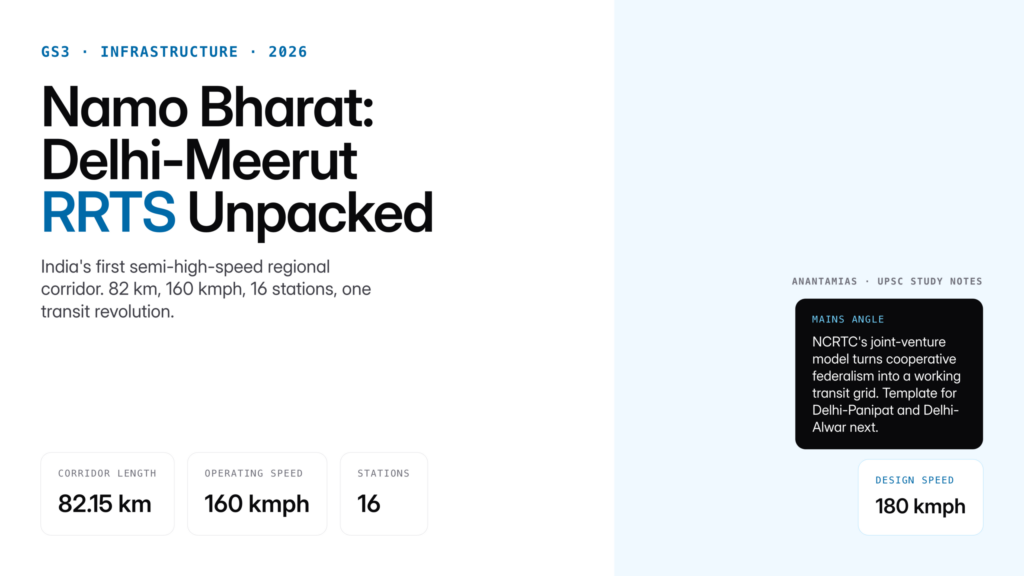
The Delhi-Meerut Regional Rapid Transit System (RRTS), branded as Namo Bharat, is India’s first operational semi-high-speed regional rail corridor. Stretching about 82 kilometres across the National Capital Region, the line is designed to move passengers at up to 180 kmph between Sarai Kale Khan in Delhi and Modipuram in Meerut, redefining how satellite towns are connected to a metropolitan core.
For UPSC aspirants, the project is more than a transport story. It brings together urban planning, public-private financing, cooperative federalism, decarbonisation targets and the governance architecture of the National Capital Region Transport Corporation (NCRTC). Examiners frequently probe the scheme under GS3 infrastructure, as well as in essay and interview discussions on sustainable urbanisation.
Quick Facts at a Glance
| Parameter | Detail |
|---|---|
| Corridor length | 82.15 km |
| Design speed | 180 kmph |
| Operating speed | 160 kmph |
| Average speed | ~100 kmph |
| Total stations | 16 (14 elevated, 2 underground, including depot stations) |
| Implementing agency | NCRTC (under Ministry of Housing and Urban Affairs) |
| Signalling | ETCS Level 3 hybrid, LTE-based |
| Gauge | Standard gauge, 1435 mm |
| Traction | 25 kV AC overhead |
| Coaches per train | 6 (including one premium and one women-only) |
| Funding partners | ADB, AIIB, NDB, EIB, JICA (select sections), Government of India, NCR states |
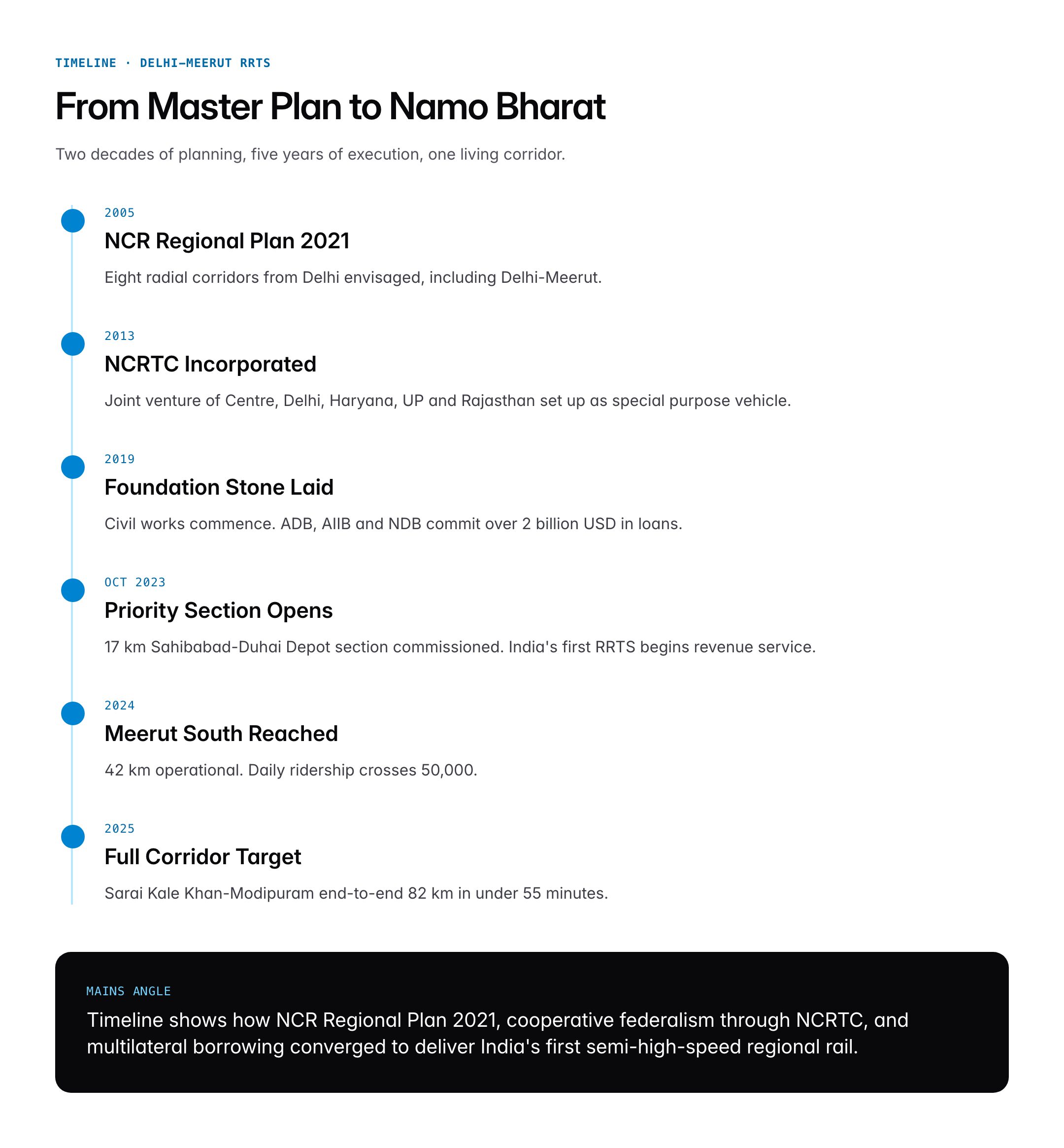
| First section opened | 17 km Sahibabad-Duhai Depot, 20 October 2023 |
| Expected full completion | 2025 |
Background and Historical Context
The idea of dedicated regional rapid rail for the National Capital Region was floated in the Delhi Master Plan 2021 and crystallised in the NCR Regional Plan 2021 published by the NCR Planning Board. Studies by RITES in the late 2000s identified eight radial corridors from Delhi, with three prioritised: Delhi-Meerut, Delhi-Alwar, and Delhi-Panipat. These three were endorsed by a high-level task force set up under the Ministry of Urban Development in 2013.
To execute these corridors, the Union Cabinet approved the creation of the National Capital Region Transport Corporation (NCRTC) in 2013 as a joint venture between the Government of India and the states of Haryana, Rajasthan, Uttar Pradesh and NCT of Delhi. NCRTC functions as the special purpose vehicle for design, construction, operation and maintenance.
Financial closure for the Delhi-Meerut corridor was achieved in 2019, with the Asian Development Bank sanctioning a 1 billion USD loan, followed by the Asian Infrastructure Investment Bank, the New Development Bank and the European Investment Bank. Civil works began in mid-2019 with the foundation stone laid by the Prime Minister on 8 March 2019. The COVID-19 pandemic delayed execution but the project survived supply-chain disruptions through domestic manufacturing of rolling stock at Alstom’s Savli facility in Gujarat.
The first 17-kilometre Priority Section from Sahibabad to Duhai Depot was inaugurated on 20 October 2023, making India the second country in Asia to operationalise a dedicated semi-high-speed regional transit system of this class.
Key Features
Alignment and Stations
The corridor runs from Sarai Kale Khan in east Delhi, through Ghaziabad, Muradnagar and Modinagar, terminating at Modipuram in Meerut. It crosses the Yamuna Expressway alignment, the Eastern Peripheral Expressway and the Delhi-Meerut Expressway, stitching together three road corridors with one rail spine. Inside Meerut city the alignment shares tracks with a local Meerut Metro service that uses the same infrastructure, operating on stop-at-every-station basis while RRTS trains skip stations.
Rolling Stock and Technology
Alstom supplies 40 six-coach Namo Bharat trainsets and 10 three-coach Meerut Metro trainsets, all with aerodynamic noses, automatic plug doors, and 2×2 transverse seating. Trains carry onboard Wi-Fi, USB charging, luggage racks and a premium coach with reclining seats. Safety is managed by ETCS Level 3 hybrid signalling over LTE, a world-first deployment that enables 5-minute headways without fixed block sections.
Civil Engineering
Over 70 kilometres are elevated on single-pier viaducts constructed using precast segmental box girders. The Yamuna river is crossed on a 626-metre bridge. Two underground stations at Anand Vihar and Meerut Central sit under dense urban cores, built by tunnel boring machines. Stations are elevated with platform screen doors and multi-modal integration with Delhi Metro, Indian Railways and UPSRTC buses.
Institutional Architecture
NCRTC operates under the Ministry of Housing and Urban Affairs, with equity split 22.5 percent Centre, 22.5 percent Delhi, 22.5 percent Haryana, 22.5 percent UP and 10 percent Rajasthan. Fare-setting is governed by a fare-fixation committee, with dynamic pricing for premium coaches.
Significance for UPSC and General Knowledge
- Demonstrates the use of Public-Private Partnership plus sovereign multilateral borrowing to finance a capital-intensive urban project
- Operationalises the idea of polycentric urbanisation in the NCR, reducing dependency on Delhi for jobs and services
- Reduces annual vehicular emissions by an estimated 2.5 lakh tonnes of CO2 and 1 lakh tonnes of pollutants, advancing India’s Updated NDC targets
- Embodies cooperative federalism through NCRTC’s multi-state shareholding
- Advances Make in India with domestic rolling stock manufacturing and indigenous signalling integration
- Provides a template for the next corridors: Delhi-Panipat and Delhi-Alwar, with detailed project reports already approved
Detailed Analysis: Urban Mobility and Regional Planning
The Delhi-Meerut RRTS addresses a structural mismatch in NCR commuting. Before the corridor, a daily commute from Meerut to central Delhi typically took three to four hours by road or sub-urban rail. The Namo Bharat trainset cuts the journey to under 55 minutes end to end, recalibrating the effective labour market radius. Economists estimate that a one-hour reduction in commute time for 8 lakh daily commuters translates to productivity gains of over 4000 crore rupees per year.
From a planning lens, the corridor catalyses transit-oriented development (TOD). The NCRTC’s TOD policy, notified by participating states, mandates higher floor area ratio within 1.5 km of stations and cross-subsidisation through value capture financing. Ghaziabad and Meerut Development Authorities have already amended master plans to increase density around stations.
The environmental case rests on modal shift. Pre-operation surveys showed 70 percent of Delhi-Meerut commuters using personal cars or shared taxis. Post-commissioning surveys by NCRTC report 23 percent of Namo Bharat passengers were earlier private-vehicle users. If sustained across the corridor, this shift could remove an estimated 1 lakh cars from NCR roads daily, improving the ambient air quality index during peak winter pollution.
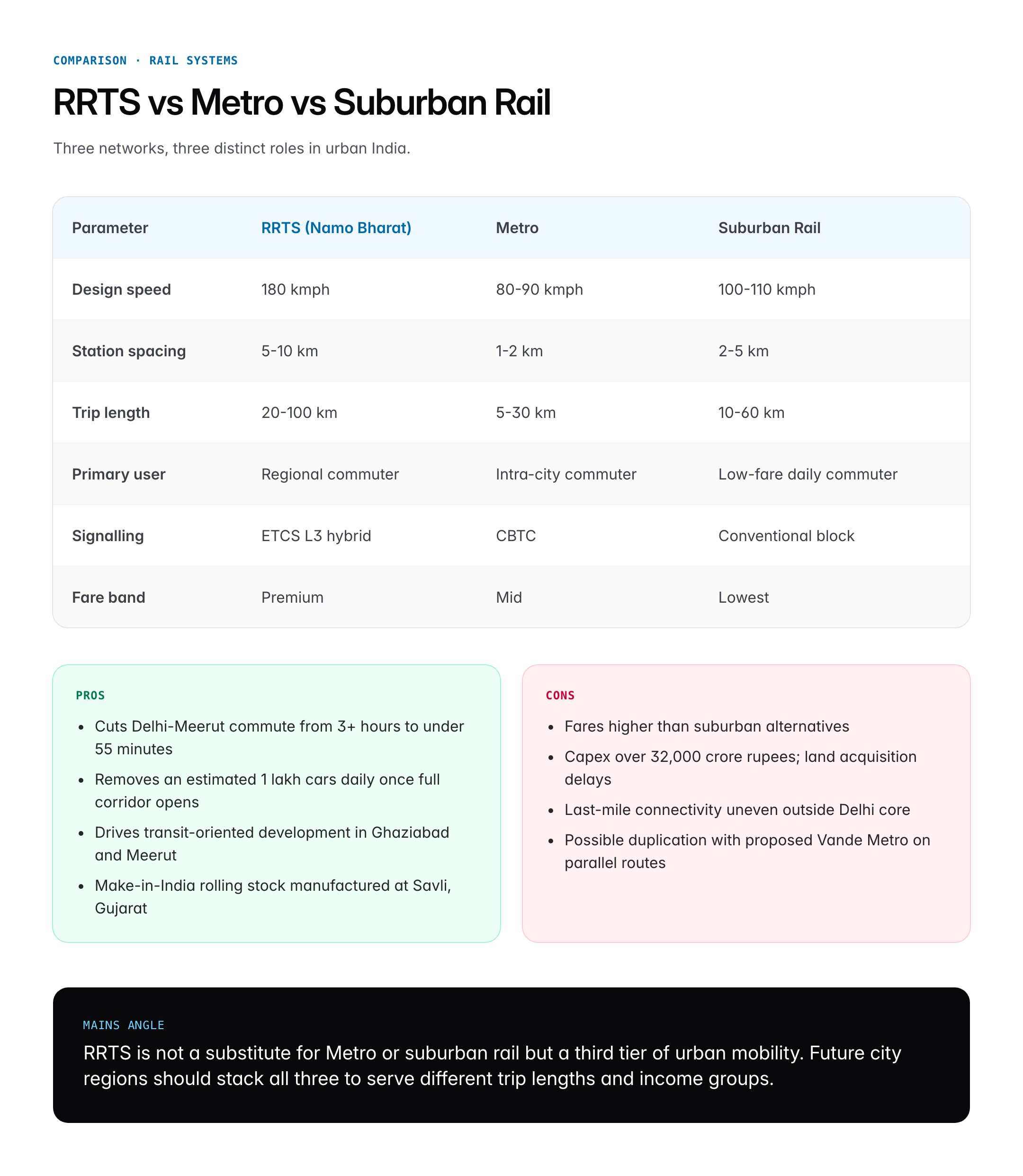
There are, however, equity questions. The premium coach tariff is 2.5 times the standard fare, and even standard fares from Sarai Kale Khan to Meerut South (40 km) are priced at about 100 rupees, higher than local train alternatives. NCRTC has rolled out concessional passes for students, senior citizens and differently-abled passengers, but fare affordability continues to be a live debate in the NCR Planning Board.
Comparative Perspective
| System | Country | Top Speed | Length | Notes |
|---|---|---|---|---|
| Delhi-Meerut RRTS | India | 180 kmph | 82 km | First regional semi-high-speed rail in India |
| RER | France | 140 kmph | 615 km | Regional express for Paris metropolitan region |
| Crossrail/Elizabeth Line | UK | 145 kmph | 118 km | London regional express, opened 2022 |
| GO Transit | Canada | 150 kmph | 500+ km | Commuter rail for Greater Toronto |
| Suzhou-Shanghai S1 | China | 160 kmph | 41 km | Shanghai-Suzhou intercity metro |
Compared with the Paris RER or London’s Elizabeth Line, the Delhi-Meerut RRTS has higher peak design speed but lower route length; it is the first Indian deployment and sets the performance benchmark for the upcoming Delhi-Panipat and Delhi-Alwar corridors.
Challenges and Criticisms
Land acquisition in dense urban stretches such as Ghaziabad and Meerut has been protracted, triggering local protests and court challenges. Cost escalation from an initial 30,274 crore rupees to over 32,000 crore rupees has raised fiscal-discipline concerns at the state level, with Uttar Pradesh bearing the largest share. Critics from the Centre for Science and Environment have flagged that unless last-mile connectivity improves, the modal shift gains may plateau after the initial novelty.
A second critique concerns tariff design. Standard fares are high for daily blue-collar commuters who may continue to prefer older sub-urban trains. Premium coaches, meanwhile, risk under-utilisation during non-peak hours. A third concern is the duplication of tracks with the upcoming Indian Railways Vande Metro service on adjacent routes, raising questions on rationalisation of the public transport portfolio.
Supporters respond that over a 30-year life cycle, the RRTS will pay back through avoided road costs, health benefits from cleaner air, and land-value appreciation captured through TOD premiums. The real test will be ridership on the full 82 km corridor once commissioned.
Prelims Pointers
- NCRTC is a joint venture of Centre, Delhi, Haryana, UP and Rajasthan under the Ministry of Housing and Urban Affairs
- Design speed of Namo Bharat trains is 180 kmph, operating speed 160 kmph
- The first operational section (October 2023) runs from Sahibabad to Duhai Depot, 17 km
- ETCS Level 3 hybrid over LTE is used for signalling, a world-first deployment
- Rolling stock is manufactured by Alstom at Savli, Gujarat, under Make in India
- The corridor spans 82.15 km with 14 elevated and 2 underground stations including depot
- Funding partners include ADB, AIIB, NDB and EIB
- Each train has 6 coaches, including one premium and one women-only coach
- NCR Regional Plan 2021 identified eight radial corridors, three prioritised
- The Delhi-Meerut corridor crosses the Yamuna via a 626-metre bridge
- Namo Bharat branding was unveiled in October 2023 ahead of the Priority Section launch
- Fare-fixation is governed by a committee notified under NCRTC’s operating rules
Mains Practice Questions
- “The Delhi-Meerut Regional Rapid Transit System is as much a governance innovation as it is an engineering feat.” Critically examine.
- Discuss the NCRTC joint-venture structure and cooperative-federalism dimensions
- Analyse financing architecture combining sovereign loans, state equity and value capture
- Evaluate execution challenges including land acquisition, cost escalation and fare affordability
- Evaluate the role of Regional Rapid Transit Systems in meeting India’s Updated NDC targets and urban sustainability goals.
- Examine emission avoidance, modal shift and air-quality impacts documented so far
- Connect RRTS with transit-oriented development and value capture financing
- Suggest policy measures for scaling RRTS to the next priority corridors
Conclusion
The Delhi-Meerut RRTS is a landmark in India’s urban infrastructure playbook. By moving 8 lakh commuters a day across 82 km at semi-high speed, it shifts the definition of NCR from a Delhi-centric hub-and-spoke to a genuinely polycentric region.
The challenge ahead is scale. Converting a single corridor’s success into a national RRTS grid across the Delhi-Panipat and Delhi-Alwar routes, and eventually to metropolitan regions of Mumbai, Bengaluru and Chennai, will test the durability of NCRTC’s institutional model. For UPSC aspirants, RRTS is a living case study in how finance, engineering and federalism combine in twenty-first-century Indian urbanism.
Frequently Asked Questions
What is the Delhi-Meerut Regional Rapid Transit System?
The Delhi-Meerut RRTS, branded Namo Bharat, is an 82 km semi-high-speed regional rail corridor connecting Sarai Kale Khan in Delhi with Modipuram in Meerut. Built by NCRTC, it is India’s first operational RRTS with a design speed of 180 kmph and targets end-to-end journey times under 55 minutes.
Why is Delhi-Meerut RRTS important for UPSC preparation?
The corridor anchors several GS3 themes: infrastructure financing through multilateral borrowing, cooperative federalism through NCRTC’s multi-state joint venture, transit-oriented development, climate-compatible urban planning aligned with India’s Updated NDC, and Make in India manufacturing. It is frequently cited in Prelims, Mains and interview discussions.
How is the RRTS related to the Delhi Metro and Indian Railways?
RRTS is distinct from both. Delhi Metro serves intra-city trips at up to 80 kmph; Indian Railways suburban services are lower priority and slower. RRTS sits between them, offering dedicated semi-high-speed intercity commuting with 5 to 10 minute headways. Stations are integrated with Metro, Railways and bus networks for seamless transfers.
What is the top speed of Namo Bharat trains?
Namo Bharat trains have a design speed of 180 kmph and an operating speed of 160 kmph. Average speed along the corridor including stops is about 100 kmph, making Delhi-Meerut end-to-end travel feasible in roughly 55 minutes once the full 82 km corridor is commissioned.
Who finances and operates the Delhi-Meerut RRTS?
The project is implemented by NCRTC, a joint venture of the Government of India, Delhi, Haryana, Uttar Pradesh and Rajasthan, under the Ministry of Housing and Urban Affairs. Financing combines state equity with loans from ADB, AIIB, NDB and EIB, plus land contributions from participating states.
How many stations does the Delhi-Meerut RRTS have?
The corridor has 16 stations including the depot station: 14 elevated and 2 underground. Key stations include Sarai Kale Khan, Anand Vihar, Sahibabad, Ghaziabad, Duhai, Muradnagar, Modinagar North, Meerut South, Meerut Central and Modipuram. Many double up for Meerut Metro services within the city.
What technology powers Namo Bharat signalling?
Namo Bharat uses ETCS Level 3 hybrid signalling over an LTE radio backbone, the world’s first such deployment. This enables moving-block train control, permits headways as low as 5 minutes and supports shared operation with Meerut Metro services on the same track inside the city section.
When will the full Delhi-Meerut corridor be operational?
The 17 km Priority Section opened in October 2023. Successive sections to Meerut South opened through 2024, with the full 82 km corridor to Modipuram targeted for commissioning by 2025. NCRTC publishes phased section opening schedules aligned with civil, systems and safety clearances from the Commissioner of Metro Rail Safety.
Tell Google you want more of this.
Add Anantam IAS as a preferred sourceOne tap, and this site shows up more often in your own Top Stories, AI Overviews and AI Mode. Remove it any time.