Desert Ecosystem in India: Thar, Species, Conservation
Desert ecosystem explained for UPSC: Thar climate, flora-fauna adaptations, Desert National Park, Great Indian Bustard, desertification, UNCCD role.
A desert ecosystem is a biome defined by extreme aridity — annual rainfall typically below 250 mm, high evaporation exceeding precipitation, wide diurnal temperature ranges, low biomass, and biota with specialised adaptations for water and heat stress. India's classic hot desert is the Thar (Great Indian Desert), spread primarily across Rajasthan, with extensions into Gujarat, Haryana and Punjab, and into Pakistan's Cholistan and Sindh. Understanding the desert ecosystem is essential for UPSC because it combines physical geography, climatology, biodiversity, conservation law, and international environmental governance (especially the UN Convention to Combat Desertification).
Classification of Deserts
| Classification basis | Categories | Indian example |
|---|---|---|
| Temperature | Hot deserts, Cold deserts | Hot: Thar; Cold: Ladakh / Spiti / Nubra |
| Precipitation | Hyper-arid (<100 mm), Arid (100–250 mm), Semi-arid (250–500 mm) | Western Thar core: hyper-arid to arid |
| Continental setting | Coastal, Rain-shadow, Interior | Thar: interior/rain-shadow-like in part; Ladakh: rain-shadow of Himalayas |
India has 12% of its geographical area under desert conditions (hot + cold), and around 30% falls under drylands at risk of desertification.
The Thar Desert — Physical Characteristics
| Feature | Value / Description |
|---|---|
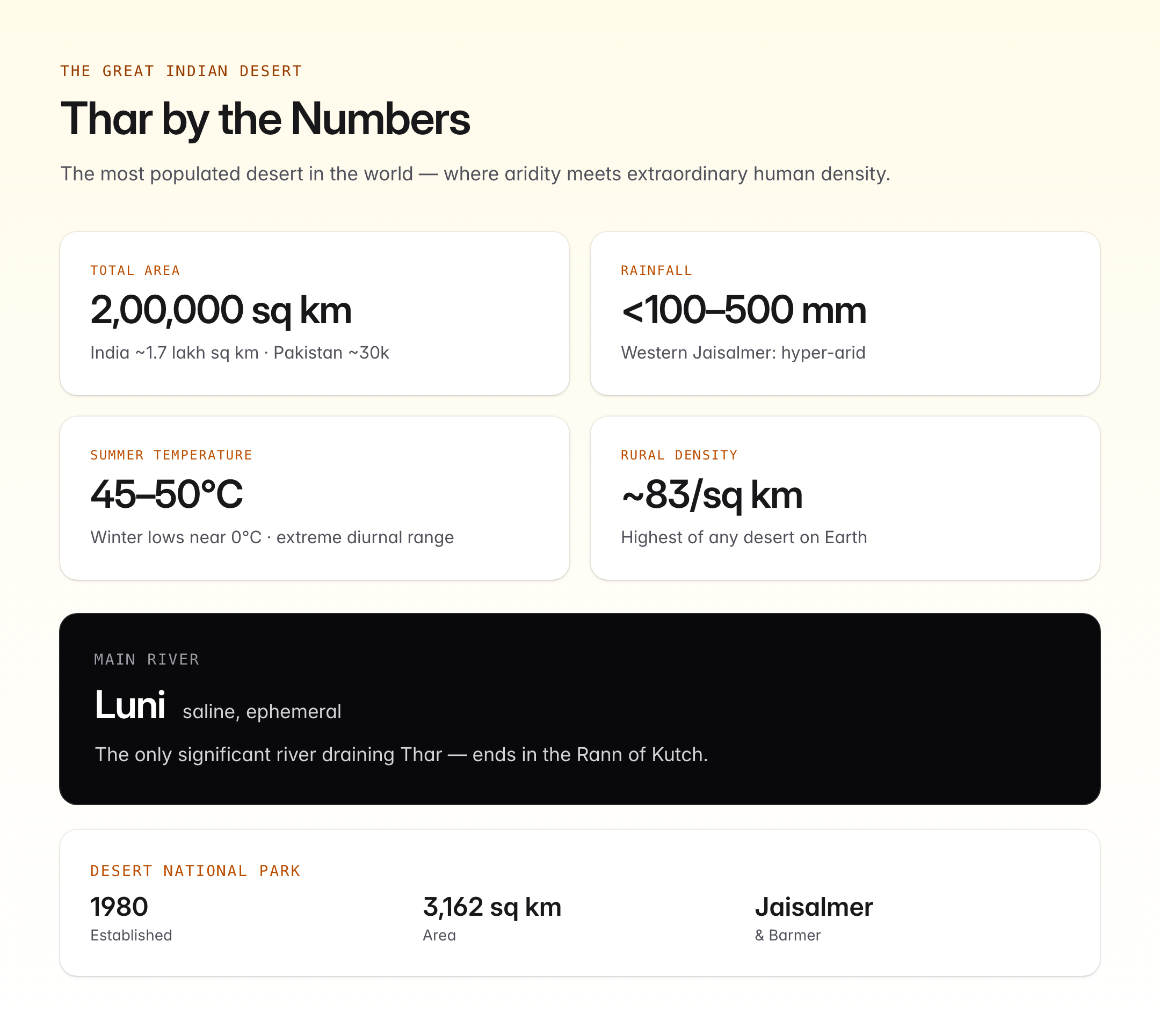
| Area | ~2,00,000 sq km (Indian side ~1,70,000 sq km; Pakistan ~30,000 sq km) |
| Location | Rajasthan (bulk), Gujarat (Kutch extensions), fringes of Haryana, Punjab |
| Latitude | Between ~24° N and 30° N |
| Rainfall | 100–500 mm; less than 100 mm in western Jaisalmer |
| Temperature | Summer 45–50°C; winter lows near 0°C; high diurnal range |
| Relief | Rolling sand dunes (barchans, longitudinal, star), gravel plains, saline depressions (ranns) |
| Soils | Arid brown, desert, saline-alkaline (Rann of Kutch); low organic matter |
| Rivers | Largely ephemeral — Luni (saline) is the main river draining Thar; ends in Rann of Kutch |
The Thar is flanked by the Aravalli range to the east — which, curiously, does not act as a classic rain shadow for the monsoon, making the aridity largely a consequence of parallel alignment of monsoon winds to the Aravalli trend and rapid warming of the subcontinent's interior.
Cold Desert — Ladakh and Spiti
- Ladakh, Lahaul-Spiti, Kargil portions in the Himalaya form cold deserts.
- Rain shadow of the Greater Himalaya; annual rainfall <100 mm (Leh ~110 mm, mostly snow).
- Temperatures: summer 3–35°C, winter −20 to −40°C (Dras).
- Unique biodiversity: snow leopard, ibex, bharal (blue sheep), Tibetan wolf, kiang (wild ass), Tibetan gazelle, black-necked crane.
- Hemis National Park (Ladakh) — largest national park in India, prime snow leopard habitat.
- Changthang Cold Desert Wildlife Sanctuary — pastoral Changpa community, Pashmina goats.
Flora of the Thar
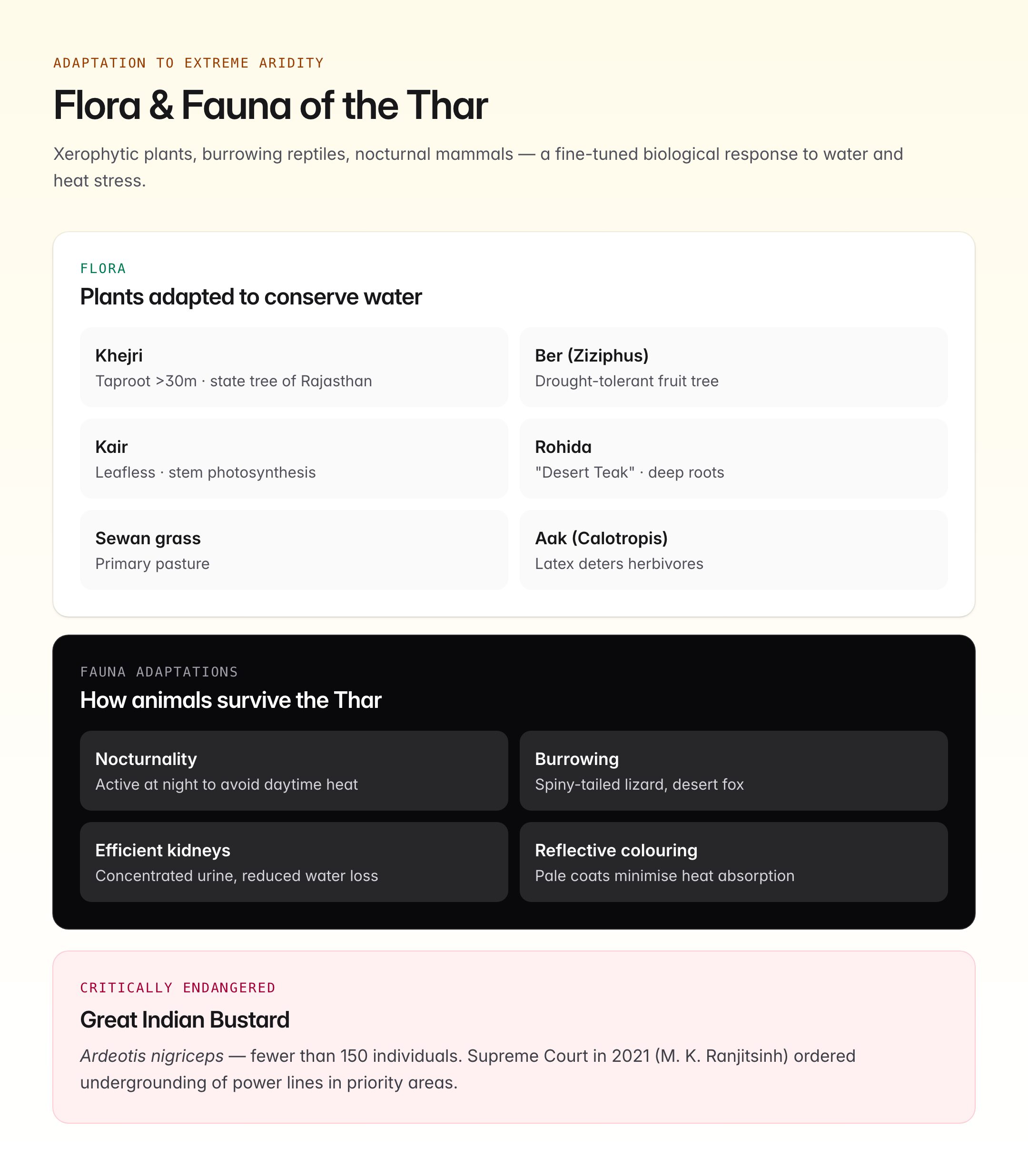
Vegetation is xerophytic — adapted to conserve water and tolerate heat.
| Plant | Adaptation |
|---|---|
| Prosopis cineraria (Khejri) — state tree of Rajasthan | Deep taproot (>30 m), nitrogen-fixing, multi-purpose; central to Bishnoi conservation ethic |
| Acacia senegal (Kumat) | Deep roots, thorny |
| Ziziphus mauritiana (Ber) | Drought-tolerant fruit tree |
| Capparis decidua (Kair) | Leafless most of year; stem photosynthesis |
| Tecomella undulata (Rohida) — "Desert Teak" | Deep roots, timber |
| Calligonum polygonoides (Phog) | Sand dune coloniser |
| Calotropis procera (Aak) | Latex reduces herbivory |
| Aerva persica, Lasiurus sindicus (Sewan grass) | Primary pasture grasses |
| Cassia angustifolia (Senna) | Medicinal; arid cultivated |
The invasive Prosopis juliflora (introduced 1877) now covers vast tracts, outcompeting native Khejri and altering soil chemistry.
Fauna of the Thar
| Species | Status / Note |
|---|---|
| Great Indian Bustard (Ardeotis nigriceps) | Critically Endangered; fewer than ~150 individuals; flagship of Thar |
| Blackbuck (Antilope cervicapra) | Least Concern globally; protected by Bishnois |
| Chinkara / Indian Gazelle (Gazella bennettii) | Least Concern; iconic Thar species |
| Nilgai (Boselaphus tragocamelus) | Largest Asian antelope |
| Desert fox (Vulpes vulpes pusilla) | Subspecies of red fox |
| Desert cat (Felis silvestris ornata) | Elusive felid |
| Caracal (Caracal caracal) | Rare; recovery programme |
| Spiny-tailed lizard (Saara hardwickii) | Herbivorous, burrowing |
| Indian wolf (Canis lupus pallipes) | Endangered regionally |
| Macqueen's bustard / Houbara (Chlamydotis macqueenii) | Winter migrant |
| Demoiselle crane (Grus virgo) — Kurja | Khichan (Jodhpur) famous wintering site |
| Great Indian spotted eagle, Short-toed snake eagle, Laggar falcon | Raptors |
Fauna adaptations include nocturnality, burrowing, reflective colouration, efficient kidneys producing concentrated urine, reduced sweating, and behavioural thermoregulation.
Desert National Park, Jaisalmer
- Established: 1980
- Area: 3,162 sq km (one of the largest national parks in India)
- Location: Jaisalmer and Barmer districts, Rajasthan
- Key species: Great Indian Bustard, chinkara, desert fox, desert cat, Bengal fox, Indian wolf, Russell’s viper, saw-scaled viper, spiny-tailed lizard.
- Landscape: sand dunes (~20%), fixed dunes, gravel plains, saline lake beds.
- Issues: live power transmission lines — leading cause of GIB mortality; Supreme Court in 2021 (M. K. Ranjitsinh v. Union of India) ordered undergrounding and installation of bird diverters in priority areas.
Adjacent and complementary sites:
- Tal Chhapar Sanctuary (Churu) — blackbuck haven.
- Sorsan Grasslands (Baran) — GIB.
- Ramdevra, Sudasari — GIB priority zones.
- Khichan — demoiselle crane wintering.
- Kutch Desert Wildlife Sanctuary, Rann of Kutch — Indian wild ass (ghudkhur), flamingos.
- Indian Wild Ass Sanctuary (Little Rann of Kutch) — Asiatic wild ass (Onager) last refuge.
Desertification — Causes and Scale
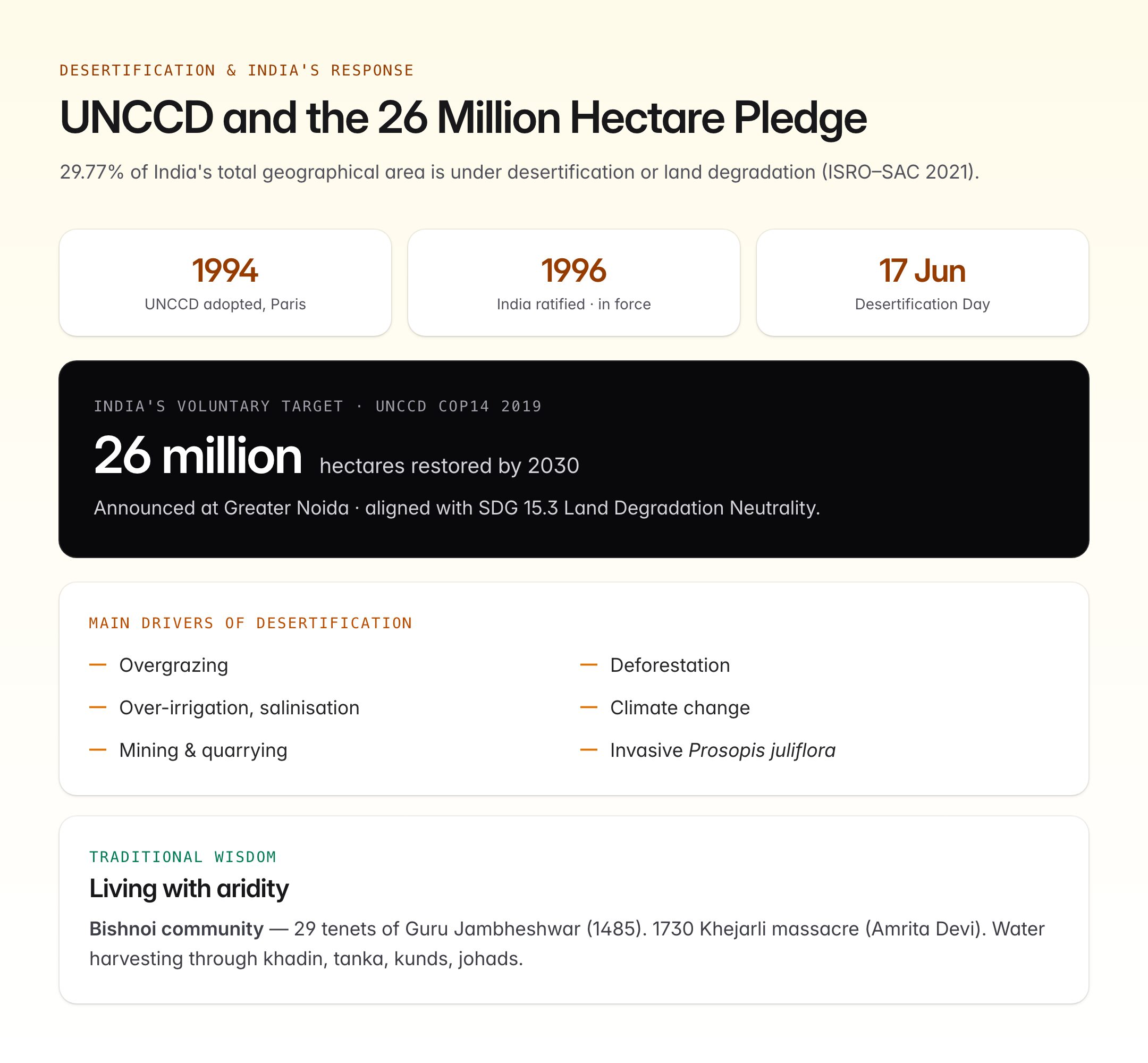
Desertification (as defined by UNCCD) is land degradation in arid, semi-arid and dry sub-humid areas caused by climatic variations and human activities. India's Desertification and Land Degradation Atlas (ISRO–SAC, 2021 edition) reports that approximately 29.77% of India's total geographical area is under desertification or land degradation.
Main drivers:
- Overgrazing and unsustainable pastoralism.
- Deforestation and fuelwood removal.
- Unsustainable agriculture — monoculture, over-irrigation causing salinisation, groundwater mining.
- Climate change — rainfall variability, temperature rise.
- Mining and quarrying.
- Invasive species — Prosopis juliflora, Lantana.
UNCCD and India's Commitments
The United Nations Convention to Combat Desertification (UNCCD) was adopted on 17 June 1994 in Paris and entered into force on 26 December 1996. It is one of the three Rio Conventions, alongside CBD and UNFCCC. 17 June is observed as the World Day to Combat Desertification and Drought.
| UNCCD Commitment | Detail |
|---|---|
| India ratified | 17 December 1996 |
| Land Degradation Neutrality (LDN) target (SDG 15.3) | Neutrality by 2030 |
| India's voluntary target | Restore 26 million hectares of degraded land by 2030 (announced UNCCD COP14 at Greater Noida, 2019) |
| Hosting | UNCCD COP14 — September 2019, India chaired the COP until 2022 |
Key Indian programmes linked to anti-desertification:
- National Mission for a Green India (NMGI).
- National Afforestation Programme.
- Integrated Watershed Management Programme (IWMP) / Pradhan Mantri Krishi Sinchai Yojana.
- Desert Development Programme (DDP) — merged into PMKSY.
- Bonn Challenge pledge: 26 million hectares by 2030 (complementing UNCCD target).
- Compensatory Afforestation Fund Management and Planning Authority (CAMPA).
Human Cultures of the Desert
The Thar is not empty. It has the highest rural population density of any desert in the world — around 83 persons per sq km in parts — because of:
- Oran — sacred groves protected by village communities.
- Bishnoi community — 29 tenets of Guru Jambheshwar (1485) include protection of green trees and wildlife; 1730 Khejarli massacre (Amrita Devi Bishnoi) is a foundational event in Indian environmental ethics.
- Traditional water harvesting — khadin (runoff-harvesting structures), tanka, kunds, johads, baoris.
- Pastoral mobility — Raika, Rebari communities with camel and sheep.
These institutions are increasingly studied as models of community-based natural resource management.
Threats and Conservation Priorities
- Power lines and windmills — GIB mortality.
- Canal irrigation (Indira Gandhi Canal) — transforming western Rajasthan, creating waterlogging and salinity.
- Invasive Prosopis juliflora replacing Khejri.
- Climate change — rainfall intensification events, droughts.
- Mining — limestone, gypsum, sandstone.
- Tourism pressure at Sam and Khuri dunes.
UPSC Relevance
Prelims: Thar area, states, Luni river, Khejri (state tree of Rajasthan), Bishnoi community, Desert National Park (1980, 3,162 sq km), Great Indian Bustard (Critically Endangered), Rann of Kutch wild ass, Hemis National Park (cold desert), UNCCD year (1994/96), India's 26 million hectare pledge (COP14 2019 at Greater Noida), World Day to Combat Desertification (17 June).
GS-I (Geography): Classification of deserts, Thar physical geography, cold desert of Ladakh, aridity factors.
GS-III (Environment): Desert ecosystem, biodiversity, desertification, UNCCD, Land Degradation Neutrality, M. K. Ranjitsinh case, GIB conservation. Typical question: "Discuss the causes of desertification in India and evaluate India's policy response in light of UNCCD commitments."
Essay: "Living with aridity," "community wisdom in conservation," "climate change and vulnerable landscapes."
Interview: Expect questions on Great Indian Bustard rescue, Indira Gandhi Canal's ecological costs, Bishnoi heritage, and cold-desert biodiversity.
Study the desert ecosystem as a dynamic, populated, culturally rich biome — not an empty wasteland. The right lens is limits, adaptation, and knowledge, which is how UPSC prefers its ecology.