Digital India Programme: Initiatives & Impact
Complete UPSC guide to Digital India Programme — 9 pillars, Aadhaar, UPI, DigiLocker, BharatNet, e-governance, digital literacy, CSCs, and India's digital transformation impact data.
Digital India Programme: Initiatives & Impact
Digital India is the Government of India’s flagship programme to transform India into a digitally empowered society and knowledge economy. Launched on July 1, 2015 by Prime Minister Narendra Modi, it restructures both the delivery of government services and India’s underlying digital infrastructure.
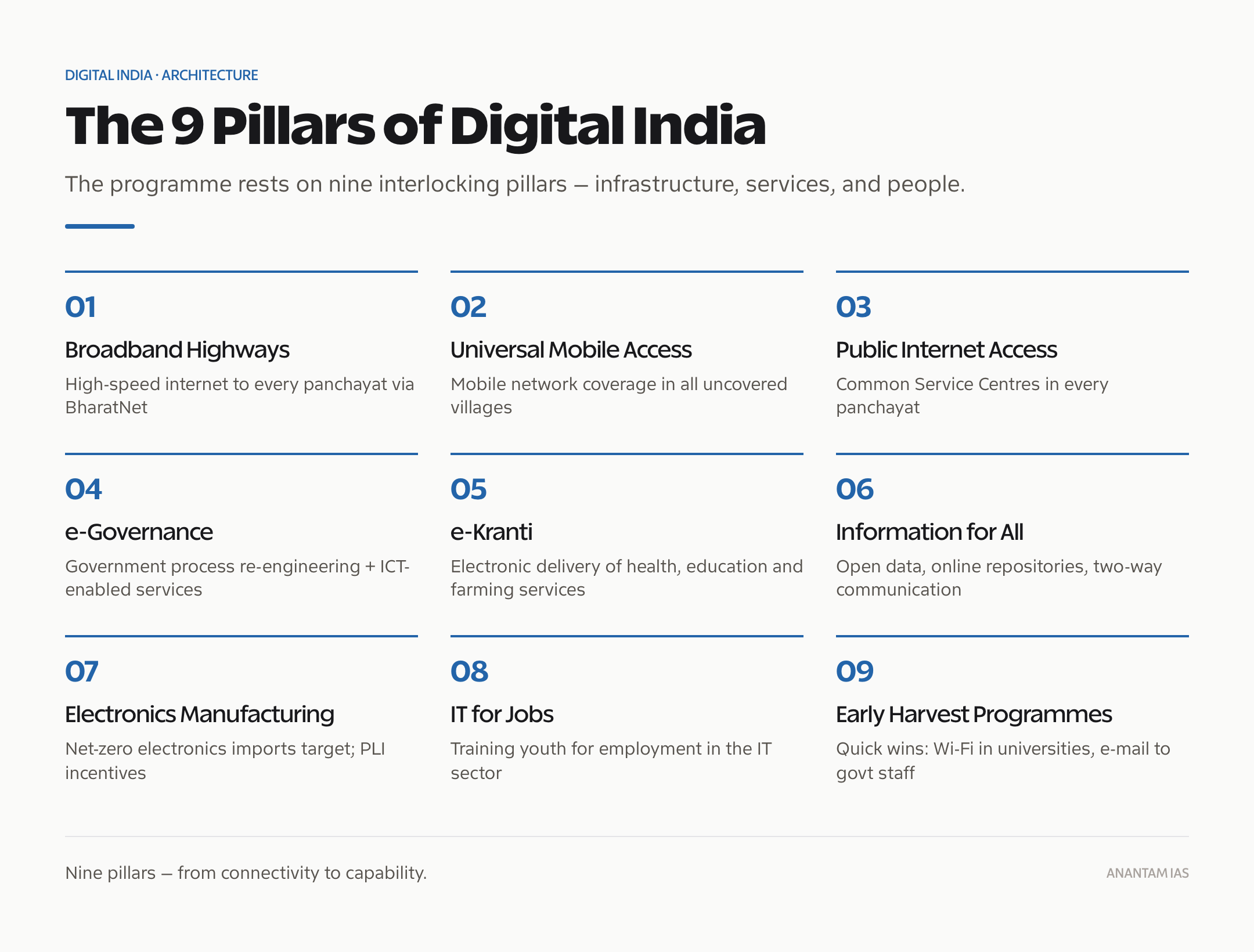
The programme rests on a 9-pillar framework covering broadband highways, universal phone access, public internet access, e-governance, e-Kranti (digital delivery of services), information for all, electronics manufacturing, IT for jobs, and early harvest programmes. For UPSC, Digital India connects to governance (GS-2), economy and technology (GS-3), and current affairs across all papers.
Background: The India That Needed Digital Transformation
In 2015, India’s digital picture was mixed. Mobile subscribers crossed 1 billion, but:
- Only 31% of villages had broadband connectivity
- Most government services required physical visits — often multiple trips
- Rural populations had no way to access government benefits digitally
- India’s digital payments infrastructure was fragmented and expensive
- Only 19% of Indians were internet users
The government recognised that digitalisation could do two things simultaneously: reduce leakage in benefit delivery (by eliminating intermediaries) and improve citizen experience (by making services available anytime, anywhere). Digital India was the policy framework to achieve both.
The 9 Pillars of Digital India
| Pillar | Focus |
|---|---|
| 1. Broadband Highways | High-speed internet to every panchayat (BharatNet) and urban areas |
| 2. Universal Access to Mobile Connectivity | Mobile network coverage in all uncovered villages |
| 3. Public Internet Access Programme | Common Service Centres (CSCs) in every panchayat |
| 4. e-Governance: Reforming Government through Technology | Government process reengineering + ICT-enabled services |
| 5. e-Kranti: Electronic Delivery of Services | Transformative delivery of health, education, farming services digitally |
| 6. Information for All | Open data, online repositories, two-way digital communication |
| 7. Electronics Manufacturing | Net Zero Imports by 2020 target; PLI for electronics |
| 8. IT for Jobs | Training youth for IT sector employment |
| 9. Early Harvest Programmes | Quick-win projects: Wi-Fi in universities, email to government staff |
BharatNet: The Broadband Backbone
What Is BharatNet?
BharatNet is the world’s largest rural broadband connectivity programme, aimed at providing optical fibre connectivity to all 2.5 lakh gram panchayats in India. Executed by Bharat Broadband Network Limited (BBNL), it’s funded by the Universal Service Obligation Fund (USOF).
Progress and Phases
| Phase | Target | Mechanism |
|---|---|---|
| Phase I (2014-17) | 1 lakh GPs | Underground OFC |
| Phase II (2017-2019+) | 1.5 lakh GPs | Underground + overhead OFC + satellite |
| BharatNet Revamped (2023+) | All 2.5 lakh GPs + last-mile FTTH | PPP model; states as implementing agencies |
As of 2024, over 2.1 lakh gram panchayats have been connected under BharatNet. The last-mile connectivity — from the gram panchayat to individual households (FTTH – Fibre to the Home) — is the remaining challenge.
Why BharatNet Matters
BharatNet is the infrastructure layer that makes everything else possible — CSCs, telemedicine, digital banking, online education. Without broadband at the panchayat level, no digital scheme can function in rural India.
Aadhaar: The Identity Infrastructure
Aadhaar is India’s biometric digital identity system — a 12-digit unique identification number assigned by UIDAI (Unique Identification Authority of India) based on fingerprints and iris scans. Over 140 crore Aadhaar numbers have been issued — virtually the entire population.
Aadhaar is the identity layer for nearly every digital government service:
- DBT (Direct Benefit Transfer): Aadhaar-linked bank accounts receive government subsidies
- PM-JAY: Ayushman card linked to Aadhaar
- PMAY-G: Beneficiary verification via Aadhaar
- PDS: Aadhaar-linked ration cards
The Supreme Court in Puttaswamy-2 (2018) upheld Aadhaar’s constitutional validity but restricted its use: mandatory only for government welfare schemes and income tax; not for private companies. This is an important legal dimension for UPSC.
UPI: Unified Payments Interface
UPI is arguably Digital India’s most transformative output. Developed by NPCI (National Payments Corporation of India) and launched in 2016, UPI allows instant, 24/7 bank-to-bank transfers using a virtual payment address (UPA ID), QR code, or mobile number.
UPI Scale
| Year | UPI Transactions (crore) | Value (₹ lakh crore) |
|---|---|---|
| 2018-19 | 535 | 8.7 |
| 2020-21 | 2,233 | 41.0 |
| 2022-23 | 8,375 | 138.9 |
| 2023-24 | 13,113 | 199.9 |
| 2024-25 (partial) | 15,000+ (annualised) | 230+ |
India accounts for 46% of global real-time digital transactions — more than the US, UK, Germany, France, and China combined. UPI has been exported internationally — QR-based UPI payment is now accepted in Singapore, UAE, France, Bhutan, Nepal, Sri Lanka, and other countries.
DigiLocker: Digital Document Repository
DigiLocker is a cloud-based document storage system where citizens can store and share official digital documents — Aadhaar, PAN card, driving licence, vehicle registration, Class X/XII marksheets, degree certificates, insurance policies.
Documents in DigiLocker are legally equivalent to physical originals under the IT Act and the National Academic Depository framework. Traffic police can accept a digital driving licence via DigiLocker on a phone.
As of 2024:
- 30 crore+ DigiLocker accounts registered
- 600 crore+ documents stored
- 2,000+ issuers (government departments, universities, insurers) connected
DigiLocker reduces corruption by eliminating notarised copies, cuts down paperwork for admissions, loans, and government applications, and makes document access instant for citizens.
Common Service Centres (CSCs)
CSCs are physical access points — digital kiosks — in rural areas that provide government and private digital services to people who don’t own smartphones or computers. Operated by Village Level Entrepreneurs (VLEs), they earn a transaction fee for each service rendered.
Services Available at CSCs
| Category | Services |
|---|---|
| Government | Aadhaar enrolment/update, passport application, PAN card, income/caste certificates |
| Financial | Banking (Business Correspondent), insurance, pension, PM-JAY enrolment |
| Agriculture | Soil health card, crop insurance, mandi prices |
| Education | CBSE results, certificate verification, e-learning |
| Healthcare | Telemedicine, Ayushman card, medicine delivery |
As of 2024:
- 5.5 lakh+ CSCs operational
- Covering all 2.5 lakh gram panchayats
- 12+ lakh VLEs employed
- 130+ crore transactions annually
CSCs are the last-mile digital infrastructure that bridges the gap between the digital government and citizens without personal devices.
e-Governance: Key Platforms
MeghRaj (GI Cloud)
India’s Government Cloud (GI Cloud/MeghRaj) hosts government applications and databases, reducing IT costs through shared infrastructure. All major central government portals run on MeghRaj.
UMANG (Unified Mobile Application for New-age Governance)
UMANG is a single app that provides access to 1,200+ government services from central and state governments — PF balance, EPFO passbook, Aadhaar, crop insurance status, Atal Pension Yojana, and more. One app, all services.
e-District
State-level platform for issuing certificates (birth, death, income, caste, domicile, character) without citizens visiting district offices. Integrated with CSCs for rural access.
MyGov
Two-way citizen-government engagement platform — citizens can suggest policies, participate in surveys, volunteer for government programmes, and receive updates. Over 3 crore registered users.
Digital Literacy: PMGDISHA
Pradhan Mantri Gramin Digital Saksharta Abhiyan (PMGDISHA) was launched in 2017 to make 6 crore rural households digitally literate. It targeted one person per eligible rural household in classes 3–12 or above.
PMGDISHA Progress
- 6.6 crore candidates registered
- 5.5 crore candidates trained and certified
- Covers basic digital skills: computer/phone use, internet browsing, online payments, email, accessing government services
- Training delivered through CSCs, schools, and gram panchayat buildings
Digital literacy is the demand-side complement to BharatNet’s supply-side infrastructure. Without digital skills, broadband reaches villages but citizens can’t use it.
Electronic Manufacturing: Make in India Synergy
Digital India’s 7th pillar (electronics manufacturing) works in tandem with Make in India. Key outcomes:
- India’s mobile phone production rose from ₹18,900 crore (2014-15) to over ₹4.10 lakh crore (2023-24)
- India became the world’s second-largest mobile phone manufacturer (after China)
- PLI for Electronics (Production-Linked Incentive) — ₹40,000 crore outlay — drove this
- Semiconductor Mission (2022): ₹76,000 crore to build India’s first semiconductor fab
Key Impact Data
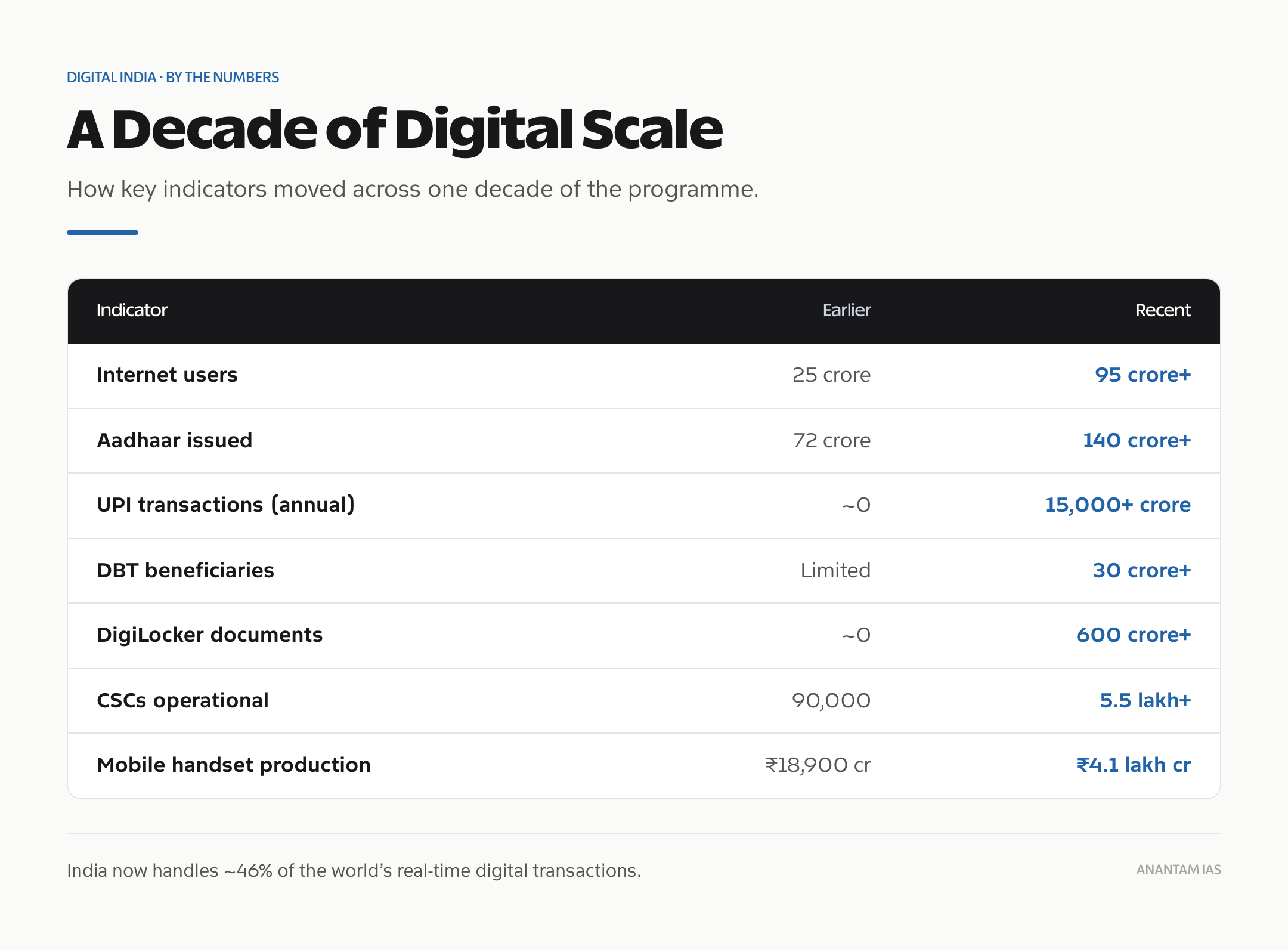
| Indicator | 2014-15 | 2024-25 |
|---|---|---|
| Internet users | 25 crore | 95 crore+ |
| Mobile internet users | 15 crore | 80 crore+ |
| UPI transactions (annual) | 0 | 15,000+ crore |
| Aadhaar issued | 72 crore | 140 crore+ |
| DBT beneficiaries | Limited | 30 crore+ |
| DBT total savings | — | ₹3.5 lakh crore (cumulative, per govt.) |
| DigiLocker documents | 0 | 600 crore+ |
| CSCs operational | 90,000 | 5.5 lakh+ |
| Mobile handset production | ₹18,900 crore | ₹4.1 lakh crore |
| India’s digital payment share | Negligible | 46% of global real-time transactions |
Challenges and Limitations
Digital Divide
Despite rapid growth, the digital divide persists:
- Rural-urban gap: 40% rural internet penetration vs 70%+ urban
- Gender gap: Women’s internet usage is 30% lower than men’s
- Language barrier: Most digital services default to English or a few major languages; local language content is inadequate
- Elderly and disabled: Interfaces often inaccessible to non-tech-savvy users
Data Privacy and Surveillance
The scale of Aadhaar linkages and digital data collection raises privacy concerns. The Supreme Court in Puttaswamy-1 (2017) recognised privacy as a fundamental right. India’s Digital Personal Data Protection Act, 2023 is the legislative response — but implementation rules are still awaited.
Cybersecurity
As more government services go online, cyberattacks on public infrastructure have increased. CERT-In (Indian Computer Emergency Response Team) coordinates responses, but capacity gaps remain.
Make in India: Sectors, Progress & UPSC Notes Skill India Mission: PMKVY & Employment Training
Key Facts Summary for UPSC
| Feature | Detail |
|---|---|
| Launched | July 1, 2015 |
| Ministry | Electronics and Information Technology (MeitY) |
| Pillars | 9 |
| Broadband infrastructure | BharatNet (BBNL/USOF) — 2.5 lakh GPs |
| Digital identity | Aadhaar (UIDAI) — 140 crore+ issued |
| Payment infrastructure | UPI (NPCI) — 46% of global real-time transactions |
| Document repository | DigiLocker — 30 crore users, 600 crore documents |
| Access points | CSCs — 5.5 lakh+, all panchayats |
| Mobile app | UMANG — 1,200+ services |
| Digital literacy scheme | PMGDISHA — 5.5 crore trained |
| DBT total savings (cumulative) | ₹3.5 lakh crore (government estimate) |
| India’s digital payment rank | 1st globally in real-time transaction volume |
Frequently Asked Questions
What are the 9 pillars of Digital India?
The 9 pillars are: Broadband Highways (BharatNet), Universal Mobile Connectivity, Public Internet Access (CSCs), e-Governance, e-Kranti (digital service delivery), Information for All, Electronics Manufacturing, IT for Jobs, and Early Harvest Programmes. Together they cover both digital infrastructure and service delivery transformation.
What is BharatNet and what is its current status?
BharatNet is India’s optical fibre rural broadband programme targeting all 2.5 lakh gram panchayats. Over 2.1 lakh GPs have been connected as of 2024. Implemented through BBNL and funded by USOF, a revamped PPP-based model is being used to accelerate last-mile household connectivity (FTTH) from 2023 onwards.
How has UPI transformed India’s digital payments?
UPI, launched in 2016 by NPCI, enables instant 24/7 bank transfers via mobile. From zero transactions in 2016 to 15,000+ crore transactions annually by 2024-25, UPI has made India the world leader in real-time digital transactions — accounting for 46% of global real-time payments. UPI is now accepted in Singapore, UAE, France, Bhutan, Nepal, and other countries.
What is DigiLocker and what is its legal status?
DigiLocker is a government cloud platform allowing citizens to store and share official digital documents. Documents stored there — driving licence, Aadhaar, marksheets, vehicle registration — are legally equivalent to physical originals under the IT Act. Over 30 crore accounts store 600 crore+ documents, eliminating the need for notarised copies in most official transactions.
What is PMGDISHA and has it achieved its target?
PMGDISHA (Pradhan Mantri Gramin Digital Saksharta Abhiyan) was launched in 2017 to train 6 crore rural households in basic digital skills. It has trained and certified 5.5 crore people through CSCs, schools, and gram panchayat buildings. Training covers basic computer/mobile use, internet access, online payments, email, and accessing government services.