Introduction
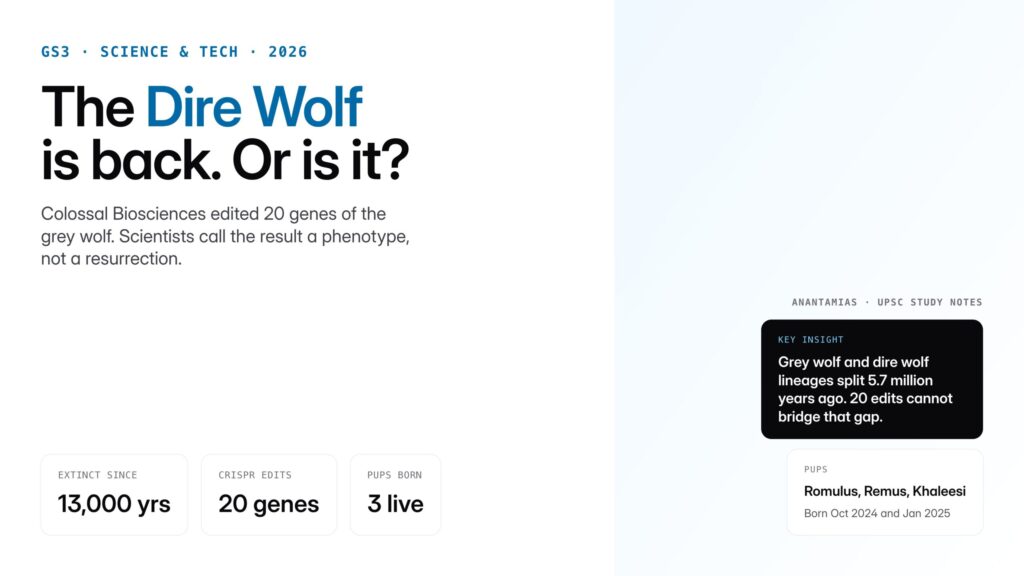
In April 2025, a Dallas-based biotech firm, Colossal Biosciences, made global headlines by unveiling three white-furred, wolf-like pups named Romulus, Remus and Khaleesi, declaring them the world’s first “de-extincted” dire wolves. The announcement was billed as the resurrection of Aenocyon dirus, a large Ice Age predator that vanished roughly 13,000 years ago. For UPSC aspirants following developments in biotechnology, conservation genetics and bioethics, the dire wolf story sits at the intersection of frontier science and old philosophical questions.
Behind the social media buzz, the claim has generated fierce scientific debate. Paleogeneticists argue that the animals Colossal produced are genetically modified grey wolves carrying about twenty targeted edits, not true dire wolves. The episode forces us to re-examine what “de-extinction” really means, whether restoring a species is biologically possible, and whether such efforts serve or distract from the urgent task of conserving the living biodiversity we still have.
Quick Facts at a Glance
| Attribute | Detail |
|---|---|
| Scientific name | Aenocyon dirus (formerly Canis dirus) |
| Extinct since | Approximately 13,000 years ago (Late Pleistocene) |
| Native range | North America and parts of South America |
| Body mass | 60 to 70 kg, about 25 percent larger than grey wolf |
| Company behind revival | Colossal Biosciences, Dallas, USA |
| Announcement date | April 2025 |
| Pups named | Romulus, Remus, Khaleesi |
| Base genome used | Grey wolf (Canis lupus) |
| Technique | CRISPR-Cas9 multiplex gene editing |
| Number of edits | About 20 in 14 genes |
| Surrogate mothers | Domestic dogs (large hound breeds) |
| Enclosure size | 2,000-acre secure preserve (undisclosed US location) |
Background and Historical Context
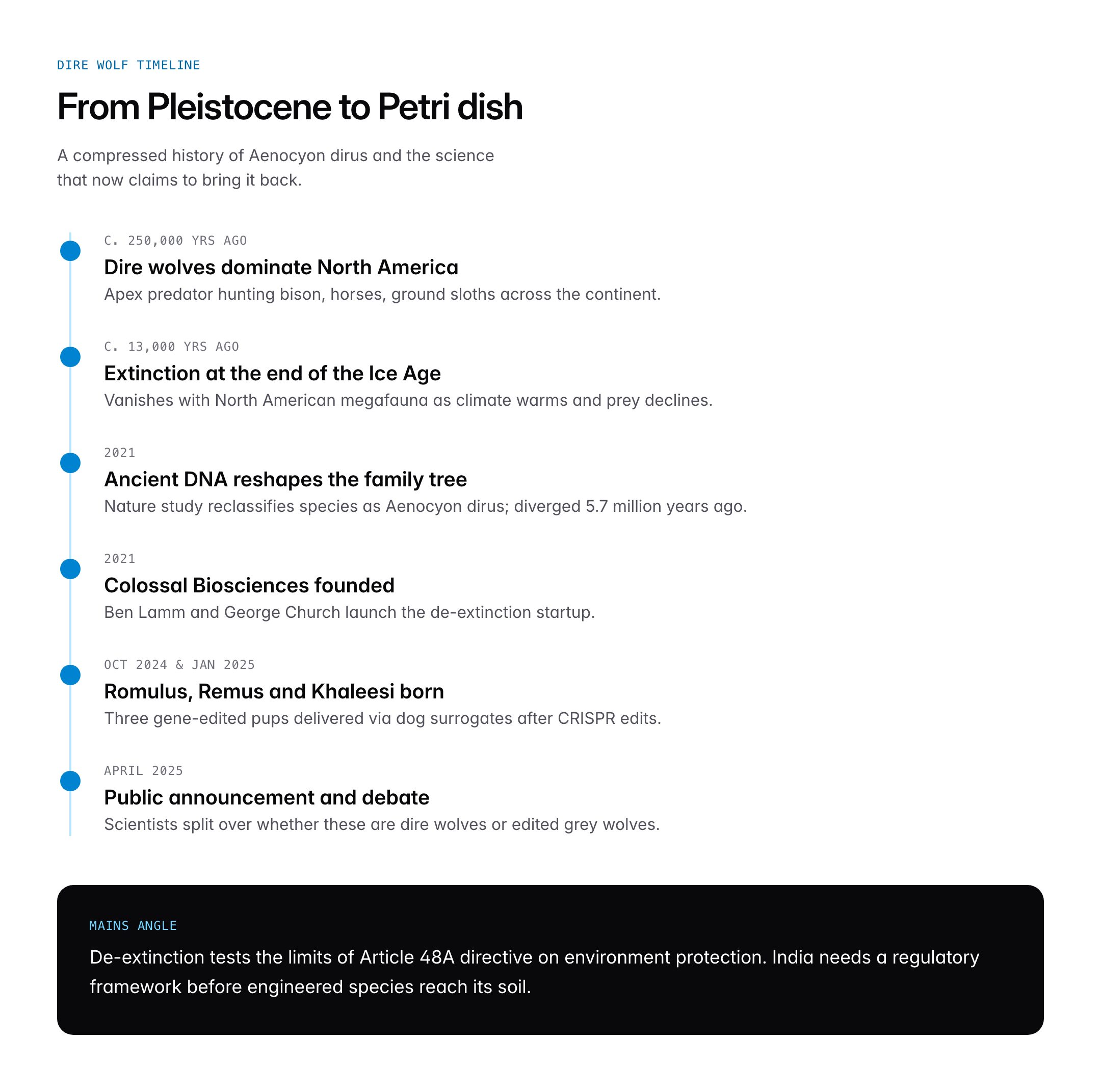
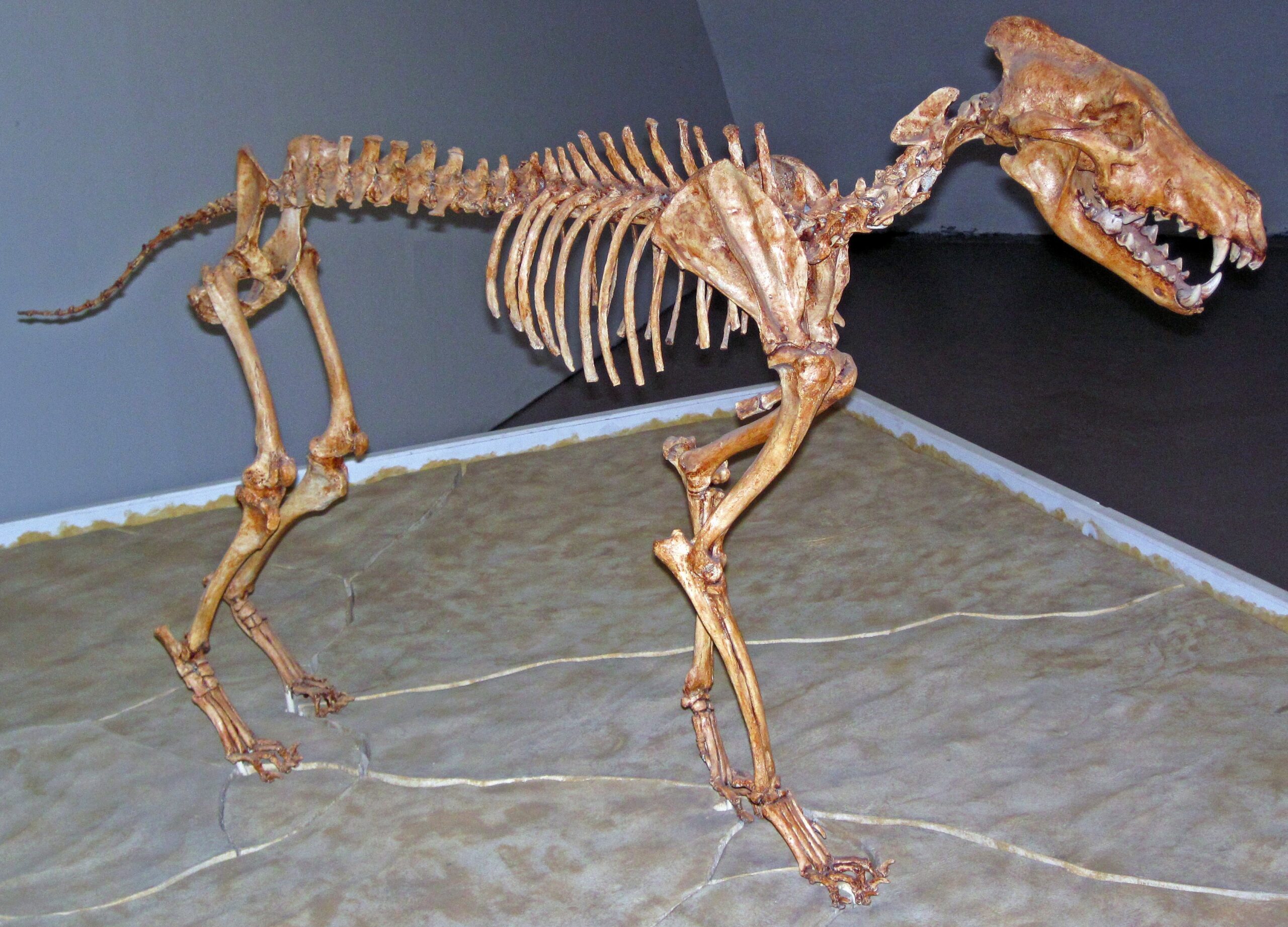
The dire wolf, Aenocyon dirus, was one of North America’s apex predators during the Pleistocene epoch. Fossils from the La Brea Tar Pits in Los Angeles have yielded more than 4,000 dire wolf specimens, making it one of the best-documented Ice Age carnivores. Dire wolves hunted megafauna like bison, horses and ground sloths, competing with sabre-toothed cats and short-faced bears. They disappeared during the Quaternary extinction event, which wiped out most of North America’s large mammals as climate warmed and human hunters spread.
For decades, scientists assumed dire wolves were close cousins of the modern grey wolf. A landmark 2021 study published in Nature upended this view. Ancient DNA extracted from five fossil specimens showed that dire wolves diverged from the lineage leading to grey wolves, coyotes and African jackals roughly 5.7 million years ago. Because they were so genetically distinct, researchers placed them in their own genus, Aenocyon, meaning “terrible wolf”. Their nearest living relatives are jackals, not wolves, making true revival by editing a wolf genome scientifically problematic.
The broader de-extinction movement emerged in the 2010s as CRISPR-Cas9 gene editing made precise DNA changes cheap and fast. Colossal Biosciences was founded in 2021 by entrepreneur Ben Lamm and Harvard geneticist George Church, with an initial goal of resurrecting the woolly mammoth. The company later added the thylacine (Tasmanian tiger) and the dodo to its de-extinction pipeline. The dire wolf announcement was its first public claim of a successful revival and a critical test of its core scientific premise.
Key Features of the Dire Wolf Project
The Original Animal
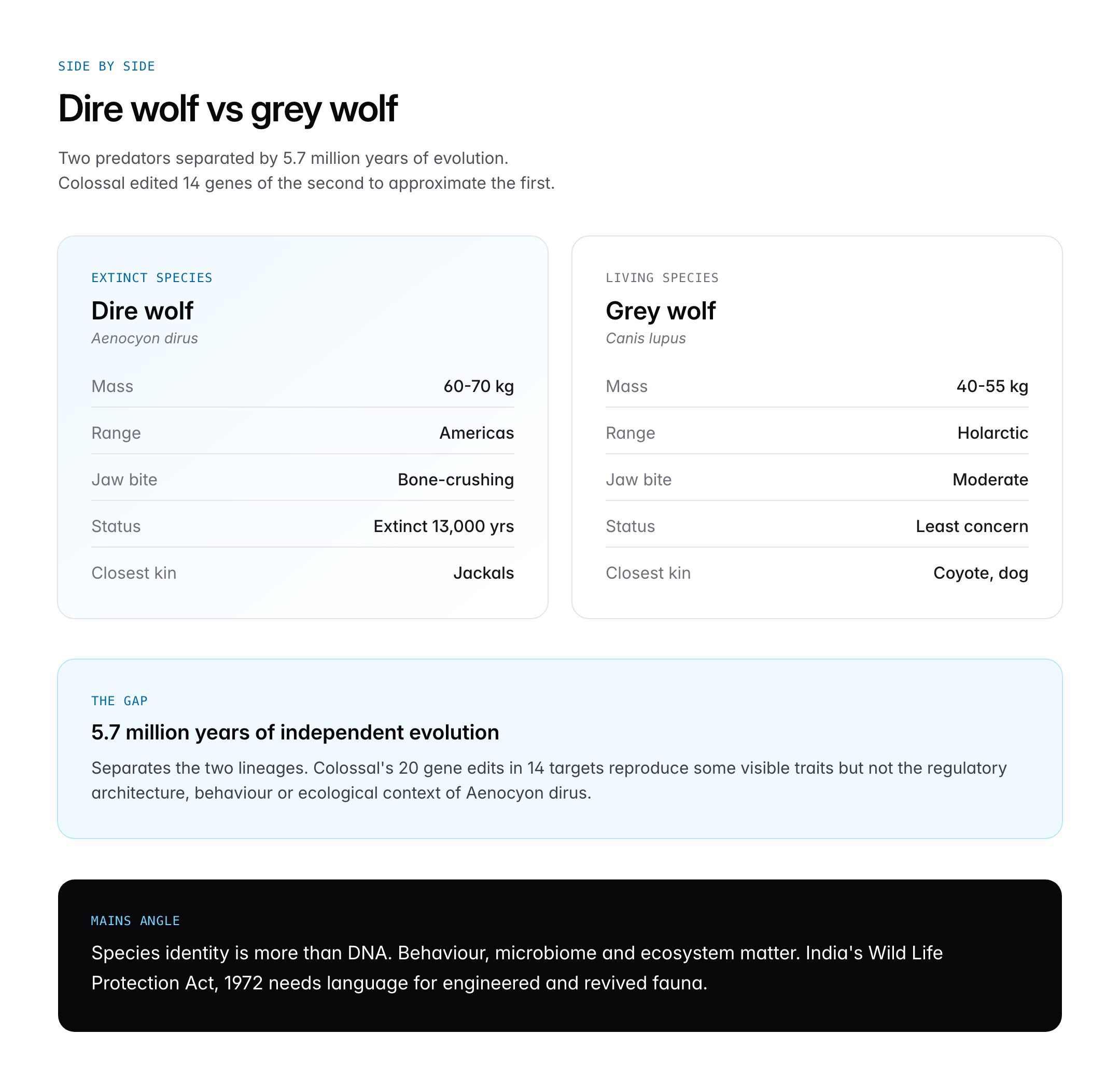
The dire wolf was heavier and more robustly built than today’s grey wolf, with a broader skull, larger teeth and stronger jaws adapted to crushing bone. Stable isotope analysis of La Brea fossils shows it was a hypercarnivore, with horse and bison forming the bulk of its diet. Its coat colour remains unknown from fossil evidence alone.
The De-Extinction Method
Colossal scientists sequenced two ancient DNA samples: a tooth dated to around 13,000 years before present and an inner ear bone dated to about 72,000 years before present. They assembled a draft dire wolf genome and compared it to the grey wolf reference genome. Using CRISPR-Cas9, the team introduced twenty edits across fourteen genes in grey wolf cells, targeting traits such as coat colour, body size, skull shape and musculature.
Cloning and Birth
The edited cell nuclei were transferred into enucleated dog egg cells through somatic cell nuclear transfer, the same technique that produced Dolly the sheep in 1996. Embryos were implanted into large domestic dogs serving as surrogate mothers. Three pups survived to term: two males (Romulus and Remus) born in October 2024 and one female (Khaleesi) born in January 2025.
Life in Captivity
The three animals live on a secure 2,000-acre preserve at an undisclosed US location, monitored by veterinarians and behaviourists. They are fed a controlled carnivore diet and will not be released into the wild. Colossal has stated the pups are intended as ambassadors for conservation technology rather than candidates for ecosystem rewilding.
What They Are Not
Critics, including many of the authors of the 2021 dire wolf genome paper, argue that twenty edits on a grey wolf genome cannot recreate a species separated by 5.7 million years of evolution. The pups are better described as genetically modified grey wolves with dire wolf phenotypic traits, not authentic Aenocyon dirus.
Significance for UPSC and General Knowledge
- Demonstrates the rapid maturation of CRISPR gene editing from laboratory tool to species-scale intervention, relevant to GS3 science and technology.
- Raises fresh bioethical questions on synthetic biology, intellectual property over genomes, and the definition of a species.
- Offers a live case study for essays on the tension between technological optimism and ecological humility.
- Connects to India’s own biodiversity debates such as the cheetah reintroduction project and conservation of critically endangered species.
- Illustrates the role of private capital (Colossal has raised over 435 million US dollars) in shaping science agendas, linking to GS2 governance concerns.
- Provides an opportunity to discuss the Biological Diversity Act, 2002, and India’s stance on genetic resources and access benefit sharing.
Detailed Analysis: Science, Hype and Conservation Impact
The dire wolf announcement is best evaluated along three axes: scientific accuracy, conservation value and ethical framing.
On the science, the consensus among paleogeneticists is that Colossal has produced impressive gene-edited grey wolves, not a resurrected species. Beth Shapiro, now chief science officer at Colossal, has herself written that true de-extinction is impossible because a species is more than its DNA. It includes behavioural inheritance, gut microbiome, learned hunting culture and the ecological context in which it evolved. Twenty edits cannot capture a multi-million-year evolutionary history, and the edits targeted phenotype, not the full gene regulatory architecture of Aenocyon dirus.
On conservation, Colossal argues that technologies developed for de-extinction will support living endangered species. The company has already cloned four red wolves, one of the most endangered canids with fewer than twenty individuals in the wild, using the same platform. This is a genuine benefit. Gene editing could rescue species suffering from severe inbreeding, such as the Florida panther or the Indian one-horned rhinoceros, by restoring lost genetic diversity. Critics counter that conservation dollars are finite, and spectacular de-extinction projects divert attention from habitat protection, anti-poaching enforcement and climate mitigation, which address the actual drivers of modern extinction.
On ethics, de-extinction raises questions that have no easy answers. Do we have the right to resurrect species whose ecosystems no longer exist? If a gene-edited animal suffers from welfare problems, who is accountable? Should the genomes of extinct species be owned by private companies? Regulators in the United States, European Union and India do not yet have clear frameworks for engineered organisms at the species scale.
For India, the implications are direct. The National Biodiversity Authority and Ministry of Environment, Forest and Climate Change will need to consider whether de-extincted or gene-edited animals fall under the Biological Diversity Act, 2002 and the Wild Life Protection Act, 1972. India’s cheetah translocation from Namibia and South Africa to Kuno National Park already tests reintroduction ethics. A future proposal to revive the Indian cheetah, the pink-headed duck or the Himalayan quail would land squarely in these debates.
Comparative Perspective
De-extinction efforts vary widely in ambition and technique. The table below compares leading projects.
| Project | Target species | Lead organisation | Technique | Status |
|---|---|---|---|---|
| Dire wolf | Aenocyon dirus | Colossal Biosciences | CRISPR edits on grey wolf | Three pups born 2024-25 |
| Woolly mammoth | Mammuthus primigenius | Colossal Biosciences | CRISPR edits on Asian elephant | Elephant stem cells created 2024 |
| Thylacine | Thylacinus cynocephalus | Colossal and University of Melbourne | Gene editing on fat-tailed dunnart | Genome assembled |
| Dodo | Raphus cucullatus | Colossal Biosciences | Primordial germ cell editing in Nicobar pigeon | Early stage |
| Pyrenean ibex | Capra pyrenaica pyrenaica | Spanish research team | Cloning from frozen tissue | Clone born 2003, died after minutes |
Unlike the Pyrenean ibex project, which used authentic frozen tissue, all Colossal programmes rely on editing a living relative’s genome. This distinction matters because it affects how closely the resulting animal resembles the extinct original.
Controversies and Debates
The dire wolf announcement ignited intense criticism from the scientific community. Geneticists pointed out that calling the pups “dire wolves” is a category error, since a species is defined by reproductive isolation and evolutionary history, not a handful of morphological traits. Conservation biologists warned that the messaging undermines public understanding of extinction by suggesting it is reversible, which could weaken support for preventing extinction in the first place.
Indigenous scholars raised questions about who speaks for species that lived on tribal lands. The dire wolf was a being in oral traditions across North America, and its symbolic revival by a private company has not involved indigenous communities. Animal welfare advocates questioned the suffering potentially endured by surrogate dogs and the psychological wellbeing of animals with no conspecifics, no pack history and no natural environment. The US Fish and Wildlife Service has stated the dire wolf is not protected under the Endangered Species Act because it is extinct, leaving a regulatory vacuum that Colossal has exploited.
Supporters argue the project demonstrates a new conservation toolkit and that public fascination with charismatic megafauna can fund research that also benefits living endangered species. The debate mirrors older controversies over genetically modified crops, cloned livestock and gene drives in mosquitoes.
Prelims Pointers
- Aenocyon dirus is the scientific name of the dire wolf, reclassified from Canis dirus in 2021.
- The dire wolf diverged from grey wolves about 5.7 million years ago.
- The La Brea Tar Pits in California have yielded the largest dire wolf fossil collection.
- Colossal Biosciences was co-founded by Ben Lamm and Harvard geneticist George Church.
- The three revived pups are named Romulus, Remus and Khaleesi.
- The technique used combines CRISPR-Cas9 gene editing with somatic cell nuclear transfer.
- Twenty genetic edits were made in fourteen genes of the grey wolf genome.
- The surrogate mothers were large domestic dog breeds.
- The pups live on a 2,000-acre preserve at an undisclosed US location.
- Colossal’s other de-extinction targets include the woolly mammoth, thylacine and dodo.
- Beth Shapiro, a leading ancient DNA expert, is chief science officer at Colossal.
- The Pyrenean ibex was the first extinct species briefly revived via cloning in 2003.
Mains Practice Questions
- “De-extinction through gene editing is less about resurrection and more about recombination.” Critically examine this statement in the light of the recent dire wolf announcement by Colossal Biosciences. (250 words)
- Explain the scientific claim and technique, noting twenty edits to a grey wolf genome.
- Discuss limits: reproductive isolation, 5.7 million year divergence, absence of ecological context.
- Evaluate conservation opportunity cost and ethical framing for India’s biodiversity governance.
- Discuss the regulatory and ethical challenges posed by de-extinction projects for a biodiversity-rich country like India. Suggest a framework under the Biological Diversity Act, 2002. (250 words)
- Identify gaps in existing Indian law regarding engineered and revived species.
- Examine precedent from the cheetah reintroduction and GM crop debates.
- Propose institutional safeguards, community consultation and benefit-sharing mechanisms.
Conclusion
The dire wolf announcement is a watershed moment in the short history of synthetic biology, but not for the reasons its promoters suggest. What Colossal Biosciences has demonstrated is powerful gene-editing and cloning capability, not the true resurrection of an Ice Age predator. The pups running on a Texas preserve are phenotypic approximations, valuable as scientific achievements but misleading as species revival. Stripping away the branding, the technology itself is real and increasingly practical.
For policy-makers, conservationists and aspirants alike, the lesson is dual. First, biotechnology is moving faster than regulation, and countries with megadiverse ecosystems such as India must update frameworks to handle gene-edited and revived organisms before commercial pressures force a choice. Second, the best response to extinction remains prevention. Habitat protection, anti-poaching, climate action and indigenous stewardship save far more species per rupee than revival ever will. The dire wolf is a reminder of what we lost and a warning about what we might distract ourselves from saving next.
Frequently Asked Questions
What is a dire wolf?
The dire wolf, scientifically known as Aenocyon dirus, was a large Ice Age predator that roamed North America until it went extinct roughly 13,000 years ago. It was heavier than today’s grey wolf, with stronger jaws for crushing bone, and is best known from fossils at the La Brea Tar Pits in California.
Did Colossal Biosciences really bring back the dire wolf?
Not exactly. In April 2025, Colossal Biosciences announced three pups, Romulus, Remus and Khaleesi, created by making about twenty CRISPR edits in fourteen genes of grey wolf cells. Most paleogeneticists describe them as genetically modified grey wolves with dire-wolf-like traits, not true Aenocyon dirus.
Why is the dire wolf project important for UPSC aspirants?
It links directly to GS3 science and technology, GS2 governance of emerging technologies, and GS4 ethics. The announcement raises questions about de-extinction, CRISPR regulation, bioethics, private capital in science and India’s Biological Diversity Act, 2002, making it a rich case for both Prelims facts and Mains analytical answers.
How is the dire wolf project related to the woolly mammoth revival?
Both projects are run by Colossal Biosciences and use similar CRISPR gene editing combined with cloning. For the mammoth, Asian elephant cells are edited with mammoth genes; for the dire wolf, grey wolf cells were edited. The dire wolf is Colossal’s first live-born claim, while mammoth work is still at the stem cell stage as of 2025.
What technique was used to create the dire wolf pups?
Scientists sequenced ancient DNA from two dire wolf fossils, compared it with the grey wolf genome, and used CRISPR-Cas9 to introduce twenty edits in grey wolf cells. The nuclei were then transferred into dog egg cells via somatic cell nuclear transfer, and embryos were carried by large domestic dog surrogates.
Are the dire wolf pups genetically identical to the extinct species?
No. The grey wolf and dire wolf lineages diverged around 5.7 million years ago. Twenty edits in fourteen genes cannot reproduce that evolutionary distance or the full gene regulatory architecture of Aenocyon dirus. The pups are better described as phenotypic approximations, carrying some visible traits but not the complete genome of a dire wolf.
What are the ethical concerns with de-extinction?
Key concerns include animal welfare for surrogates and pups, diversion of conservation funding from habitat protection, lack of clear regulation for engineered species, questions over genome ownership by private firms, and indigenous consultation for species tied to traditional cultures. De-extinction may also create a false sense that modern extinction is reversible.
How might dire wolf technology help living endangered species?
The same CRISPR and cloning techniques can rescue species with dangerously low genetic diversity. Colossal has already cloned red wolves, of which fewer than twenty survive in the wild. The approach could potentially help the Indian one-horned rhinoceros, Florida panther, Asiatic lion or Great Indian bustard by reintroducing lost genetic variation and increasing population viability.
Tell Google you want more of this.
Add Anantam IAS as a preferred sourceOne tap, and this site shows up more often in your own Top Stories, AI Overviews and AI Mode. Remove it any time.