Dr B.R. Ambedkar: Life, Constitution, Constitutional Morality | UPSC
Complete UPSC guide on Dr B.R. Ambedkar: life timeline, constitutional contributions, Annihilation of Caste, Ambedkar vs Gandhi, 1956 Buddhist conversion, economic ideas, constitutional morality, Hindu Code Bill, Prelims and Mains practice.
Dr B.R. Ambedkar (1891-1956), known to millions as Babasaheb, is the thinker who turned the anguish of caste into a programme of constitutional emancipation. Architect of the Indian Constitution, formidable jurist, independent India’s first Law Minister, and the political strategist who forced the national movement to reckon with social injustice — Ambedkar belongs in the first rank of India’s ethical thinkers. He was posthumously awarded the Bharat Ratna in 1990. For UPSC, he is a pivotal figure on social justice, affirmative action, public ethics, and the moral architecture of the Indian Constitution.
This guide is a complete reference on Dr B.R. Ambedkar: his life timeline, his economic and constitutional contributions, his major writings (Annihilation of Caste, States and Minorities, The Buddha and His Dhamma), his philosophical framework of liberty-equality-fraternity, the Ambedkar-Gandhi debate, his 1956 Buddhist conversion, his enduring legacy in jurisprudence and policy, and his direct relevance for UPSC GS-I, GS-II, GS-III, and GS-IV. The aim is to give an aspirant a single page that explains who Ambedkar was and why he still matters in 2026.
If you remember nothing else about Dr B.R. Ambedkar, remember three propositions he made unforgettable: caste is a structural hierarchy, not a division of labour. Political democracy is unsustainable without social democracy. Constitutional morality must rule even when social morality dissents.
Dr B.R. Ambedkar: Quick Facts at a Glance
| Aspect | Detail |
|---|---|
| Full name | Bhimrao Ramji Ambedkar |
| Born | 14 April 1891 — Mhow, Madhya Pradesh (then Central Provinces, British India) |
| Died | 6 December 1956 — Delhi (Mahaparinirvan Diwas) |
| Education | Elphinstone College Bombay; MA + PhD Columbia University; DSc + Bar-at-Law London School of Economics & Gray’s Inn |
| Major roles | Chairman, Drafting Committee of the Constituent Assembly (1947-49); first Law Minister of independent India (1947-51) |
| Major works | The Problem of the Rupee (1923); Annihilation of Caste (1936); Pakistan or the Partition of India (1940); States and Minorities (1947); Who Were the Shudras? (1946); The Buddha and His Dhamma (1957) |
| Political parties founded | Independent Labour Party (1936); Scheduled Castes Federation (1942); Republican Party of India (announced 1956, founded 1957) |
| Conversion | 14 October 1956 — Embraced Buddhism at Deekshabhoomi, Nagpur with ~5 lakh followers (founder of Navayana Buddhism) |
| Honours | Bharat Ratna (1990, posthumous); 14 April observed as Ambedkar Jayanti, public holiday since 2015 |
| Constitutional articles drafted | Articles 14-18 (Equality), Article 17 (Untouchability), Article 32 (Constitutional Remedies — “heart and soul”), Articles 330-342 (Reservations), Articles 14-22, 25-28, 39-46 |
| UPSC syllabus relevance | GS-I (Indian society, modern history); GS-II (Constitution, polity, social justice); GS-III (economy); GS-IV (ethics, integrity, public service values); Essay; Optional (Sociology, PSIR, Public Administration, Law) |
From Mhow to Deekshabhoomi: A Life Timeline
Ambedkar’s life is a sequence of breaks with established Indian social order. He was born into a Mahar family treated as untouchable across Maharashtra. He was the fourteenth child of a subedar in the British Indian Army. By the time of his death, he had reshaped India’s legal and political imagination.
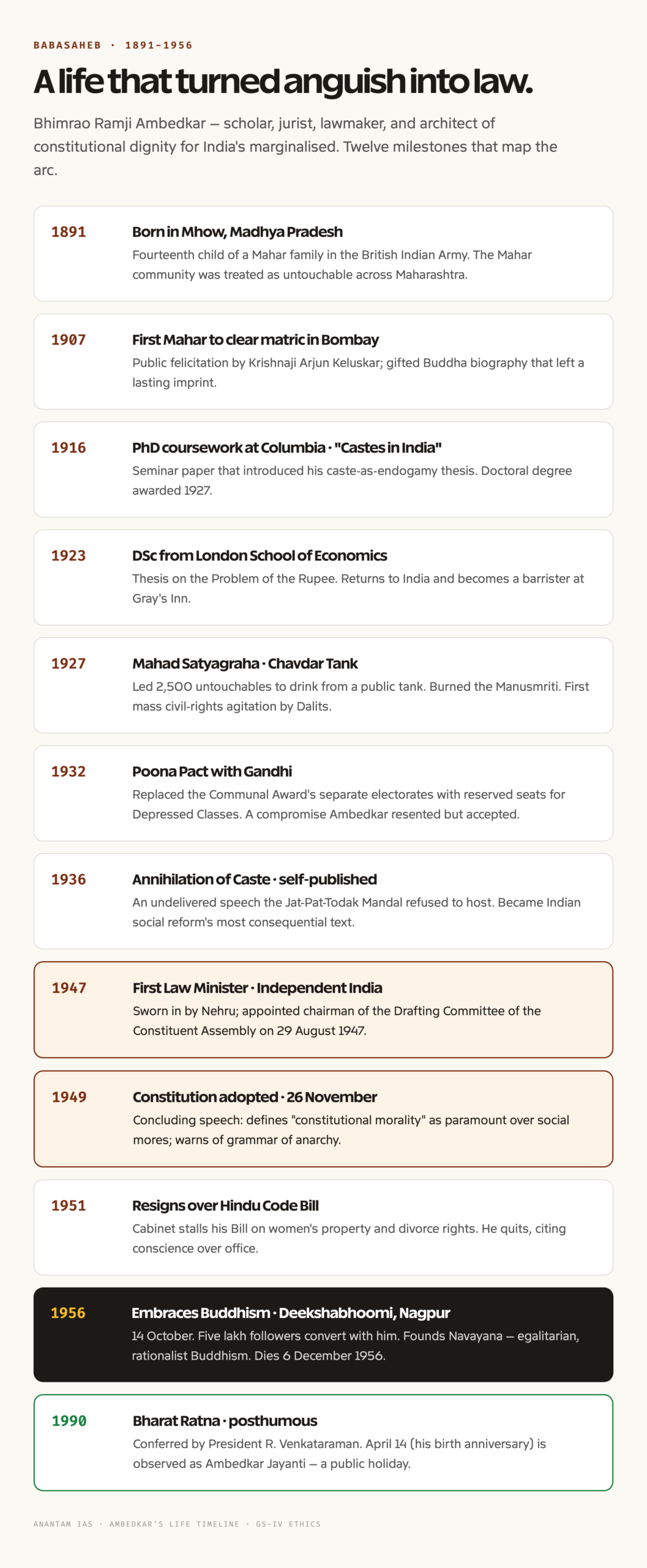
Three formative experiences mark his early years. The first was being made to sit on a separate gunny sack outside his classroom, with the school sweeper handling his water from a height to avoid contact. The second was the 1900s Bombay matriculation, where he was felicitated by Krishnaji Arjun Keluskar with a biography of the Buddha — a gift that would prove decisive in 1956. The third was his time at Columbia under John Dewey, who shaped Ambedkar’s pragmatist conviction that reform must produce concrete change in the lives of the marginalised.
From the late 1920s, Ambedkar’s public life moved across three intersecting fronts: legal scholarship (Bar-at-Law in 1923, professor of political economy at Sydenham College), mass political organising (Mahad satyagraha 1927, Kalaram Temple entry agitation 1930, Round Table Conferences 1930-32), and institutional architecture (Reserve Bank of India design ideas, Drafting Committee chair, Hindu Code Bill).
Architect of the Constitution
On 29 August 1947 the Constituent Assembly elected Ambedkar Chairman of the Drafting Committee, alongside six others. His committee’s draft, sustained through 165 days of debate spread over 11 sessions, became the Constitution adopted on 26 November 1949. The republic that emerged on 26 January 1950 is, in its rights architecture, his architecture.
The provisions Ambedkar fought for personally form the moral spine of the Constitution: Article 14 (equality before law), Article 15 (prohibition of discrimination on caste, race, religion, sex, place of birth) and its enabling clause 15(4) for special provisions, Article 16 with 16(4) for reservation in public employment, Article 17 (abolition of untouchability — the only article in the Constitution to declare a social practice illegal in absolute terms), Articles 25-28 (freedom of religion balanced against social reform), Article 32 (constitutional remedies, which he called the “heart and soul of the Constitution”), and Articles 330-342 (reservation in legislatures and public service for SCs and STs).
Ambedkar also embedded a long programme of social-democratic transformation in the Directive Principles of State Policy (Articles 36-51): right to work, equal pay for equal work, free legal aid, public health, free and compulsory education, decent standard of living, uniform civil code. The DPSPs were not aspirations to him; they were the social-democracy operating manual that the political-democracy framework would have to deliver if it was to last.
His 25 November 1949 closing speech in the Constituent Assembly is the single most-cited UPSC text on Indian constitutionalism. He warned of three dangers: hero-worship that would eclipse institutions; the “grammar of anarchy” — bandhs, strikes and satyagraha after independence when constitutional methods are open; and the contradiction between political equality and social-economic inequality that would, if uncorrected, blow up the structure of political democracy.
Liberty, Equality, Fraternity: The Three Pillars
For Ambedkar, the trinity is not a slogan. It is a load-bearing argument. Liberty, equality and fraternity are linked. Each fails without the others, and the failure cascades into authoritarianism.
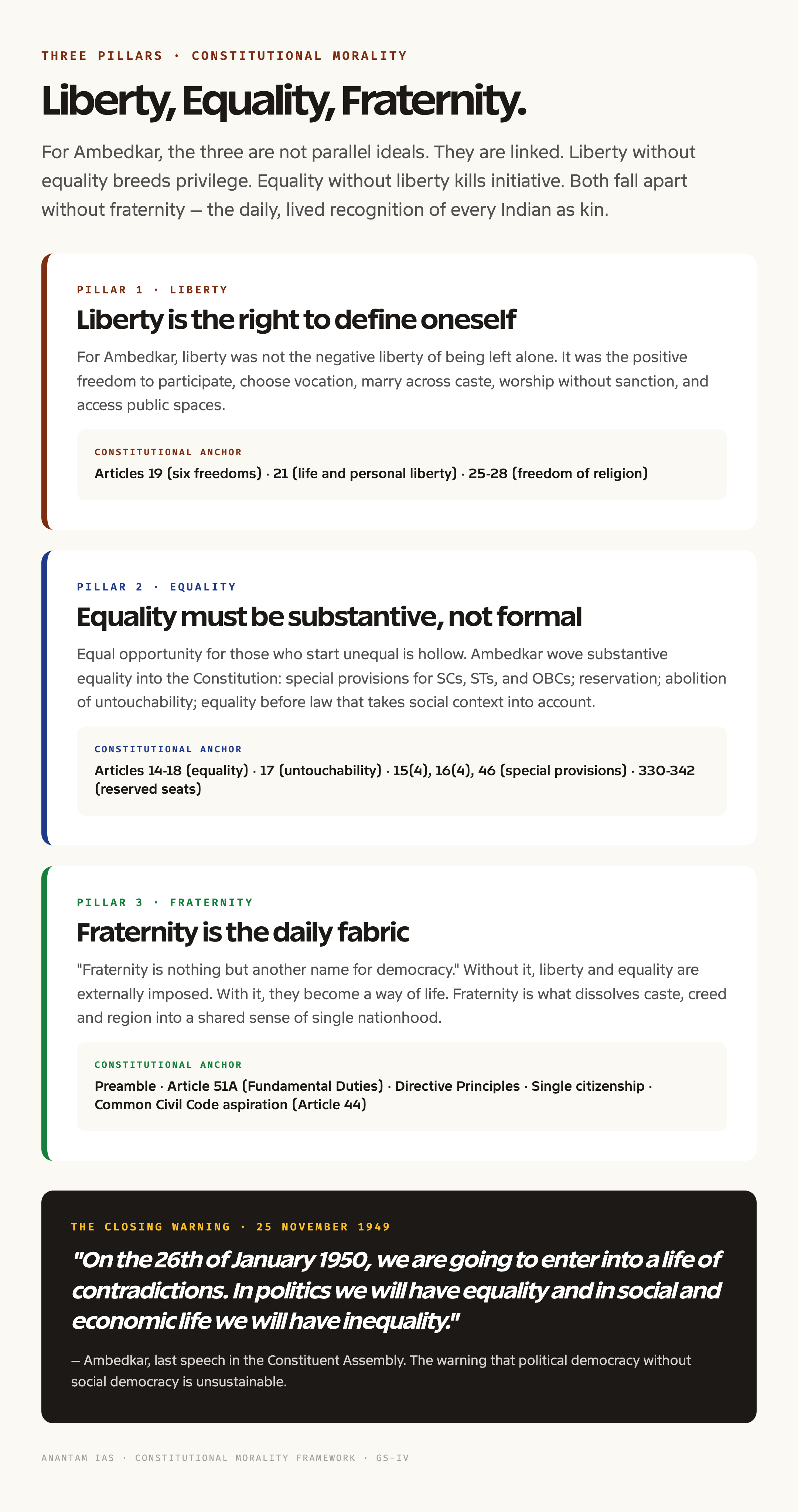
Why Ambedkar refused to separate the three
Liberty cannot be divorced from equality, equality cannot be divorced from liberty. Nor can liberty and equality be divorced from fraternity. Without equality, liberty would produce the supremacy of the few over the many. Equality without liberty would kill individual initiative. Without fraternity, liberty and equality could not become a natural course of things.
— Ambedkar, Constituent Assembly, 25 November 1949
This is constitutional theology. It says that any reform that picks two and ignores the third will collapse. India in 2026 still tests this thesis daily — wherever liberty exists without substantive equality, equality without effective liberty, or both without fraternity, the social fabric tears.
Annihilation of Caste (1936): The Argument
Annihilation of Caste is the most consequential single text in modern Indian social reform. It was originally an undelivered speech written for the Jat-Pat-Todak Mandal of Lahore, a reformist Hindu organisation that wanted to abolish caste. When Ambedkar’s draft proved too radical — explicitly attacking the authority of the Vedas and Shastras — the Mandal cancelled the event. Ambedkar self-published the text in 1936. It has been reprinted, annotated and translated in dozens of editions.
The argument has four moves:
- Caste is a structural hierarchy, not a division of labour. It is, in his exact phrase, “a division of labourers.” The hierarchy is the structure, not a by-product.
- Endogamy is the lock. Caste survives because people marry within caste. Inter-caste marriage is the only structural solvent that breaks the lock from inside.
- Religious sanction sustains caste. So long as Hindu scripture treats caste as divinely ordained, no reform can dissolve it. “You must destroy the religion of the Shrutis and Smritis.”
- Reformers cannot be priests. The reforming impulse must come from outside the priestly caste authority. Internal reform leaves the structure intact.
Gandhi’s published responses in Harijan defended the varna ideal as a moral division of duty corrupted by practice and untouchability. Ambedkar’s reply was uncompromising: there is no recoverable kernel; the hierarchy is the system.
Ambedkar vs Gandhi: The Caste Question
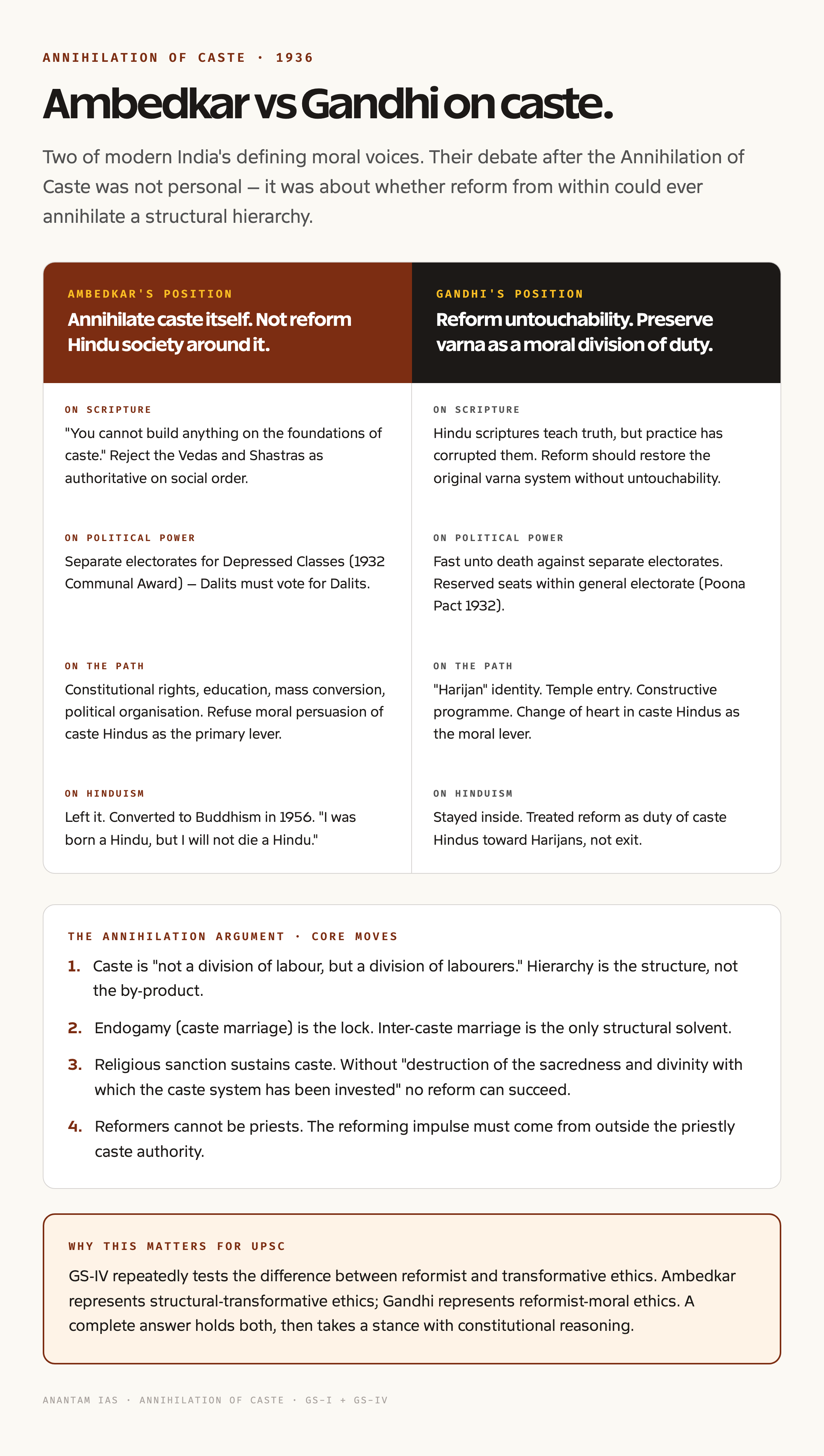
Treating Ambedkar and Gandhi as opposite poles flattens both. They are better understood as different theories of moral change in a society shot through with caste. Gandhi’s was a reformist-moral theory: change hearts of caste Hindus, restore the original varna ideal stripped of untouchability, work through trusteeship and constructive programme. Ambedkar’s was a structural-transformative theory: caste is not redeemable from within; constitutional rights, education, mass conversion, political organisation are the levers.
The 1932 Communal Award and the Poona Pact are the practical pivot of the disagreement. The Award gave Depressed Classes separate electorates — they would vote separately for their own representatives. Gandhi went on a fast unto death against this, fearing communal partition of Hindus. Ambedkar accepted the Poona Pact compromise (24 September 1932 in Yerwada Jail) — reserved seats inside the general electorate, in exchange for a doubled number of constituencies. He always considered it a strategic loss imposed by Gandhi’s pressure.
UPSC GS-I and GS-IV often invite a take on this debate. The mature answer holds both moral universes simultaneously. Gandhi’s reform-of-heart persuasion is necessary but insufficient. Ambedkar’s structural transformation through constitutional rights is necessary but cannot succeed without the social fraternity Gandhi tried to cultivate. Both belong on the same syllabus.
The 1956 Conversion: Navayana Buddhism
On 14 October 1956 at Deekshabhoomi in Nagpur, Ambedkar embraced Buddhism along with around five lakh of his followers. It was one of the largest peaceful religious conversions in modern history. He had announced the intention as early as 1935 at Yeola: “I was born a Hindu, but I will not die a Hindu.” Two decades of comparative study followed before he chose Buddhism over Sikhism, Islam, and Christianity.
Ambedkar’s Buddhism is not the Buddhism of the orthodox Theravada or Mahayana traditions. He called it Navayana — the New Vehicle — articulated in his posthumously published The Buddha and His Dhamma (1957). Navayana strips Buddhism of metaphysical doctrines (rebirth, karma as cosmological law, miracles) and centres it on social-democratic ethics: liberty, equality, fraternity. He said the trinity he carried into the Constitution came not from the French Revolution but from his teacher, the Buddha.
Ambedkar took 22 vows at the conversion ceremony — explicit rejections of Hindu ritual practice and unequivocal commitments to Buddhist ethics. He died 51 days later, on 6 December 1956. The conversion movement he started has continued, with more than 70 lakh Indian Buddhists today identifying as Ambedkarite Buddhists, primarily in Maharashtra, Uttar Pradesh, Madhya Pradesh and Karnataka.
The Economic Ambedkar: An Underrated Legacy
Ambedkar’s economic thinking is among the most underrated in Indian intellectual history. His doctoral work at Columbia under Edwin Seligman (The Evolution of Provincial Finance in British India, 1925) and his DSc at LSE under Edwin Cannan (The Problem of the Rupee, 1923) anticipated several arguments later used to design the Reserve Bank of India in 1935.
Three pillars defined his economic vision:
- State socialism with parliamentary democracy. In States and Minorities (1947), he proposed state ownership of agriculture, key industries, and insurance, alongside parliamentary democracy. The model anticipates Nehruvian socialism but locates it within an explicitly social-justice frame.
- Land reform and cooperative farming. He saw land concentration as both an economic and a caste problem. His proposals included nationalisation of agricultural land, redistribution to cooperatives, and state-led capitalisation of agriculture.
- Public works and human capital investment. Free and compulsory education, public health, water access, and infrastructure for marginalised communities — what we now call human-development economics — were core to his programme decades before the language existed.
As Labour Member in the Viceroy’s Executive Council (1942-46), he laid the groundwork for the Damodar Valley Corporation, the Hirakud Dam, the Sone River project, the Central Water Commission, the Central Technical Power Board (precursor to the Central Electricity Authority), and the modern Indian labour-statistics architecture (Industrial Disputes Act, eight-hour working day, paid leaves, ESIC, EPF). Most of independent India’s industrial-relations machinery dates to Ambedkar’s tenure as Labour Member.
The Hindu Code Bill: Why He Resigned
As first Law Minister, Ambedkar drafted the Hindu Code Bill — a comprehensive statute granting women rights in marriage, divorce, succession, adoption, maintenance, and minority. It would have abolished bigamy, allowed inter-caste and inter-religious marriage, recognised divorce, given daughters equal share in property, and applied uniformly across Hindus, Sikhs, Buddhists and Jains.
Conservative opposition — inside Congress, outside it, and on the streets — proved decisive. Nehru, despite personal support, judged the political cost too high in 1951. The Bill was watered down and stalled. Ambedkar resigned from the cabinet on 27 September 1951, citing the Hindu Code Bill, the lack of Cabinet support for backward classes, and his marginalisation in foreign policy. His resignation speech is one of the great documents of conscience-over-office in Indian political history.
The Bill’s substance survived in fragments: the Hindu Marriage Act 1955, Hindu Succession Act 1956, Hindu Adoptions and Maintenance Act 1956, Hindu Minority and Guardianship Act 1956. The Hindu Succession (Amendment) Act 2005 gave daughters coparcenary rights — completing one element of Ambedkar’s original draft 49 years after his death.
Constitutional Morality in the Supreme Court
Ambedkar coined “constitutional morality” in 1949. The Supreme Court has weaponised it in three landmark 2018 judgments and several more since:
- Naz Foundation (2009) and Navtej Singh Johar (2018): Reading down Section 377 IPC. Constitutional morality, the Court held, must override social morality where the latter denies dignity to a minority.
- Sabarimala (Indian Young Lawyers Association v State of Kerala, 2018): Right of women aged 10-50 to enter Sabarimala. The Court invoked constitutional morality to override the temple’s exclusionary tradition.
- Joseph Shine (2018): Striking down Section 497 IPC (adultery). Constitutional morality and Article 14 dignity over patriarchal social code.
- Puttaswamy (2017): Right to privacy as a fundamental right under Article 21. The judgment approvingly cites Ambedkar’s social-democracy framework.
- Bhima Koregaon, NALSA (2014, transgender rights), Joseph Shine (2018), Sabarimala review (2020): Constitutional morality remains the recurring constitutional argument in cases that involve dignity of marginalised communities.
Constitutional morality is not without critics. Justices have warned that it can become a judicial substitute for legislative deliberation. Ambedkar himself anticipated this — he wrote that the form is the responsibility of the framer; the spirit is the responsibility of the people. Courts can defend the spirit, but they cannot manufacture it.
Why Ambedkar Still Matters in 2026
Three live debates reproduce Ambedkar’s arguments without naming them:
The reservation debate
From the Mandal Commission (1980, implemented 1990) to EWS reservation (103rd Amendment 2019) to the sub-classification of Scheduled Castes (Davinder Singh, 2024 SC ruling) to the Bihar caste survey (2023) and the Caste Census of 2026 — every chapter of the reservation debate sits inside Ambedkar’s framework. He saw reservation as a temporary remedy that should remain only until structural inequality was dismantled. The Constitutional 105th Amendment (2021) restoring state powers to identify SEBCs is a direct continuation of his federal-substantive-equality framework.
Caste atrocities and access
The Scheduled Castes and Scheduled Tribes (Prevention of Atrocities) Act 1989, the Manual Scavengers Act 2013, the NAMASTE scheme (2023), and the recurring debates on caste-based violence and inter-caste marriage all play out in the moral grammar Ambedkar codified.
Constitutional morality in court
Each major Supreme Court judgment that invokes constitutional morality — Sabarimala, Navtej Singh Johar, Joseph Shine, Puttaswamy — is, in effect, a footnote to Ambedkar’s 1949 closing speech.
Ambedkar in the Indian Thinkers Pantheon
| Thinker | Core moral concept | Stance on caste | Method |
|---|---|---|---|
| Ambedkar | Constitutional morality, social democracy | Annihilate the structure | Law, politics, education, conversion |
| Gandhi | Truth, non-violence, trusteeship | Reform untouchability, preserve varna ideal | Constructive programme, fast, satyagraha |
| Tagore | Universal humanism, jiva-atma | Critique through art and education | Visva-Bharati, literature |
| Vivekananda | Service of human as service of God | Critique untouchability as Hindu corruption | Religious reform, monastic order |
| Periyar (E.V. Ramasamy) | Self-respect, rational rejection | Reject Hinduism, Brahminism, caste outright | Self-Respect Movement, Dravidian politics |
| Phule | Liberty for the Shudra and Ati-Shudra | Brahminical Hinduism is the source | Satyashodhak Samaj, schools for girls and Dalits |
| Nehru | Scientific temper, secular state | Reservation, abolition of untouchability | Planning, parliamentary democracy |
Ambedkar’s distinctive contribution is the fusion of jurisprudence, mass political organisation, and religious reform in one career. No other Indian thinker reached comparable depth across all three.
UPSC Prelims Pointers on Ambedkar
- Born 14 April 1891 at Mhow, Madhya Pradesh.
- Died 6 December 1956 (Mahaparinirvan Diwas).
- Doctorates: PhD Columbia (1927), DSc LSE (1923).
- 1923 thesis: The Problem of the Rupee — anticipated arguments behind RBI design (RBI Act 1934, established 1935).
- 1927 Mahad Satyagraha: Chavdar Tank water access, burning of Manusmriti.
- 1932 Poona Pact: Replaced separate electorates (Communal Award) with reserved seats.
- 1936 Annihilation of Caste: Self-published; Jat-Pat-Todak Mandal cancelled the speech.
- 1947 Drafting Committee: Chairman from 29 August 1947.
- 26 November 1949: Constitution adopted; closing speech defines constitutional morality.
- 1951: Resigned over Hindu Code Bill.
- 1956 Buddhist Conversion: 14 October at Deekshabhoomi, Nagpur with ~5 lakh followers.
- 1990: Bharat Ratna (posthumous).
- 22 vows taken at conversion, rejecting Hindu deities and rituals.
- Article 32: Called “the heart and soul of the Constitution” by Ambedkar.
- Articles drafted/championed: 14, 15, 16, 17, 21, 25-28, 32, 39-46, 330-342.
UPSC Mains Practice Questions on Ambedkar
- GS-I (250 words): “Discuss B.R. Ambedkar’s contribution to the social reform movement in India and its continuing relevance in 2026.”
- GS-II (150 words): “What is constitutional morality? Examine the Supreme Court’s invocation of constitutional morality in landmark judgments since 2017.”
- GS-II (250 words): “Ambedkar warned that political democracy without social democracy is unsustainable. Critically examine this thesis in the context of contemporary India.”
- GS-IV (150 words): “Explain Ambedkar’s three foundations of liberty, equality and fraternity. How are these reflected in the conduct expected of public servants?”
- GS-IV (150 words): “Compare Ambedkar’s and Gandhi’s approaches to caste reform. Which approach is more relevant to addressing contemporary inequalities?”
- Essay (1,000-1,200 words): “Constitutional morality vs social morality: the unfinished work of Indian democracy.”
- Optional (PSIR): “Critically analyse Ambedkar’s conception of social democracy with reference to his writings and speeches.”
- Optional (Sociology): “Endogamy, caste and Ambedkar’s Annihilation of Caste: a sociological assessment.”
Related references on this site: Indian Constitution, Fundamental Rights, Directive Principles, Basic Structure Doctrine, Reservation in India, Bhakti and Sufi Movements, Socio-Religious Reform Movements, Buddhism in India, Mahatma Gandhi, and Poona Pact.
Conclusion: A Compass, Not a Statue
Ambedkar’s writings are not closed texts. They are working papers for an unfinished republic. The Constitution he drafted is the working document. The constitutional morality he articulated is the operating principle. The social democracy he insisted on is the test that political democracy still has to pass.
For an aspirant who will sit in district magistracies and policy rooms, the question is not whether to admire Ambedkar from a distance. The question is whether the institutions you serve will deliver liberty, equality and fraternity together — and whether you will recognise constitutional morality even when social morality dissents. Ambedkar wrote a manual for that recognition. The exam tests whether you can read it. Public service tests whether you can apply it.
Ambedkar is among the most frequently examined Indian thinkers in GS-II and GS-IV. Answers that cite Annihilation of Caste, his distinction between political and social democracy, his concept of constitutional morality, and the link between liberty, equality and fraternity demonstrate a grasp of the moral foundations of Indian public life. For a candidate preparing to serve a society still wrestling with its oldest inequalities, Dr B.R. Ambedkar is not a name to cite but a compass to carry.
Frequently Asked Questions about Dr B.R. Ambedkar
Why is B.R. Ambedkar called the architect of the Indian Constitution?
Ambedkar served as Chairman of the Drafting Committee of the Constituent Assembly from August 1947. He led the article-by-article framing of the Constitution adopted on 26 November 1949 and defended every clause through 165 days of debate. Sardar Patel and Pandit Nehru both publicly described his role as central. The phrase ‘architect of the Constitution’ captures the depth and sustained legal authorship he brought to the draft.
What is constitutional morality according to Ambedkar?
Constitutional morality is the ethical commitment to uphold the values of justice, liberty, equality and fraternity even when those values conflict with dominant social mores. Ambedkar introduced the term in his 25 November 1949 speech to the Constituent Assembly, warning that a Constitution is only as effective as the conduct of those who implement it. The Supreme Court has invoked constitutional morality in landmark judgments like Sabarimala (2018), Navtej Singh Johar (2018), and Joseph Shine (2018).
What is Annihilation of Caste and why is it important?
Annihilation of Caste is the 1936 undelivered speech that Ambedkar wrote for the Jat-Pat-Todak Mandal in Lahore. The Mandal cancelled the event after objecting to its critique of Hindu scriptures. Ambedkar self-published it. The text argues that caste is a structural hierarchy, not a division of labour; that endogamy is its lock; that religious sanction sustains it; and that no internal reform of Hindu society can dissolve it without rejecting the scriptural authority on which it rests.
What was the Poona Pact between Ambedkar and Gandhi?
Signed on 24 September 1932 in Yerwada Jail, the Poona Pact replaced the British Communal Award’s separate electorates for the Depressed Classes with reserved seats inside the general electorate. Gandhi had begun a fast unto death against separate electorates. Ambedkar accepted the compromise to save Gandhi’s life but considered it a setback for political autonomy of Dalits. The pact established the architecture of reserved constituencies that survived into the Constitution.
Why did Ambedkar convert to Buddhism in 1956?
Ambedkar had announced as early as 1935 at Yeola that ‘I was born a Hindu, but I will not die a Hindu.’ His search ended in Buddhism, which he saw as rationalist, egalitarian, and compatible with science and democracy. On 14 October 1956 at Deekshabhoomi, Nagpur, he embraced Buddhism with around five lakh followers in one of the largest peaceful religious conversions in modern history. He founded Navayana — a reinterpretation of Buddhism centred on social democracy.
What is the difference between political democracy and social democracy in Ambedkar’s thought?
Political democracy is one-person-one-vote, free elections and parliamentary government. Social democracy is a way of life that recognises liberty, equality and fraternity as principles of life. Ambedkar argued that political democracy without social democracy creates a life of contradictions: equal in politics, unequal in society and economy. He warned that this contradiction, if not corrected, would ‘blow up the structure of political democracy’.
What is the Ambedkar-Gandhi debate about?
It is a debate over the means and ends of caste reform. Ambedkar wanted annihilation of the caste system itself, treated scripture as the source of caste sanction, and worked through constitutional rights, political organisation and conversion. Gandhi wanted abolition of untouchability while preserving an idealised varna system, treated scripture as redeemable, and worked through reform-of-heart in caste Hindus. The Annihilation of Caste was Ambedkar’s case; Gandhi’s published responses in Harijan are the counter-case.
How is Ambedkar relevant for UPSC GS-IV Ethics?
Ambedkar is central to GS-IV themes: constitutional morality, social justice, public service ethics, dignity, and the moral foundations of public administration. He provides the framework for evaluating reservations, affirmative action, the conduct of public servants in plural societies, and the ethics of constitutional interpretation. Quoting Ambedkar’s distinction between political and social democracy, his three foundations (liberty, equality, fraternity), and his concept of constitutional morality strengthens any GS-IV answer on these areas.
What were Ambedkar’s economic ideas?
Ambedkar’s economic thinking is often underrated. His 1923 DSc thesis ‘The Problem of the Rupee’ anticipated several arguments used to design the Reserve Bank of India in 1935. He authored ‘States and Minorities’ (1947), proposing state ownership of agriculture and key industries. He advocated land reform, cooperative farming, public works, and active state intervention. His economic vision was social-democratic, predating Indian planning by decades.
Why did Ambedkar resign from Nehru’s cabinet in 1951?
Ambedkar resigned over the stalled Hindu Code Bill, which he had drafted to grant women rights in marriage, divorce, succession, and adoption. The cabinet, under conservative pressure, declined to push it through Parliament in his form. He saw it as a litmus test of social democracy. The Bill was passed in fragments through 1955-56 (Hindu Marriage Act, Hindu Succession Act, Hindu Adoptions and Maintenance Act, Hindu Minority and Guardianship Act), but by then Ambedkar had left government on principle.