
Introduction
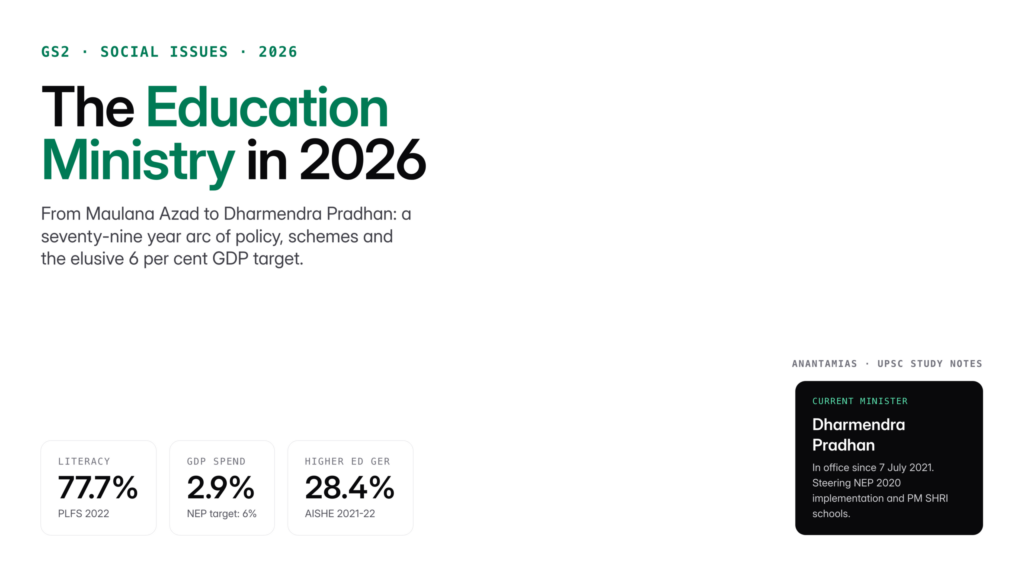
The Education Minister of India heads the Union Ministry of Education, the nodal authority responsible for school education, higher education, literacy and research policy across the country. The portfolio covers more than 260 million enrolled students, over 1.5 million schools, 1,100 universities and a public spending envelope of close to 1.5 lakh crore rupees in the 2025–26 Union Budget. Few cabinet positions touch as many Indian households on a daily basis.
For the UPSC aspirant, the Education Minister sits at the intersection of GS Paper 2 (governance, welfare), GS Paper 1 (social issues and education as a driver of mobility) and essays on the republic’s human capital. This article covers the current post-holder, the full list since independence, the ministry’s structure, the Wardha and Sergeant Plans of colonial origin that still inform policy debate, the National Education Policy 2020 and the literacy record of the country.
Quick Facts at a Glance
| Feature | Detail |
|---|---|
| Current Education Minister (2026) | Dharmendra Pradhan |
| First Education Minister of independent India | Maulana Abul Kalam Azad (1947–1958) |
| Ministry of Education established | 29 August 1947; renamed MHRD in 1985; restored as Education in 2020 |
| Current structure | Two departments: School Education & Literacy; Higher Education |
| Headquarters | Shastri Bhavan, New Delhi |
| Constitutional status | Education moved from State to Concurrent List by 42nd Amendment, 1976 |
| Literacy rate (NSO 2022 PLFS) | 77.7 per cent overall, 84.7 per cent male, 70.3 per cent female |
| Key policy instrument | National Education Policy 2020 |
Background and Historical Context
Education in colonial India was shaped by a succession of policy documents. Thomas Macaulay’s 1835 Minute on Education anchored English-medium instruction and a filtering-down theory of elite education. Lord Ripon’s Hunter Commission of 1882, the Sadler Commission of 1917 and the Hartog Committee of 1929 each reviewed and patched the system without fundamentally broadening access. Two late-colonial schemes mattered the most for post-1947 policy memory.
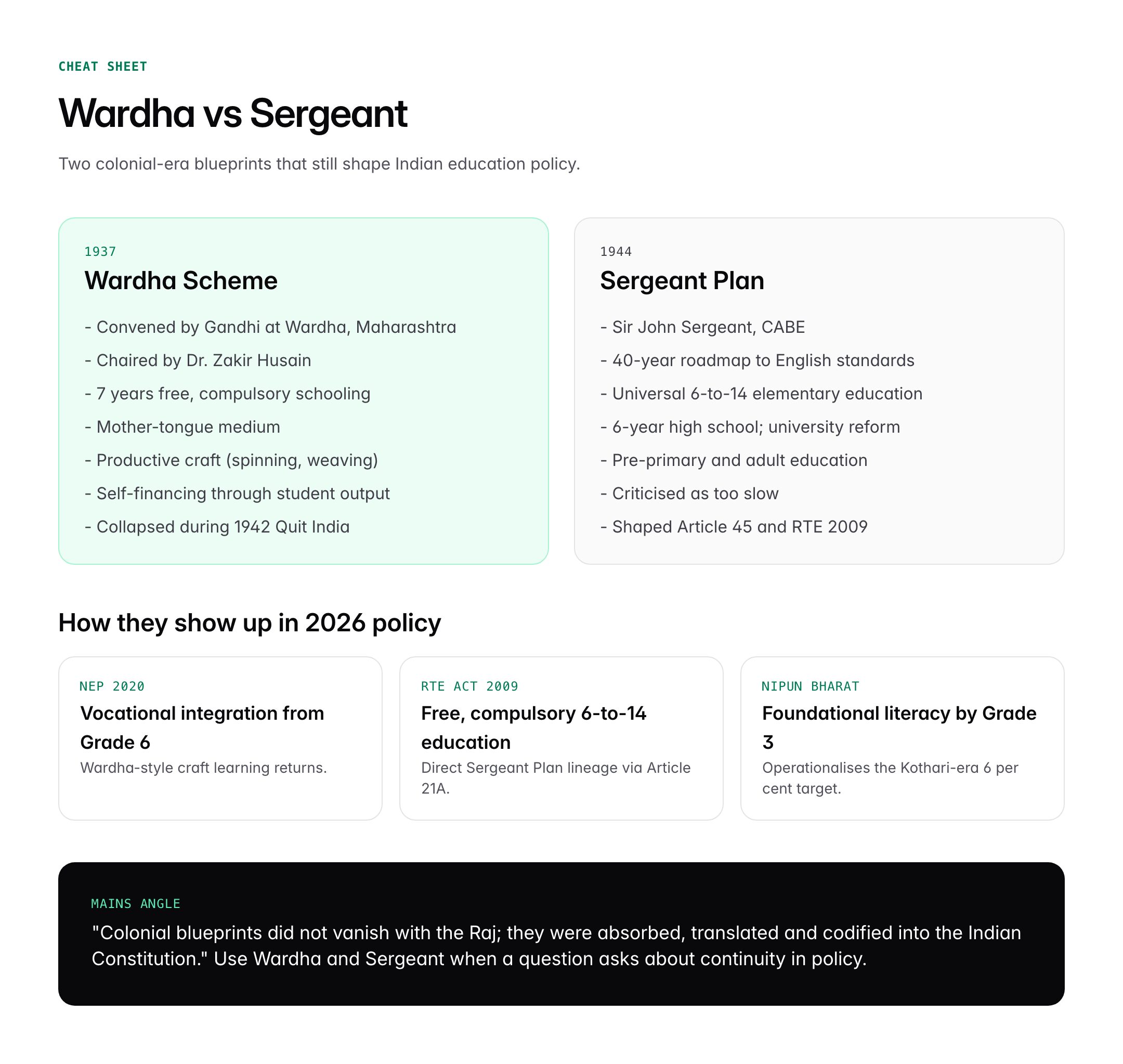
The Wardha Scheme of Basic Education was drafted at a 1937 conference in Wardha, Maharashtra, convened by Mahatma Gandhi and presided over by Dr. Zakir Husain. It proposed seven years of free, compulsory, mother-tongue instruction organised around a productive craft such as spinning, weaving or agriculture. The idea was that the school would pay for itself through the sale of student-made goods and that children would learn dignity of labour. The scheme was piloted in Congress-ruled provinces but collapsed during the 1942 Quit India movement.
The Sergeant Plan was produced by the Central Advisory Board of Education in 1944 under Sir John Sergeant, Educational Adviser to the Government of India. It aimed to bring India to the educational standards of contemporary England within forty years. It proposed universal, free, compulsory elementary education for children aged 6 to 14, a six-year high school, and university reform. Its forty-year timeline was criticised as too slow, but its architecture, especially the 6-to-14 elementary band, shaped the Constitution’s Article 45 directive and later the Right to Education Act of 2009.
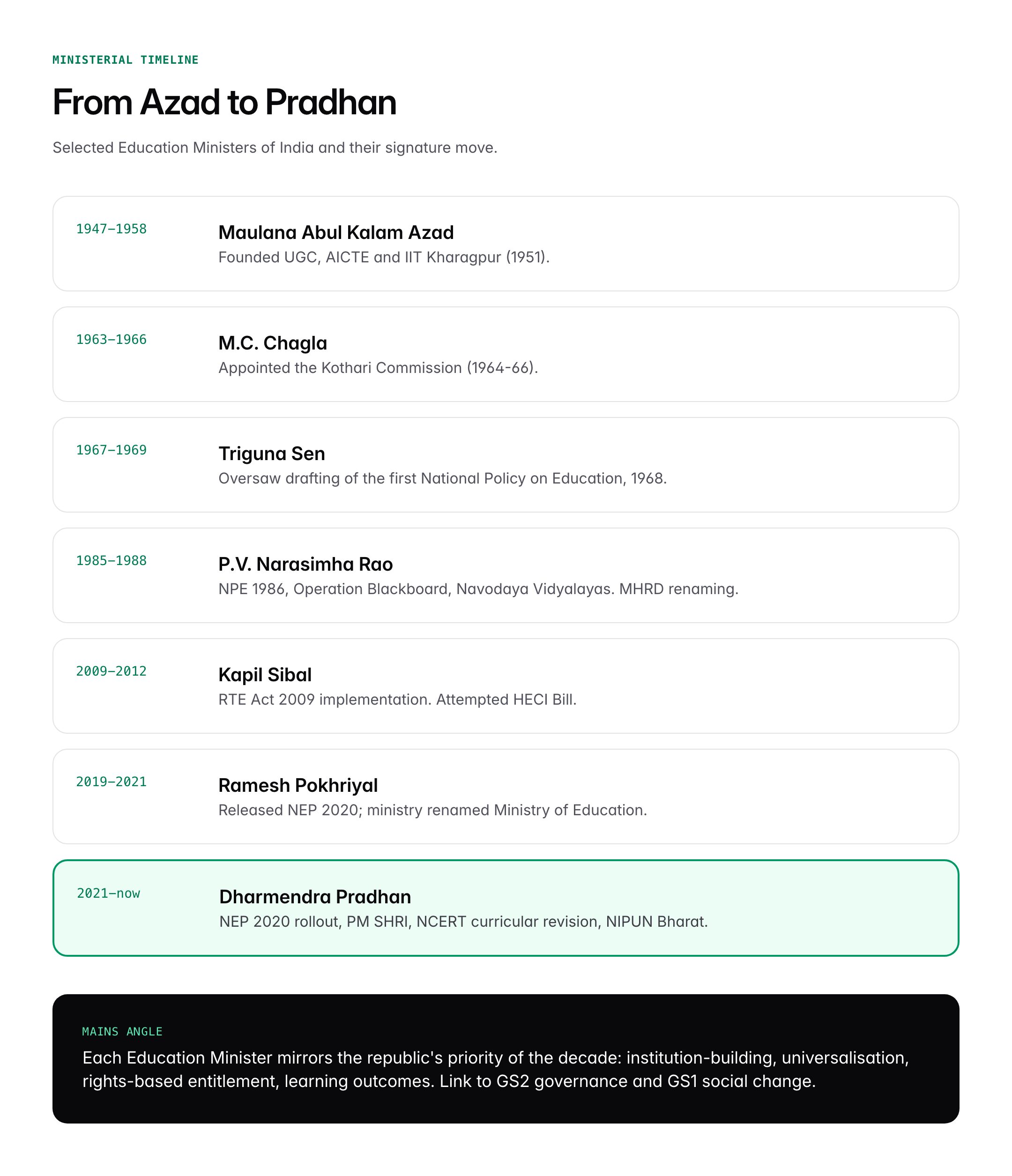
Post-independence, Maulana Abul Kalam Azad served as the first Education Minister from 1947 to 1958 and founded the University Grants Commission, the AICTE and the first IITs. His successors oversaw the Kothari Commission of 1964–66, the first National Policy on Education in 1968, Rajiv Gandhi’s 1986 NPE revision, the renaming of the ministry to Human Resource Development in 1985, and its 2020 reversion to Ministry of Education.
Key Features of the Ministry
Structure
The ministry is organised into two departments. The Department of School Education and Literacy oversees the Samagra Shiksha Abhiyan, PM POSHAN (Mid-Day Meal), Kendriya Vidyalayas, Navodaya Vidyalayas, the Central Board of Secondary Education and the National Council of Educational Research and Training (NCERT). The Department of Higher Education oversees central universities, the UGC, AICTE, NCTE, NAAC, IITs, IIMs, NITs, IISc, IISERs, the Institutions of Eminence scheme and international academic cooperation.
Current Minister and Ministers of State
Dharmendra Pradhan has held the Education portfolio since 7 July 2021 and was re-inducted after the 2024 general election. Born in 1969 and educated at Utkal University, he is a Rajya Sabha member from Madhya Pradesh and previously served as Union Petroleum and Skill Development Minister. The Ministers of State as of 2026 include Jayant Chaudhary and Sukanta Majumdar, though portfolio allocations can shift with cabinet reshuffles.
Major Ongoing Schemes
- National Education Policy 2020, which replaces the 1986/1992 policy and proposes a 5+3+3+4 curricular structure, mother-tongue instruction up to Grade 5, a four-year undergraduate programme and a target of 6 per cent of GDP on education.
- Samagra Shiksha Abhiyan, an umbrella scheme for school education covering SSA, RMSA and teacher education.
- PM SHRI Schools, a 2022 scheme to upgrade 14,500 schools as model institutions.
- PM POSHAN, the rechristened Mid-Day Meal programme serving 11.8 crore children.
- NIPUN Bharat, for foundational literacy and numeracy by Grade 3 by 2026–27.
Constitutional Framework
Education was originally a State subject under Entry 11 of List II but was moved to the Concurrent List by the 42nd Amendment of 1976. The Constitution engages the sector through Article 21A (right to education, inserted by the 86th Amendment in 2002), Article 45 (directive on early childhood care), Article 46 (educational interests of SCs, STs and weaker sections), and Articles 29 and 30 on minority educational rights.
Significance for UPSC and General Knowledge
- Education policy is a recurring Mains theme across GS Papers 1, 2 and essay, with frequent questions on NEP 2020, RTE implementation and skill India.
- Prelims questions test schemes, years, commissions, constitutional articles and first-holder facts like Maulana Azad in 1947.
- The Wardha and Sergeant Plans are classic answers to questions on colonial-era reform roots.
- Literacy data from Census 2011 and NSO PLFS is staple economy and society material.
- “Education without values” is a Gandhi-inspired phrase that surfaces in GS4 ethics essay answers.
- India’s higher-education gross enrolment ratio of 28.4 per cent (AISHE 2021–22) sets up a comparison with the NEP target of 50 per cent by 2035.
Detailed Analysis: Education Ministers Since 1947
| Minister | Tenure | Prime Minister | Signature contribution |
|---|---|---|---|
| Maulana Abul Kalam Azad | 1947–1958 | Nehru | UGC, AICTE, first IIT Kharagpur (1951) |
| K.L. Shrimali | 1958–1963 | Nehru | Three-language formula draft |
| M.C. Chagla | 1963–1966 | Nehru/Shastri | Kothari Commission appointed 1964 |
| Triguna Sen | 1967–1969 | Indira Gandhi | First NPE 1968 drafting |
| Nurul Hasan | 1972–1977 | Indira Gandhi | Emergency-era reforms, 42nd Amendment prep |
| P.V. Narasimha Rao | 1985–1988 | Rajiv Gandhi | NPE 1986, Operation Blackboard, Navodaya Vidyalayas |
| Arjun Singh | 2004–2009 | Manmohan Singh | OBC reservation extension, Central Universities Act 2009 |
| Kapil Sibal | 2009–2012 | Manmohan Singh | RTE Act 2009 implementation, aborted HECI Bill |
| Smriti Irani | 2014–2016 | Narendra Modi | Renamed Swachh Vidyalaya, NIRF rankings launched |
| Prakash Javadekar | 2016–2019 | Narendra Modi | Institutions of Eminence scheme |
| Ramesh Pokhriyal | 2019–2021 | Narendra Modi | NEP 2020 release, ministry renamed back to Education |
| Dharmendra Pradhan | 2021–present | Narendra Modi | NEP 2020 implementation, PM SHRI, NCERT curricular revision |
Regarding Prime Minister Narendra Modi’s own education qualifications, his affidavits and Delhi University and Gujarat University records cite a BA in Political Science from Delhi University (1978) and an MA from Gujarat University (1983). This has been a matter of political debate but the documents are on the public record.

Comparative Perspective
| Country | Education Ministry name | Share of GDP on education | Literacy rate | Target |
|---|---|---|---|---|
| India | Ministry of Education | 2.9 per cent (2022 Economic Survey) | 77.7 per cent | 6 per cent (NEP) |
| China | Ministry of Education | 4.0 per cent | 97 per cent | Embedded in 14th Five-Year Plan |
| USA | Department of Education | 6.1 per cent | 99 per cent | ESSA Act 2015 |
| UK | Department for Education | 5.5 per cent | 99 per cent | National Curriculum framework |
| Japan | MEXT | 3.4 per cent | 99 per cent | Basic Plan for Promotion of Education |
India’s per-student public expenditure remains the lowest among the G20 middle-income peers, and the NEP 2020 target of 6 per cent of GDP has remained unmet since it was first set by the Kothari Commission in 1966. The gap between ambition and allocation is the single biggest story in Indian education policy.
Challenges and Criticisms
The Ministry faces persistent structural problems. School-level learning outcomes remain poor. The ASER 2023 report found that only 25 per cent of Grade 5 students could read a Grade 2 text fluently. Teacher vacancies stood at over 10 lakh across government schools according to 2023 parliamentary replies. The dropout rate at secondary level is about 12 per cent, rising sharply for SC, ST and Muslim girls.
Critics of the NEP 2020 argue that the policy is ambitious on paper but thin on financing. States, which spend close to 80 per cent of total public education outlays, have not been meaningfully consulted on the three-language formula or the common school board model. Academic freedom debates around UGC draft regulations, the future of the JNU campus and textbook revisions at NCERT have attracted commentary from both supporters and critics. The phrase “education without values is, as useful as it is, seems rather to make man more clever devil”, attributed to C.S. Lewis and popularised in India by Gandhi’s own writings, continues to frame the ethics-in-curriculum debate.
Prelims Pointers
- First Education Minister: Maulana Abul Kalam Azad, 1947–1958.
- Ministry renamed MHRD in 1985 under Rajiv Gandhi; renamed Education in 2020.
- Wardha Scheme: 1937, Gandhi, chaired by Dr. Zakir Husain.
- Sergeant Plan: 1944, Central Advisory Board of Education, Sir John Sergeant.
- Education shifted from State to Concurrent List by 42nd Amendment, 1976.
- Article 21A inserted by 86th Amendment (2002); RTE Act 2009.
- NEP 2020 proposes 5+3+3+4 curricular structure.
- Current literacy rate (PLFS 2022): 77.7 per cent.
- Higher education GER (AISHE 2021–22): 28.4 per cent.
- NEP target: 50 per cent GER by 2035, 6 per cent of GDP on education.
- PM POSHAN serves 11.8 crore children across 11.2 lakh schools.
- Dharmendra Pradhan is the Education Minister since July 2021.
Mains Practice Questions
- “The National Education Policy 2020 is as much a financing problem as a pedagogical one.” Critically examine, citing the Kothari Commission’s 6 per cent target.
- Trace the 6 per cent target from 1966 to NEP 2020
- Compare current Union plus State expenditure (2.9 per cent of GDP) with peers
- Suggest financing models including Cess, PPP and philanthropic routes
- Compare the Wardha Scheme of 1937 and the Sergeant Plan of 1944 and assess their influence on post-independence education policy.
- Wardha: craft-centred, self-financing, Gandhian
- Sergeant: universal 6-14 elementary, English model
- Influence visible in RTE 2009 and NEP 2020’s vocational integration
Conclusion
The office of Union Education Minister has evolved from Maulana Azad’s institution-building in the 1950s to Dharmendra Pradhan’s NEP 2020 implementation in the 2020s. Across seven decades, the portfolio has reflected the republic’s shifting priorities: from establishing IITs and the UGC, to mass literacy, to RTE-era enrolment, to learning outcomes and skilling in the present day.
For UPSC candidates, the minister’s role is an organising lens for the entire education ecosystem. Tracking current policies, remembering colonial blueprints like Wardha and Sergeant, and linking them to constitutional articles and fiscal debates is what distinguishes a surface answer from a substantive one. Education remains, as Nelson Mandela put it and as Indian policy-makers have repeatedly echoed, the most powerful weapon to change the world.
Frequently Asked Questions
Who is the current Education Minister of India in 2026?
Dharmendra Pradhan is the Union Minister of Education of India, a position he has held since 7 July 2021. A senior BJP leader and Rajya Sabha member from Madhya Pradesh, he was re-inducted in the Modi 3.0 cabinet after the 2024 general election. He previously served as Union Minister for Petroleum and Natural Gas and Skill Development.
Why is the Education Minister important for UPSC?
The portfolio sits at the centre of GS Paper 2 (governance, welfare, centrally sponsored schemes), GS Paper 1 (social issues, women’s education, poverty) and GS Paper 4 (ethics in education). UPSC regularly asks about the NEP 2020, RTE Act, education commissions and constitutional articles like 21A, 45 and 46 that define the state’s educational obligations.
How is the Education Ministry related to UGC and AICTE?
The University Grants Commission (established 1956) and the All India Council for Technical Education (established 1945, statutory in 1987) are both regulatory bodies under the Department of Higher Education in the Union Ministry of Education. The UGC governs general higher education; AICTE regulates technical institutions. Both report to the Education Minister through the Higher Education Secretary.
What was the Wardha Scheme of Education?
The Wardha Scheme of Basic Education was proposed at a 1937 conference in Wardha, Maharashtra, convened by Mahatma Gandhi. Chaired by Dr. Zakir Husain, it recommended seven years of free, compulsory, mother-tongue education organised around a productive craft. Schools were meant to be self-supporting through the sale of student-made goods. It was piloted in Congress-ruled provinces but collapsed during the 1942 Quit India movement.
What was the Sergeant Plan of Education?
The Sergeant Plan of 1944, drafted under Sir John Sergeant, Educational Adviser to the Government of India, was a forty-year roadmap to bring Indian education to then-contemporary English standards. It proposed universal free compulsory elementary education for ages 6 to 14, a six-year high school and higher education reform. Its 6-to-14 framework influenced the Indian Constitution’s Article 45 and the 2009 Right to Education Act.
What is Prime Minister Narendra Modi’s education qualification?
Prime Minister Narendra Modi’s academic record, available through his election affidavits and university records, shows a Bachelor of Arts in Political Science from Delhi University in 1978 and a Master of Arts from Gujarat University in 1983. The qualifications have been politically debated but are on the public record via official university documents.
What is India’s current literacy rate?
According to the NSO’s Periodic Labour Force Survey 2022 report, India’s literacy rate for persons aged 7 and above is 77.7 per cent, with 84.7 per cent among males and 70.3 per cent among females. Kerala leads state rankings at around 94 per cent, followed by Mizoram and Tripura, while Bihar and Andhra Pradesh have the lowest literacy levels in the country.
What does ‘education without values’ mean in the UPSC context?
The phrase, popularised in India by Gandhi’s writings and used in ethics essays, argues that academic instruction divorced from moral grounding produces technically skilled but socially harmful individuals. C.S. Lewis, Mahatma Gandhi and Swami Vivekananda have all been quoted on this theme. It is useful in GS4 answers on value education, integrity and the aims of the Indian republican education project.
Tell Google you want more of this.
Add Anantam IAS as a preferred sourceOne tap, and this site shows up more often in your own Top Stories, AI Overviews and AI Mode. Remove it any time.