Introduction
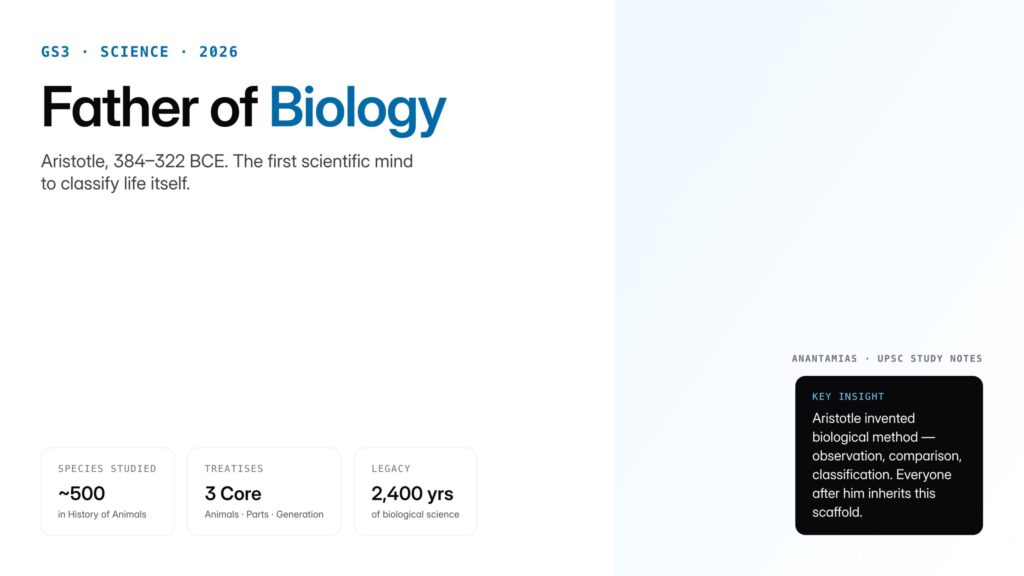
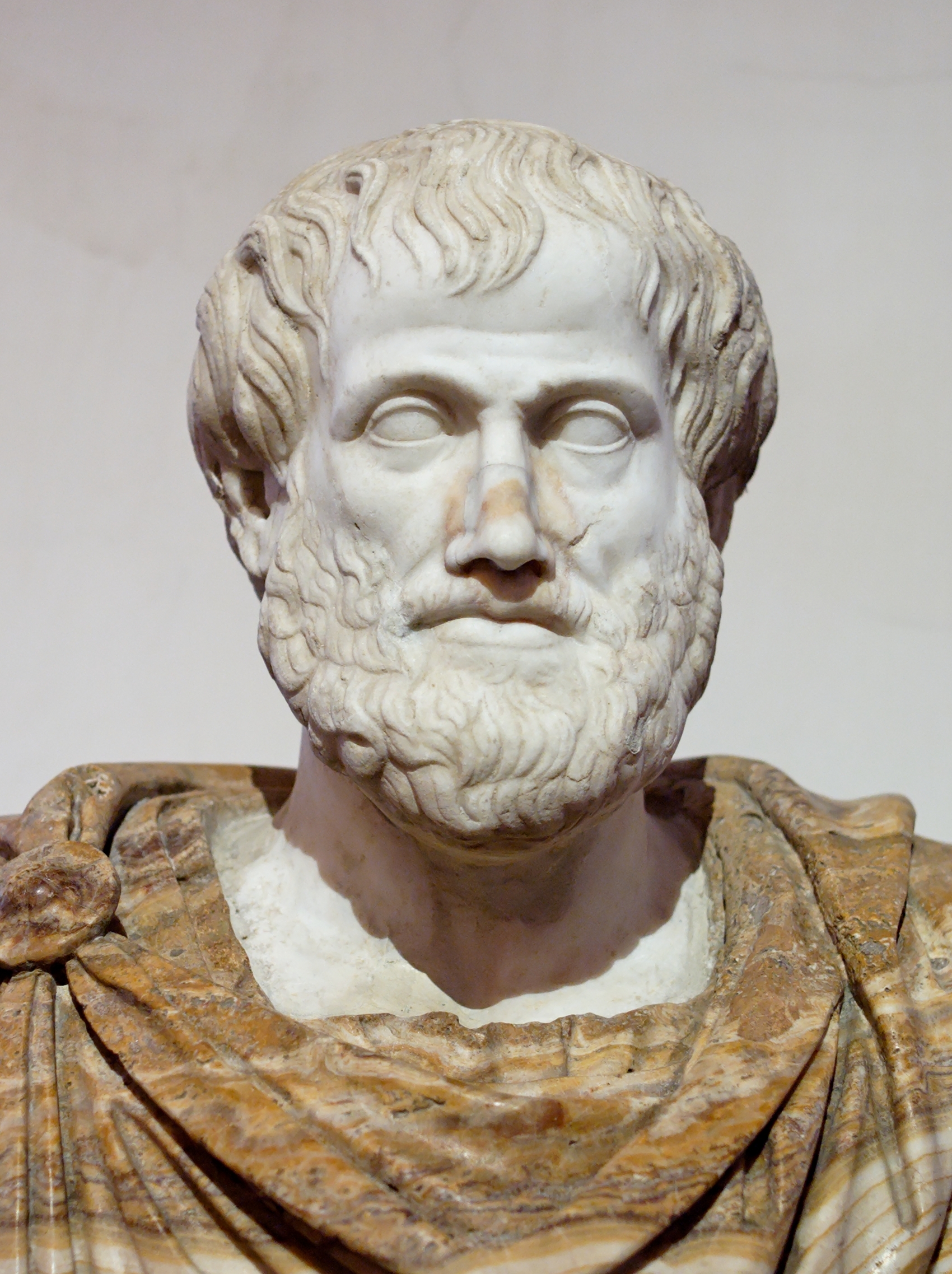
The question who is the father of biology is a Prelims staple and a general knowledge fixture. The answer, almost universally accepted, is Aristotle. The Greek philosopher (384 BCE to 322 BCE) is credited with founding the systematic study of living organisms through his treatises History of Animals, Parts of Animals and Generation of Animals. Nearly 2,400 years later, biology has split into more than thirty specialised branches, from cell biology and genetics to ecology and astrobiology.
This guide goes beyond the one-line answer. It traces why Aristotle earned the title, lists the fathers of the major biological sub-disciplines, maps the main branches of biology for UPSC Prelims and provides a comparative table of founders across allied sciences. Fact-based, source-backed and built for revision, it gives aspirants and general readers a single reference they can return to.
Quick Facts at a Glance
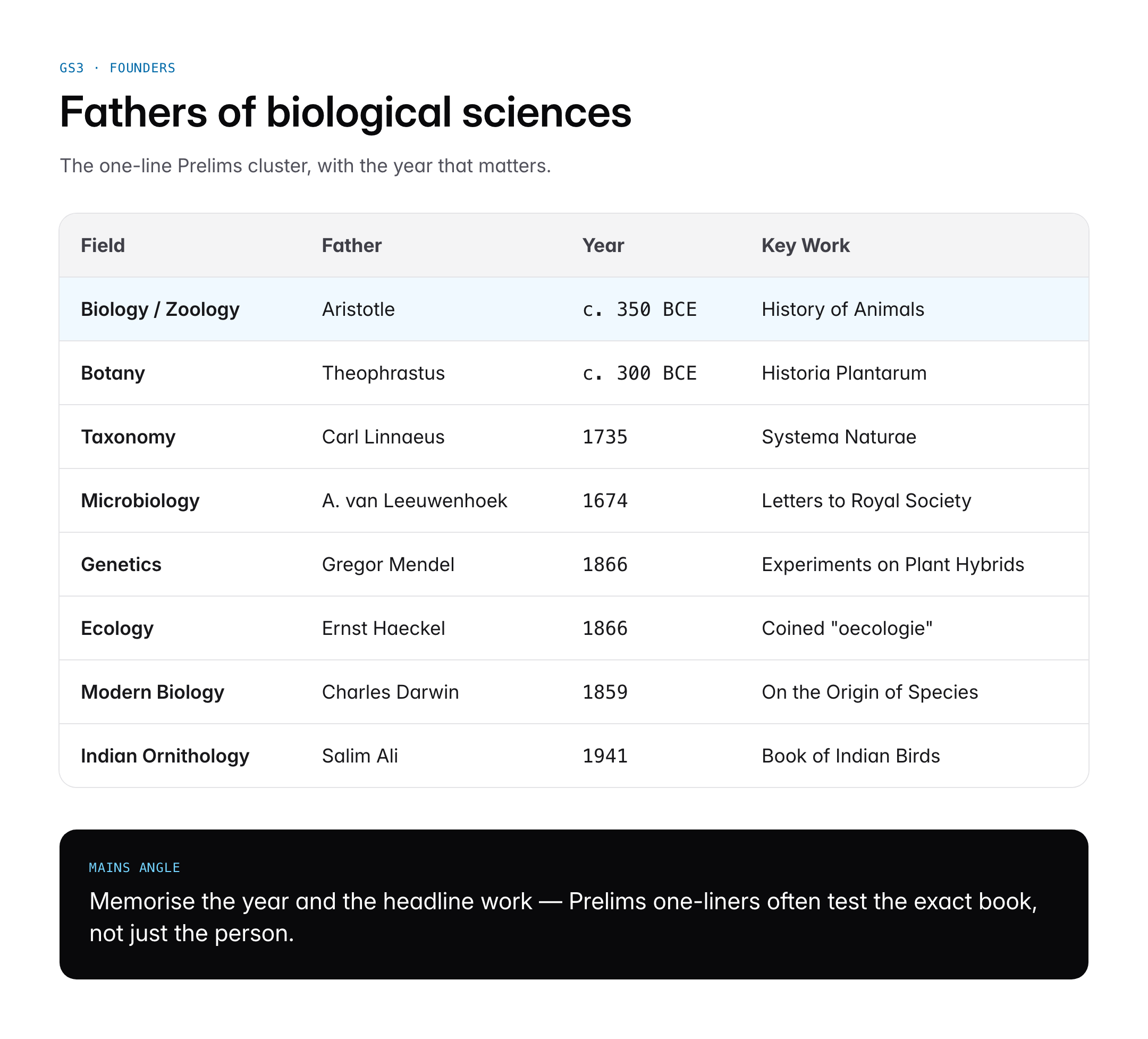
| Field | Father | Key Contribution |
|---|---|---|
| Biology | Aristotle | History of Animals, systematic classification of ~500 species |
| Modern Biology | Charles Darwin (often cited) | Theory of natural selection, On the Origin of Species, 1859 |
| Botany | Theophrastus | Historia Plantarum; student of Aristotle |
| Zoology | Aristotle | Classification of animals by common features |
| Genetics | Gregor Johann Mendel | Laws of inheritance, pea plant experiments, 1866 |
| Microbiology | Antonie van Leeuwenhoek | First to observe microorganisms via microscope |
| Taxonomy | Carl Linnaeus | Binomial nomenclature, Systema Naturae, 1735 |
| Ecology | Ernst Haeckel | Coined the term oecologie, 1866 |
Background and Historical Context
Aristotle was born in Stagira, Macedonia in 384 BCE and studied at Plato’s Academy in Athens. After Plato’s death he tutored the young Alexander the Great and later founded the Lyceum. While his philosophical work defined metaphysics, ethics and logic, roughly a quarter of his surviving writings describe living organisms. His three major biological treatises include descriptions of about 500 species, observed either first-hand or through informants in the eastern Mediterranean.
His most enduring contribution to biology was method. Aristotle insisted on direct observation, comparative anatomy and systematic classification. He grouped animals by shared characteristics such as whether they had blood (roughly equivalent to vertebrates and invertebrates), how they reproduced and where they lived. This scala naturae, or ladder of life, was the first known attempt to order life forms by structural complexity. Modern taxonomy by Linnaeus in 1735 was a direct descendant of this thinking.
Aristotle’s student Theophrastus (371 BCE to 287 BCE) is regarded as the father of botany for his two surviving botanical works, Historia Plantarum and De Causis Plantarum. Together the master and student founded zoology and botany, the two oldest branches of biology. The word biology itself was coined independently by Karl Friedrich Burdach in 1800 and popularised by Jean-Baptiste Lamarck in 1802, more than two millennia after Aristotle’s death.
Key Contributions of Aristotle
Systematic Observation
Aristotle broke from earlier Greek natural philosophers who relied on speculation. He dissected animals, watched chick embryos develop and documented the life cycles of bees, squid and fish. His account of the hectocotylus arm of the octopus, dismissed for centuries, was confirmed by naturalists only in the 19th century.
Scala Naturae — the Ladder of Life
Scala naturae arranged living beings from minerals at the bottom through plants, invertebrates, vertebrates and humans at the top. This idea influenced medieval European thought for nearly 1,800 years and formed the conceptual scaffold for later evolutionary theory.
Comparative Anatomy
Aristotle introduced the practice of comparing organs across species — a heart in fish, a heart in mammals — and looking for analogies and differences. This was the seed of modern comparative anatomy, later developed by Georges Cuvier in the 18th century.
Classification by Common Features
Aristotle grouped animals into those with blood and those without, equivalent to vertebrates and invertebrates. Within each group he used traits like reproduction, habitat and locomotion. Modern cladistics is more sophisticated, but the underlying logic is still Aristotelian.
Teleology in Biology
Teleology, the idea that organisms are structured for a purpose, is a controversial Aristotelian legacy. Darwin replaced purpose with natural selection in 1859, but teleological language still pervades biology teaching through phrases like the function of the heart or the purpose of the kidney.
Branches of Biology — Quick Reference
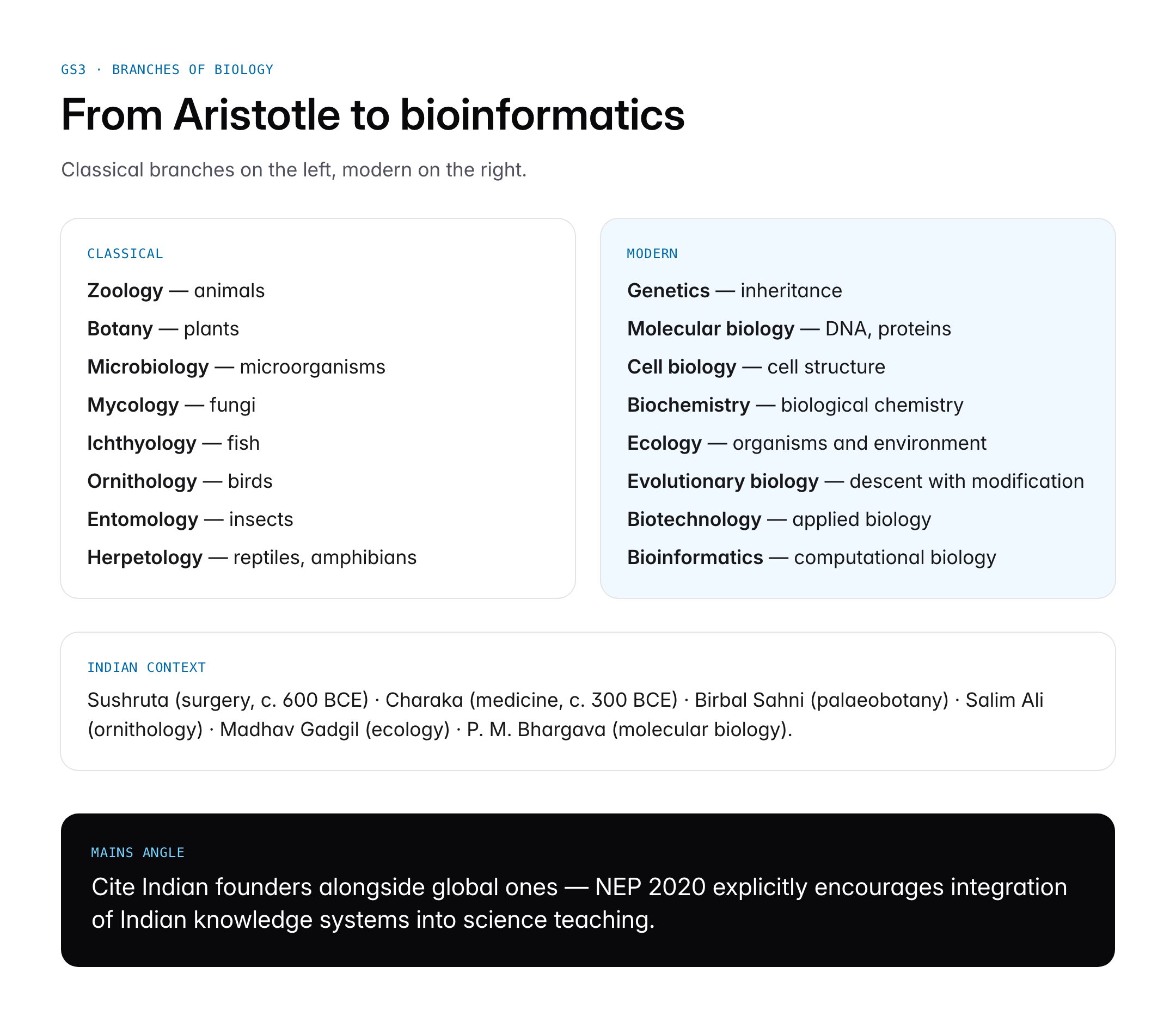
Classical Branches
- Zoology — the study of animals
- Botany — the study of plants
- Microbiology — the study of microorganisms
- Mycology — the study of fungi
- Ichthyology — the study of fish
- Ornithology — the study of birds
- Entomology — the study of insects
- Herpetology — the study of reptiles and amphibians
Modern Branches
- Genetics — heredity and variation
- Molecular biology — biological macromolecules and their interactions
- Cell biology — the cell as a unit of life
- Biochemistry — chemical processes within organisms
- Ecology — organisms and their environment
- Evolutionary biology — the origin and descent of species
- Biotechnology — applied biology and genetic engineering
- Bioinformatics — computational analysis of biological data
Significance for UPSC and General Knowledge
- The father of biology is a recurring Prelims one-liner across UPSC CSE, State PSCs and SSC
- The fathers of allied sciences (genetics, taxonomy, microbiology) form a standard factual cluster
- Understanding Aristotle’s methodology supports GS3 answers on the history and philosophy of science
- The branches of biology vocabulary underpins Prelims questions on biotechnology and health
- Names like Mendel, Darwin and Linnaeus reappear in Indian biology curricula and current affairs
Detailed Analysis — Founders across Biological Sciences
Every branch of biology has a commonly accepted founder. These attributions are never absolute, and academic historians often dispute them, but the traditional list is what Prelims questions test. Gregor Mendel, the Augustinian friar from Brno in the present-day Czech Republic, published his laws of inheritance in 1866 after eight years of experiments on pea plants in the monastery garden. His work was ignored until it was independently rediscovered by Hugo de Vries, Carl Correns and Erich von Tschermak in 1900.
Antonie van Leeuwenhoek, a Dutch cloth merchant with no formal scientific training, is the father of microbiology. His hand-ground lenses with magnifications up to 270x allowed him to observe bacteria, protozoa and red blood cells between 1674 and 1677. His letters to the Royal Society in London remain foundational documents in microbiology.
Carl Linnaeus, the Swedish botanist, gave biology its system of binomial nomenclature in Systema Naturae (1735). Every species is identified by a genus and a species name — Homo sapiens, Panthera tigris, Ficus religiosa. His hierarchy of kingdom, class, order, genus and species is still the backbone of modern taxonomy.
Ernst Haeckel, the German zoologist, coined the term oecologie in 1866, and is regarded as the father of ecology. His Kunstformen der Natur drawings influenced art and science in equal measure. In India, the development of ecological studies owes a great debt to Salim Ali (father of Indian ornithology) and Madhav Gadgil (pioneer of Indian ecology).
Hippocrates is often listed as the father of medicine, while Charaka and Sushruta are regarded as the fathers of Indian medicine and surgery respectively. T. H. Morgan is the father of experimental genetics, and James Watson and Francis Crick gave biology the structure of DNA in 1953.
Comparative Perspective
| Field | Western Father | Indian Equivalent |
|---|---|---|
| Medicine | Hippocrates | Charaka |
| Surgery | Not a single father | Sushruta |
| Botany | Theophrastus | Birbal Sahni (palaeobotany) |
| Zoology | Aristotle | M. S. Swaminathan (agricultural science) |
| Ornithology | John James Audubon (USA) | Salim Ali |
| Genetics | Gregor Mendel | Pushpa Mittra Bhargava (molecular biology in India) |
The Indian tradition is less hierarchical than the Western and tends to acknowledge many founders across ancient, medieval and modern periods. Aryabhata in astronomy, Sushruta in surgery and Charaka in medicine belong to the ancient Indian knowledge systems that the NEP 2020 now encourages schools and universities to integrate into their curricula.
Controversies and Debates
Attributing a science to a single father is a convenient shorthand, but historians of science argue it flattens a much messier reality. Aristotle’s biology included factual errors — he believed that eels spontaneously generated from mud — that persisted for centuries. The concept of spontaneous generation was finally disproved by Louis Pasteur in 1862.
Mendel’s work, too, has been scrutinised. The statistician Ronald Fisher in 1936 suggested that Mendel’s results were too close to theoretical ratios, hinting at confirmation bias or selective reporting. Most historians today accept Mendel’s integrity, but the debate is a reminder that even foundational experiments are subject to reanalysis.
The absence of women in the classical list of biology’s fathers is itself a criticism. Rosalind Franklin’s X-ray crystallography was central to the DNA double helix, yet credit and the Nobel Prize went to Watson, Crick and Wilkins. Barbara McClintock discovered transposable genetic elements in maize but was largely ignored for decades before winning the Nobel Prize in 1983. A modern Prelims answer should mention these corrections alongside the traditional fathers.
Prelims Pointers
- Aristotle, Greek philosopher (384 BCE to 322 BCE), is the father of biology and zoology
- Theophrastus, student of Aristotle, is the father of botany
- Charles Darwin is often cited as the father of modern biology or evolutionary biology
- Gregor Mendel is the father of genetics, publishing his laws in 1866
- Antonie van Leeuwenhoek is the father of microbiology
- Carl Linnaeus gave biology the system of binomial nomenclature in Systema Naturae 1735
- Ernst Haeckel coined the term ecology in 1866
- The word biology was popularised by Lamarck in 1802
- Louis Pasteur disproved spontaneous generation in 1862
- Watson and Crick published the structure of DNA in April 1953
- Salim Ali is the father of Indian ornithology
- Sushruta and Charaka are the Indian fathers of surgery and medicine
Mains Practice Questions
- The history of biology is the history of ideas about life. Discuss with reference to the contributions of Aristotle, Mendel and Darwin.
- Explain each figure’s foundational contribution
- Identify the method they introduced (observation, experiment, theory)
- Evaluate their combined impact on modern biology
- Indian contributions to the biological sciences deserve greater recognition in school and university curricula. Discuss in the context of NEP 2020.
- List notable Indian biologists including Sushruta, Charaka and Salim Ali
- Examine the integration of Indian knowledge systems into NEP 2020
- Suggest reforms for equitable representation in textbooks
Conclusion
Aristotle remains the father of biology for a simple reason. He was the first thinker to combine careful observation, systematic comparison and formal classification into what we now call a scientific method for living organisms. Every modern biologist, from Mendel to Crick to contemporary genome sequencers, stands on that foundation.
Yet the full picture is richer. Botany has its father in Theophrastus, genetics in Mendel, microbiology in Leeuwenhoek, taxonomy in Linnaeus, ecology in Haeckel. A well-prepared aspirant remembers not just the one-line Prelims answer, but the network of founders that built biology into the vast, branching discipline it is today.
Frequently Asked Questions
Who is the father of biology?
Aristotle, the Greek philosopher who lived from 384 BCE to 322 BCE, is universally regarded as the father of biology. He authored History of Animals, Parts of Animals and Generation of Animals, describing about 500 species and introducing systematic classification, comparative anatomy and the scala naturae ladder of life that influenced biological thought for nearly 1,800 years.
Why is Aristotle called the father of biology for UPSC purposes?
UPSC Prelims frequently tests founders of scientific disciplines. Aristotle is the standard answer for the father of biology because he was the first to apply systematic observation and classification to living organisms. His method of grouping animals by shared features — with blood or without — foreshadowed modern taxonomy and is referenced in both NCERT Class 11 Biology and the Class 9 Science textbook.
How is Aristotle related to Theophrastus, the father of botany?
Theophrastus was Aristotle’s student at the Lyceum and succeeded him as its head. While Aristotle focused on animals and is called the father of zoology, Theophrastus wrote Historia Plantarum and De Causis Plantarum, the first systematic works on plants, and is therefore the father of botany. Together, the master and student founded the two oldest branches of biology.
Who is the father of modern biology?
Charles Darwin is commonly called the father of modern biology or evolutionary biology. His 1859 book On the Origin of Species introduced the theory of natural selection, replacing Aristotelian teleology with a mechanistic explanation of adaptation and diversification. Some sources also credit Louis Pasteur or Gregor Mendel with this title depending on the branch emphasised.
Who is the father of genetics?
Gregor Johann Mendel, an Augustinian friar working at the monastery of St. Thomas in Brno, is the father of genetics. Between 1856 and 1863 he conducted cross-breeding experiments on pea plants, from which he derived the laws of segregation and independent assortment. His 1866 paper was ignored until rediscovery in 1900 by de Vries, Correns and Tschermak.
Who is the father of microbiology?
Antonie van Leeuwenhoek, a Dutch cloth merchant and self-taught scientist, is the father of microbiology. Using hand-ground lenses that achieved up to 270x magnification, he became the first person to observe bacteria, protozoa and red blood cells between 1674 and 1677. His letters to the Royal Society of London remain foundational microbiology documents.
What are the main branches of biology?
Biology has classical branches — zoology, botany, microbiology, mycology, entomology, ornithology, ichthyology — and modern branches including genetics, molecular biology, cell biology, biochemistry, ecology, evolutionary biology, biotechnology and bioinformatics. For UPSC Prelims, aspirants should know the definition, scope and a famous scientist associated with each branch.
Who is the father of Indian ornithology?
Salim Ali (1896 to 1987) is the father of Indian ornithology. His Book of Indian Birds, first published in 1941, introduced generations of Indians to systematic birdwatching. He led the first Bombay Natural History Society bird surveys and was awarded the Padma Vibhushan in 1976. The Salim Ali Centre for Ornithology and Natural History in Coimbatore carries his name.
Tell Google you want more of this.
Add Anantam IAS as a preferred sourceOne tap, and this site shows up more often in your own Top Stories, AI Overviews and AI Mode. Remove it any time.