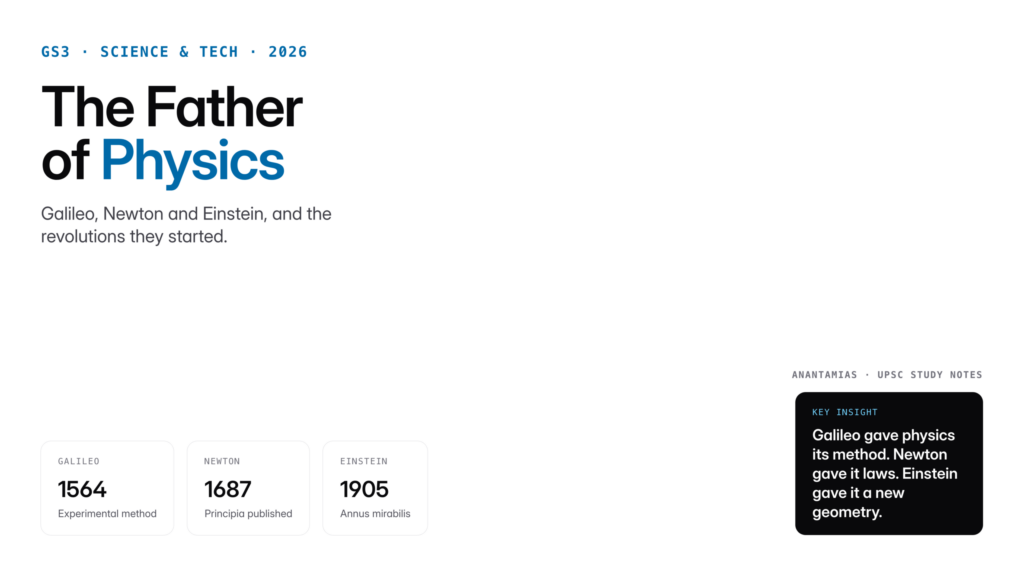
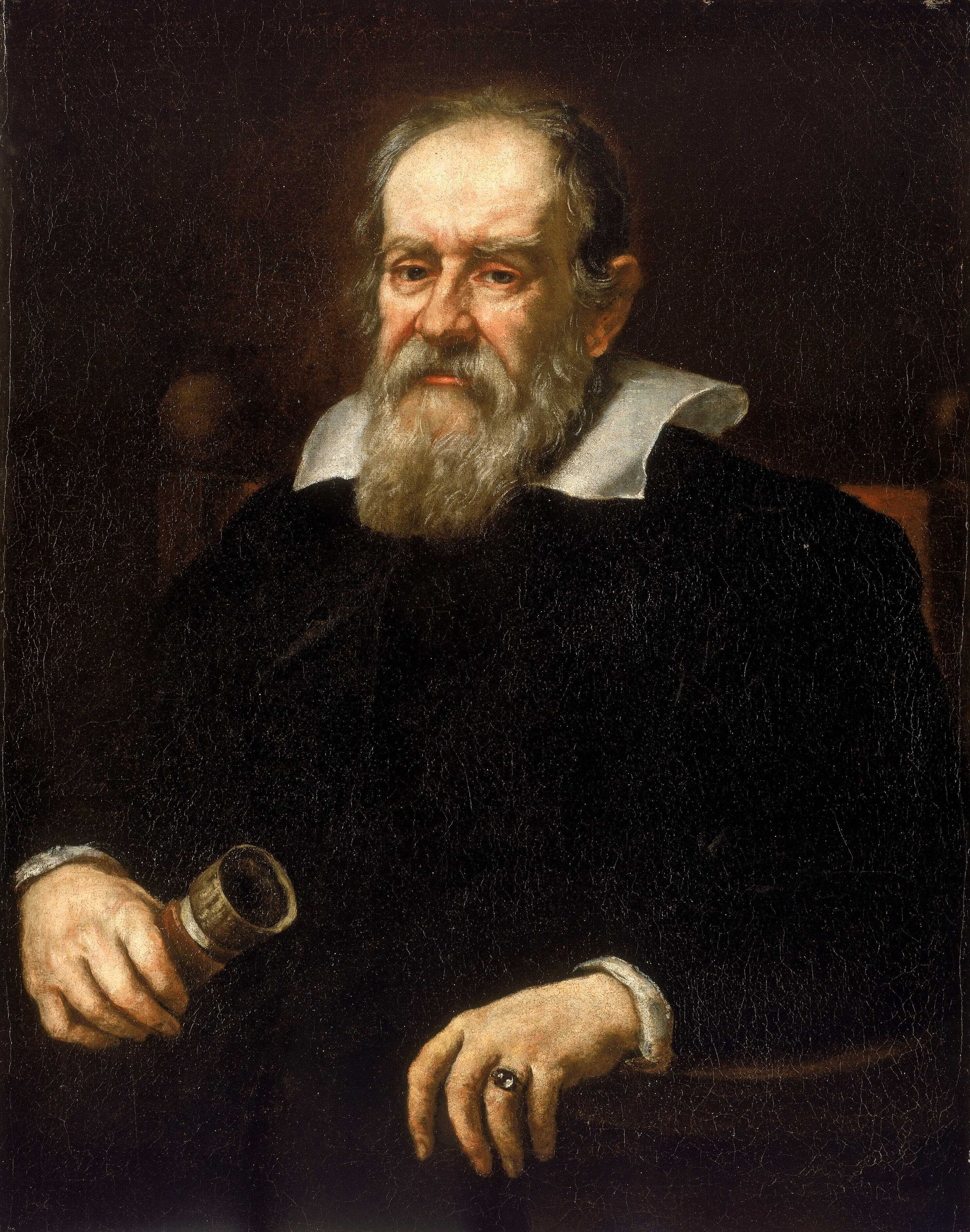
Galileo Galilei is most often called the father of modern physics. If a general-knowledge question asks for one “father of physics,” Galileo is usually the expected answer because he joined controlled experiment, measurement and mathematics in the study of motion.
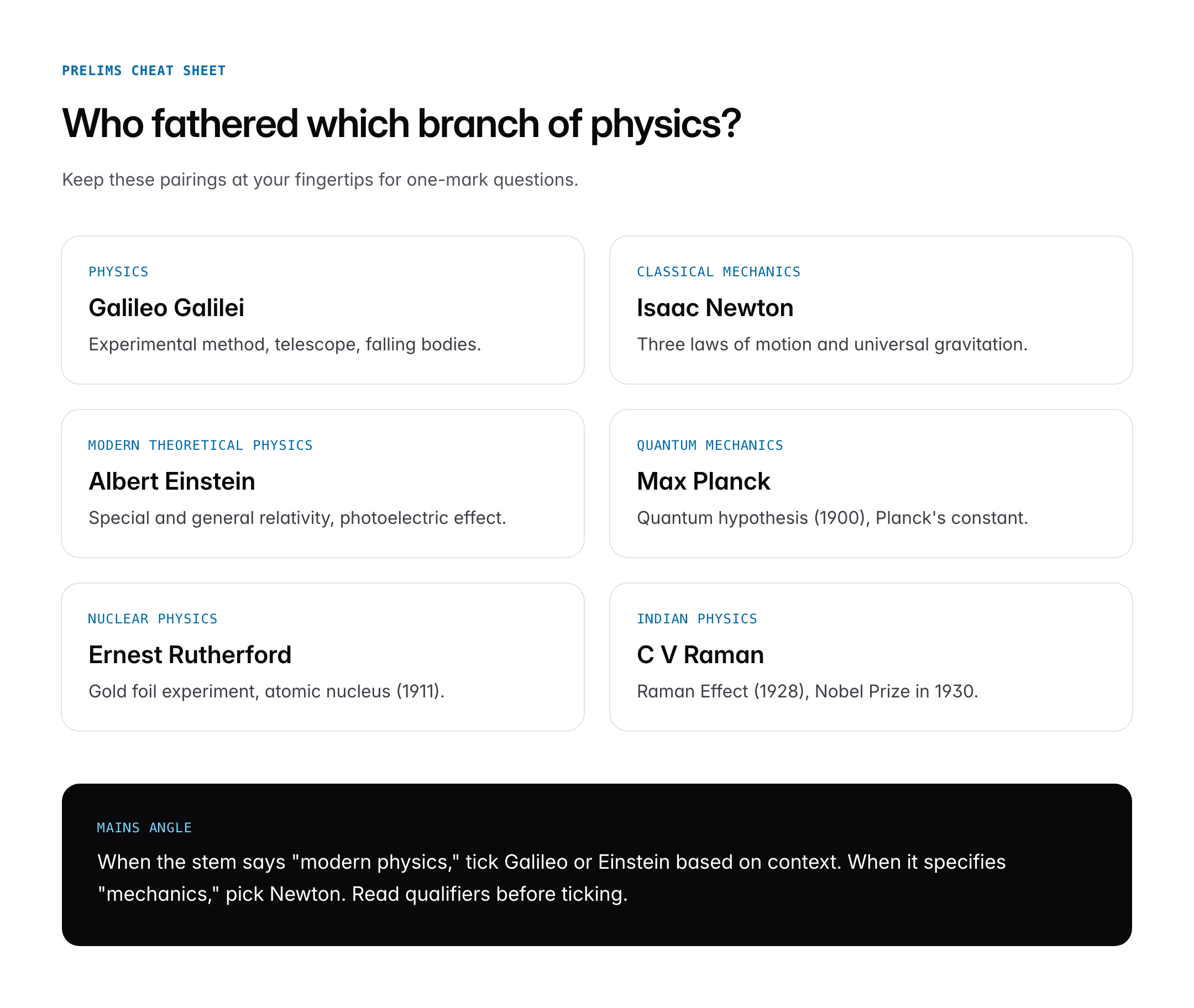
Isaac Newton is more precisely associated with classical mechanics, while Albert Einstein is associated with modern theoretical physics and relativity. These are conventional historical labels, not official scientific titles, so the wording of the question matters.
The safest exam response is therefore: Galileo for modern experimental physics, Newton for classical mechanics, and Einstein for relativity and twentieth-century theoretical physics. The sections below explain the contribution behind each label.
Quick Facts at a Glance
| Question | Most Accepted Answer | Reason |
|---|---|---|
| Father of Physics | Galileo Galilei | Introduced experimental method |
| Father of Modern Physics | Galileo Galilei / Albert Einstein | Telescope observations / relativity |
| Father of Classical Mechanics | Isaac Newton | Laws of motion, universal gravitation |
| Father of Modern Theoretical Physics | Albert Einstein | Special and general relativity |
| Father of Indian Physics | C V Raman | Raman Effect, Nobel Prize 1930 |
| Father of Quantum Mechanics | Max Planck | Quantum hypothesis, 1900 |
| Father of Nuclear Physics | Ernest Rutherford | Atomic nucleus discovery, 1911 |
Background and Historical Context
Physics as a systematic discipline began in ancient Greece. Aristotle attempted a complete theory of motion in the fourth century BCE, but his framework was largely qualitative and tied to metaphysics. For nearly two thousand years his ideas dominated European thought. Indian scholars in the same period, including Kanada with his atomistic school of Vaisheshika, offered independent speculations on matter, yet they too lacked experimental verification.
The real shift came during the European Renaissance and Scientific Revolution, between the sixteenth and seventeenth centuries. Nicolaus Copernicus placed the Sun at the centre of the solar system in 1543, and Johannes Kepler published his three laws of planetary motion between 1609 and 1619. These were remarkable, but still largely mathematical descriptions. What was missing was a method that combined careful experiment with mathematical reasoning.
Galileo Galilei filled that gap. Born in Pisa in 1564, he rolled bronze balls down inclined planes, timed pendulums with his pulse, and pointed an improved telescope at Jupiter. His insistence that nature must be interrogated through repeatable experiment gave birth to what we now call the scientific method. Isaac Newton, born the year Galileo died in 1642, built on this foundation to unify terrestrial and celestial mechanics. Two centuries later Albert Einstein dissolved the Newtonian picture of absolute space and time, opening the door to relativity and the quantum era. Each figure stands on the shoulders of the one before, which is why the single honorific of “father of physics” is distributed across three towering names.
Key Contributions
Galileo Galilei and the Birth of Modern Physics
Galileo Galilei (1564-1642) is most commonly cited as the father of physics. He formulated the law of falling bodies, showing that objects of different masses fall at the same rate in a vacuum, a direct challenge to Aristotle. He studied projectile motion as a combination of uniform horizontal and accelerated vertical motion, and he described the isochronism of the pendulum.
His telescopic observations of 1610, published in Sidereus Nuncius, revealed the four largest moons of Jupiter, the phases of Venus and craters on the Moon. These findings supported the Copernican heliocentric model and eventually led to his trial by the Roman Inquisition in 1633. More than the data, his lasting gift was the method itself, the insistence on experiment, measurement and mathematical expression.
Isaac Newton and Classical Mechanics
Isaac Newton (1643-1727) is the father of classical mechanics. His Philosophiae Naturalis Principia Mathematica, published in 1687, set out the three laws of motion and the universal law of gravitation. He showed that the same force pulling an apple to the ground holds the Moon in orbit.
Newton also developed calculus independently of Gottfried Leibniz, split white light into its spectrum using a prism, and designed the first working reflecting telescope. His framework ruled physics for over two hundred years and still underlies engineering, space travel and everyday mechanics.
Albert Einstein and Modern Physics
Albert Einstein (1879-1955) redefined physics in the twentieth century. In his annus mirabilis of 1905 he published four papers covering the photoelectric effect, Brownian motion, special relativity, and the mass-energy equivalence E = mc squared. His 1915 theory of general relativity reshaped our understanding of gravity as curvature of spacetime.
Einstein received the Nobel Prize in Physics in 1921, not for relativity but for his explanation of the photoelectric effect, which was a cornerstone of quantum theory. His work continues to guide astrophysics, GPS technology and cosmology.
The Indian Contribution
C V Raman is celebrated as the father of Indian physics. His discovery of the Raman Effect in 1928 earned him the Nobel Prize in 1930. Other giants include Satyendra Nath Bose, whose work with Einstein gave us Bose-Einstein statistics and the boson family of particles, and Homi Jehangir Bhabha, the architect of India’s nuclear programme.
Significance for UPSC and General Knowledge
- GS Paper 3 covers Science and Technology, including the evolution of scientific thought and contributions of Indian scientists.
- Prelims regularly asks who is called the father of a particular field, making this cluster high yield.
- Understanding the scientific method helps answer Mains questions on innovation ecosystems and research policy.
- Raman, Bose, Bhabha and Sarabhai link directly to India’s space and atomic energy programmes.
- Essay topics on science and society often draw on Galileo versus the Church and Einstein’s pacifism.
- General Studies interview rounds test conceptual clarity on classical versus modern physics.
Detailed Analysis: Classical Mechanics to Modern Physics
The arc from Galileo to Einstein is a case study in how paradigms shift. Galileo replaced philosophical speculation with measurement. Newton synthesised those measurements into universal laws that worked for everything from cannonballs to comets. For two hundred years physics looked complete. Then small cracks appeared. The orbit of Mercury did not quite match Newtonian predictions. The speed of light stubbornly stayed the same regardless of the observer. Blackbody radiation produced absurd answers when treated classically.
Max Planck resolved the blackbody problem in 1900 by proposing that energy came in discrete packets or quanta. Einstein extended the idea to light in 1905, launching quantum theory. The same year, his special theory of relativity replaced absolute time with a spacetime where simultaneity depended on the observer. In 1915 his general theory recast gravity as geometry. Within two decades Werner Heisenberg, Erwin Schrodinger, Niels Bohr, Paul Dirac and Satyendra Nath Bose built the full machinery of quantum mechanics.
Indian physics grew along this timeline. Jagadish Chandra Bose demonstrated wireless transmission in Kolkata in 1895, before Marconi. C V Raman’s spectroscopic breakthrough of 1928 showed that frontier physics could be done with modest equipment. Meghnad Saha’s ionisation equation of 1920 became essential to astrophysics. Homi Bhabha founded the Tata Institute of Fundamental Research in 1945 and the Department of Atomic Energy in 1954. Vikram Sarabhai launched the Indian space programme. Today, Indian scientists contribute to LIGO, the Large Hadron Collider and ISRO’s astronomy missions, continuing a lineage that began with Galileo’s first telescope.
Comparative Perspective
| Parameter | Galileo | Newton | Einstein |
|---|---|---|---|
| Era | 1564-1642 | 1643-1727 | 1879-1955 |
| Core contribution | Experimental method, telescope | Laws of motion, gravitation | Relativity, photoelectric effect |
| Branch founded | Modern physics | Classical mechanics | Modern theoretical physics |
| Key work | Sidereus Nuncius (1610) | Principia (1687) | Relativity papers (1905, 1915) |
| Honour | Tried by Inquisition | Knighted 1705 | Nobel 1921 |
Galileo supplied the method, Newton supplied the synthesis, and Einstein supplied the revolution. No single name captures all three roles, which is why UPSC answer keys often accept Galileo as the default but mark Newton and Einstein correct when the question specifies classical or modern theoretical physics respectively.
Controversies and Debates
The title “father of physics” is contested precisely because physics itself is a cumulative enterprise. Purists argue that calling Galileo the father of physics ignores Archimedes, who worked out statics and hydrostatics in the third century BCE. Others push the title backward to Aristotle for founding the very idea of natural philosophy.
There are cultural debates as well. Indian and Islamic historians point out that Aryabhata, Brahmagupta, Alhazen and Al-Biruni made measurable advances centuries before the European Renaissance. Alhazen’s Book of Optics around 1021 CE anticipated the experimental method that Galileo made famous. Recognising these contributions does not diminish Galileo, but it complicates the habit of Western-centric founding myths.
A final debate concerns Einstein and the modern label. Some physicists prefer to call Einstein the father of modern physics because relativity and quantum theory define the twentieth century picture. Others reserve “modern” for Galileo because he inaugurated the method on which everything else rests. UPSC keys have accepted both at different times, which is why the answer depends on the qualifier used in the question stem.
Prelims Pointers
- Galileo Galilei is most often called the father of physics and of modern physics.
- Newton published the Principia in 1687, setting out three laws of motion.
- Einstein’s annus mirabilis was 1905, producing four landmark papers.
- E equals m c squared expresses mass-energy equivalence.
- Max Planck proposed the quantum hypothesis in 1900.
- Ernest Rutherford discovered the atomic nucleus in 1911.
- C V Raman won the Nobel Prize in 1930 for the Raman Effect.
- Satyendra Nath Bose is honoured in the word boson.
- Homi Bhabha founded TIFR in 1945 and is called the father of Indian nuclear programme.
- Vikram Sarabhai is called the father of the Indian space programme.
- Galileo’s telescope observations supported the Copernican model.
- Einstein received the Nobel Prize in 1921 for the photoelectric effect.
Mains Practice Questions
- Trace the evolution of physics from Galileo to Einstein and examine how shifts in methodology shaped scientific progress. (250 words)
- Note Galileo’s experimental turn and Newton’s synthesis
- Discuss the twin revolutions of relativity and quantum theory
- Link methodological shifts to technology and policy outcomes
- Evaluate the contribution of Indian scientists to twentieth century physics and assess how this legacy informs current science policy. (250 words)
- Cover Raman, Bose, Saha, Bhabha and Sarabhai
- Connect to TIFR, ISRO and DAE institutions
- Suggest reforms for research funding and innovation
Conclusion
The father of physics question resists a single answer because physics itself is the cumulative work of countless minds across civilisations. Galileo gave it method, Newton gave it laws, Einstein gave it a new geometry of space and time. For UPSC purposes, the default answer is Galileo, but a well prepared candidate knows when Newton or Einstein is the correct fit.
Beyond trivia, the question is an invitation to think about how knowledge grows. Each generation inherits a framework, tests it against observation, and either refines it or replaces it. That discipline, more than any single name, is the true father of physics. For aspirants, mastering this history builds both Prelims accuracy and Mains depth, and it connects the abstract world of science to the very concrete project of national development.
Frequently Asked Questions
Who is the father of physics?
Galileo Galilei, the Italian astronomer and physicist who lived from 1564 to 1642, is most widely considered the father of physics. He pioneered the experimental method, established the laws of falling bodies and projectile motion, and used the telescope to confirm the Copernican heliocentric model, giving physics its scientific foundation.
Why is the father of physics important for UPSC?
UPSC Prelims frequently asks which scientist founded a particular field, and GS Paper 3 covers the history and contribution of science. Knowing that Galileo is the father of physics, Newton of classical mechanics, Einstein of modern theoretical physics and C V Raman of Indian physics ensures quick, accurate answers and enriches essay and interview responses.
How is the father of physics related to the scientific method?
Galileo’s claim to the title rests almost entirely on his role in founding the scientific method. By combining controlled experiments with mathematical analysis, he replaced Aristotelian speculation with testable hypotheses. This approach of observation, measurement and mathematical modelling defines physics and all natural sciences today.
Who is called the father of modern physics?
Galileo Galilei is traditionally called the father of modern physics for his experimental turn. Many textbooks, however, also apply the title to Albert Einstein because his theories of special and general relativity, along with the photoelectric effect, reshaped twentieth century physics. UPSC accepts both answers depending on the phrasing.
Who is the father of Indian physics?
Sir Chandrasekhara Venkata Raman is regarded as the father of Indian physics. In 1928 he discovered the scattering effect that bears his name, the Raman Effect, and received the Nobel Prize in Physics in 1930, becoming the first Asian scientist to win a Nobel in the sciences.
What is Newton’s main contribution to physics?
Isaac Newton formulated the three laws of motion and the universal law of gravitation, published in his 1687 work, the Principia. He also developed calculus, explained the spectrum of white light with a prism, and built the first reflecting telescope, making him the father of classical mechanics.
What makes Einstein a father of modern physics?
Albert Einstein transformed physics in 1905 with papers on the photoelectric effect, Brownian motion, special relativity and mass-energy equivalence. His 1915 general theory of relativity recast gravity as curvature of spacetime. These insights ended absolute Newtonian space and time and launched modern cosmology.
Who is the father of quantum mechanics and nuclear physics?
Max Planck is called the father of quantum mechanics for proposing in 1900 that energy is emitted in discrete packets called quanta. Ernest Rutherford is the father of nuclear physics, having discovered the atomic nucleus in 1911 through his gold foil experiment with alpha particles.
Tell Google you want more of this.
Add Anantam IAS as a preferred sourceOne tap, and this site shows up more often in your own Top Stories, AI Overviews and AI Mode. Remove it any time.