
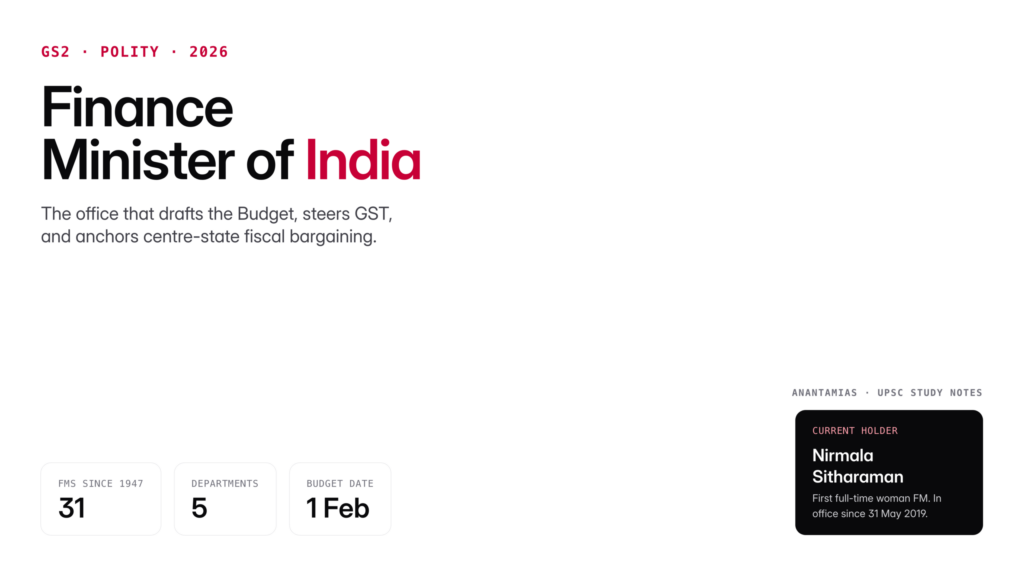
As of 2026, the Finance Minister of India is Nirmala Sitharaman, who has held the portfolio since 31 May 2019 under Prime Minister Narendra Modi. She is the first full-time woman Finance Minister in India’s history, and in July 2025 became the longest continuous-serving Finance Minister of India (surpassing C. D. Deshmukh). In February 2026 she presented her ninth consecutive Union Budget, a national record.
Introduction
The Finance Minister of India is one of the most consequential posts in the Union Cabinet. The office manages the country’s fiscal policy, presents the Union Budget every February, oversees public debt, taxation, banking regulation and financial sector supervision, and negotiates with multilateral institutions from the IMF to the Asian Development Bank. As of 2026, Nirmala Sitharaman holds the portfolio, making her the first full-time woman Finance Minister in independent India’s history, having assumed office on 31 May 2019.
This guide surveys the office from every UPSC angle: the constitutional basis, the list of all Finance Ministers from R. K. Shanmukham Chetty in 1947 to the present day, the internal structure of the Ministry of Finance’s five departments, the Budget-making timeline, and the debates around finance ministry autonomy, RBI relations and fiscal federalism.
Quick Facts at a Glance
| Parameter | Detail |
|---|---|
| Current Finance Minister (2026) | Nirmala Sitharaman |
| First Finance Minister | R. K. Shanmukham Chetty (1947-1949) |
| Constitutional position | Union Cabinet Minister |
| Ministry | Ministry of Finance, Government of India |
| Departments under FM | 5 |
| Budget presentation date | 1 February |
| First woman FM (full-time) | Nirmala Sitharaman |
| First woman FM (additional charge) | Indira Gandhi (1970-71) |
| Longest continuous-serving FM | Nirmala Sitharaman (since 2019; surpassed C. D. Deshmukh in July 2025) |
| Most Union Budgets presented | Morarji Desai (10); Nirmala Sitharaman (9 consecutive, a record) |
| FMs who became PM | 3 (Morarji Desai, Charan Singh, Manmohan Singh) |
| Budget consolidated from | 2017 (Railway Budget merged) |
| Headquarters | North Block, New Delhi |
Background and Historical Context
The Finance portfolio has roots in the colonial Imperial Finance Member of the Viceroy’s Executive Council, a post held by figures such as James Wilson, founder of The Economist, who presented the first Indian Budget on 18 February 1860. Post-independence, R. K. Shanmukham Chetty presented India’s first Union Budget on 26 November 1947, covering just seven and a half months of 1947-48. His successor John Mathai presented the first full-year Budget in 1948-49.
The Ministry of Finance has seen several landmark Finance Ministers shape the Indian economy. C. D. Deshmukh (1950-56), the first Indian Governor of the RBI before becoming FM, drove the first two Five Year Plans. T. T. Krishnamachari shepherded the Life Insurance Corporation Act 1956. Morarji Desai held the portfolio in two spells under Nehru and Indira Gandhi. Y. B. Chavan managed the 1971-74 oil shock years. V. P. Singh (1984-87) led a crackdown on tax evasion that made headlines.
The pivotal moment came in 1991 when Dr. Manmohan Singh, as FM under P. V. Narasimha Rao, presented the 24 July 1991 Budget that launched economic liberalisation, dismantled the industrial licensing raj, devalued the rupee and invited foreign investment. P. Chidambaram followed with the 1997 “Dream Budget” that slashed direct tax rates. Yashwant Sinha and Jaswant Singh under the NDA between 1998 and 2004 pushed the Fiscal Responsibility and Budget Management (FRBM) Act 2003. Pranab Mukherjee, Arun Jaitley, Piyush Goyal (additional charge) and Nirmala Sitharaman have held the post in the subsequent decades.
Key Features of the Office
Constitutional Basis
The Finance Minister is a Union Cabinet Minister appointed by the President on the advice of the Prime Minister under Article 75 of the Constitution. The office is not separately named in the Constitution, but Article 112 requires the Annual Financial Statement (Union Budget) to be laid before Parliament, which by convention is presented by the Finance Minister. Article 110 empowers the FM to certify Money Bills. Article 280 brings the FM into the constitution of the Finance Commission, and Article 266 gives the Ministry of Finance custody of the Consolidated Fund of India.
The Five Departments
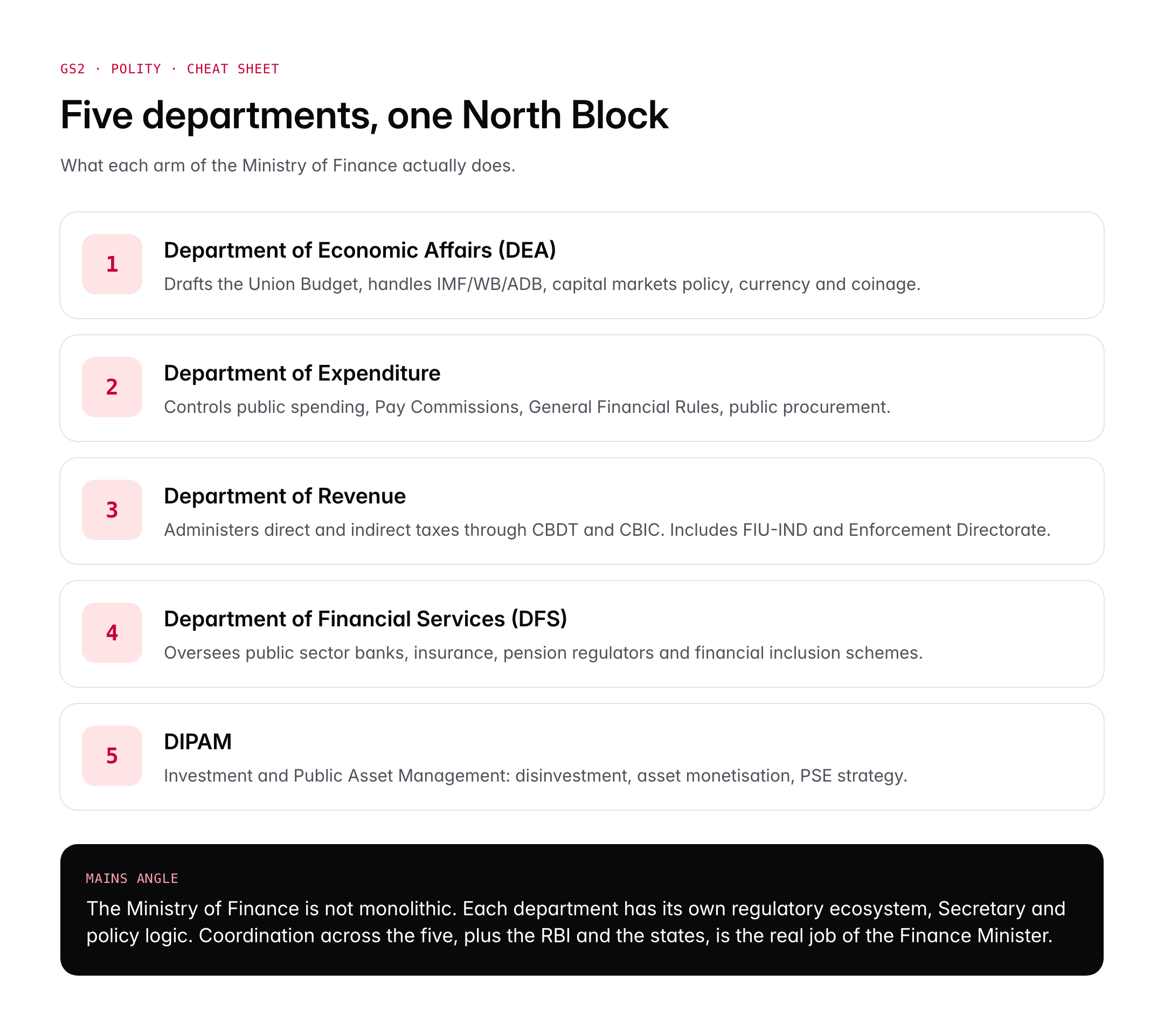
The Ministry of Finance is organised into five departments, each headed by a Secretary to the Government of India:
- Department of Economic Affairs (DEA) — drafts the Union Budget, handles multilateral institutions, capital markets policy, currency and coinage.
- Department of Expenditure — controls public expenditure, pay commissions, GFR rules, public procurement policy.
- Department of Revenue — administers direct and indirect taxes through CBDT and CBIC, plus drugs control, FIU-IND and Enforcement Directorate.
- Department of Financial Services (DFS) — oversees public sector banks, insurance companies, pension regulators and financial inclusion schemes.
- Department of Investment and Public Asset Management (DIPAM) — manages disinvestment, asset monetisation and public sector enterprise strategy.
Core Functions
The Finance Minister’s day-to-day functions span five broad heads:
- Budget preparation and presentation every 1 February, including macro-fiscal projections, tax proposals and expenditure ceilings.
- Tax policy through CBDT (direct) and CBIC (indirect), including GST Council representation.
- Debt management alongside the RBI via the Public Debt Management Cell.
- Financial sector oversight of public sector banks, LIC, SBI, RBI policy coordination and capital markets.
- External finance through negotiations with the IMF, World Bank, ADB, AIIB, New Development Bank and bilateral credit lines.
Powers and Tools
- Chairs the GST Council alongside state FMs (Article 279A).
- Moves Money Bills and Finance Bills in Parliament.
- Signs the Union Budget, Economic Survey and Medium-term Fiscal Policy Statement.
- Authorises expenditure against the Consolidated Fund through demands for grants.
- Represents India at G20 Finance Ministers and Central Bank Governors meetings.
Significance for UPSC and General Knowledge
- The FM post is a canonical GS2 polity topic covering the executive, federal finance and parliamentary procedure.
- The list of FMs doubles as modern economic history (1991 reforms, 2003 FRBM, 2017 GST rollout, 2020 Atmanirbhar package).
- The Budget presented by the FM is the primary GS3 economy input every year.
- Finance Commission interactions illustrate centre-state fiscal federalism (GS2).
- FMs like Manmohan Singh and Chidambaram link to India’s liberalisation narrative.
- The RBI-FM relationship, including the 2018 Section 7 episode under Urjit Patel, is a ready GS3 governance case study.
List of Finance Ministers of India
India has had 31 individuals hold the Finance portfolio since 1947, counting additional charges and interim arrangements.
| No. | Finance Minister | Tenure | Party/Govt |
|---|---|---|---|
| 1 | R. K. Shanmukham Chetty | 1947-1949 | INC |
| 2 | John Mathai | 1949-1950 | INC |
| 3 | C. D. Deshmukh | 1950-1956 | INC |
| 4 | T. T. Krishnamachari | 1956-1958, 1964-66 | INC |
| 5 | Morarji Desai | 1958-1964, 1967-1969 | INC |
| 6 | Sachindra Chaudhuri | 1966-1967 | INC |
| – | Indira Gandhi (add. charge) | 1969-1971 | INC |
| 7 | Y. B. Chavan | 1971-1975 | INC |
| 8 | C. Subramaniam | 1975-1977 | INC |
| 9 | H. M. Patel | 1977-1979 | Janata |
| 10 | Charan Singh | 1979 | Janata |
| 11 | R. Venkataraman | 1980-1982 | INC |
| 12 | Pranab Mukherjee | 1982-1984, 2009-2012 | INC |
| 13 | V. P. Singh | 1984-1987 | INC |
| 14 | Rajiv Gandhi (add. charge) | 1987 | INC |
| 15 | N. D. Tiwari | 1987-1988 | INC |
| 16 | S. B. Chavan | 1988-1989 | INC |
| 17 | Madhu Dandavate | 1989-1990 | Janata Dal |
| 18 | Yashwant Sinha | 1990-1991, 1998-2002 | Samata/BJP |
| 19 | Manmohan Singh | 1991-1996 | INC |
| 20 | Jaswant Singh | 1996, 2002-2004 | BJP |
| 21 | P. Chidambaram | 1996-1998, 2004-2008, 2012-2014 | INC |
| 22 | I. K. Gujral (add. charge) | 1996 | Janata Dal |
| 23 | Manmohan Singh (PM in charge) | 2008-2009 | INC |
| 24 | Arun Jaitley | 2014-2019 | BJP |
| 25 | Piyush Goyal (add. charge) | 2018-2019 | BJP |
| 26 | Nirmala Sitharaman | 2019-present | BJP |

Comparative Perspective
The Indian Finance Minister differs structurally from counterparts in other democracies. In the United Kingdom, the Chancellor of the Exchequer is based at 11 Downing Street with Treasury under it; the role is a political heavyweight often rivalling the PM. In the United States, the Secretary of the Treasury is a Cabinet officer but without parliamentary duties, complemented by the OMB Director for budget preparation. In China, the Minister of Finance reports to the State Council under a planning-heavy institutional architecture.
| Country | Post | Budget role | RBI/Central bank relationship |
|---|---|---|---|
| India | Finance Minister | Presents Union Budget in Parliament | RBI autonomous, FM-RBI consultative |
| UK | Chancellor of the Exchequer | Presents Spring Budget and Autumn Statement | Bank of England operationally independent |
| USA | Treasury Secretary | President sends Budget to Congress | Federal Reserve independent |
| China | Minister of Finance | State Council submits Budget to NPC | PBOC under State Council |
India’s constitutional design places the FM inside Parliament, making the Budget a legislative, not an executive, act. This gives the FM a unique combination of policy authorship and political accountability.
Controversies and Debates
The office has seen its share of controversies. V. P. Singh‘s 1987 resignation over alleged corruption probes triggered a larger political realignment. Pranab Mukherjee‘s 2012 retrospective taxation amendment in the Vodafone case cast a shadow over investor confidence for years. Arun Jaitley‘s demonetisation of 8 November 2016, announced by the PM but steered through the ministry, remains a debated macroeconomic event.
The RBI-Ministry relationship has been politically sensitive. The 2018 public dispute between Governor Urjit Patel and the government under the Section 7 of the RBI Act invocation threat, and earlier frictions around RBI surplus transfer to the Centre, have raised questions on central bank independence versus fiscal needs. The Bimal Jalan Committee (2019) recommended a framework for RBI capital, partially resolving these tensions.
Fiscal federalism is another live debate. States have contested the FM’s decisions on GST compensation cess extension, cess and surcharge shares outside the Finance Commission divisible pool, and the design of centrally sponsored schemes. The 15th Finance Commission period debates, and the ongoing 16th FC deliberations, place the FM at the centre of centre-state bargaining.
Finally, there is criticism that the Union Budget increasingly resembles a policy statement document rather than an annual fiscal account, with numerous non-fiscal announcements weakening Parliamentary scrutiny of money matters.
Prelims Pointers
- R. K. Shanmukham Chetty presented the first Union Budget on 26 November 1947.
- Morarji Desai has presented the highest number of Union Budgets at 10.
- Nirmala Sitharaman became the first full-time woman Finance Minister on 31 May 2019.
- Indira Gandhi held the Finance portfolio as additional charge from 1970-71.
- Manmohan Singh presented the 1991 liberalisation Budget.
- The Ministry of Finance is organised into 5 departments.
- The Union Budget has been presented on 1 February since 2017.
- The Railway Budget was merged with the Union Budget from 2017-18.
- The FRBM Act was enacted in 2003 under Jaswant Singh.
- GST was rolled out from 1 July 2017 under Arun Jaitley.
- The FM chairs the GST Council under Article 279A.
- The North Block in New Delhi houses the Ministry of Finance.
Mains Practice Questions
Q1. Discuss the constitutional and statutory framework that governs the office of the Union Finance Minister in India. (250 words)
- Cover Article 75 (appointment), Article 112 (Annual Financial Statement), Article 110 (Money Bills).
- Discuss the FRBM Act 2003 and the CAG Act 1971.
- Map the FM’s role on the GST Council (Article 279A), Finance Commission (Article 280), and parliamentary finance committees.
- Conclude with the checks and balances built in, and the scope for reform.
Q2. Evaluate the role of the Finance Minister of India in steering economic liberalisation from 1991 to the present. (250 words)
- Trace the 1991 crisis and Manmohan Singh’s response: devaluation, industrial delicensing, tax rationalisation.
- Discuss Chidambaram’s Dream Budget 1997 and subsequent tax reforms.
- Cover Jaitley-era GST, FRBM amendment, Insolvency and Bankruptcy Code 2016.
- Assess Sitharaman-era responses: corporate tax cut 2019, Atmanirbhar Bharat 2020, capex push in successive Budgets.
Conclusion
The Finance Minister of India sits at the hinge between politics and economics, between the Executive and Parliament, and between the Centre and the States. Every major reform era in Indian economic history, from the First Five Year Plan to liberalisation to GST, has been driven by a Finance Minister willing to place fiscal choices at the centre of policy.
For UPSC aspirants, mastering the list, tenure, key Budgets and current holder of the office is the ground floor. The real payoff lies in linking the office to the wider architecture of fiscal federalism, the RBI relationship, and the politics of the annual Budget. That is where the subject gets interesting, and where Mains answers separate themselves from bare facts.
Frequently Asked Questions
Who is the Finance Minister of India in 2026?
Nirmala Sitharaman is the Finance Minister of India in 2026, a post she has held since 31 May 2019 under Prime Minister Narendra Modi. She is the first full-time woman Finance Minister in independent India’s history and has presented successive Union Budgets from 2020 onward.
Why is the Finance Minister of India important for UPSC?
The Finance Minister bridges GS2 polity and GS3 economy. The post intersects constitutional provisions, Budget process, fiscal federalism, Finance Commission relations, GST Council chairing and RBI coordination, making it a high-yield topic for Prelims and Mains across multiple subject areas.
How is the Finance Ministry related to the RBI?
The Ministry of Finance and the Reserve Bank of India share responsibility for macroeconomic stability. The FM and RBI Governor coordinate on monetary policy, debt management, banking regulation and FDI. The relationship is consultative but has seen public frictions, notably the 2018 Section 7 episode under Governor Urjit Patel.
When was the first Union Budget of independent India presented?
R. K. Shanmukham Chetty presented independent India’s first Union Budget on 26 November 1947, covering a seven-and-a-half month period ending 31 March 1948. John Mathai presented the first full-year Budget of 1948-49, and C. D. Deshmukh drove the first two Five Year Plans from 1950 onward.
How many departments does the Ministry of Finance have?
The Ministry of Finance has five departments: the Department of Economic Affairs (DEA), Department of Expenditure, Department of Revenue, Department of Financial Services (DFS), and Department of Investment and Public Asset Management (DIPAM). Each is headed by a Secretary to the Government of India.
Who was the first woman Finance Minister of India?
Indira Gandhi was the first woman to hold the Finance portfolio, as additional charge from 1970 to 1971 while she was Prime Minister. Nirmala Sitharaman, in office since May 2019, became the first full-time woman Finance Minister and remains the only one to present multiple regular Union Budgets.
Which Finance Ministers have later become Prime Minister?
Three Finance Ministers went on to become Prime Minister of India: Morarji Desai (PM 1977-79), Charan Singh (PM 1979-80), and Manmohan Singh (PM 2004-14). Each brought finance-ministry experience to the PM’s office, shaping economic policy direction in distinctive ways.
What role does the Finance Minister play in the GST Council?
The Union Finance Minister chairs the GST Council under Article 279A of the Constitution. The Council, with state Finance Ministers as members, decides GST rates, exemptions, thresholds, compensation and dispute resolution. It embodies cooperative federalism and meets periodically to issue policy recommendations.
Tell Google you want more of this.
Add Anantam IAS as a preferred sourceOne tap, and this site shows up more often in your own Top Stories, AI Overviews and AI Mode. Remove it any time.