Gupta Empire (320 to 550 CE): Golden Age, Rulers and Decline
The Gupta Empire (c. 320 to 550 CE) is celebrated as the classical age of India, with rulers like Chandragupta I, Samudragupta and Chandragupta II Vikramaditya, and achievements from the decimal system and Aryabhata to Kalidasa and the Iron Pillar at Delhi. UPSC notes on the dynasty, administration and decline under the Hunas.
The Gupta Empire ruled north and central India from about 320 to 550 CE and is conventionally celebrated as the classical or golden age of Indian civilisation. It produced a roll call of legendary rulers (Chandragupta I, Samudragupta, Chandragupta II Vikramaditya, Kumaragupta I, Skandagupta), a court culture that supported Kalidasa and the Navaratnas, the consolidation of the decimal place value system and the work of Aryabhata in mathematics and astronomy, the canonical form of the Sanskrit Hindu temple, and a maritime trade that ran from Cambodia to the Mediterranean. It collapsed under the pressure of the White Hun (Huna) invasions in the early sixth century.
This article walks through the Gupta Empire ruler by ruler, with separate sections on administration, the so-called golden age, the religious and cultural shifts of the period, the decline, and the long argument among historians over whether the Gupta age really was a golden age or a period of stagnation. It is one of the most heavily examined topics in UPSC Prelims and Mains under Ancient History and Indian Art and Culture, and it is the natural pair to the Mauryan Empire on the other end of the ancient Indian story.
The Gupta Empire matters in 2026 because the modern Indian sense of cultural greatness reaches back to its court and its inscriptions. The Allahabad Prashasti of Samudragupta, the Mehrauli Iron Pillar of Chandragupta II, and the cave paintings at Ajanta are still active cultural references. The decimal system that the modern world uses to count was, in its modern form, stabilised by Gupta-period mathematicians.
Quick Facts About the Gupta Empire
- Dates: c. 320 to 550 CE
- Founder of imperial line: Chandragupta I (reigned c. 320 to 335 CE)
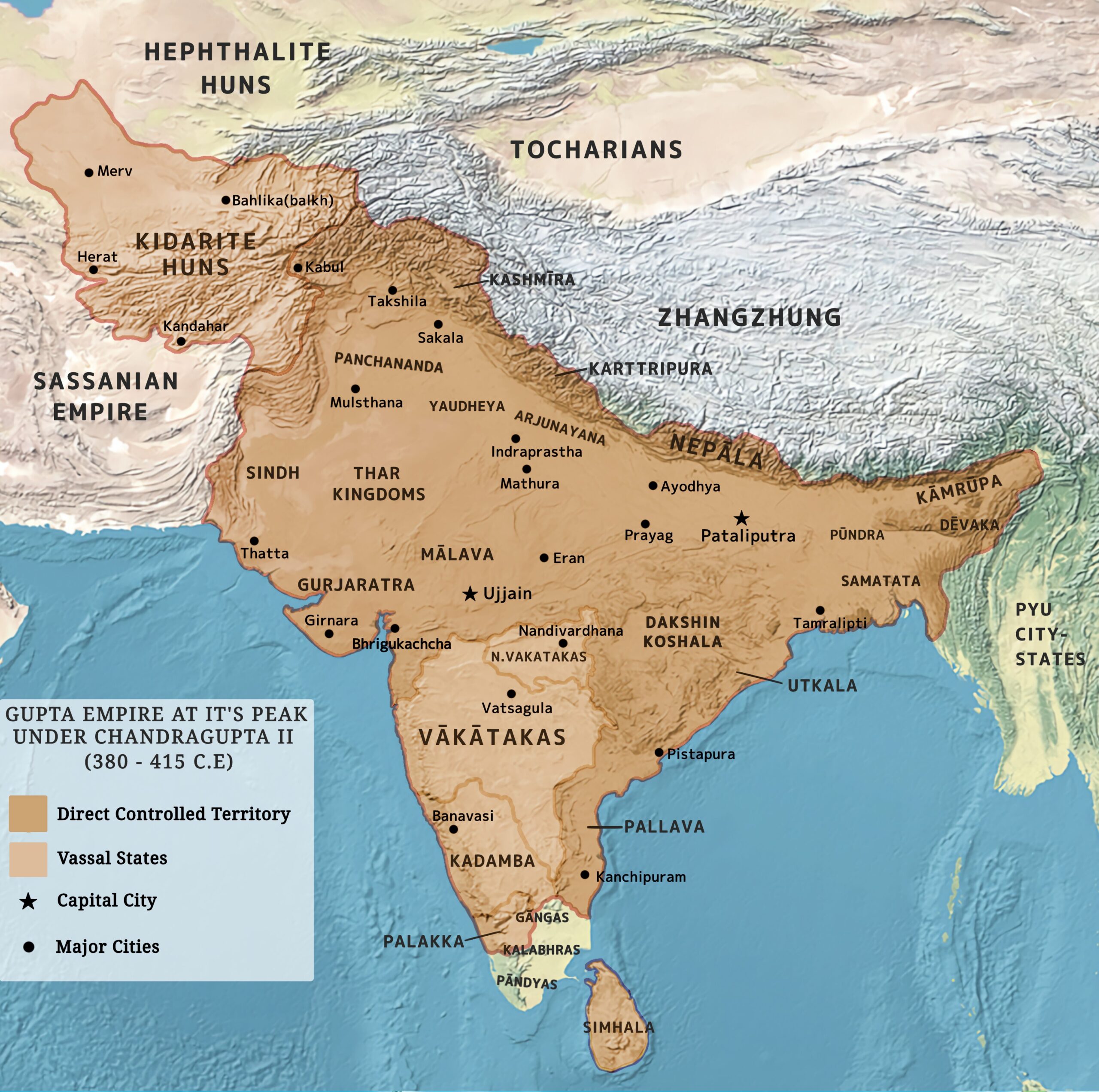
- Capital: Pataliputra (modern Patna, Bihar), with Ujjain as a secondary capital under Chandragupta II
- Major rulers: Chandragupta I, Samudragupta (c. 335 to 380 CE), Chandragupta II Vikramaditya (c. 380 to 415 CE), Kumaragupta I (c. 415 to 455 CE), Skandagupta (c. 455 to 467 CE)
- Capital court culture: The Navaratnas (Nine Gems), including Kalidasa, Varahamihira, Amarasimha, Dhanvantari and Vetalabhatta
- Currency: Pure gold dinaras, possibly the most beautiful coinage in ancient Indian history
- Languages: Sanskrit as state language, Prakrits in popular use
- Religion: Brahmanical Hinduism revived, with patronage of Vaishnava cults; Buddhism and Jainism tolerated and supported
- End: Effective collapse after 550 CE under the pressure of the Huna invasions and internal fragmentation
Rise of the Gupta Dynasty: Sri Gupta and Chandragupta I
The earliest known Gupta is Maharaja Sri Gupta (around 240 to 280 CE), followed by his son Ghatotkacha (around 280 to 320 CE). They were minor rulers in the eastern Gangetic plain, probably feudatories of a larger kingdom (possibly the Maukharis or the late Kushanas). The Gupta Empire proper begins with Chandragupta I, who took the imperial title Maharajadhiraja and inaugurated the Gupta era in 319 to 320 CE.
The decisive event of Chandragupta I’s reign was his marriage to Kumaradevi, a princess of the Lichchhavis, the powerful tribal republic of north Bihar. The Lichchhavi alliance gave the Guptas legitimacy, military weight and trading access. Chandragupta I issued a special coin type showing himself and Kumaradevi together, with the Lichchhavi name on the reverse. The new state covered Magadha, Saketa (Ayodhya) and Prayag (Allahabad).
The Gupta era of 319 to 320 CE became one of the standard reckonings of north Indian history for the next several centuries.
Samudragupta, the Napoleon of India
Samudragupta, son and successor of Chandragupta I, ruled approximately from 335 to 380 CE. He is documented above all by the Allahabad Prashasti (also called the Prayag Prashasti), a long Sanskrit poem composed by his court poet and minister Harisena and inscribed on a pillar that had originally carried Ashoka’s edicts. The Allahabad Prashasti, written in the Champu style (mixed prose and verse), is one of the most important Sanskrit inscriptions in Indian history.
According to the inscription, Samudragupta carried out a four-stage campaign of conquest:
- Aryavarta: Twelve kings of the upper Ganga and Yamuna plain were “uprooted” and their territories annexed.
- Dakshinapatha: Twelve kings of peninsular India, from the Mahanadi to Kanchi, were defeated and reinstated as tributaries. This is the “dharmavijaya” or pious conquest, in which the king takes tribute but allows the conquered to keep their thrones.
- Atavika kingdoms: Eighteen forest kingdoms were reduced to vassalage.
- Foreign relations: Tribute and submission were received from kings of Sri Lanka, the Kushanas of the north-west, the Shakas of the west, and lesser frontier kings.
Samudragupta’s empire stretched, at its core, from the Hindu Kush to the Brahmaputra and from the Himalayas to the Narmada, with a tributary periphery extending to Kanchi (Tamil Nadu) and Sri Lanka. The historian V.A. Smith called him the “Napoleon of India” for the sheer scale of his campaigns, although later historians have noted that, unlike Napoleon, he ended his life on the throne.
Samudragupta was also a cultivated king. His coins show him performing the Ashvamedha (horse sacrifice), playing the vina (lyre), and slaying lions and tigers. He was a patron of poetry, music and religion, and was himself titled Kaviraja (“king of poets”) in his inscription.
Allahabad Pillar Inscription
The Allahabad Prashasti is engraved on a polished sandstone Ashokan pillar standing in the fort at Allahabad. It bears, on the same shaft, edicts of Ashoka (3rd century BCE) and the prashasti of Samudragupta (4th century CE), separated by almost six centuries. It was first deciphered by James Prinsep. The text describes Samudragupta as the “exterminator of all kings” and lists his conquests in detail, making it one of the most precise pieces of evidence for the political geography of fourth-century India.
Chandragupta II Vikramaditya
Chandragupta II, son of Samudragupta, ruled from about 380 to 415 CE and is generally considered the high noon of the Gupta Empire. He took the title Vikramaditya (“the sun of valour”). He is also commonly identified with the legendary Vikramaditya of Sanskrit literature, the patron of the Navaratnas (Nine Gems) at his court at Ujjain, although the legendary Vikramaditya is a composite figure pulling from multiple historical rulers.
Chandragupta II’s most important campaign was against the Western Kshatrapas (the Shaka satraps of Gujarat and Malwa). He overthrew Rudrasimha III around 400 CE, annexed Gujarat, Kathiawar and Malwa, and gave the Gupta Empire direct access to the western ports and the Arabian Sea trade. The conquest is celebrated in the title Shakari (“destroyer of the Shakas”). To consolidate the western territories he made Ujjain a secondary capital.
He made marriage alliances with the Nagas (his queen Kuberanaga was a Naga princess), with the Vakatakas of the Deccan (his daughter Prabhavatigupta married Rudrasena II of the Vakatakas, and after his death she ruled the Vakataka state as regent for her sons), and with the Kadambas. The result was a system of allied dynasties surrounding the Gupta core.
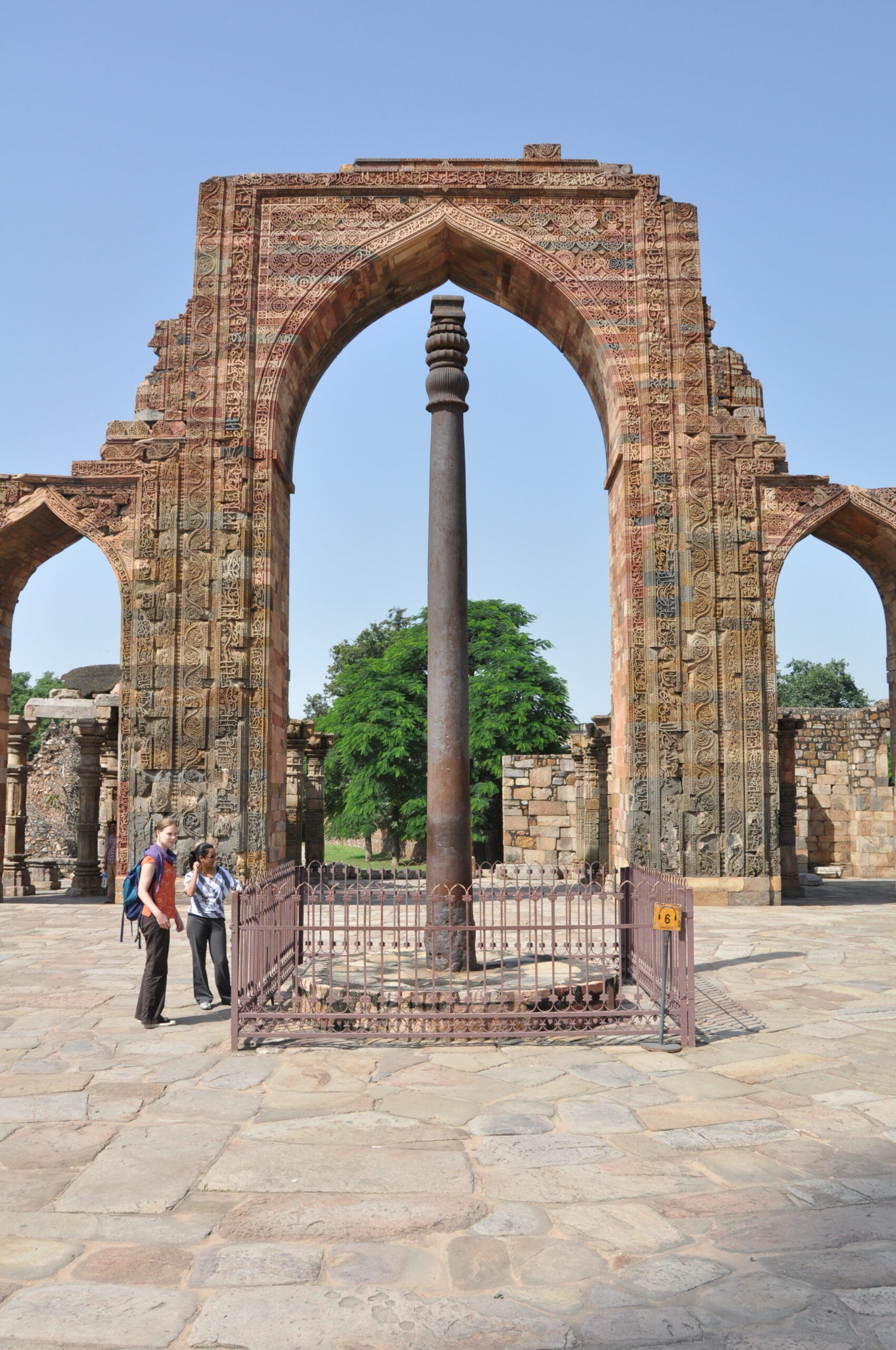
The most famous physical artefact of Chandragupta II’s reign is the Iron Pillar at Delhi (originally at Vishnupada in modern Madhya Pradesh, later moved to Mehrauli). It is a six-tonne wrought iron pillar, 7.2 metres tall, that has resisted rust for 1,600 years. The Sanskrit inscription in Brahmi names a king “Chandra” (most historians identify him as Chandragupta II) who conquered the Vahlikas across the seven mouths of the Indus and is described as a devotee of Vishnu.
Fa Hien’s Visit
The Chinese Buddhist monk Fa Hien (Faxian) visited India during Chandragupta II’s reign, between 405 and 411 CE, in search of Buddhist texts. His account, Fo-Kuo-Ki (“Record of Buddhist Kingdoms”), is the most detailed foreign description of Gupta India. He records that the country was peaceful, the people were vegetarian, the laws were mild, capital punishment was rare, and the king ruled without using force. He also notes the strong presence of Buddhism in cities like Pataliputra and Mathura, the great monastery at Nalanda just beginning to take shape, and the prosperity of trade.
Kumaragupta I and Skandagupta
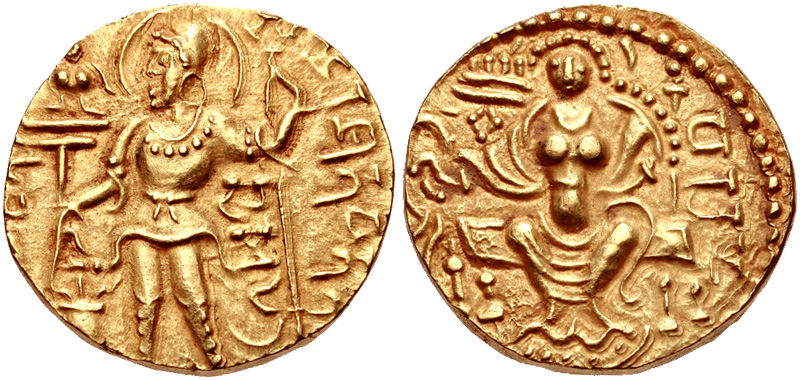
Kumaragupta I (c. 415 to 455 CE) consolidated the empire of his father. His reign was largely peaceful and prosperous. He performed the Ashvamedha and issued an unusually large number of coin types. He is also credited in tradition with the founding of Nalanda Mahavihara, the great Buddhist university in Bihar that would dominate higher education for the next eight centuries.
The pressure on the empire began at the end of his reign. The Pushyamitras, a tribe from the Narmada region, rebelled in central India. More seriously, the White Huns (Hunas, Hephthalites) began pressing on the north-west.
Skandagupta (c. 455 to 467 CE), Kumaragupta’s son, repelled the first major Huna invasion in the 450s CE, the event celebrated in the Junagadh Inscription and the Bhitari Pillar Inscription. The Junagadh Inscription, set in the same Sudarshana Lake complex that Chandragupta Maurya had originally built six centuries earlier, records that Skandagupta repaired the lake when a flood breached its embankment. Skandagupta’s victory over the Hunas preserved the empire for another generation, but it was the last great moment of Gupta strength.
Gupta Administration
Gupta administration was less centralised than the Mauryan system. The empire was a layered structure of directly ruled imperial provinces (bhukti), tributary vassal kingdoms, and allied tribal states.
The king (Maharajadhiraja, “great king of kings”) was at the apex. Below him were ministers, with the senapati (commander-in-chief), the mahadandanayaka (chief justice and military officer), the sandhivigrahika (minister of war and peace) and the mahapratihara (chief chamberlain) as the most important. The empire was divided into bhuktis (provinces) under uparika (governor), districts called vishayas under vishayapati (with a council of citizens including a guild representative), and below them towns and villages with their own self-government bodies.
The single biggest administrative shift from the Mauryan period was the rise of land grants. The Gupta state increasingly granted land (along with the right to collect taxes from it) to Brahmins for religious services (brahmadeya), to temples (devadana), and to officers in lieu of salary. These grants were inscribed on copper plates, many of which survive. Over time this practice eroded the central revenue base and laid the groundwork for the medieval feudal-like (samanta) political order.
Gupta coinage is some of the most beautiful in ancient world history. The standard was the gold dinara, modelled on the Roman aureus, but Indianised in iconography. Each major king issued his own coin types: Samudragupta with vina-playing, lion-slaying, horse-sacrifice and tiger-slaying types; Chandragupta II with archer, horseman, lion-slaying and umbrella types. Silver and copper coinage also circulated. The decline of gold purity in the late Gupta period is one of the markers of economic stress.
Golden Age: Science, Literature, Art and the Decimal System
The “golden age” label for the Gupta Empire rests on four broad achievements:
Mathematics and astronomy. Aryabhata, born in 476 CE, composed the Aryabhatiya at the age of 23. He laid out the decimal place value system in essentially the modern form, introduced the concept of zero as a place holder, gave a remarkably accurate value of pi (approximately 3.1416), computed the length of the solar year to within minutes of the modern value, and proposed that the earth rotates on its own axis. Varahamihira, working slightly later, wrote the Brihat Samhita and the Panchasiddhantika, the encyclopedic Sanskrit text of astronomy and astrology.
Sanskrit literature. Kalidasa, traditionally placed at the court of Chandragupta II, wrote Abhijnanashakuntalam (a Sanskrit play translated into European languages from the 18th century onwards), Meghaduta, Raghuvamsha and Kumarasambhava. Sanskrit became the standardised language of inscriptions and high literature across the subcontinent in this period. Vishakhadatta wrote Mudrarakshasa. Shudraka wrote Mrichchhakatika.
Art and architecture. The Gupta period gives us the canonical form of the early Hindu temple (Dashavatara temple at Deogarh, Vishnu temple at Tigawa, brick temples at Bhitargaon), the mature Gupta image of the Buddha (the Sarnath standing Buddha, the Mathura Buddha images), and the great cave paintings of Ajanta (Cave 1, Cave 16, Cave 17 are largely Vakataka-Gupta period). The figure type, with its even modelling, downcast eyes and translucent drapery, set the standard for South and Southeast Asian Buddhist art for a thousand years.
Medicine and metallurgy. The Sushruta and Charaka Samhitas were re-codified during this period. The Iron Pillar at Delhi proves the metallurgical skill of Gupta-era smiths. Indian iron and steel were exported westwards as far as the Roman world.
Was It Really a Golden Age?
Historians have debated the “golden age” label. The case for is the cultural and scientific output and the relative stability for two centuries. The case against, advanced by R.S. Sharma and others, is that the period saw the consolidation of caste rigidity (the smritis of Yajnavalkya, the Manusmriti was reaching final form), the practice of land grants that locked peasants into dependency on Brahmin landlords, and a marked decline of urban centres. Most contemporary textbooks now treat the Gupta age as both a creative high point of classical Indian civilisation and the period in which the institutional foundations of medieval Indian society were laid.
Decline of the Gupta Empire
The Gupta Empire declined in the second half of the fifth century and effectively ended around 550 CE. The principal causes were four.
First, the Huna invasions. After Skandagupta’s death the Hunas under Toramana (around 500 CE) and his son Mihirakula (around 510 CE) pushed deep into north India, capturing Malwa, Gujarat and as far east as central India. Mihirakula was eventually defeated by Yashodharman of Malwa in 528 CE, but the damage to Gupta territory and prestige was permanent.
Second, administrative decentralisation through land grants. The conversion of revenue rights into hereditary grants eroded central revenue. The samantas (great vassals) became increasingly autonomous and stopped sending tribute.
Third, weak successors after Skandagupta. Purugupta, Kumaragupta II, Budhagupta, Vainyagupta and Bhanugupta were short-reigned and increasingly local rulers, with effective control reduced to Magadha.
Fourth, economic decline. Long-distance trade with the Roman Mediterranean fell off after the collapse of the western Roman empire, and the related decline of urban centres reduced the tax base. Gold coinage debased in the late Gupta period, a classic marker of fiscal stress.
By the mid-sixth century the Gupta Empire had fragmented into successor states: the Maukharis at Kanauj, the Maitrakas of Vallabhi, the Vardhanas of Thaneshwar, and the later Guptas of Magadha. The unity of north India would not be restored until the brief rule of Harshavardhana in the seventh century.
Legacy of the Gupta Empire
Three things from the Gupta Empire have outlasted its political collapse.
First, Sanskrit cultural standardisation. The Gupta court set the canon for classical Sanskrit literature, the prashasti inscription tradition, the form of the Sanskrit temple, and the iconography of the Hindu deities. Every later Indian dynasty (Pratiharas, Palas, Cholas, Vijayanagar, even the Mughals through Sanskrit translations) drew on this canon.
Second, the decimal place value system and zero. Aryabhata and his successors gave the modern world the way it counts.
Third, the temple as the focus of public religion. The early Hindu temple form, the Brahmin land grant, and the temple economy that would dominate medieval India all crystallised under the Guptas.
For related ancient and medieval Indian history reading, see Mauryan Empire, Chandragupta Maurya, Ashoka the Great, Kautilya, Rajaraja Chola I, and Brihadeeswara Temple at Thanjavur.
Frequently Asked Questions
Who founded the Gupta Empire?
The imperial Gupta Empire was founded by Chandragupta I, who took the title Maharajadhiraja and inaugurated the Gupta era in 319 to 320 CE. He was preceded by the minor rulers Sri Gupta and Ghatotkacha. Chandragupta I’s marriage to the Lichchhavi princess Kumaradevi gave the dynasty its critical military and political weight.
Why is Samudragupta called the Napoleon of India?
The Indian historian V.A. Smith called Samudragupta the Napoleon of India because of the scale and military success of his conquests, documented in the Allahabad Prashasti of his court poet Harisena. Samudragupta conquered or subjugated kings in north India, the Deccan, the forest kingdoms, the north-west and even received tribute from Sri Lanka. Unlike Napoleon, he died on his throne.
What is the Allahabad Pillar Inscription?
The Allahabad Pillar Inscription (or Prayag Prashasti) is a long Sanskrit eulogy of Samudragupta composed by his court poet Harisena. It is inscribed on a polished sandstone pillar that originally carried edicts of Ashoka, and is one of the most important inscriptions in Indian history. It catalogues Samudragupta’s four-stage conquest, his cultural accomplishments and his political relationships.
Who was Chandragupta II Vikramaditya?
Chandragupta II Vikramaditya (c. 380 to 415 CE) was the son of Samudragupta and is regarded as the high point of the Gupta Empire. He overthrew the Western Kshatrapas, annexed Gujarat and Malwa, made Ujjain a secondary capital, and patronised the Navaratnas (Nine Gems) at his court, including Kalidasa. He is also commemorated by the Iron Pillar at Delhi.
What were the Gupta period scientific achievements?
The Gupta period produced Aryabhata’s Aryabhatiya (decimal place value system, the use of zero, accurate value of pi, computation of the solar year, the theory of axial rotation of the earth), Varahamihira’s Brihat Samhita and Panchasiddhantika, the codification of Sushruta and Charaka in medicine, and the metallurgical achievement represented by the rust-resistant Iron Pillar at Delhi.
What is the Iron Pillar of Delhi?
The Iron Pillar of Delhi is a seven-metre wrought iron pillar standing in the Qutb complex at Mehrauli. It weighs about six tonnes and has resisted rust for around 1,600 years. The Sanskrit Brahmi inscription names a king u0022Chandra,u0022 generally identified with Chandragupta II, who is described as a devotee of Vishnu and a conqueror of the Vahlikas. It is a metallurgical wonder of the ancient world.
Why did the Gupta Empire decline?
The Gupta Empire declined because of repeated White Hun (Huna) invasions under Toramana and Mihirakula in the late fifth and early sixth century, administrative decentralisation through hereditary land grants to Brahmins and officers, weak successors after Skandagupta, and the collapse of long-distance trade with the Roman world. By 550 CE the empire had fragmented into several successor states.
Was the Gupta period really a golden age?
The Gupta period is conventionally called a golden age because of its remarkable cultural and scientific output: Kalidasa’s Sanskrit literature, Aryabhata’s mathematics, the early Hindu temple, and the canonical Sanskrit iconography of the gods. Critics like R.S. Sharma point to the consolidation of caste rigidity, the expansion of land grants that locked peasants into Brahmin dependency, and the decline of urban centres. Most modern accounts treat the Gupta age as both a creative high point and the institutional starting point of medieval Indian society.