Introduction
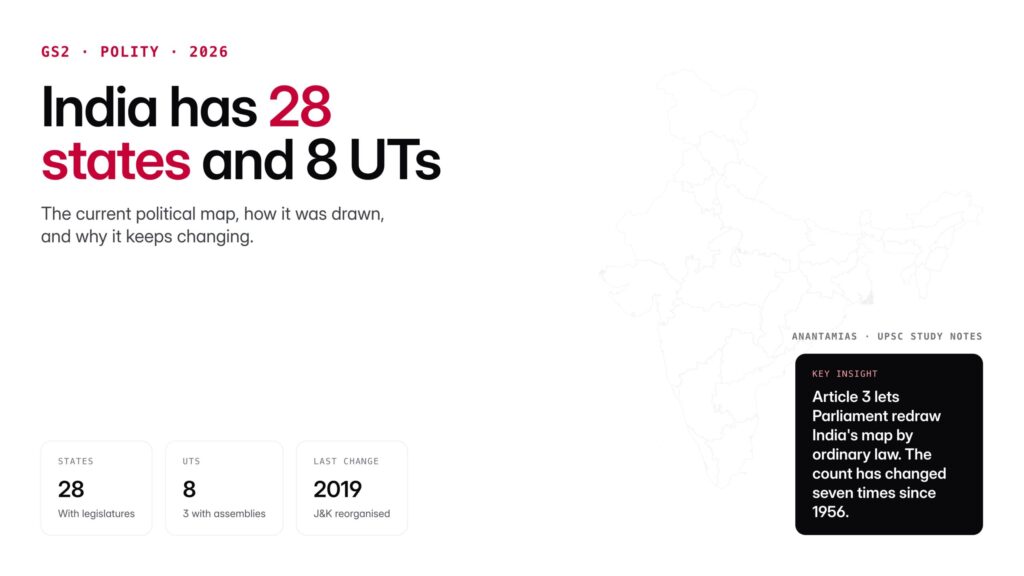
How many states are in India? The current answer is 28 states and 8 Union Territories, a total of 36 political units under the Indian Union. That number, however, has changed many times since independence and continues to be a live question in politics, administration and UPSC examination papers. Between the States Reorganisation Act of 1956 and the Jammu and Kashmir Reorganisation Act of 2019, every generation of Indians has seen the map redrawn.
For aspirants, the list of states and UTs is foundational. It appears in Prelims year after year, feeds Mains questions on federalism under GS Paper 2, and anchors interview questions on regional issues. This article gives the full list with capitals, explains the constitutional machinery that creates and dissolves states, and places the political map in historical and comparative context.
Quick Facts at a Glance
| Metric | Number |
|---|---|
| Total states | 28 |
| Total Union Territories | 8 |
| States with own legislature | 28 |
| UTs with legislative assembly | 3 (Delhi, Puducherry, J&K) |
| Bicameral state legislatures | 6 |
| Last state created | Telangana (2 June 2014) |
| Last UT reorganisation | J&K and Ladakh (31 October 2019) |
| Largest state by area | Rajasthan |
| Smallest state by area | Goa |
| Most populous state | Uttar Pradesh |
| Least populous state | Sikkim |
| Constitutional basis | Articles 1 to 4, First Schedule |
Background and Historical Context
At independence in 1947, India was a patchwork of British provinces and over 560 princely states. The Constitution of India that came into force on 26 January 1950 grouped the Union into four classes: Part A former British provinces, Part B former princely states, Part C Chief Commissioner’s provinces, and Part D territories directly administered by the Union. This scheme was administratively convenient but had little to do with language, ethnicity or cultural identity.
Popular agitation for linguistic reorganisation, culminating in the fast unto death of Potti Sriramulu in 1952 for a Telugu state, forced a rethink. Andhra State was carved out of Madras in 1953. The States Reorganisation Commission, headed by Fazl Ali with K M Panikkar and H N Kunzru as members, submitted its report in 1955. The States Reorganisation Act of 1956 abolished the Part A, B, C, D classification and created 14 states and 6 Union Territories, largely along linguistic lines. This is the most consequential act of internal boundary making in independent India.
Since 1956 the map has been redrawn repeatedly. Bombay split into Maharashtra and Gujarat in 1960. Punjab split into Punjab, Haryana and Himachal Pradesh in 1966. The North East Reorganisation Act of 1971 created Meghalaya, and the 1986-87 period elevated Mizoram, Arunachal Pradesh and Goa to statehood. In 2000, three new states appeared on a single day: Chhattisgarh from Madhya Pradesh, Uttarakhand from Uttar Pradesh and Jharkhand from Bihar. Telangana was bifurcated from Andhra Pradesh in 2014. Most recently, on 31 October 2019, the Jammu and Kashmir Reorganisation Act split the former state into the Union Territories of Jammu and Kashmir and Ladakh. That is how the current count of 28 states and 8 UTs came to be.
Key Features of the 28 States
Constitutional Basis
Article 1 of the Constitution declares India a Union of States. Article 2 empowers Parliament to admit new states, and Article 3 allows Parliament to form new states by separation, unite or merge existing states, and alter areas, boundaries or names. Article 4 clarifies that such changes do not amount to a constitutional amendment under Article 368, which is why Parliament can redraw the political map by ordinary law.
List of 28 States and Capitals
The 28 states and their capitals are: Andhra Pradesh (Amaravati proposed, Visakhapatnam and others as alternatives), Arunachal Pradesh (Itanagar), Assam (Dispur), Bihar (Patna), Chhattisgarh (Raipur), Goa (Panaji), Gujarat (Gandhinagar), Haryana (Chandigarh), Himachal Pradesh (Shimla), Jharkhand (Ranchi), Karnataka (Bengaluru), Kerala (Thiruvananthapuram), Madhya Pradesh (Bhopal), Maharashtra (Mumbai), Manipur (Imphal), Meghalaya (Shillong), Mizoram (Aizawl), Nagaland (Kohima), Odisha (Bhubaneswar), Punjab (Chandigarh), Rajasthan (Jaipur), Sikkim (Gangtok), Tamil Nadu (Chennai), Telangana (Hyderabad), Tripura (Agartala), Uttar Pradesh (Lucknow), Uttarakhand (Dehradun winter, Gairsain summer) and West Bengal (Kolkata).
List of 8 Union Territories
The eight Union Territories are Andaman and Nicobar Islands, Chandigarh, Dadra and Nagar Haveli and Daman and Diu, Delhi (National Capital Territory), Jammu and Kashmir, Ladakh, Lakshadweep and Puducherry. Three of these, Delhi, Puducherry and Jammu and Kashmir, have their own elected legislative assemblies under specific constitutional or statutory provisions.
Special Categories
Certain states have special provisions. Article 371 to 371J grants special constitutional protections to states including Maharashtra, Gujarat, Nagaland, Assam, Manipur, Andhra Pradesh, Sikkim, Mizoram, Arunachal Pradesh, Goa and Karnataka. These cover matters from tribal councils and development boards to protection of customary law. The sixth schedule separately governs tribal areas in Assam, Meghalaya, Mizoram and Tripura.
Significance for UPSC and General Knowledge
- GS Paper 2 covers Indian Polity, federalism and Centre-State relations, where state formation is a high-frequency topic.
- Prelims routinely asks list-type questions on states, capitals, CMs and UTs.
- Understanding Article 3 is essential for questions on the creation of new states such as Telangana.
- The J&K Reorganisation Act 2019 remains current affairs material with constitutional implications.
- Linguistic reorganisation is a classic Mains essay topic that links history and polity.
- Demands for Gorkhaland, Bodoland and separate Vidarbha show how the map is still contested.
Detailed Analysis: State-wise Distribution and Regional Balance
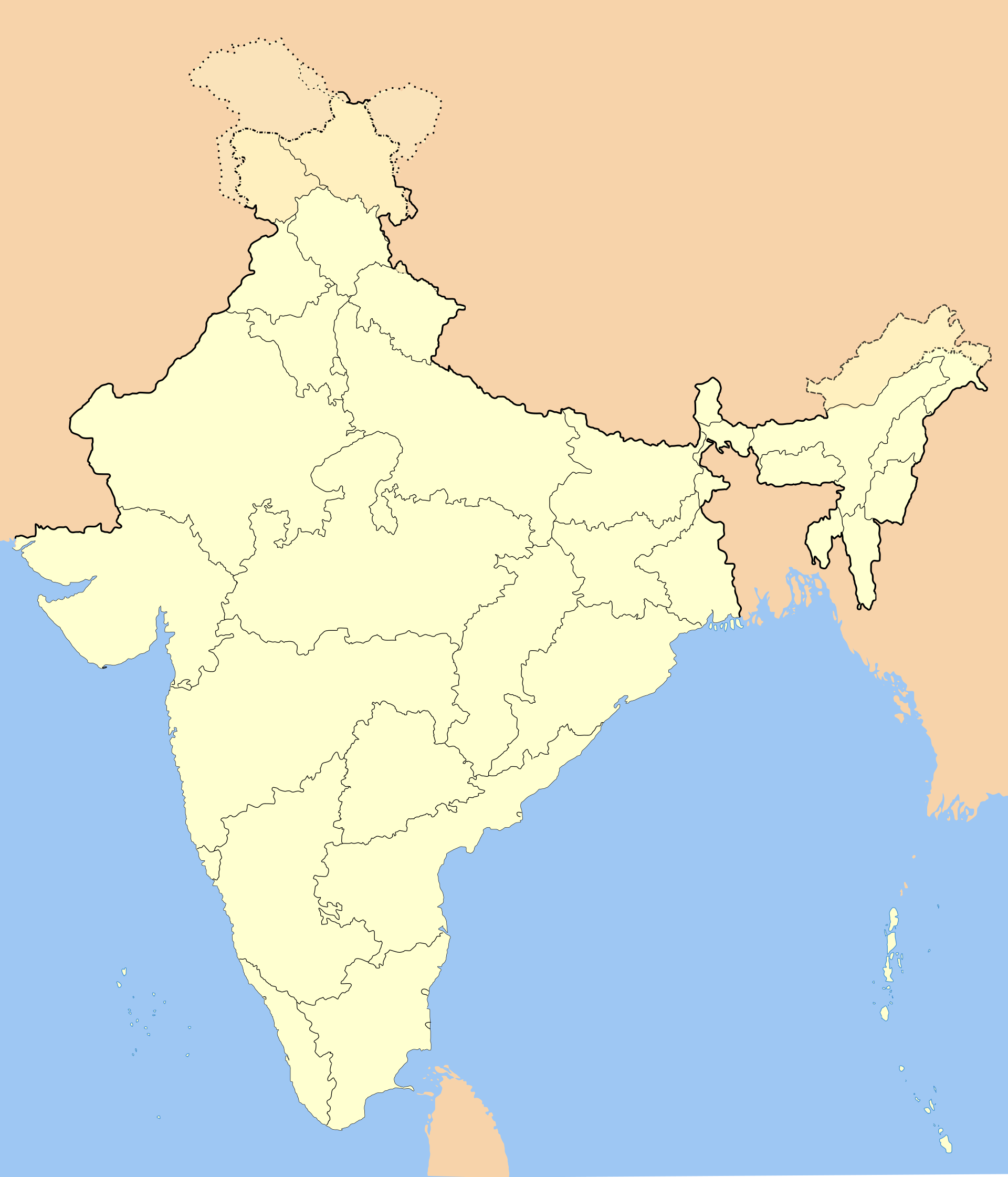
India’s 28 states fall into broad regional groupings. North India covers Jammu and Kashmir, Ladakh, Punjab, Haryana, Himachal Pradesh, Uttarakhand, Uttar Pradesh and Delhi. South India covers Karnataka, Kerala, Tamil Nadu, Andhra Pradesh and Telangana along with Puducherry. The East covers Bihar, Jharkhand, Odisha and West Bengal. The West covers Rajasthan, Gujarat, Maharashtra and Goa. Central India has Madhya Pradesh and Chhattisgarh. The North East groups the seven sisters of Assam, Arunachal Pradesh, Meghalaya, Manipur, Mizoram, Nagaland and Tripura, along with Sikkim as the eighth sister.
Uttar Pradesh remains India’s most populous state with over 199 million people at the 2011 census, projected above 240 million today. Sikkim is the least populous at just over 600000. Rajasthan is the largest by area at 342239 square kilometres, and Goa the smallest at 3702 square kilometres. Six states, namely Bihar, Andhra Pradesh, Telangana, Karnataka, Maharashtra and Uttar Pradesh, maintain bicameral legislatures with a Vidhan Sabha and Vidhan Parishad. J&K also has a legislative council under its special 2019 reorganisation arrangement.
The Union Territories vary widely in size and character. Delhi is essentially a large urban state with 33 million residents projected. Puducherry is a cluster of four non-contiguous districts from colonial French India. Chandigarh uniquely serves as shared capital for Punjab and Haryana. Jammu and Kashmir and Ladakh, previously one state, were separated in 2019, and a single governor or lieutenant governor now oversees each. Andaman and Nicobar and Lakshadweep are island territories critical to India’s maritime strategy. Dadra and Nagar Haveli and Daman and Diu were merged into one UT in January 2020 to reduce administrative cost.
Comparative Perspective
| Country | States or Provinces | Union Territories | Total Units |
|---|---|---|---|
| India | 28 | 8 | 36 |
| United States | 50 | 1 federal district + 5 territories | 56 |
| China | 23 provinces + 5 autonomous regions | 4 municipalities + 2 SARs | 34 |
| Australia | 6 | 10 (mainland + external) | 16 |
| Germany | 16 Lander | none | 16 |
India’s federation is notable for an asymmetric structure: most states have equal powers, but some have special provisions, and UTs range from fully elected to fully centre-administered. This blend reflects the diversity and scale of the country and distinguishes India from more uniform federations like Germany or Australia.
Challenges and Debates
The demand for new states continues. Gorkhaland in North Bengal, Bodoland in Assam, Vidarbha in Maharashtra, Saurashtra in Gujarat, Bundelkhand across UP and MP, Harit Pradesh in western UP and Poorvanchal in eastern UP are all active movements. Smaller states can improve governance by bringing administration closer to people, as the 2000 trifurcation showed. They can also create fiscal strain, duplicate bureaucracies and new boundary disputes.
The J&K Reorganisation Act 2019 provoked significant debate. Petitions challenging its constitutionality on Article 3 and Article 370 grounds were heard by a Supreme Court constitution bench, which in December 2023 upheld the abrogation and ordered assembly elections in J&K. Ladakh remains a UT without a legislature, which has triggered renewed demand for sixth schedule protection. The 2019 move also changed the total count of states from 29 to 28 and raised the UT count from 7 to 9, before the Dadra merger brought it to 8.
Federal fiscal concerns also shape the debate. The Finance Commission devolution formula, GST Council votes and the centrally sponsored schemes all depend on state counts and populations. Creating new states alters these equations, which is why reorganisation is never a purely administrative decision.
Prelims Pointers
- India has 28 states and 8 Union Territories as of 2026.
- Articles 1 to 4 and the First Schedule of the Constitution deal with states.
- Article 3 empowers Parliament to form new states by ordinary law.
- States Reorganisation Act 1956 is the biggest single reorganisation.
- Telangana, created on 2 June 2014, was the 29th state before the 2019 change.
- Jammu and Kashmir Reorganisation Act took effect on 31 October 2019.
- Dadra and Nagar Haveli merged with Daman and Diu on 26 January 2020.
- Delhi, Puducherry and J&K are UTs with legislative assemblies.
- Rajasthan is the largest state by area, Goa the smallest.
- Uttar Pradesh is the most populous state, Sikkim the least populous.
- Six states have bicameral legislatures.
- Chandigarh serves as the shared capital of Punjab and Haryana.
Mains Practice Questions
- Discuss the evolution of India’s state boundaries from 1950 to the present and evaluate how the principle of linguistic reorganisation has shaped Indian federalism. (250 words)
- Trace Part A-D setup and the Fazl Ali Commission
- Analyse post-1956 reorganisations including 2000 and 2014
- Assess the strengths and limits of linguistic federalism
- Examine the constitutional provisions relating to the formation of new states and the political economy of recent state creation movements. (250 words)
- Explain Articles 2, 3 and 4
- Cite Telangana and J&K as case studies
- Weigh governance and fiscal implications
Conclusion
India’s political map of 28 states and 8 Union Territories is the result of seven decades of negotiation between language, geography, administrative logic and political will. From the Fazl Ali Commission to the Jammu and Kashmir Reorganisation Act, the country has shown that borders are living artefacts, redrawn when people and Parliament find compelling reasons. The current configuration is neither final nor sacrosanct.
For UPSC aspirants, mastery of this topic means more than memorising capitals. It means grasping why Article 3 matters, why six states have legislative councils, why some UTs have assemblies and others do not, and how federal fiscal arithmetic shifts every time a new state is carved out. Those are the threads that tie a Prelims one-liner to a Mains answer and to an interview discussion about the next big question: which movement will produce India’s 29th state?
Frequently Asked Questions
How many states are in India?
India has 28 states and 8 Union Territories as of 2026, making a total of 36 political units under the Indian Union. The present count took shape after the Jammu and Kashmir Reorganisation Act of 2019 and the merger of Dadra and Nagar Haveli with Daman and Diu in January 2020, both of which changed the previous numbers.
Why is knowing how many states in India important for UPSC?
The list of states and UTs appears directly in UPSC Prelims in map, capital and current affairs questions. For Mains GS Paper 2, federalism, Article 3, linguistic reorganisation and state creation movements are recurring themes. Interview boards also probe regional issues, so a clear picture of India’s political map is foundational preparation.
How is the number of states related to Article 3 of the Constitution?
Article 3 empowers Parliament to form new states by separation, union or merger, and to alter names, areas and boundaries of existing states. Such changes are made by ordinary law and do not count as constitutional amendments under Article 368, which is why the number of states has changed several times since 1950 without invoking the amendment process.
When did India have 29 states?
India had 29 states between 2 June 2014, when Telangana was formed, and 31 October 2019, when the Jammu and Kashmir Reorganisation Act converted J&K into two Union Territories. From that date the count fell back to 28 states, and the Union Territories rose to 9 before merging into the current 8.
What are the 8 Union Territories of India?
The eight Union Territories are Andaman and Nicobar Islands, Chandigarh, Dadra and Nagar Haveli and Daman and Diu, Delhi, Jammu and Kashmir, Ladakh, Lakshadweep and Puducherry. Delhi, Puducherry and Jammu and Kashmir have their own elected legislative assemblies, while the other five are administered directly through a lieutenant governor or administrator.
Which was the latest state created in India?
Telangana was the latest full state created in India. It was carved out of Andhra Pradesh under the Andhra Pradesh Reorganisation Act and came into existence on 2 June 2014 with Hyderabad as its capital. Since then, no new full state has been created, though Jammu and Kashmir was reorganised into two Union Territories in 2019.
Which is the largest state in India?
Rajasthan is the largest state in India by area, covering 342239 square kilometres, which is roughly 10.4 percent of the country’s total land area. Madhya Pradesh is the second largest. By population, Uttar Pradesh ranks first with over 199 million residents at the 2011 census, a figure estimated to exceed 240 million today.
What is the States Reorganisation Act 1956?
The States Reorganisation Act of 1956 was a landmark law that abolished the earlier Part A to D classification and reorganised India largely along linguistic lines, creating 14 states and 6 Union Territories. It followed the Fazl Ali Commission report and became the foundation for all later reorganisations, including the 2000 creation of Chhattisgarh, Uttarakhand and Jharkhand.
Tell Google you want more of this.
Add Anantam IAS as a preferred sourceOne tap, and this site shows up more often in your own Top Stories, AI Overviews and AI Mode. Remove it any time.