IAS vs IPS vs IFS: Services Comparison Guide
IAS vs IPS vs IFS complete comparison — salary, powers, career progression, training, posting, work-life balance, and how service allocation works by rank and preference.
IAS vs IPS vs IFS: Which All India Service Should You Aim For?
IAS, IPS, and IFS are the three All India Services — the most prestigious outcomes from UPSC Civil Services Examination. Every serious aspirant has a preference. But few understand the actual differences in day-to-day work, career ceiling, powers, and lifestyle.
This guide covers what you actually need to know — not just the textbook differences but the ground reality of each service.
The Three All India Services: An Overview
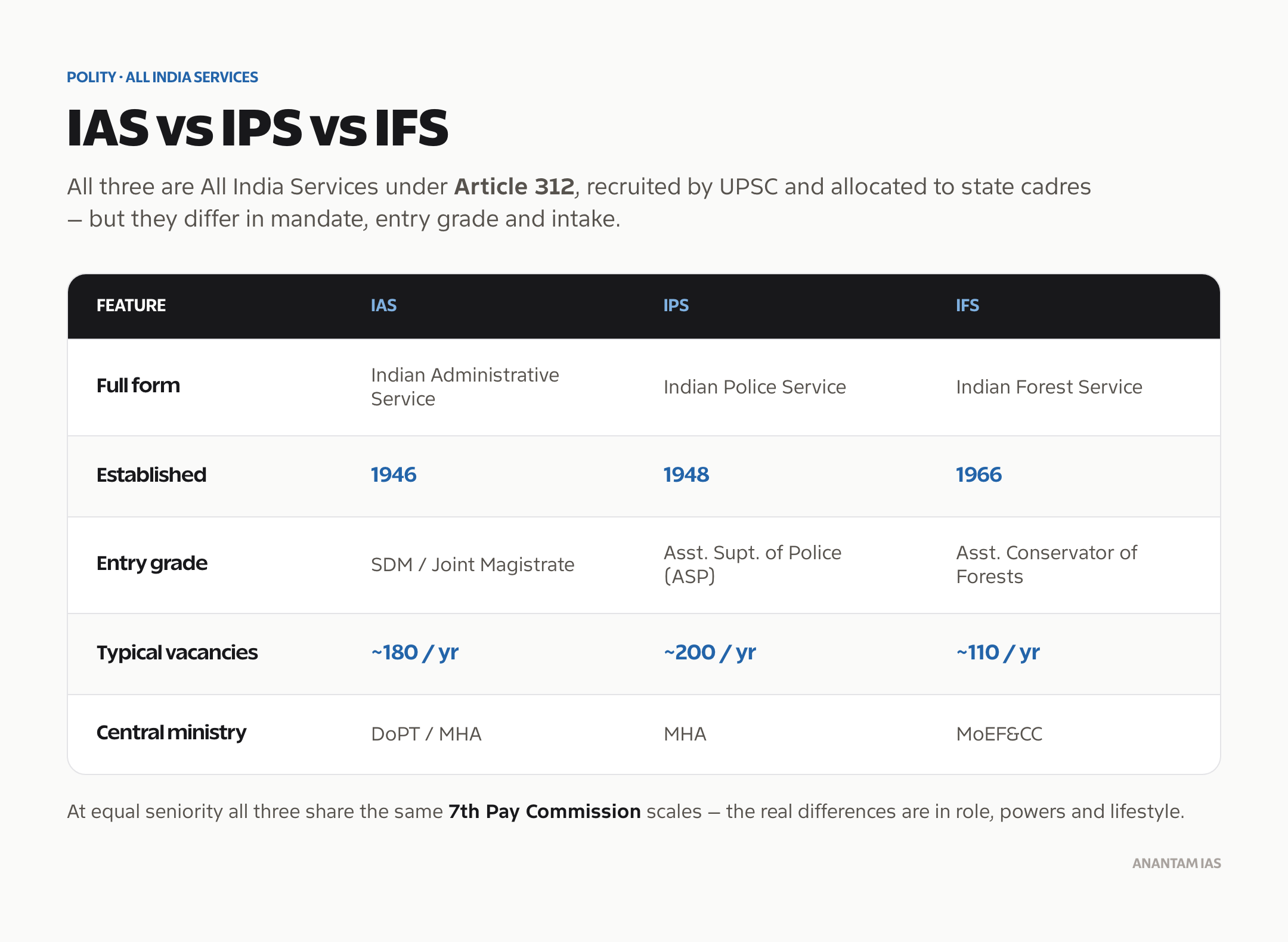
All three — Indian Administrative Service (IAS), Indian Police Service (IPS), and Indian Forest Service (IFS) — are All India Services under Article 312 of the Constitution. Officers are recruited centrally by UPSC but allocated to state cadres and serve both the state government and the central government at various points in their careers.
“All India” means their service conditions, pay scales, and basic rules are governed centrally by the Government of India, not by the state where they serve. A state government cannot transfer an IAS officer arbitrarily without following central rules — which gives these officers a degree of insulation from political pressure that state civil servants don’t have.
| Feature | IAS | IPS | IFS |
|---|---|---|---|
| Full Form | Indian Administrative Service | Indian Police Service | Indian Forest Service |
| Established | 1946 | 1948 | 1966 |
| Constitutional Basis | Article 312 | Article 312 | Article 312 |
| Allocated to | State cadres | State cadres | State cadres |
| Entry Grade | Joint Magistrate/SDM | Assistant Superintendent of Police | ACF/Assistant Conservator of Forests |
| Typical Vacancies | ~180 per year | ~200 per year | ~110 per year |
| Ministry (Centre) | Various; primarily DoPT, MHA, Home | MHA | MoEF&CC |
How Service Allocation Works
This is one of the most misunderstood aspects of UPSC. Your final rank in the merit list, combined with your stated preferences, determines which service and which state cadre you get.
The Process
- Merit List: UPSC publishes a final combined merit list after the Personality Test. Your rank is your position on this list.
- Preference Form: Before the interview, every candidate submits a preference form listing: (a) which services they prefer, in order, and (b) which state cadres they prefer.
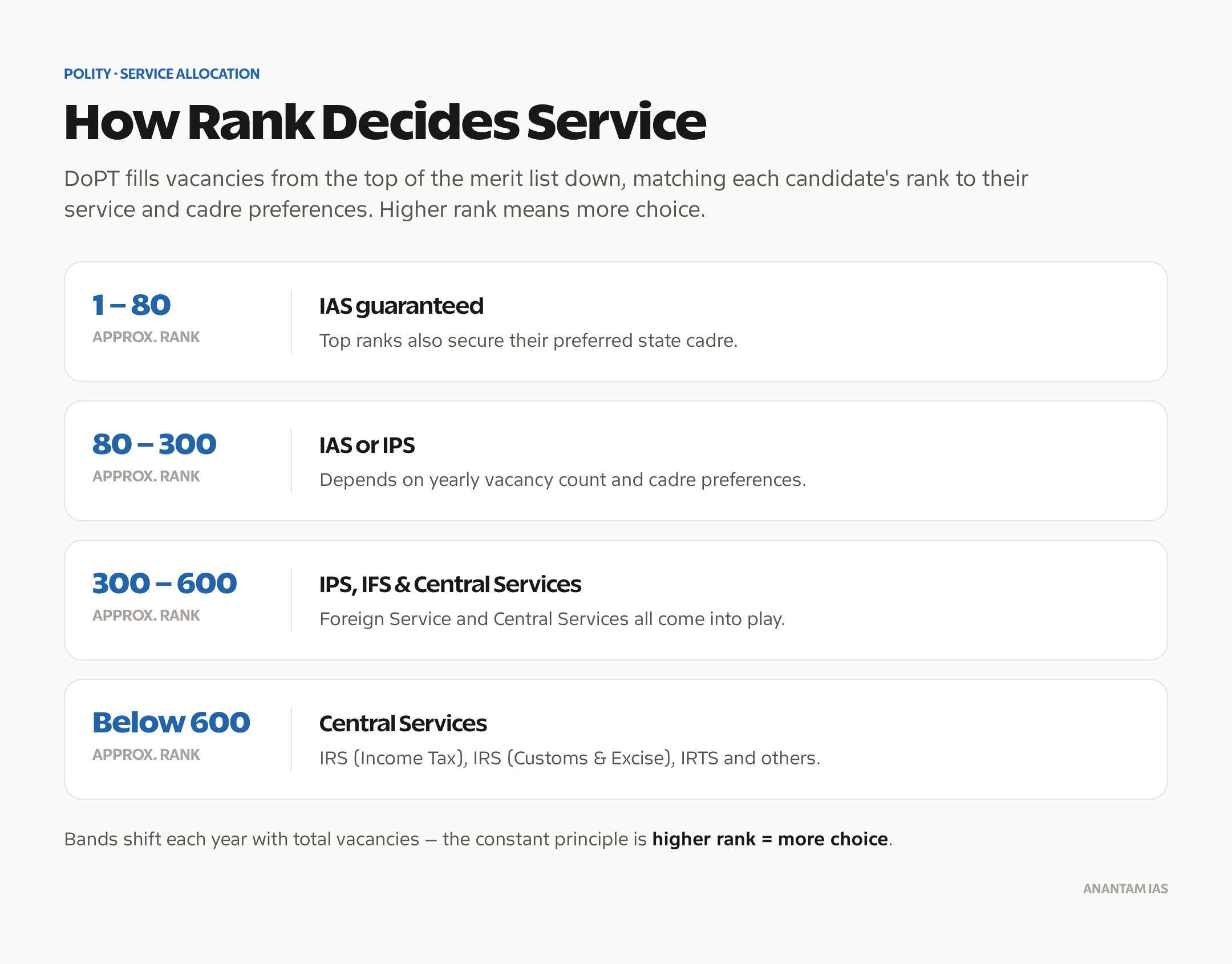
- Allocation: The Department of Personnel and Training (DoPT) fills vacancies from top to bottom of the merit list. If a vacancy exists in your top service preference and top cadre preference, you get it. If not, allocation proceeds to your next preferences.
What Actually Happens
- Ranks 1–80 (approximately): IAS guaranteed. These candidates can also get their preferred state cadre.
- Ranks 80–300 (approximately): IAS or IPS, depending on exact vacancy count that year and cadre preferences.
- Ranks 300–600: IPS, IFS, and Central Services (IRS-IT, IRS-CE, IFS-Foreign Service) are all in play.
- Below 600: Central Services — IRS Income Tax, IRS Customs & Excise, IDAS, IDAS, IRTS, etc.
These numbers shift each year with total vacancies. The principle is constant: higher rank = more choice.
State Cadre Allocation
Each All India Service has a fixed number of cadre posts per state. The cadres are grouped:
- AGMUT: Arunachal Pradesh-Goa-Mizoram-Union Territories (a combined cadre for smaller states/UTs)
- Other cadres: Each large state (UP, Maharashtra, MP, Rajasthan, Karnataka, etc.) is a separate cadre
Your home state is given preference — if your home state has vacancies in your allocated service, you’re allocated there if you rank high enough. Non-home-state postings are common for services like IFS where state-wise vacancies are small.
IAS Full Form: Indian Administrative Service Guide
IAS: Powers, Roles, and Career
The Indian Administrative Service is the most generalist of the three services and carries the most diverse authority. An IAS officer holds a different role roughly every 3–5 years.
Entry Level: SDM/Joint Magistrate
Fresh IAS officers (after training at LBSNAA, Mussoorie) are posted as Sub-Divisional Magistrate (SDM) or Joint Magistrate at sub-district level. Responsibilities:
- Revenue administration, land records
- Maintenance of law and order (executive magistrate powers)
- Supervision of development schemes (PM Awas, PM-KISAN, MGNREGA)
- Revenue court functions
Mid-Career: District Magistrate / Collector
The DM/Collector posting — typically at 8–12 years of service — is the pinnacle of field administration. Powers include:
- Head of all government departments in the district
- Disaster management authority
- Executive magistrate functions
- Electoral Officer (for Parliament and Assembly elections)
- Chair of District Development Authority
This role has no equivalent in any other service. The DM is effectively the face of the government in a district of 10–30 lakh people.
Senior Roles
- Director/Joint Secretary (State Secretariat): Policy work at state level
- Secretary to State Government: Heads a state department; reports to minister
- Joint Secretary/Additional Secretary/Secretary to GoI: Central deputation in Union ministries
- CMD of PSU / Ambassador / Regulator: Extension roles in public enterprises or diplomacy
IAS: Work-Life Balance Reality
Be honest with yourself: IAS work-life balance is poor at field posting levels. DM postings routinely involve 14–16 hour days, 7-day weeks during elections, disasters, or agricultural crises. Politicians can and do call at midnight. Transfers happen frequently.
At secretariat levels (Delhi or state capital), hours are more structured but political pressure remains.
IPS: Powers, Roles, and Career
The Indian Police Service is responsible for law enforcement, internal security, and intelligence. It’s more specialised than IAS — an IPS officer stays in the police hierarchy throughout, though at senior levels they move to central organisations.
Entry Level: ASP (Assistant Superintendent of Police)
After training at the Sardar Vallabhbhai Patel National Police Academy (SVPNPA), Hyderabad, IPS officers are posted as ASP — assistant to a Superintendent. Within 2–3 years, they become full Superintendent of Police (SP) of a district.
SP (Superintendent of Police)
The SP is the head of police in a district. Powers include:
- Commanding district police force
- Investigation oversight for serious crimes
- Maintaining law and order
- Counterterrorism at district level
- Anti-naxal operations (in affected areas)
Senior IPS Roles
- DIG (Deputy Inspector General): Range-level; oversees multiple districts
- IG (Inspector General): Zone-level or heading a specific function (CID, intelligence, armed police)
- ADG/DGP (Additional Director General / Director General of Police): Heads state police or major departments
- Central Deputation: CBI, IB, RAW (Technical), NIA, CISF, CRPF, BSF, NSG Director, IB Director
The most coveted central positions for IPS officers: Director of IB (Intelligence Bureau), Director of CBI, DG of CRPF/BSF, and NSA office.
IPS: Work-Life Balance Reality
IPS is typically harder on personal life than IAS — especially at SP level. Night operations, riots, VIP duties, election arrangements. Officers in naxal-affected areas or terrorism-heavy states face genuine physical danger. Transfers can be very frequent (some states transfer SPs every 6–9 months for political reasons).
Central postings (IB, CBI, RAW) are more regular in hours but carry their own pressures.
IPS Full Form: Indian Police Service Guide
IFS (Forest Service): Powers, Roles, and Career
The Indian Forest Service is the least known of the three All India Services but has a distinct and important mandate: managing India’s 7 crore hectares of forest land, biodiversity, wildlife, and implementing environment and forest laws.
Entry Level: ACF (Assistant Conservator of Forests)
IFS officers are trained at the Indira Gandhi National Forest Academy (IGNFA) in Dehradun. After training, they’re posted as ACF — responsible for a forest range.
Mid-Career: Divisional Forest Officer (DFO)
The DFO manages a forest division — typically 2,000–5,000 sq km of forests. Powers include:
- Forest protection, anti-poaching operations
- Plantation and afforestation
- Forest rights adjudication
- Issuing permits under Forest Conservation Act
- Wildlife management (in protected areas)
Senior IFS Roles
- CF/CCF (Conservator of Forests / Chief Conservator): Regional/state-level
- PCCF (Principal Chief Conservator of Forests): Heads state forest department
- Central Deputation: MoEF&CC (Ministry of Environment), Wildlife Institute of India, NTCA (Tiger Authority), ICFRE, Global Environment Facility projects
IFS is uniquely suited for officers genuinely passionate about environment and wildlife. It’s not a stepping stone to bureaucratic power — it’s a specialised service with distinct challenges and rewards.
IFS: Work-Life Balance Reality
IFS at field levels involves remote postings in forest areas — limited urban amenities, difficult terrain, and in some areas, conflicts with encroachers or poachers. Family schooling and healthcare access can be difficult in remote forest beats. However, the work itself — managing wildlife reserves, implementing conservation — is deeply meaningful for those drawn to it.
At central levels, MoEF&CC postings involve policy, international conventions (CITES, CBD, UNFCCC), and project approvals.
Salary Comparison: IAS vs IPS vs IFS
All three services are under the 7th Pay Commission. At the same level of seniority, pay scales are essentially identical.
| Level | Pay Level | Basic Pay | Indicative Total (Basic + DA + HRA) |
|---|---|---|---|
| Entry (Junior Scale) | Level 10 | ₹56,100 | ₹90,000–1,10,000 |
| Senior Scale | Level 11 | ₹67,700 | ₹1,10,000–1,30,000 |
| JTS (Junior Time Scale) | Level 12 | ₹78,800 | ₹1,25,000–1,50,000 |
| Selection Grade | Level 13 | ₹1,18,500 | ₹1,80,000–2,10,000 |
| Super Time Scale | Level 14 | ₹1,44,200 | ₹2,20,000–2,50,000 |
| Apex Scale | Level 17 | ₹2,25,000 | ₹3,20,000–3,50,000 |
| Cabinet Secretary Scale | Level 18 | ₹2,50,000 | ₹3,50,000+ |
In practice, IAS officers reach higher pay levels faster — not because of a different pay scale but because of faster promotions and senior roles becoming available at central government level (Secretary to GoI = Level 17; DGP in state police can reach Level 16).
Non-salary perks matter: Official residence (bungalow for senior officers), government vehicles, domestic staff, medical coverage, CGHS — these are common to all three services at equivalent levels and are worth ₹50,000–2,00,000/month equivalent at senior levels.
Training: Where Each Service Goes
| Service | Training Academy | Location | Duration |
|---|---|---|---|
| IAS | Lal Bahadur Shastri National Academy of Administration (LBSNAA) | Mussoorie, Uttarakhand | ~2 years (including state attachment) |
| IPS | Sardar Vallabhbhai Patel National Police Academy (SVPNPA) | Hyderabad, Telangana | ~1 year foundation + 1 year professional |
| IFS | Indira Gandhi National Forest Academy (IGNFA) | Dehradun, Uttarakhand | ~2 years |
All three services start with a joint Foundation Course at LBSNAA, Mussoorie — about 3 months where all new IAS, IPS, IFS, and central service officers train together. This shared foundation builds inter-service networks.
Which Service Is “Better”?
There’s no single answer — it depends on what you value.
Choose IAS if: You want the most diverse career, the highest administrative power (DM/Collector, Secretary to GoI), and are comfortable with constant transfers and generalised roles. IAS offers unmatched breadth and policy influence.
Choose IPS if: You’re drawn to law enforcement, counterterrorism, intelligence, or crime investigation. If you find the idea of leading a district police force or heading CBI/IB more exciting than revenue administration, IPS is your service. Also a strong choice if you prefer a more structured hierarchy.
Choose IFS if: You’re genuinely passionate about environment, wildlife, and forests. IFS is often dismissed as a “third choice” — that’s a mistake. For the right person, managing Project Tiger reserves or implementing climate policy through MoEF&CC is more fulfilling than any desk in Delhi.
The honest truth: most aspirants who say they want IPS really mean they want IAS but think IPS is more attainable. Make sure your preference is genuine — you’ll spend 30 years in whichever service you join.
Frequently Asked Questions
What is the difference between IAS, IPS, and IFS?
IAS (Indian Administrative Service) handles revenue, development, and general administration. IPS (Indian Police Service) handles law enforcement and internal security. IFS (Indian Forest Service) manages forests, wildlife, and environment. All three are All India Services recruited through UPSC CSE — they share the same exam but differ in training, roles, and career paths.
Which service gets allocated first — IAS, IPS, or IFS?
Service allocation is based on merit rank and candidate preferences. IAS is typically allocated to the top ~180 rankers. IPS is allocated next (roughly rank 100–350 range). IFS vacancies are filled within the same preference-based system. The exact cutoff shifts every year based on total vacancies.
Is IAS salary higher than IPS salary?
At the same pay level, IAS and IPS salaries are identical — both are under the 7th Pay Commission scales. In practice, IAS officers tend to reach higher-level central positions (Secretary to GoI, Level 17) that IPS officers rarely access, so peak career earnings tend to be higher for IAS.
What is the training duration for IAS, IPS, and IFS?
IAS training at LBSNAA Mussoorie lasts approximately 2 years (including probation, state attachments, and district training). IPS training at SVPNPA Hyderabad lasts approximately 2 years. IFS training at IGNFA Dehradun lasts approximately 2 years. All services attend a joint 3-month Foundation Course at LBSNAA before proceeding to their respective academies.
Can an IPS officer become IAS?
No, IPS officers cannot become IAS officers through promotion. The services are separate. However, IPS officers can be posted to senior positions at the centre (Joint Secretary equivalent) through deputation. Some IPS officers have held positions as Governor, Central Vigilance Commissioner, etc. — but their service classification remains IPS.