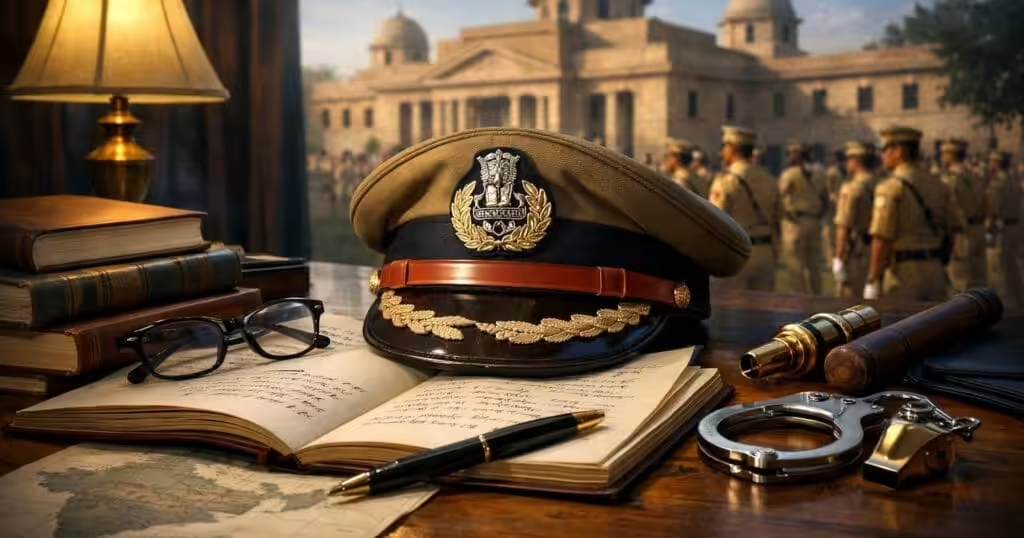
IPS stands for Indian Police Service. It's one of the three All India Services — alongside the IAS and Indian Forest Service — and the backbone of India's law enforcement and internal security architecture. An IPS officer's career spans from heading a district police force as Superintendent of Police to commanding national security agencies as Director General.
If you're targeting the UPSC Civil Services Examination and want the IPS, here's everything you need to know: selection, training, ranks, salary, roles, and how the IPS compares with the IAS.
IPS Full Form and Constitutional Status
The full form of IPS is Indian Police Service. Like the IAS, the IPS is an All India Service constituted under Article 312 of the Indian Constitution. This means IPS officers can serve both at the state level (under state governments) and at the central level (on central deputation with the Union government).
History of IPS: From Imperial Police to All India Service
Before 1947, the higher police service was called the Indian Police — a colonial cadre created by the British to maintain law and order. After independence, the Indian Police was reorganized and renamed the Indian Police Service in 1948.
The IPS was formally constituted under the All India Services Act, 1951, which gave statutory backing to the three All India Services. The Act was passed under Article 312, which empowers the Rajya Sabha to pass a resolution creating All India Services — the Constituent Assembly had first done this in 1947 for the IPS.
Difference Between IPS and State Police Services
This is a critical distinction aspirants often miss:
- IPS is an All India Service. Officers are recruited by UPSC, trained centrally, and allocated to state cadres. They hold senior positions (SP and above).
- State Police Services (SPS) are state-level services. Each state has its own SPS, and officers are recruited by the respective State Public Service Commission.
- SPS officers can be promoted to the IPS after a certain number of years — these are called promotee IPS officers, as distinct from direct recruit IPS officers who come through UPSC.
UPSC Civil Services Examination: Path to IPS
The only direct route to IPS is through the UPSC Civil Services Examination. There's no separate IPS exam.
How IPS Allocation Works
After UPSC declares the final merit list, candidates fill preference forms listing which services they want. Allocation depends on:
- Merit rank in the final list — higher rank means more choice
- Service preference — candidates rank services from IAS down
- Vacancies — each service has notified vacancies that year
In most years, candidates ranked roughly 150–400 (beyond the IAS allocation zone) who prefer IPS over other services get allocated IPS. The exact cut-off varies by year.
Eligibility for IPS
| Criteria | Details |
|---|---|
| Nationality | Indian citizen |
| Age (General) | 21–32 years |
| Age (OBC) | 21–35 years |
| Age (SC/ST) | 21–37 years |
| Education | Bachelor's degree from recognized university |
| Attempts (General) | 6 |
| Attempts (OBC) | 9 |
| Attempts (SC/ST) | Unlimited within age limit |
| Physical Standards | Minimum height, chest, and eyesight requirements apply |
Physical standards matter for IPS in a way they don't for IAS. UPSC specifies minimum height (165 cm for men, 150 cm for women in most cases), chest expansion, and corrected visual acuity requirements. Medical examination is part of the final selection process.
Related: UPSC Full Form: Union Public Service Commission Guide
Training at SVPNPA: Where IPS Officers Are Shaped
After selection, IPS probationers go through one of the most demanding training programs in the Indian civil services.
Foundation Course at LBSNAA, Mussoorie
All civil services probationers — IAS, IPS, IFoS, and central services — first attend a joint Foundation Course at the Lal Bahadur Shastri National Academy of Administration (LBSNAA) in Mussoorie for 3–4 months. This phase builds inter-service bonds and covers Indian governance, history, ethics, and language.
Phase I Training at SVPNPA, Hyderabad
After the Foundation Course, IPS probationers report to the Sardar Vallabhbhai Patel National Police Academy (SVPNPA) in Hyderabad for their specialized Phase I training. This lasts approximately 11 months and covers:
- Law: Indian Penal Code, CrPC, Evidence Act, Special and Local Laws
- Police Science: Investigation techniques, crime scene management, forensics
- Physical training: Parade, weapon training, unarmed combat, horse riding
- Field exercises: Mock exercises, raids, crowd management simulations
- Technology: Cybercrime, surveillance, digital forensics
- Leadership and management: Crisis management, command and control
SVPNPA is known for its rigorous physical training. The Academy is located on a sprawling campus and includes a firing range, obstacle course, and parade grounds.
State Training and District Training
After SVPNPA Phase I, IPS probationers go to their allotted state cadre for practical training. They work as trainee SPs in districts, learning from senior IPS officers on the ground. This phase lasts about 12 months.
Phase II at SVPNPA
Probationers return to SVPNPA for Phase II, which includes specialized modules, international study tours, and passing-out parade. Total probationary period: approximately 2 years.
IPS Ranks: The Complete Hierarchy
IPS has a well-defined rank structure. Ranks determine posting seniority, pay, and the level of command.
| Rank | Abbreviation | Typical Posting |
|---|---|---|
| Deputy Superintendent of Police | DSP / Dy.SP | Sub-division head (probationary posting) |
| Superintendent of Police | SP | District head / SSP in large districts |
| Senior Superintendent of Police | SSP | Large districts / ranges |
| Deputy Inspector General | DIG | Range / zone level |
| Inspector General | IG | Zone / sector / specialized wings |
| Additional Director General | ADG | Zonal / department heads |
| Director General of Police | DGP | Head of state police |
| Director General (Central) | DG | Heads of CRPF, BSF, NIA, CBI, etc. |
Entry-Level Rank: DSP or ASP
Direct recruit IPS officers enter as Assistant Superintendent of Police (ASP) or Deputy Superintendent of Police (DSP) depending on the state. After completing probation successfully, they're confirmed and begin rising through the ranks.
Senior-Most IPS Positions
At the apex level, IPS officers hold positions like:
- Director, Intelligence Bureau (IB) — India's domestic intelligence chief
- Director, CBI — head of India's premier investigation agency
- Director General, NSG — National Security Guard
- Director General, CRPF/BSF/CISF/SSB/ITBP — paramilitary force heads
- Commissioner of Police, Delhi/Mumbai — heads of major metropolitan police forces
IPS Salary and Pay Scale
IPS officers are paid under the 7th Central Pay Commission. Pay levels mirror the IAS at equivalent ranks.
| Rank | Pay Matrix Level | Basic Pay |
|---|---|---|
| ASP/DSP (Junior Time Scale) | Level 10 | ₹56,100 onwards |
| SP (Senior Time Scale) | Level 11 | ₹67,700 onwards |
| SSP (Junior Administrative Grade) | Level 12 | ₹78,800 onwards |
| DIG (Non-Functional Selection Grade) | Level 13 | ₹1,18,500 onwards |
| IG (Senior Administrative Grade) | Level 13A | ₹1,31,100 onwards |
| ADG (Higher Administrative Grade) | Level 14 | ₹1,44,200 onwards |
| DGP (Apex Scale) | Level 17 | ₹2,25,000 (fixed) |
In addition to basic pay, IPS officers receive Dearness Allowance, HRA, government accommodation, vehicle with driver, security personnel, and other allowances. At senior levels, government housing in Class I cities is a significant perk.
Key Roles of IPS Officers
An IPS career offers diverse roles — from frontline law enforcement to intelligence and policy.
Superintendent of Police: The Core District Role
The SP is the cornerstone IPS posting. An SP commands the entire district police force, handles law and order, oversees investigation of major crimes, and coordinates with the District Magistrate (an IAS officer). The SP-DM relationship is central to district governance in India.
Central Deputation Roles
On central deputation, IPS officers serve in:
- Intelligence Bureau (IB) — domestic intelligence and surveillance
- CBI — investigation of corruption and major crimes
- RAW (Research and Analysis Wing) — while RAW primarily recruits IPS officers on deputation
- NSG, CRPF, BSF, CISF — paramilitary forces
- Ministry of Home Affairs — policy advisory roles
Specialized Wings
Most state police forces have specialized wings headed by IPS officers:
- Criminal Investigation Department (CID)
- Anti-Terrorism Squad (ATS)
- Economic Offences Wing (EOW)
- Cyber Crime Division
- State Intelligence Department (SID)
IPS vs IAS: Key Differences
Aspirants often debate IPS vs IAS. Here's an objective comparison:
| Parameter | IAS | IPS |
|---|---|---|
| Full Form | Indian Administrative Service | Indian Police Service |
| Primary Domain | General administration, policy | Law enforcement, internal security |
| Training Academy | LBSNAA, Mussoorie | SVPNPA, Hyderabad |
| Entry Rank | SDO/SDM equivalent | ASP/DSP |
| Physical Standards | Minimal | Strict (height, vision, fitness) |
| Top Position | Cabinet Secretary | DG (Central) / DGP |
| Transfers | More frequent at district level | District to state to central rotation |
| Central Deputation | Ministries, PSUs | MHA, CBI, IB, paramilitary |
| Dominant Role in District | District Magistrate (heads revenue) | Superintendent of Police (heads police) |
Both services operate in the same district — the DM/DC (IAS) handles revenue and general administration, while the SP (IPS) handles law and order. Coordination between these two officers defines how well a district functions.
Pay Parity Issue
Historically, IPS officers have raised the issue that IPS pay scales lag behind IAS at equivalent years of service. The 6th and 7th Pay Commissions partially addressed this, but IPS associations continue to flag disparities in non-functional upgrades (NFU) and empanelment rates for senior positions.
IPS and UPSC Exam Relevance
For UPSC aspirants, IPS-related content appears across multiple GS papers:
- GS Paper II: Police reforms, federalism (IPS as All India Service), accountability mechanisms
- GS Paper III: Internal security, left-wing extremism, cybercrime, coastal security
- GS Paper IV: Police ethics, use of force, encounter killings, custodial deaths
Key reports and committees relevant for UPSC:
- National Police Commission (1977–81) — comprehensive review of policing
- Model Police Act (2006) — draft legislation for police reforms
- Ribeiro Committee (1998) and Padmanabhaiah Committee (2000) — police reforms
- Supreme Court guidelines in Prakash Singh case (2006) — mandatory police reforms including fixed tenures for DGPs and creation of Police Complaints Authorities
Related: IAS Full Form: Indian Administrative Service Guide
Frequently Asked Questions About IPS
What is the full form of IPS?
IPS stands for Indian Police Service. It is one of the three All India Services of India, constituted under Article 312 of the Constitution. Recruitment is through the UPSC Civil Services Examination.
Where is IPS training conducted?
IPS probationers train at two locations: first at LBSNAA, Mussoorie for the joint Foundation Course (shared with IAS and other services), then at the Sardar Vallabhbhai Patel National Police Academy (SVPNPA) in Hyderabad for specialized Phase I police training lasting about 11 months.
What is the highest rank in IPS?
Director General of Police (DGP) is the highest rank in a state police force. At the central level, officers can become Director General of a central paramilitary force (like CRPF DG or BSF DG), or Director of the Intelligence Bureau, which are effectively the apex-level IPS postings.
What is the starting salary of an IPS officer?
An IPS officer starts at Pay Matrix Level 10 with a basic pay of ₹56,100. With DA (currently around 55%), HRA, and other allowances, the effective in-hand salary for a new IPS officer in a metro city can exceed ₹1,00,000 per month.
Can an IPS officer become the Home Secretary?
Yes, IPS officers on central deputation can be posted as Home Secretary or serve in the Ministry of Home Affairs. However, the position of Home Secretary is often held by IAS officers. The position of Union Home Secretary is a key policy role overseeing India's internal security architecture.
Tell Google you want more of this.
Add Anantam IAS as a preferred sourceOne tap, and this site shows up more often in your own Top Stories, AI Overviews and AI Mode. Remove it any time.