Indian Agriculture: Challenges & Government Policies
Comprehensive study notes on Indian agriculture — crop patterns, MSP, challenges, government schemes, and key reforms for UPSC GS-III preparation.
Indian Agriculture: Challenges & Government Policies
Indian agriculture employs nearly 42% of the workforce but contributes only about 18% to GDP — a structural imbalance that defines the sector’s core challenge. Agriculture remains the primary livelihood for over 60 crore people, making it central to any discussion of economic development, food security, and rural welfare. For UPSC, agriculture spans GS-I (geography), GS-III (economy), and even GS-II (governance).
Overview of Indian Agriculture
India is the world’s second-largest agricultural producer. The country is the largest producer of milk, pulses, and spices, and the second-largest producer of rice, wheat, fruits, and vegetables. Agriculture’s share in GDP has steadily declined from over 50% at independence to about 18% today — a natural part of structural transformation, but the workforce shift hasn’t kept pace.
Key institutions governing agriculture:
- Ministry of Agriculture and Farmers’ Welfare: Nodal ministry for policy formulation
- Commission for Agricultural Costs and Prices (CACP): Recommends Minimum Support Prices
- National Bank for Agriculture and Rural Development (NABARD): Apex development bank for rural credit
- Indian Council of Agricultural Research (ICAR): Premier research body
- Food Corporation of India (FCI): Procurement and distribution of foodgrains
Land Holding Pattern
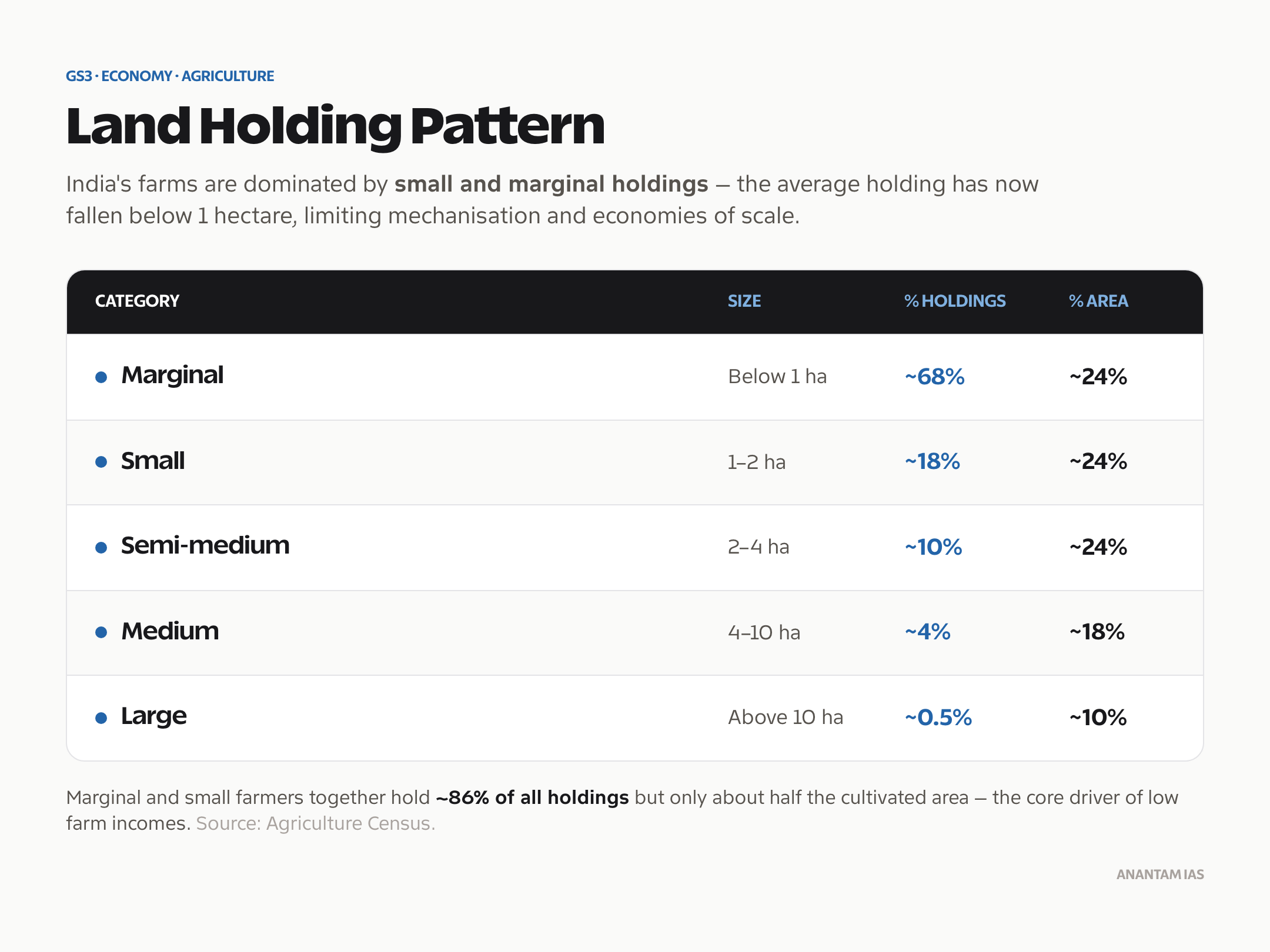
India’s agriculture is characterised by small and marginal holdings. According to the Agriculture Census:
| Category | Holding Size | Share of Total Holdings | Share of Total Area |
|---|---|---|---|
| Marginal | Below 1 hectare | ~68% | ~24% |
| Small | 1–2 hectares | ~18% | ~24% |
| Semi-medium | 2–4 hectares | ~10% | ~24% |
| Medium | 4–10 hectares | ~4% | ~18% |
| Large | Above 10 hectares | ~0.5% | ~10% |
The average holding size has fallen below 1 hectare. This fragmentation limits mechanisation, reduces economies of scale, and keeps productivity low.
Land Reforms in India: History & Impact
Cropping Patterns in India
India’s cropping pattern is shaped by climate, soil, irrigation availability, and market forces. The country has three main cropping seasons.
Agricultural Seasons
- Kharif (June–October): Monsoon-dependent crops — rice, maize, jowar, bajra, cotton, jute, soybean, groundnut
- Rabi (October–March): Winter crops — wheat, barley, gram, mustard, linseed
- Zaid (March–June): Short summer season — watermelon, cucumber, moong dal
Major Crops and Their Geography
Rice: West Bengal, Punjab, Andhra Pradesh, Tamil Nadu, Uttar Pradesh. Requires high temperature (above 25°C) and heavy rainfall or irrigation. India is the world’s largest exporter of rice.
Wheat: Punjab, Haryana, Uttar Pradesh, Madhya Pradesh, Rajasthan. Requires cool growing season and bright sunshine at harvest. The Green Revolution transformed wheat production in the 1960s–70s.
Pulses: Madhya Pradesh (largest producer), Maharashtra, Rajasthan, Uttar Pradesh. India is the world’s largest producer and consumer of pulses but still imports significant quantities.
Cotton: Gujarat, Maharashtra, Telangana, Andhra Pradesh, Rajasthan. India is the largest producer of cotton globally. Bt Cotton adoption transformed yields after 2002.
Sugarcane: Uttar Pradesh, Maharashtra, Karnataka. India is the world’s second-largest producer after Brazil.
Shift in Cropping Patterns
A significant trend is the shift from food crops to cash crops and from coarse cereals to rice and wheat. This has implications for:
- Nutritional security (declining millet and pulse cultivation)
- Water sustainability (rice and sugarcane are water-intensive)
- Soil health (monoculture depletes specific nutrients)
The National Mission on Sustainable Agriculture and promotion of millets (International Year of Millets 2023) aim to rebalance cropping patterns.
Minimum Support Price (MSP) Mechanism
The MSP is the price at which the government guarantees to purchase crops from farmers. It acts as a safety net against market price crashes.
How MSP Works
- CACP recommends MSP based on production cost, demand-supply, input prices, and international prices
- The Cabinet Committee on Economic Affairs (CCEA) approves MSP
- FCI and state agencies procure crops at MSP
- Currently, MSP is announced for 22 mandatory crops + sugarcane (FRP)
MSP Formula
Following the Swaminathan Commission recommendation, the government announced in 2018 that MSP would be fixed at least 1.5 times the comprehensive cost of production (A2+FL). However, farmers’ organisations demand 1.5 times C2 cost (which includes imputed rent and interest on owned land and capital).
| Cost Concept | Components |
|---|---|
| A2 | All paid-out costs (seeds, fertilisers, labour, fuel, irrigation) |
| A2+FL | A2 + imputed value of family labour |
| C2 | A2+FL + imputed rent on land + interest on fixed capital |
Issues with MSP
- Procurement is concentrated in a few states (Punjab, Haryana, MP) and a few crops (rice, wheat)
- No legal guarantee for MSP — a key demand of farm protests (2020–21)
- Distorts cropping patterns towards MSP-supported crops
- Storage and procurement costs are enormous for FCI
Irrigation in India
Only about 55% of India’s net sown area is irrigated. The rest depends on monsoon rainfall — making agriculture vulnerable to climate variability.
Sources of Irrigation
- Canals: Major and medium irrigation projects — significant in Punjab, Haryana, UP
- Tubewells and borewells: The dominant source, especially in north India — but causing groundwater depletion
- Tanks: Traditional irrigation in south India (Tamil Nadu, Andhra Pradesh, Karnataka)
- Sprinkler and drip irrigation: Micro-irrigation for water efficiency — promoted under PMKSY (Pradhan Mantri Krishi Sinchayee Yojana)
The Pradhan Mantri Krishi Sinchayee Yojana aims for “per drop more crop” through micro-irrigation expansion. The Atal Bhujal Yojana addresses groundwater management in water-stressed blocks.
Key Challenges in Indian Agriculture
Low Productivity
Indian crop yields remain below global averages for most crops. Rice productivity in India is about 4 tonnes/hectare compared to 7 tonnes in China. Causes include fragmented holdings, poor seed replacement rates, inadequate extension services, and low mechanisation.
Agricultural Marketing Deficiencies
Farmers face exploitative intermediaries, poor market infrastructure, and information asymmetry. The APMC (Agricultural Produce Market Committee) system — while intended to protect farmers — often restricts market access and creates monopolies of licensed traders.
Key reforms attempted:
- e-NAM (National Agriculture Market): Online trading platform linking APMCs across states
- Farm Laws 2020 (now repealed): Attempted to allow trading outside APMCs and enable contract farming
- Model APMC Act: Centre’s recommended reforms for states to adopt
Credit and Indebtedness
Despite expansion of institutional credit through Kisan Credit Cards and bank lending, many farmers still depend on informal moneylenders. The NSSO Situation Assessment Survey showed that over 50% of agricultural households are indebted. Rising input costs and stagnant incomes create a debt trap.
Post-Harvest Losses
India loses an estimated 10–15% of foodgrains and 25–30% of fruits and vegetables post-harvest due to inadequate storage, cold chain infrastructure, and poor transportation. This represents enormous economic waste and undermines food security.
Climate Change Impact
Indian agriculture is highly vulnerable to climate change:
- Erratic monsoons — delayed onset, uneven distribution, extreme rainfall events
- Rising temperatures reducing wheat and rice yields
- Increased pest and disease incidence
- Water stress from depleting groundwater and glacier retreat
The National Mission for Sustainable Agriculture (NMSA) under the National Action Plan on Climate Change addresses climate adaptation in farming.
Major Government Policies and Schemes
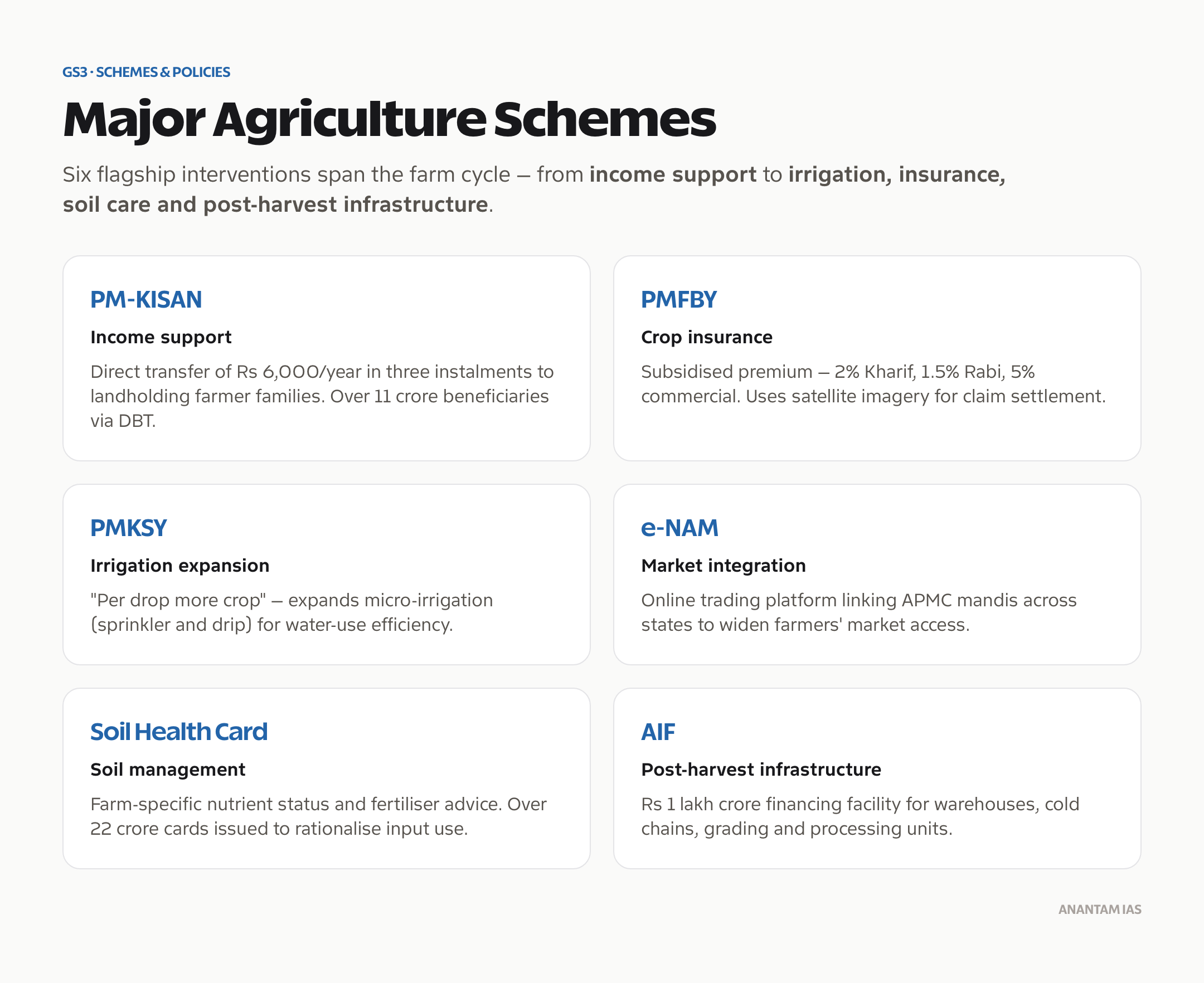
PM-KISAN (Pradhan Mantri Kisan Samman Nidhi)
Direct income transfer of Rs 6,000 per year to all landholding farmer families, paid in three instalments. Over 11 crore beneficiaries. This is a direct benefit transfer (DBT) scheme that bypasses intermediaries.
Pradhan Mantri Fasal Bima Yojana (PMFBY)
Crop insurance scheme with subsidised premiums (2% for Kharif, 1.5% for Rabi, 5% for commercial/horticultural crops). Uses satellite imagery and technology for quick claim settlement. Coverage has expanded but farmer awareness and claim processing remain challenges.
Soil Health Card Scheme
Provides farm-specific soil nutrient status and fertiliser recommendations. Over 22 crore cards issued. Aims to rationalise fertiliser use and improve soil health.
Paramparagat Krishi Vikas Yojana (PKVY)
Promotes organic farming through cluster approach. Each cluster of 50 farmers receives support for organic certification, training, and marketing.
Agricultural Infrastructure Fund (AIF)
Rs 1 lakh crore financing facility for post-harvest management infrastructure — warehouses, cold chains, sorting/grading units, processing facilities.
| Scheme | Objective | Key Feature |
|---|---|---|
| PM-KISAN | Income support | Rs 6,000/year DBT |
| PMFBY | Crop insurance | Subsidised premium, technology-based |
| PMKSY | Irrigation expansion | Per drop more crop |
| e-NAM | Market integration | Online APMC trading |
| Soil Health Card | Soil management | Farm-specific recommendations |
| AIF | Infrastructure | Rs 1 lakh crore credit facility |
Agricultural Reforms: The Way Forward
Several committees and commissions have recommended comprehensive agricultural reforms:
Swaminathan Commission (National Commission on Farmers, 2004–06)
Key recommendations:
- MSP at C2 + 50% margin
- Land reform legislation
- Assured irrigation access
- National Land Use Advisory Service
- Establishment of a National Food Security Act (implemented in 2013)
Ashok Dalwai Committee on Doubling Farmers’ Income (2017)
Identified seven sources of growth:
- Improvement in crop productivity
- Improvement in livestock productivity
- Resource use efficiency
- Crop diversification
- Better price realisation
- Shift from farm to non-farm occupations
- Savings from reduced post-harvest losses
Contemporary Reform Agenda
- Contract farming: Allows farmers to enter into agreements with buyers for assured prices
- Farmer Producer Organisations (FPOs): Collective bargaining power for small farmers — target of 10,000 FPOs by 2027
- Digital agriculture: Use of drones, AI, satellite data for precision farming
- Natural farming: Zero-budget natural farming promoted in states like Andhra Pradesh
- Agri-tech startups: Technology-driven solutions for input delivery, market linkage, and advisory services
Food Security in India: PDS, NFSA & UPSC Notes
Allied Sectors: Animal Husbandry, Fisheries, and Forestry
Agriculture includes allied activities that contribute significantly to rural livelihoods.
Animal Husbandry
India has the world’s largest livestock population. The White Revolution (Operation Flood), led by Dr Verghese Kurien through NDDB (National Dairy Development Board) and Amul, made India the world’s largest milk producer. Schemes like Rashtriya Gokul Mission and National Livestock Mission support the sector.
Fisheries
India is the third-largest fish producer and second-largest aquaculture producer globally. The Pradhan Mantri Matsya Sampada Yojana (PMMSY) aims to double fisheries exports and create 55 lakh employment opportunities. Blue Revolution focuses on integrated aquaculture development.
Agroforestry
The Sub-Mission on Agroforestry promotes tree plantation on farmlands for additional income, environmental benefits, and climate resilience.
Agriculture and UPSC: Key Linkages
For Mains GS-III, agriculture questions connect to:
- Economic development: Structural transformation, disguised unemployment
- Food security: PDS, buffer stock, NFSA
- Technology: GM crops, precision farming, biotechnology
- Environment: Stubble burning, pesticide pollution, groundwater depletion
- Governance: APMC reforms, federalism in agriculture (state subject)
- International trade: WTO Agreement on Agriculture, subsidies, food stockpiling
Frequently Asked Questions
Why is Indian agriculture called a gamble on monsoons?
Nearly 45% of India’s net sown area still depends entirely on rainfall for irrigation. Monsoon variability directly affects crop production, farmer incomes, and food prices. Despite expansion of irrigation infrastructure, the dependence on monsoon remains critical — explaining why a bad monsoon year often triggers rural distress and food inflation.
What is the Minimum Support Price (MSP)?
MSP is the price at which the government purchases crops from farmers to protect them from market price crashes. The CACP recommends MSP for 23 crops based on production costs and other factors. While it provides a safety net, effective procurement is limited to a few crops (rice, wheat) and a few states (Punjab, Haryana).
How does climate change affect Indian agriculture?
Climate change causes erratic monsoons, heat stress on crops, increased pest attacks, and water scarcity from depleting aquifers. Studies estimate that wheat yields could decline by 6–23% by 2050 without adaptation measures. Rising sea levels threaten coastal agriculture. The National Mission for Sustainable Agriculture promotes climate-resilient farming practices.
What are Farmer Producer Organisations (FPOs)?
FPOs are collective institutions where small and marginal farmers pool resources for better market access, bargaining power, and input procurement. The government targets formation of 10,000 FPOs with Rs 6,865 crore support. FPOs help overcome the disadvantages of fragmented land holdings and give small farmers access to technology, credit, and markets.
What is the difference between Green Revolution and Evergreen Revolution?
The Green Revolution (1960s–70s) used high-yielding varieties, chemical fertilisers, and irrigation to boost wheat and rice production — but caused environmental damage. The Evergreen Revolution, coined by MS Swaminathan, advocates for productivity growth without ecological harm through sustainable practices, organic farming, and biotechnology. It aims for long-term food security.