Introduction
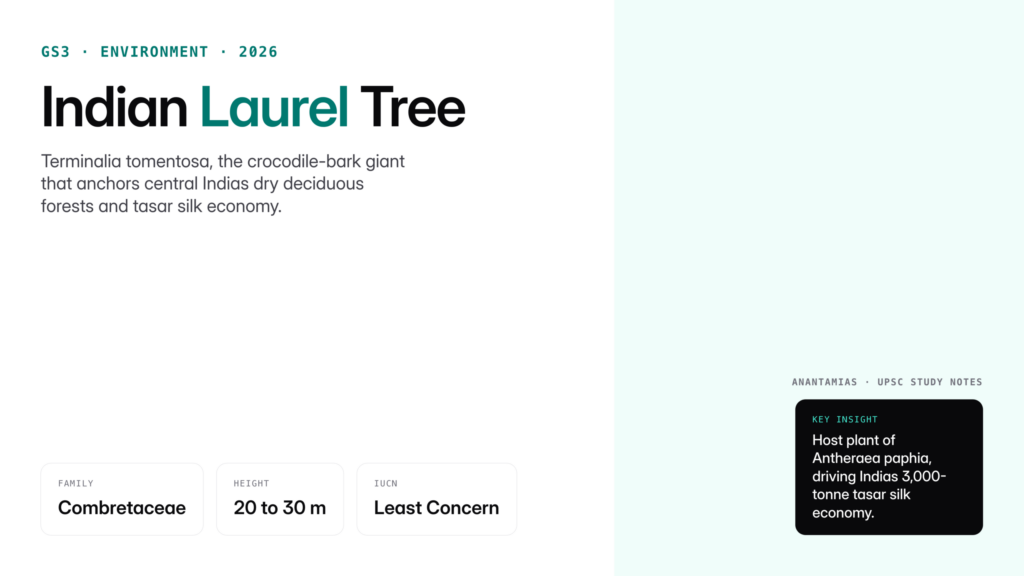
The Indian Laurel Tree, botanically known as Terminalia tomentosa (now widely accepted as Terminalia elliptica), is one of the most recognisable deciduous trees of the Indian subcontinent. With its deeply fissured, crocodile-skin bark and towering presence across the dry forests of central and peninsular India, it anchors the ecology of teak-dominated woodlands and sal-teak transition zones. The species is locally known as Asna, Saj, Saaj, Ain, Marda, Sadar or Matti depending on the region, and belongs to the family Combretaceae.
For the UPSC aspirant, the Indian Laurel is more than a botanical curiosity. It is the primary host plant of the Antheraea paphia moth that produces tasar silk, an input to tribal livelihoods in Jharkhand, Chhattisgarh and Odisha. It is listed as a non-timber forest produce of significance under Joint Forest Management, and finds mention in the Indian Forest Service syllabus and optional papers on Forestry. Understanding this single tree therefore cuts across GS3 (environment, forestry, tribal economy) and GS1 (geography of natural vegetation).
Quick Facts at a Glance
| Attribute | Detail |
|---|---|
| Scientific name | Terminalia tomentosa / Terminalia elliptica |
| Family | Combretaceae |
| Common Hindi names | Asna, Saj, Saaj, Sadar |
| Height | 20 to 30 metres |
| Girth | Up to 3 metres |
| Leaf type | Simple, opposite, oblong |
| Flowering season | May to July |
| Fruit | 5-winged samara |
| IUCN status | Least Concern |
| Primary use | Host of tasar silkworm; timber; medicinal bark |
| Distribution | Central India, Deccan plateau, sub-Himalayan tracts |
Background and Historical Context
The genus Terminalia derives its name from the Latin terminus, referring to the crowded arrangement of leaves at the tips of branches. It was described by the French botanist Carl Linnaeus the Younger in the late 18th century, and Terminalia tomentosa was formally catalogued by Wight and Arnott in 1834. Colonial forest administrators, notably Dietrich Brandis and William Schlich of the Imperial Forest Service, documented its presence in the working plans of central provinces forests during the 1870s and 1880s, recognising it as a principal associate of teak.
In Indian cultural memory the tree predates colonial science. Sanskrit and Prakrit texts mention Asana as a timber for chariots, agricultural implements and yoke-wood. The Arthashastra of Kautilya, compiled around the Mauryan era, classifies forest produce into timber, fibre, dye and fragrance categories, and Terminalia species figured prominently in the dye and tanning lists. Tribal communities across the Chota Nagpur plateau have practiced tasar sericulture on Asan leaves for at least a millennium, with community memory linking the craft to the Kol, Santhal and Munda oral traditions.
After independence, the Central Silk Board constituted in 1948 formally mapped tasar host plantations. The Forest Survey of India assessments from the 1990s onwards have tracked the species as a bioindicator of dry deciduous forest health. Terminalia elliptica also figures in the Compensatory Afforestation Fund Management and Planning Authority (CAMPA) species lists used for degraded land restoration.
Key Features
Morphology
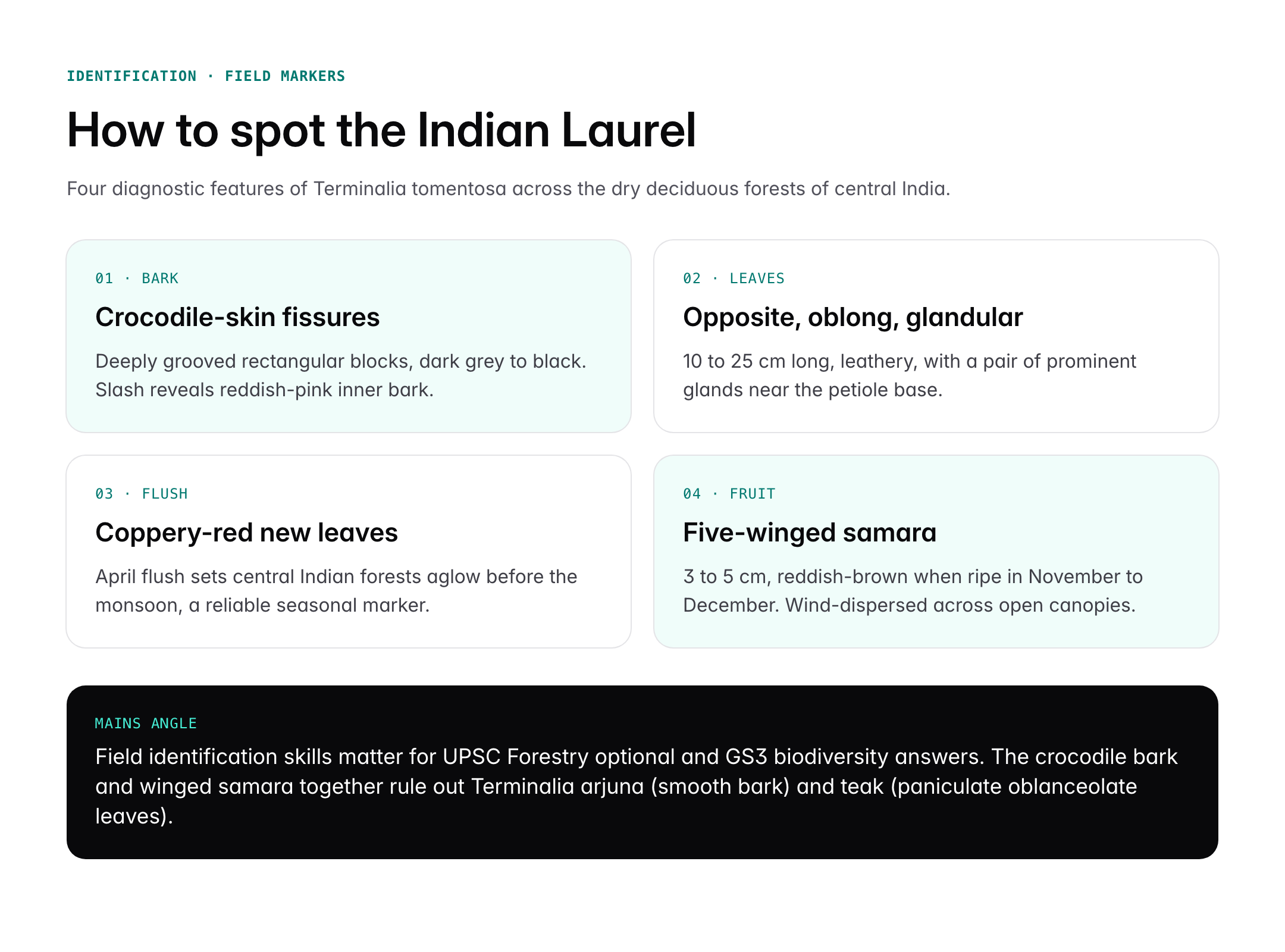
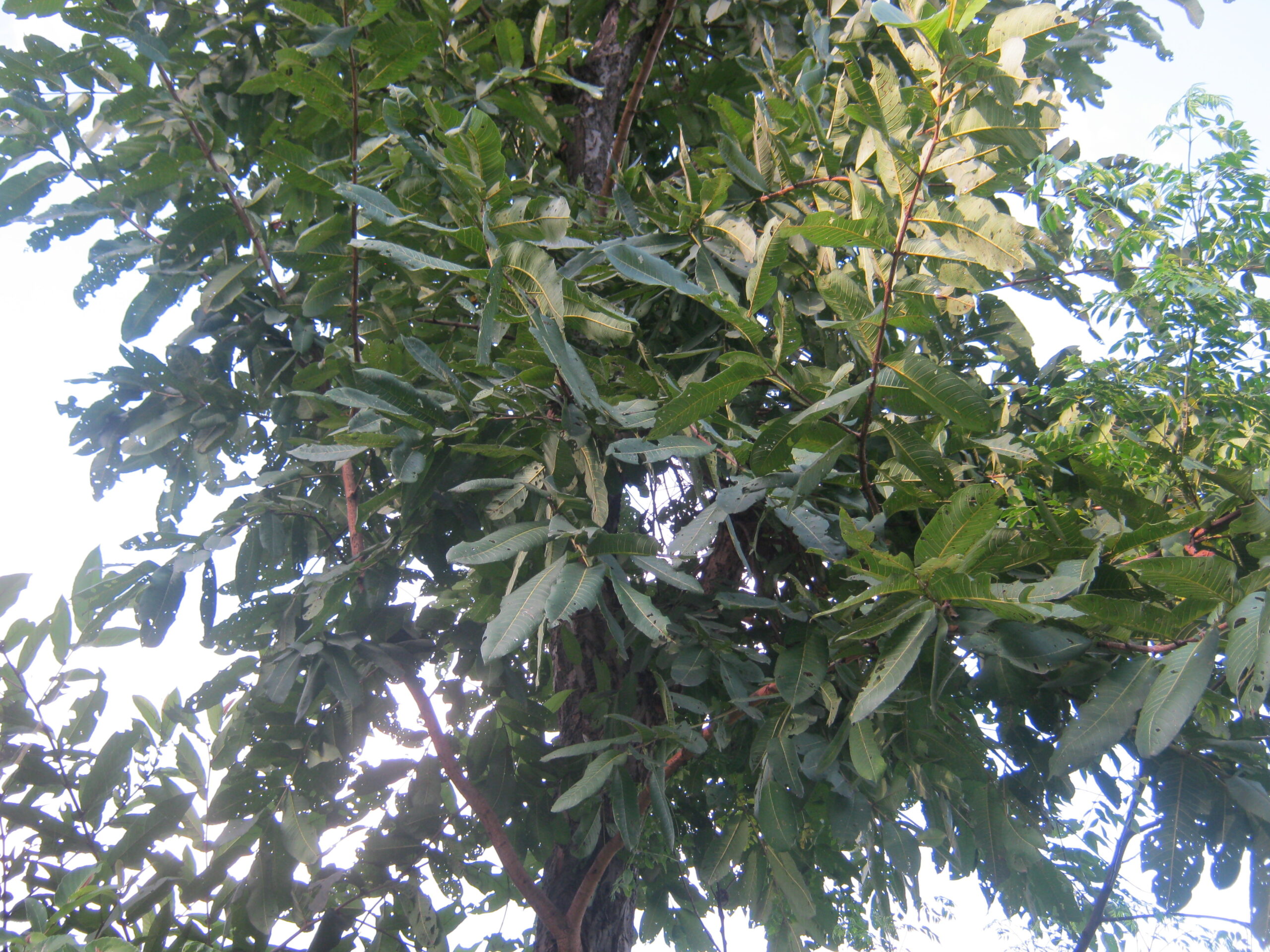
The Indian Laurel is a large deciduous tree reaching 20 to 30 metres. Its bole is straight and often clear of branches for the first 10 to 15 metres. The bark is the most diagnostic feature: dark grey to black, deeply fissured into rectangular blocks that resemble crocodile skin, earning it the name crocodile-bark tree. A slash reveals reddish-pink inner bark that oxidises to deep brown.
Leaves and phenology
Leaves are simple, opposite, oblong to elliptic, 10 to 25 centimetres long, leathery in texture with a pair of prominent glands at the petiole base. The tree is deciduous, shedding leaves in February and March and flushing bright coppery-red new foliage in April, a visual marker of the pre-monsoon landscape in central Indian forests.
Flowers and fruits
Inflorescences are panicles of small, cream-yellow, strong-smelling flowers that bloom from May to July. The characteristic fruit is a five-winged samara, 3 to 5 centimetres across, ripening to reddish-brown in November and December. The wings permit wind dispersal across open deciduous canopies.
Wood properties
The heartwood is dark brown with darker streaks, moderately hard with a density of about 850 kilograms per cubic metre. It is used for furniture, house construction, agricultural implements, and increasingly in plywood. Sapwood is pale and susceptible to borer attack.
Ecological associations
The species commonly associates with teak (Tectona grandis), sal (Shorea robusta in transition zones), mahua (Madhuca longifolia), and bamboo. It is a fire-tolerant tree, with thick bark enabling survival in repeatedly burnt dry deciduous forests.
Significance for UPSC and General Knowledge
- Principal host plant of the tasar silkworm Antheraea paphia, supporting tribal sericulture livelihoods in Jharkhand, Chhattisgarh, Odisha, and West Bengal.
- Key species of the tropical dry deciduous forest ecosystem, the dominant forest type of central India as classified by Champion and Seth 1968.
- Listed as a preferred species in CAMPA afforestation and under the National Bamboo Mission landscape mosaics.
- Bark yields pyrogallol tannins used in leather tanning and traditional dyeing.
- Provides Non-Timber Forest Produce income via tasar cocoons, gum karaya substitutes and fodder leaves.
- Cited in Indian Forest Service syllabus under silviculture of Indian trees.
Detailed Analysis: Economic and Ecological Role
The Indian Laurel sits at the intersection of ecology and rural economy. On the ecological side, it anchors the tropical dry deciduous forest biome, which according to the India State of Forest Report 2021 accounts for about 38 percent of Indias forest cover. These forests are the primary catchment for central Indian rivers such as the Narmada, Mahanadi, Godavari and Wainganga, and the deep root system of Terminalia species stabilises murram and laterite soils on the Deccan plateau.
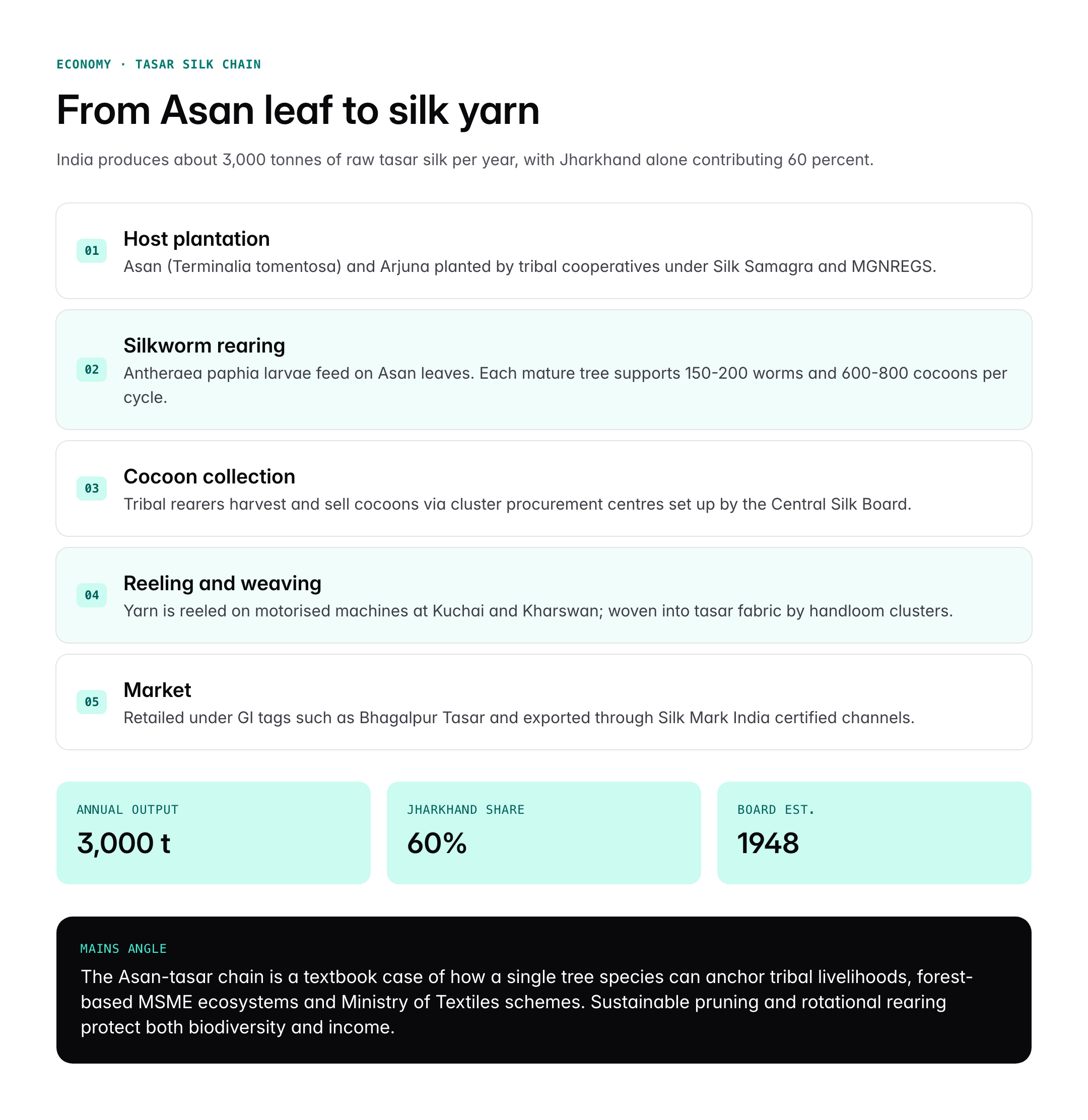
On the economic side the tree drives the tasar silk value chain. Central Silk Board data indicate that India produces around 3,000 tonnes of raw tasar silk annually, of which Jharkhand alone contributes about 60 percent. A single mature Asan tree can support 150 to 200 silkworms per rearing cycle and yield 600 to 800 usable cocoons. Tribal cooperatives such as the Kharswan and Kuchai clusters, supported under the Mahatma Gandhi National Rural Employment Guarantee Scheme and the Silk Samagra scheme of the Ministry of Textiles, plant Asan and Arjuna as a combined host base.
Timber harvest is regulated under state forest working plans. The species is not in the CITES appendices, but state rules in Madhya Pradesh and Chhattisgarh classify it as a royalty-bearing timber. Recent pressure has come from plywood mills in Yavatmal, Balaghat and Seoni districts. The Indian Council of Forestry Research and Education has advocated rotational felling of 80 to 100 years to maintain seed-bearing mother trees.
In traditional medicine, bark decoctions are documented in Ayurvedic texts such as the Bhavaprakasha Nighantu for cardiotonic, haemostatic and antidiabetic use. Phytochemical surveys at CSIR laboratories have identified ellagic acid, gallic acid and arjunolic acid in bark extracts, prompting patent applications on lipid-lowering formulations.
Comparative Perspective
Aspirants often confuse Terminalia tomentosa with its close relatives. The table below disambiguates the commercially important species of the genus.
| Species | Common name | Bark | Principal use |
|---|---|---|---|
| Terminalia tomentosa | Indian Laurel / Asan | Crocodile-fissured, black | Tasar host, timber |
| Terminalia arjuna | Arjuna | Smooth, whitish, flaking | Cardiac medicine, tasar |
| Terminalia bellirica | Baheda | Bluish-grey, small fissures | Triphala ingredient |
| Terminalia chebula | Haritaki | Brownish, longitudinal cracks | Triphala, tanning |
| Terminalia catappa | Indian Almond | Smooth, light grey | Shade, edible kernel |
Compared with teak, the Indian Laurel has lower commercial timber value but a wider ecological amplitude, tolerating shallower soils and higher fire frequencies. Against sal, Asan dominates in drier rainfall regimes of 900 to 1,500 millimetres, while sal prefers moister zones above 1,500 millimetres.
Challenges and Criticisms
The Indian Laurel faces a quiet crisis despite its Least Concern IUCN listing. Working plans across Madhya Pradesh and Maharashtra report declining regeneration, with seedling recruitment below sustainable replacement levels in nearly 40 percent of sampled compartments. Causes include heavy leaf extraction for tasar rearing, cattle browsing, repeated anthropogenic fires and illicit felling for the plywood market.
A second concern is taxonomic. The name Terminalia tomentosa has been widely replaced by Terminalia elliptica in global databases such as Plants of the World Online maintained by Kew, but Indian forest departments and silk board publications continue to use tomentosa, creating data-reporting confusion in biodiversity registers.
Tasar sericulture itself raises debates. Intensive leaf pruning for cocoon rearing can reduce photosynthetic capacity and flowering, limiting natural regeneration. Civil society groups working in Simdega and Saraikela have called for rotational pruning quotas. Finally, climate model projections from the Indian Institute of Tropical Meteorology suggest that dry deciduous forests may shift northward by 100 to 200 kilometres by 2070, potentially contracting Asan range in peninsular India.
Prelims Pointers
- Scientific name: Terminalia tomentosa, synonym Terminalia elliptica.
- Family: Combretaceae.
- Common names: Asan, Saj, Sadar, Matti, Marda.
- Host plant of: Antheraea paphia, the tasar silkworm.
- Forest type: Tropical Dry Deciduous, Champion and Seth classification group 5.
- Fruit type: five-winged samara.
- Diagnostic feature: deeply fissured crocodile-skin black bark.
- Traditional medicine use: cardiotonic and haemostatic bark decoctions.
- Main tasar-producing state: Jharkhand, about 60 percent of Indian output.
- Regulatory body for silk: Central Silk Board, established 1948, Ministry of Textiles.
- Major scheme supporting Asan plantations: Silk Samagra of the Ministry of Textiles.
- IUCN Red List status: Least Concern.
Mains Practice Questions
- Examine the ecological and economic significance of Terminalia tomentosa in the tropical dry deciduous forests of central India. (250 words)
- Ecological role in soil stabilisation, fire tolerance, and association with teak-dominated forests.
- Economic role as tasar host, timber species, and source of tannins for tribal livelihoods.
- Threats from over-pruning, illicit felling, and climate-induced range shifts.
- Discuss how tasar sericulture linked to the Indian Laurel tree can be leveraged for tribal livelihoods in the Chota Nagpur plateau. (150 words)
- Employment linkage via MGNREGS and Silk Samagra schemes.
- Cluster model of cooperatives in Jharkhand and Odisha.
- Need for rotational pruning and sustainable host management.
Conclusion
The Indian Laurel tree is a quiet workhorse of Indias dry deciduous forests, holding together soil, canopy, silk economy and tribal cultural memory in equal measure. Its unmistakable crocodile bark, coppery spring flush and five-winged fruits make it a staple of central Indian landscapes from the Satpuras to the Eastern Ghats. For administrators and foresters, protecting and regenerating Asan forests is not an optional ecological goal but a prerequisite for sustaining the tasar value chain and the catchment hydrology of peninsular rivers.
For the UPSC aspirant, Terminalia tomentosa is a useful single-species case study that unites environment, rural economy, tribal affairs and scientific classification. Memorising its crocodile-skin bark and tasar host role will pay dividends on Prelims MCQs; reasoning about regeneration failures, CAMPA funding and climate shifts will anchor high-quality GS3 answers in the Mains arena.
Frequently Asked Questions
What is the Indian Laurel Tree?
The Indian Laurel Tree is Terminalia tomentosa, also accepted as Terminalia elliptica, a large deciduous tree of the Combretaceae family native to India. It grows up to 30 metres, sports a distinctive crocodile-skin fissured bark, and dominates tropical dry deciduous forests across central and peninsular India alongside teak and sal.
Why is the Indian Laurel Tree important for UPSC?
It is a high-yield single-topic question because it links GS3 environment, GS1 geography and tribal economy. It is the principal host plant of the tasar silkworm, a CAMPA afforestation species, and a bioindicator of dry deciduous forest health, making it relevant for Prelims factual MCQs and Mains answers on forestry and tribal livelihoods.
How is the Indian Laurel Tree related to tasar silk production?
The Indian Laurel, locally called Asan or Saj, is the primary host plant of Antheraea paphia, the tasar silkworm. Tribal rearers in Jharkhand, Chhattisgarh, Odisha and West Bengal feed silkworms on its leaves, producing around 3,000 tonnes of raw tasar silk annually. The Central Silk Board supports Asan plantations under the Silk Samagra scheme.
What are the identifying features of the Indian Laurel Tree?
The diagnostic features are a deeply fissured, crocodile-skin black bark, opposite oblong leathery leaves with petiolar glands, cream-yellow panicle flowers with a strong smell blooming May to July, and a distinctive five-winged samara fruit ripening November to December. Coppery-red spring flush in April is another easy field marker.
Where is the Indian Laurel Tree distributed in India?
It is widespread across the tropical dry deciduous belt of central India, the Deccan plateau and sub-Himalayan tracts. Major concentrations occur in Madhya Pradesh, Chhattisgarh, Maharashtra, Jharkhand, Odisha, and parts of Andhra Pradesh, Karnataka and Tamil Nadu. It prefers rainfall between 900 and 1,500 millimetres and tolerates shallow lateritic soils.
What are the medicinal uses of the Indian Laurel Tree?
Ayurvedic texts such as the Bhavaprakasha Nighantu document bark decoctions as cardiotonic, haemostatic and antidiabetic. Modern phytochemistry has isolated ellagic acid, gallic acid and arjunolic acid from its bark, with research interest in lipid-lowering and wound-healing formulations. Tribes also use bark powder for tanning hides and dyeing cotton yarn.
How is Terminalia tomentosa different from Terminalia arjuna?
Both are Terminalia species used in tasar rearing but differ sharply in bark. Terminalia tomentosa has a dark, deeply fissured crocodile-skin bark and is mainly a timber and tasar host. Terminalia arjuna has smooth whitish flaking bark, grows along rivers, and is famed for cardiac medicine. Asan prefers drier uplands while Arjuna occupies moist riparian tracts.
What is the conservation status of the Indian Laurel Tree?
The IUCN Red List classifies Terminalia elliptica as Least Concern because of its wide distribution. However, working plans in Madhya Pradesh and Maharashtra report poor regeneration in nearly 40 percent of sampled forest compartments due to over-pruning, fire, cattle browsing and illegal felling for plywood, suggesting latent pressures that warrant proactive silvicultural management.
Tell Google you want more of this.
Add Anantam IAS as a preferred sourceOne tap, and this site shows up more often in your own Top Stories, AI Overviews and AI Mode. Remove it any time.