Introduction
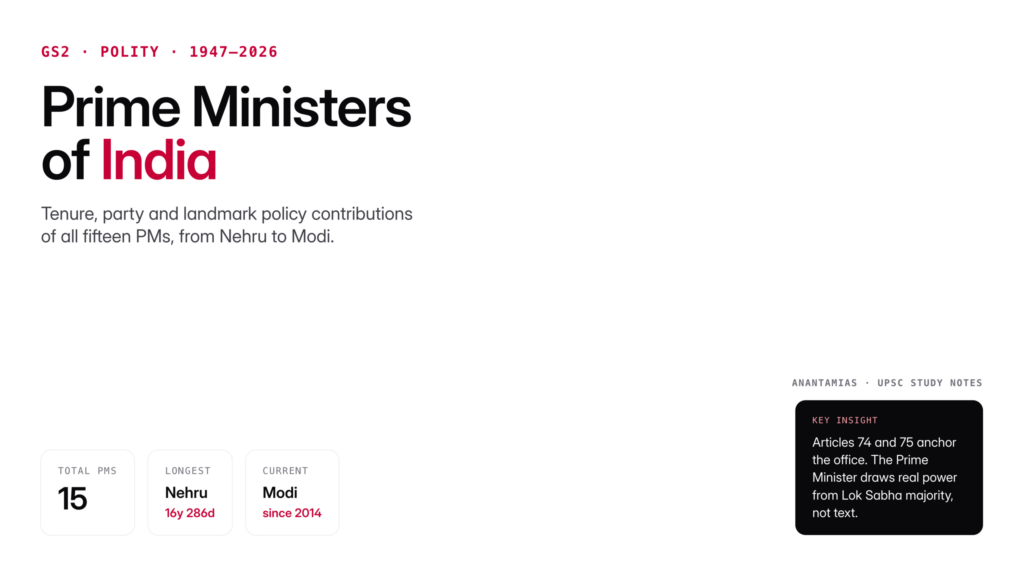
The office of the Prime Minister of India sits at the very apex of the Union executive. Since 15 August 1947, fifteen individuals have held the post, shaping the political, economic and strategic trajectory of the world’s largest democracy. A clear, chronological grasp of the Indian prime minister list, including tenure, party, constituency and signature policy contributions, is a non-negotiable part of UPSC Prelims preparation and a recurring anchor in Mains General Studies Paper II.
This reference brings together every Prime Minister from Jawaharlal Nehru to Narendra Modi, plus the handful of acting incumbents. It also situates each leadership tenure within its constitutional, economic and foreign-policy context so aspirants can connect factual recall with analytical argument on questions dealing with coalition governance, cabinet form of government and the evolving role of the Prime Minister’s Office (PMO).
Quick Facts at a Glance
| Parameter | Detail |
|---|---|
| Constitutional basis | Articles 74 and 75 of the Constitution |
| First Prime Minister | Jawaharlal Nehru (15 August 1947) |
| Longest serving | Jawaharlal Nehru, 16 years 286 days |
| Shortest serving | Gulzarilal Nanda, 13 days (acting) |
| First woman PM | Indira Gandhi (1966) |
| Youngest PM | Rajiv Gandhi, age 40 |
| Oldest on assumption | Morarji Desai, age 81 |
| Total PMs (till 2026) | 15 (excluding acting tenures) |
| Current PM | Narendra Modi (since 26 May 2014) |
| Appointing authority | President of India |
Background and Historical Context
The Prime Minister is the head of government in India’s parliamentary, Westminster-derived system. While Article 74 makes the Council of Ministers, headed by the Prime Minister, the body that aids and advises the President, Article 75 lays down that the Prime Minister shall be appointed by the President and other Ministers shall be appointed on the Prime Minister’s advice. The office draws its primacy from convention, from control of the Lok Sabha majority, and from the Prime Minister’s role as the principal channel of communication between the Union Cabinet and the President.
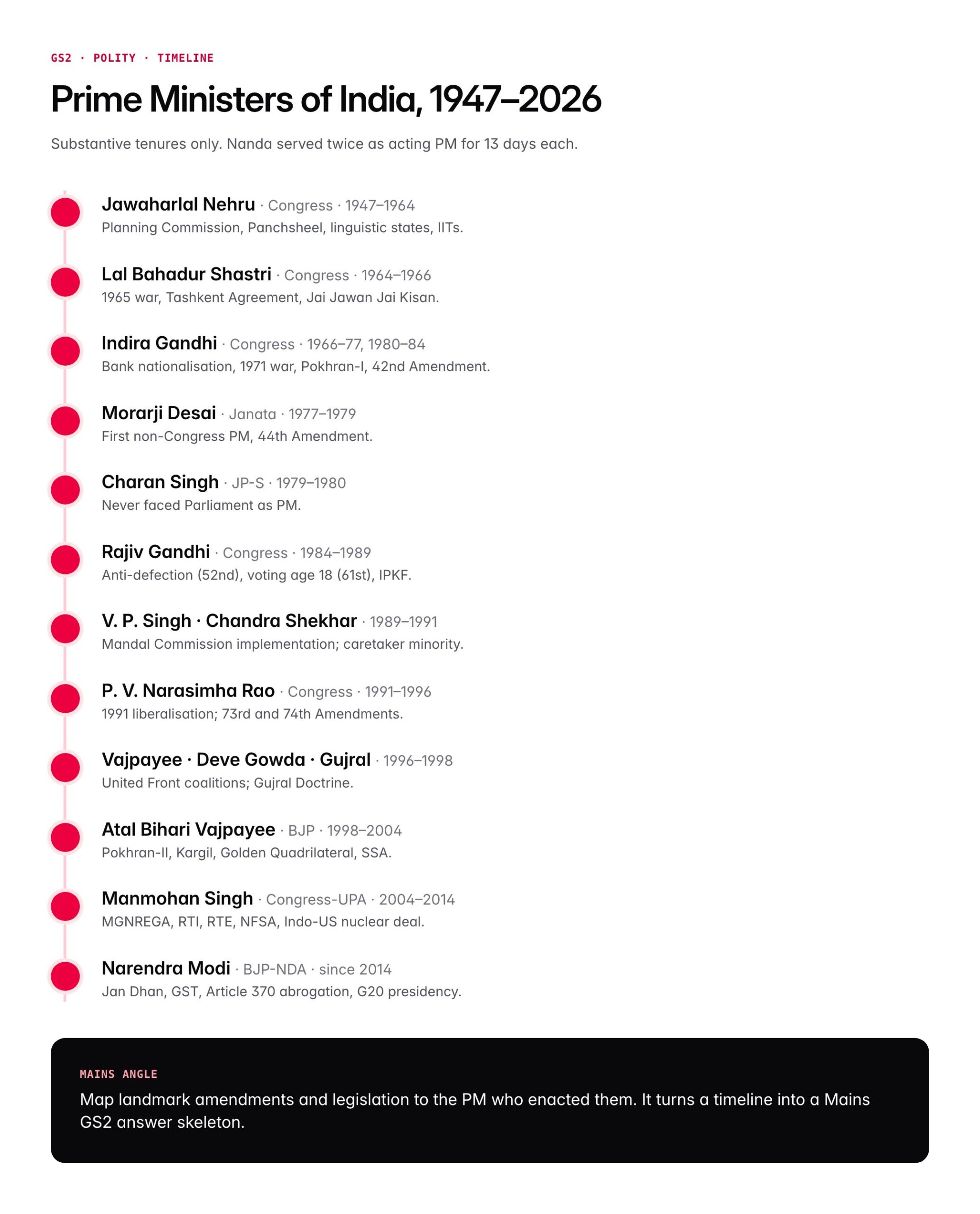
The first Prime Minister, Jawaharlal Nehru, took office on 15 August 1947, and his seventeen-year tenure set the foundational template of planning, non-alignment and scientific temper. Lal Bahadur Shastri‘s brief but consequential term saw the 1965 war and the coining of the slogan Jai Jawan Jai Kisan. Indira Gandhi dominated the 1966–1984 period with only a brief interruption during the Janata Party interlude (1977–1979), which produced the Morarji Desai and Charan Singh governments.
The 1990s ushered in the era of coalition politics. P. V. Narasimha Rao’s minority government initiated the 1991 economic liberalisation. Atal Bihari Vajpayee led the first non-Congress full-term government (1999–2004). Manmohan Singh served two full terms at the head of the United Progressive Alliance (2004–2014), and Narendra Modi has led Bharatiya Janata Party governments since 2014, securing third-term continuity in 2024. Understanding this arc is essential for situating constitutional amendments, landmark legislation and doctrinal shifts in Indian foreign policy.
Key Facts: Full List of Prime Ministers
Founding Era (1947–1977)
Jawaharlal Nehru (Congress) served from 15 August 1947 to 27 May 1964, the longest tenure in Indian history. His government steered the Constitution’s commencement in 1950, the First Five-Year Plan (1951), Panchsheel (1954) and the formation of linguistic states (1956).
Gulzarilal Nanda acted twice as Prime Minister, in 1964 and 1966, for thirteen days each after the deaths of Nehru and Shastri respectively. Nanda is not counted in the official numeric sequence of substantive Prime Ministers.
Lal Bahadur Shastri (Congress) served from 9 June 1964 to 11 January 1966. He led India through the 1965 Indo-Pak war, signed the Tashkent Agreement, and gave the enduring slogan Jai Jawan Jai Kisan.
Indira Gandhi (Congress) served in two stints: 24 January 1966 to 24 March 1977, and 14 January 1980 to 31 October 1984. Her tenure covered bank nationalisation (1969), the Bangladesh Liberation War (1971), Pokhran-I (1974), the Emergency (1975–1977) and Operation Blue Star (1984).
Janata and Coalition Interlude (1977–1998)
Morarji Desai (Janata Party) served from 24 March 1977 to 28 July 1979 as the first non-Congress PM. Charan Singh (Janata Party Secular) held office from 28 July 1979 to 14 January 1980 without ever facing Parliament. Rajiv Gandhi (Congress) served from 31 October 1984 to 2 December 1989 and oversaw the Anti-Defection Law (52nd Amendment), Panchayati Raj push, and IPKF deployment.
V. P. Singh (Janata Dal, December 1989 to November 1990) implemented Mandal Commission recommendations. Chandra Shekhar (Samajwadi Janata Party, November 1990 to June 1991) led a minority caretaker government.
P. V. Narasimha Rao (Congress, 1991–1996) presided over the 1991 economic reforms alongside Finance Minister Manmohan Singh. Atal Bihari Vajpayee served a 13-day term in 1996, and H. D. Deve Gowda (Janata Dal, 1996–1997) and I. K. Gujral (Janata Dal, 1997–1998) headed United Front governments.
Coalition Stability and BJP Era (1998–2026)
Atal Bihari Vajpayee (BJP) returned from 1998 to 1999 and then served a full term from 1999 to 2004, conducting Pokhran-II (1998), the Kargil War (1999), the Golden Quadrilateral project and Sarva Shiksha Abhiyan.
Manmohan Singh (Congress-led UPA) served two terms from 2004 to 2014, overseeing MGNREGA, Right to Information Act, Right to Education Act, the US civil nuclear deal and Aadhaar rollout.
Narendra Modi (BJP-led NDA) has served since 26 May 2014, winning third-term re-election in 2024. Signature initiatives include Jan Dhan Yojana, GST rollout (2017), demonetisation (2016), abrogation of Article 370 (2019), CAA (2019), and the G20 presidency (2023).
Significance for UPSC and General Knowledge
- Tests routinely ask about tenure, party and constituency of specific Prime Ministers, especially short-term incumbents like Charan Singh and Chandra Shekhar.
- Mains GS2 questions on cabinet form of government, collective responsibility and PMO expansion directly reference PM office evolution.
- The list anchors indirect questions on landmark legislation and constitutional amendments such as the 42nd, 44th, 52nd, 73rd, 74th, 101st and 103rd amendments.
- Foreign policy doctrines, from Panchsheel to the Gujral Doctrine and the Modi Doctrine, are tagged to individual Prime Ministers.
- The five-yearly General Election cycle, Lok Sabha strength and coalition arithmetic are easier to revise when mapped onto the PM timeline.
- Awareness of PMs aids essay paper topics on leadership, democracy and institutional legacy.
Detailed Analysis: Political Contributions and Policy Legacies
A policy-weighted review of the Indian prime minister list reveals distinct governing paradigms. Nehru institutionalised planning, parliamentary conventions and scientific institutions such as the Atomic Energy Commission and the Indian Institutes of Technology. Shastri, despite a short tenure, operationalised the Food Corporation of India (1965) and initiated the Green Revolution under C. Subramaniam.
Indira Gandhi reshaped the Centre-State balance with the 42nd Amendment (1976), nationalised 14 banks in 1969, abolished privy purses in 1971 and conducted India’s first nuclear test at Pokhran in May 1974. The Emergency (25 June 1975 to 21 March 1977) remains a central case study on fundamental rights suspension, and the 44th Amendment (1978) under Morarji Desai restored several safeguards, including making proclamation of Emergency subject to written Cabinet advice.
Rajiv Gandhi’s legacy rests on the 52nd Amendment (anti-defection, 1985), the 61st Amendment (voting age reduced to 18, 1988), the National Policy on Education (1986) and the push to informatics through C-DOT and TIFAC. V. P. Singh implemented Mandal Commission recommendations (1990), triggering reservation for Other Backward Classes in central government jobs.
Narasimha Rao and Manmohan Singh, as PM and Finance Minister respectively, dismantled the licence-permit Raj in July 1991 through the New Industrial Policy, devaluing the rupee, abolishing industrial licensing for most sectors and opening up to foreign direct investment. Vajpayee prioritised infrastructure with the Golden Quadrilateral and nuclear deterrence through the second Pokhran tests and the Nuclear Doctrine (2003).
Manmohan Singh’s UPA decade legislated rights-based welfare: MGNREGA (2005), Right to Information (2005), Forest Rights Act (2006), Right to Education (2009) and the National Food Security Act (2013). Modi’s tenures combine financial inclusion (Jan Dhan, Mudra), indirect tax reform (GST, 2017), direct benefit transfer scale-up, strategic assertion (surgical strikes 2016, Balakot 2019), the abrogation of Article 370 (5 August 2019), and digital public infrastructure exports.
Comparative Perspective
Compared with other Westminster democracies, the Indian prime ministership is more executive-centric than the British or Australian counterparts, largely because the PMO has grown into a nodal policymaking hub since Indira Gandhi’s time. The average tenure, however, is shorter than the American presidency due to coalition volatility between 1989 and 1999.
| Country | Head of Government | Avg Tenure (years) | Term Limit | Selection |
|---|---|---|---|---|
| India | Prime Minister | ~4.5 | None | Lok Sabha majority |
| United Kingdom | Prime Minister | ~4 | None | House of Commons majority |
| United States | President | 4 | 2 terms | Electoral college |
| Canada | Prime Minister | ~5 | None | House of Commons majority |
| Japan | Prime Minister | ~2 | None | Diet majority |
India’s structure allows mid-term change of Prime Minister without fresh elections, as seen in 1979, 1984, 1991, 1997 and 2004. The stability of a single-party majority, re-established in 2014, 2019 and 2024, marks a return to the Nehru-era pattern after two decades of coalition governments.
Controversies and Debates
The office of the Prime Minister has been at the centre of several controversies. The 1975 Emergency raised enduring questions about executive overreach, press freedom and the independence of the judiciary, culminating in the Shah Commission report. Rajiv Gandhi’s tenure was shadowed by the Bofors case, which influenced the 1989 general election outcome.
The anti-defection framework, the role of the Governor in recommending who should be invited to form government, and the convention of the PM being a Lok Sabha member have all produced debates. The appointment of Manmohan Singh, a Rajya Sabha member, as Prime Minister in 2004 was criticised but was constitutionally valid, since the Constitution only requires that the PM be a member of either House within six months.
More recent debates include the expanding footprint of the PMO, the use of executive ordinances, and the perceived centralisation of policymaking. Balanced preparation for GS Paper II requires aspirants to engage with both the case for strong prime ministerial leadership and the concerns about institutional checks and balances.
Prelims Pointers
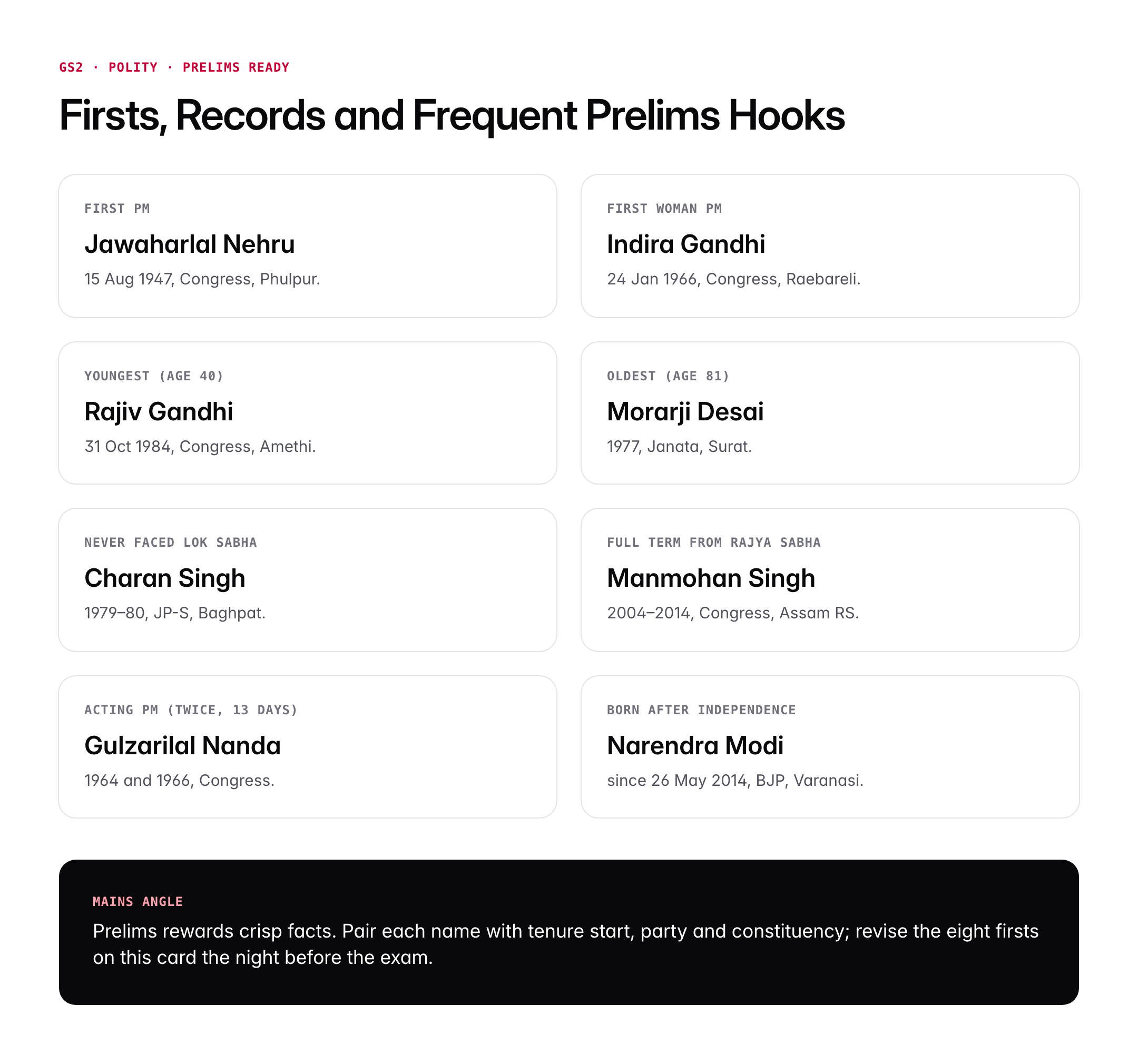
- India has had 15 Prime Ministers (excluding acting tenures) as of 2026.
- Jawaharlal Nehru’s tenure of 16 years 286 days is the longest.
- Gulzarilal Nanda served as acting Prime Minister twice, each time for 13 days.
- Indira Gandhi was the first and, so far, only woman Prime Minister.
- Rajiv Gandhi, at 40, was the youngest to assume office.
- Morarji Desai, at 81, was the oldest to assume office.
- Morarji Desai was the first non-Congress Prime Minister.
- Charan Singh never faced the Lok Sabha as Prime Minister.
- Manmohan Singh was the first Rajya Sabha member to serve a full PM tenure.
- Narendra Modi is the first PM born after Independence.
- Article 75(5) requires the PM to be a member of either House within six months.
- The PM is appointed by the President under Article 75(1).
Mains Practice Questions
Q1. The Prime Minister of India is the linchpin of the Union Executive. Discuss with reference to constitutional provisions and evolving conventions. (15 marks, 250 words)
- Start with Articles 74 and 75 and the position of the PM as head of Council of Ministers and principal adviser to the President.
- Highlight conventions: leader of majority party in Lok Sabha, selection of ministers, chairing Cabinet, allocation of portfolios, coordination through PMO and NITI Aayog.
- Conclude with case studies of coalition era adjustments, anti-defection and the debate over centralisation versus cabinet government.
Q2. Coalition politics between 1989 and 1999 transformed the nature of prime ministerial authority in India. Examine. (10 marks, 150 words)
- Trace PMs from V. P. Singh to Vajpayee 1998, noting short tenures, minority governments and reliance on regional allies.
- Explain impact: federalisation, common minimum programmes, role of regional parties, 73rd and 74th amendments under Rao, economic liberalisation.
- Evaluate the consequence of dilution of PM’s discretion and how post-2014 single-party majorities have reversed this.
Conclusion
From Jawaharlal Nehru to Narendra Modi, the list of Indian Prime Ministers mirrors the arc of the Republic itself, from the founding moment through the Emergency, liberalisation, coalition recalibration and the current phase of assertive governance. Each incumbent has shaped a distinct mix of constitutional conventions, legislative milestones and foreign-policy postures that the UPSC syllabus constantly revisits.
For aspirants, internalising this timeline is less about rote memorisation and more about mapping decisions to decision-makers. A well-indexed Indian prime minister list becomes a skeleton on which the flesh of legislation, amendments and Supreme Court cases can be hung, producing answers that are factually precise and argumentatively coherent in both Prelims and Mains.
Frequently Asked Questions
What is the Indian prime minister list from 1947 to 2026?
India has had 15 Prime Ministers since 1947: Jawaharlal Nehru, Lal Bahadur Shastri, Indira Gandhi, Morarji Desai, Charan Singh, Rajiv Gandhi, V. P. Singh, Chandra Shekhar, P. V. Narasimha Rao, Atal Bihari Vajpayee, H. D. Deve Gowda, I. K. Gujral, Manmohan Singh and Narendra Modi. Gulzarilal Nanda served twice as acting PM.
Who was the first Prime Minister of India?
Jawaharlal Nehru was the first Prime Minister, taking office on 15 August 1947. He served for 16 years and 286 days, the longest tenure in Indian history, and shaped institutions such as the Planning Commission, non-alignment and linguistic reorganisation of states.
Why is the Indian prime minister list important for UPSC?
The list anchors UPSC Prelims questions on tenure, party and firsts, and structures GS Paper II answers on parliamentary government, cabinet system and coalitions. Policy milestones from the 42nd Amendment to GST are tied to specific Prime Ministers, so chronological mastery supports both factual and analytical answers.
How is the Prime Minister related to the President in India?
Under Articles 74 and 75, the President appoints the PM, who leads the Council of Ministers that aids and advises the President. The PM is the principal channel of communication between the Cabinet and the President, and the President must act on the advice of the Council of Ministers except in limited discretionary matters.
Who was the youngest Prime Minister of India?
Rajiv Gandhi was the youngest, assuming office on 31 October 1984 at the age of 40. He led Congress to its largest-ever Lok Sabha majority in the 1984 elections and introduced landmark measures such as the 52nd Amendment on anti-defection and the 61st Amendment lowering voting age to 18.
Has any Prime Minister of India been from the Rajya Sabha?
Yes. Indira Gandhi was briefly a Rajya Sabha member during her first term, and Manmohan Singh served two full terms (2004 to 2014) entirely as a Rajya Sabha member, representing Assam. The Constitution only requires the PM to be a member of either House within six months of appointment.
Who was the first non-Congress Prime Minister of India?
Morarji Desai of the Janata Party, who served from 24 March 1977 to 28 July 1979 after the Congress defeat in the post-Emergency election. He also became the oldest person to assume the office, taking charge at the age of 81, and led the passage of the 44th Amendment.
Who is the current Prime Minister of India in 2026?
Narendra Modi of the Bharatiya Janata Party is the Prime Minister in 2026. He first took office on 26 May 2014 and secured a third consecutive term after the 2024 general elections, representing the Varanasi Lok Sabha constituency. He is the first Prime Minister born after Independence.
Tell Google you want more of this.
Add Anantam IAS as a preferred sourceOne tap, and this site shows up more often in your own Top Stories, AI Overviews and AI Mode. Remove it any time.