Introduction
On 13 September 2019, a week before the 14th anniversary of the Right to Information Act, the Government of Rajasthan launched Jan Soochna Portal at Birla Auditorium in Jaipur. It was the first state-level platform anywhere in India to disclose, in near real time and through a single window, information that citizens would otherwise have filed RTI applications to obtain. For UPSC aspirants working through GS2 on accountability, e-governance and the RTI Act, Jan Soochna is the cleanest Indian case study of Section 4 suo motu disclosure being taken seriously.
The portal operationalises a simple proposition: if information is a public good, the government should publish it first and spare the citizen the cost of a Rs 10 application fee, a 30 day waiting period and a possible appeal. This guide unpacks the portal’s architecture, the civil-society push behind it, the schemes it covers and how aspirants should deploy it in essays and GS2 answers on transparency.
Quick Facts at a Glance
| Item | Detail |
|---|---|
| Name | Jan Soochna Portal (jansoochna.rajasthan.gov.in) |
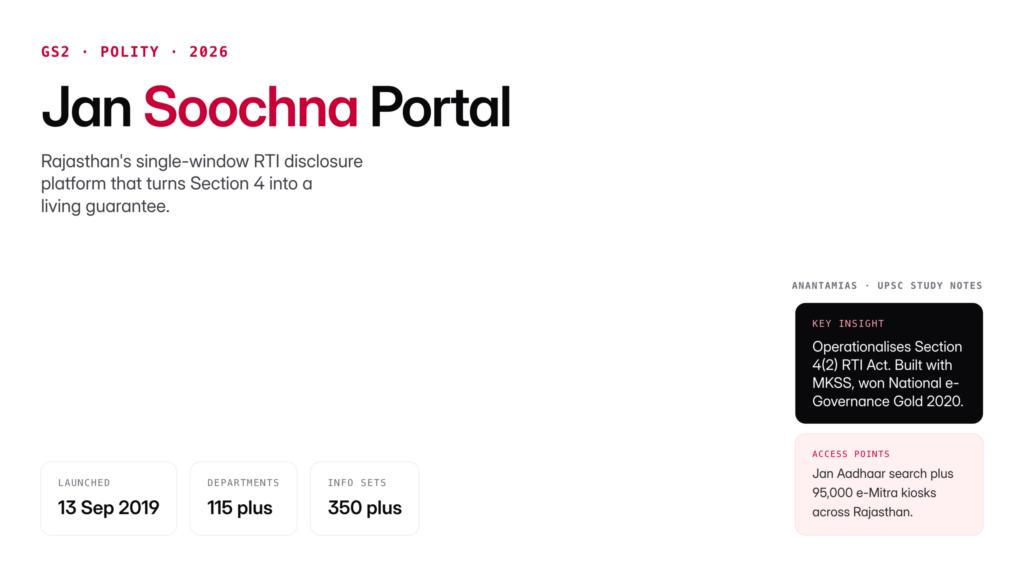
| Launched | 13 September 2019 |
| Launching Chief Minister | Ashok Gehlot |
| Implementing agency | Department of Information Technology and Communication, Rajasthan |
| Civil society partner | Mazdoor Kisan Shakti Sangathan (MKSS), Soochna Evam Rozgar Ka Adhikar Abhiyan |
| Statutory anchor | Section 4(2), Right to Information Act 2005 |
| Departments onboarded at launch | 13 |
| Departments now covered | 115 plus (as of 2024) |
| Schemes and information sets | 350 plus |
| Mobile app | Jan Soochna (Android and iOS) |
| Languages | Hindi and English |
Background and Historical Context
The Right to Information Act, passed by Parliament in 2005, emerged from a movement that was itself born in Rajasthan. In the 1990s the Mazdoor Kisan Shakti Sangathan led by Aruna Roy, Nikhil Dey and Shankar Singh pioneered the jan sunwai or public hearing in districts like Rajsamand, demanding muster rolls and bill vouchers from panchayats. Those public hearings exposed ghost workers, inflated measurements and contractor fraud, seeding the demand for a statutory right to information.
The 2005 Act codified the right but concentrated the delivery mechanism in the hands of Public Information Officers who processed applications one by one. Section 4 of the Act required proactive disclosure of 17 categories of information, but compliance across Indian states was weak. A 2018 assessment by the Research Assessment and Analysis Group noted that most state websites met less than half the Section 4 obligations.
Rajasthan’s civil society returned to the original insistence that information should flow outward by default. In 2017 and 2018 the MKSS led a series of Soochna Ke Adhikar Yatra rallies, raising the slogan “hamara paisa, hamara hisab” (our money, our accounts). The Gehlot government, returning to power in December 2018, committed in its common minimum programme to operationalise Section 4 through a single portal. The Department of Information Technology built the backend, while the civil society collective co-designed the information architecture, and the portal went live within nine months.
The historical arc is therefore continuous: from jan sunwai in the 1990s, to the RTI Act in 2005, to Jan Soochna in 2019. UPSC Mains answers that situate the portal within this movement trajectory score higher than those that treat it as a stand-alone e-governance launch.
Key Features and Provisions
Single Window Architecture
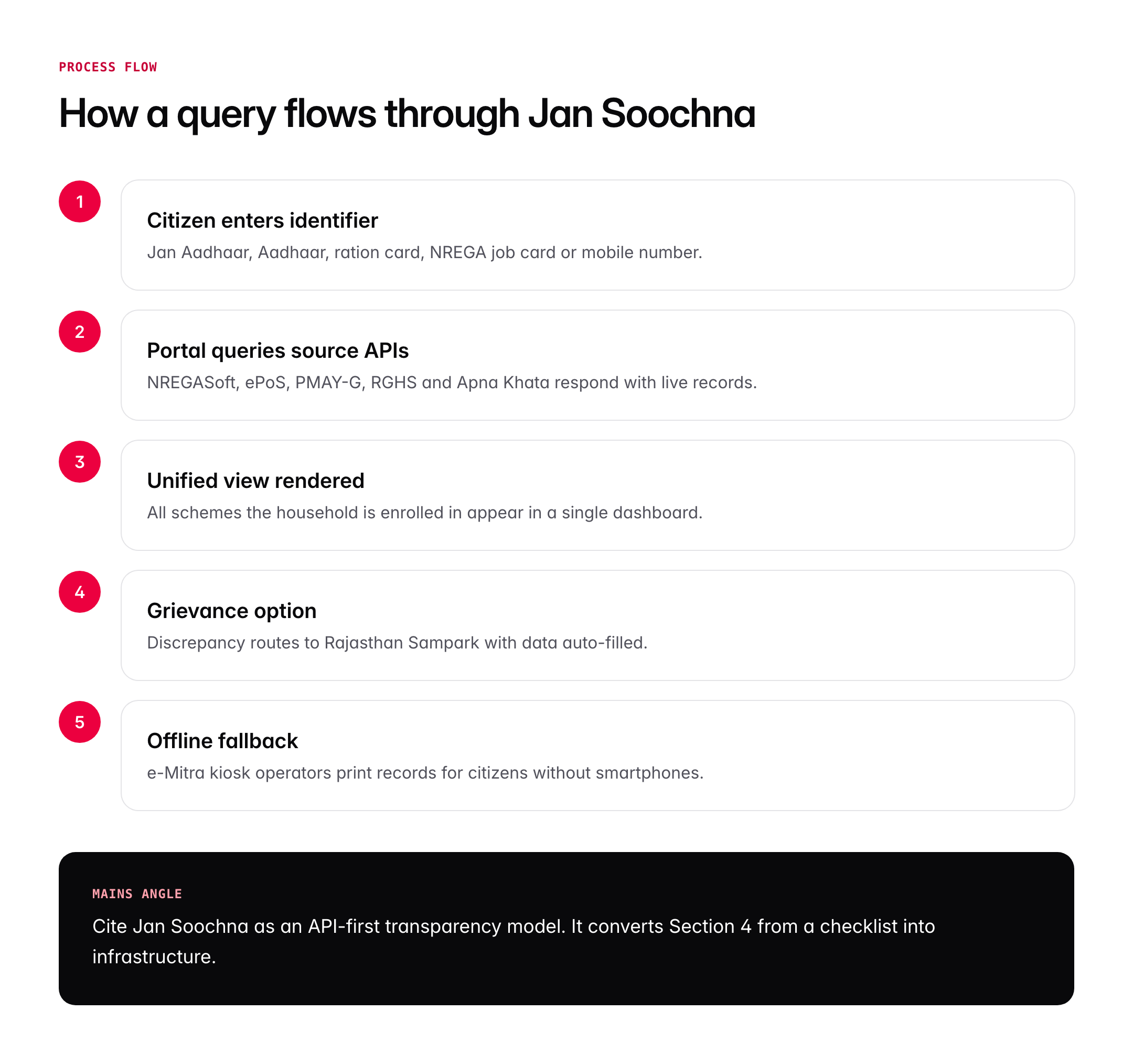
Jan Soochna pulls data from departmental databases through APIs rather than asking departments to upload PDFs. This ensures that information updates with the source system. A citizen searching for an NREGA muster roll, a ration card status or a pension disbursement sees the current record, not a dated upload.
Department and Scheme Coverage
At launch the portal covered 13 departments including Rural Development, Social Justice, Food and Civil Supplies, Medical and Health, and Panchayati Raj. It has since expanded to over 115 departments and more than 350 information sets. Flagship coverage includes MGNREGA job cards and muster rolls, the National Food Security Act ration cards, the Pradhan Mantri Awas Yojana-Gramin beneficiary lists, Palanhar scheme pensions, scholarship disbursements and mining leases.
Citizen Facing Design
The portal offers search by Aadhaar number, Jan Aadhaar family ID, ration card number, job card number or mobile number. A citizen can therefore pull the entire bouquet of schemes their household is enrolled in from a single query. The interface is available in Hindi and English, with village and panchayat level filters.
Grievance Redressal Integration
Jan Soochna is linked to the Rajasthan Sampark grievance portal. When a citizen finds a discrepancy, say a pension not credited despite sanction, the grievance can be filed directly from the same interface with the data auto-populated. The state also ties in the RGHS health scheme data and the Indira Gandhi Shahari Rozgar Guarantee Yojana records launched in 2022.
Jan Soochna Kiosks
Outside the online interface, Jan Soochna information is displayed at 95,000 plus kiosks and common service centres called e-Mitras across Rajasthan. This is critical because mobile internet penetration in rural Rajasthan, while rising, remains uneven.
Significance for UPSC and General Knowledge
- Direct GS2 relevance under Transparency, Accountability, Citizens’ Charter and e-Governance.
- Worked example of Section 4(2) of the RTI Act being operationalised rather than cited rhetorically.
- Illustrates co-production of public services with civil society, a theme in second ARC recommendations.
- Useful in Ethics GS4 under public service values, integrity and reducing opportunities for corruption.
- Connects with Digital India, JAM trinity and DBT architecture.
- Comparable to other state transparency portals, giving aspirants a ready comparative framework.
State-wise Transparency Landscape
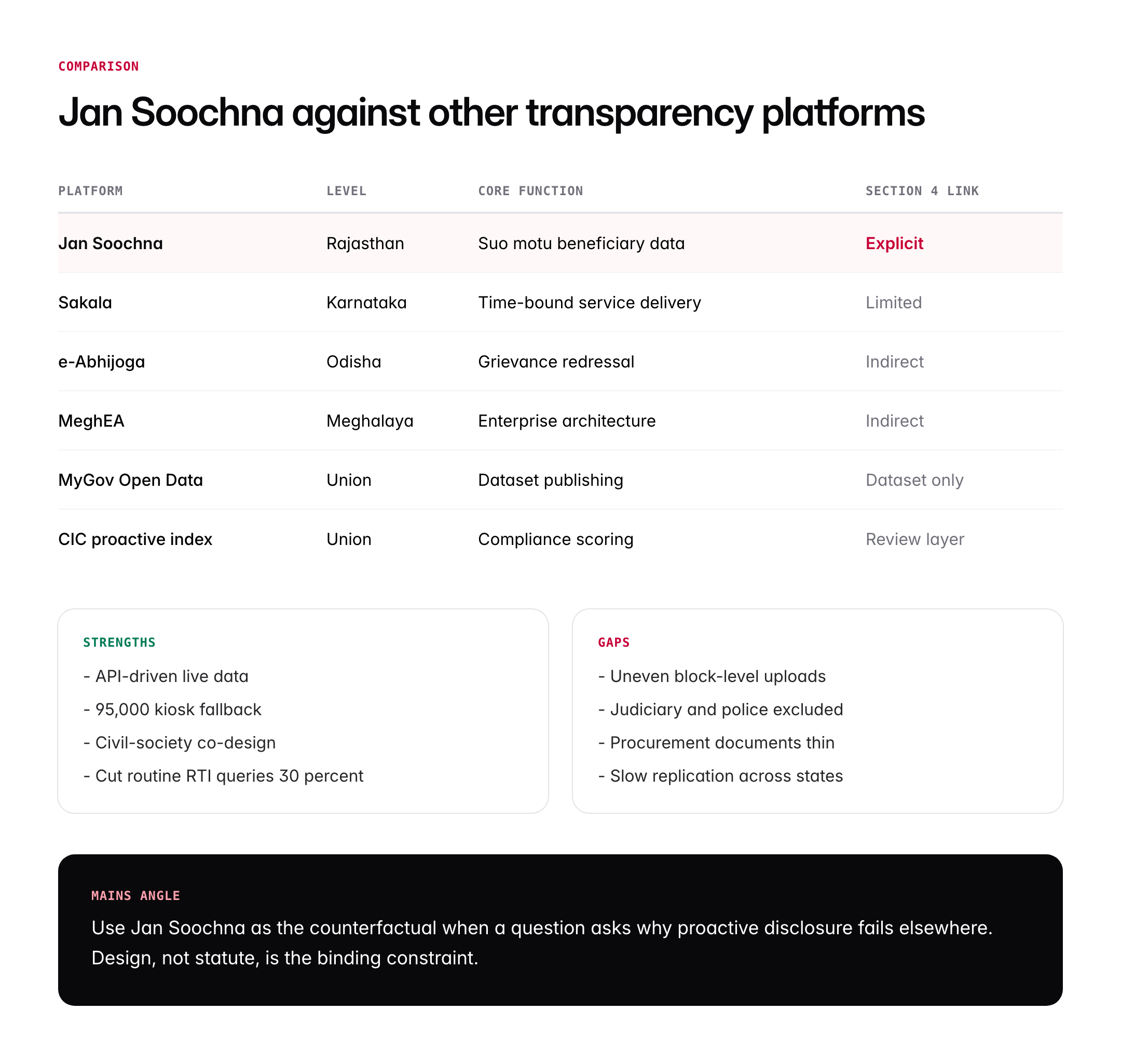
Rajasthan’s Jan Soochna sits within a wider landscape of Indian transparency platforms, but its coverage and design are unusually ambitious. Meghalaya’s MeghEA and Odisha’s e-Abhijoga focus on grievance redressal, Karnataka’s Sakala tracks time-bound service delivery under the Right to Services Act, and the Centre’s MyGov and India Data Portal host datasets but rarely tie them to individual beneficiary status. The Central Information Commission’s annual reports note that proactive disclosure compliance by Union ministries averages below 70 percent on the 17 Section 4 heads.
Within Rajasthan the portal’s reach varies by department. MGNREGA, PDS and social pensions show near-complete coverage because those schemes already had digital backends such as the NREGASoft MIS and the ePoS network. Land records and revenue data are patchier because Apna Khata, the land records portal, is integrated but not always updated in real time. Mining and environment-clearance data have been added more recently after civil-society pressure.
Third-party evaluations have been broadly positive. A 2020 study by the Accountability Initiative at the Centre for Policy Research found that 86 percent of sampled users were able to locate the information they sought on Jan Soochna within five minutes, compared to the weeks typical for an RTI application. A 2022 review in Economic and Political Weekly noted that the portal had reduced the volume of RTI applications on routine benefit queries by roughly 30 percent in pilot districts, freeing Public Information Officers to handle substantive policy questions.
The portal won the National e-Governance Gold Award in 2020 from the Department of Administrative Reforms and Public Grievances and was cited in the United Nations Public Service Day 2021 panels on open government.
Comparative Perspective
| Platform | State or Level | Core Function | Section 4 Link |
|---|---|---|---|
| Jan Soochna Portal | Rajasthan | Suo motu disclosure across schemes | Strong and explicit |
| Meri Pehchaan | Union | Single sign-on for citizen services | Indirect |
| Sakala | Karnataka | Service delivery guarantees | Limited |
| e-Abhijoga | Odisha | Grievance redressal | Indirect |
| MyGov Open Data | Union | Dataset publication | Limited to datasets |
| DIKSHA | Union education | Teacher and learner resources | Not applicable |
Against this field Jan Soochna stands out for three reasons. It is designed around Section 4, not adjacent service guarantees. It publishes beneficiary level data that allows third-party audit. And it was built in partnership with the same civil-society collective that drove the original RTI Act, so the design reflects movement priorities rather than bureaucratic convenience.
Challenges and Criticisms
Jan Soochna has not silenced its critics. First, data quality depends on the source department. MKSS follow-up surveys have found that in some blocks the MGNREGA muster roll data shows fewer person-days than the physical records, suggesting incomplete uploads. Second, the portal has faced sporadic downtime and the Hindi interface has occasional translation gaps, which discourage rural users. Third, critics argue that the portal has made the RTI Act look optional, allowing departments to claim compliance while denying specific queries with the retort that information is already available online. Fourth, extending the model to other states has been slow; Tamil Nadu, Punjab and Chhattisgarh have announced similar portals but coverage is narrower. Finally, the portal does not yet include the judiciary, police complaints or procurement tender details at granular levels, which are often the most contested categories of information. A 2023 audit by the Satark Nagrik Sangathan recommended adding CAG paragraphs, social audit reports and contract documents to the portal.
Prelims Pointers
- Jan Soochna Portal was launched on 13 September 2019 by Chief Minister Ashok Gehlot.
- The portal operationalises Section 4(2) of the Right to Information Act 2005.
- The civil-society partner is the Mazdoor Kisan Shakti Sangathan led by Aruna Roy.
- At launch the portal covered 13 departments and 23 schemes.
- It now covers more than 115 departments and 350 plus information sets.
- Information can be searched through Jan Aadhaar, Aadhaar or mobile number.
- The portal is available in Hindi and English.
- It is integrated with the Rajasthan Sampark grievance redressal portal.
- It won the National e-Governance Gold Award 2020.
- Physical access is provided through over 95,000 e-Mitra kiosks.
- Rajasthan was the first state to host such a suo motu disclosure platform.
- The portal draws data via APIs from source databases such as NREGASoft and ePoS.
Mains Practice Questions
Q1. “Jan Soochna Portal operationalises Section 4 of the RTI Act in a way that reduces dependence on formal applications.” Discuss. (15 marks)
- Outline the Section 4 mandate and chronic compliance gaps.
- Describe Jan Soochna’s architecture and coverage.
- Evaluate the claim using data on RTI application volumes and third-party audits.
Q2. Examine the role of civil society in co-producing transparency platforms, with special reference to the Mazdoor Kisan Shakti Sangathan and Jan Soochna. (10 marks)
- Trace MKSS from jan sunwai to the RTI Act.
- Show how the 2019 portal was co-designed.
- Assess implications for the second ARC’s governance framework.
Conclusion
Jan Soochna Portal is a useful corrective to the assumption that digital governance is inherently transparent. Many portals publish what is convenient; Jan Soochna publishes what citizens have fought to see. By linking Section 4 of the RTI Act with API driven datasets and physical kiosks, it has shortened the distance between statute and delivery.
For the UPSC aspirant, the portal functions as a ready-made illustration for questions on accountability, e-governance and centre-state innovation. Treat it not as an anecdote but as a governance model that pairs statutory obligation, administrative capability and civic pressure. That is the combination second ARC reports have long recommended, and Rajasthan’s portal shows what it looks like when the combination actually ships.
Frequently Asked Questions
What is Jan Soochna Portal?
Jan Soochna Portal is the Government of Rajasthan’s single-window online platform for proactive disclosure of information under Section 4(2) of the Right to Information Act 2005. Launched on 13 September 2019, it publishes beneficiary-level data on over 350 schemes from 115 plus departments so citizens can access information without filing formal RTI applications.
When and why was Jan Soochna launched?
The portal was launched on 13 September 2019 by Chief Minister Ashok Gehlot, a week before the 14th anniversary of the RTI Act. It responded to civil-society criticism led by Mazdoor Kisan Shakti Sangathan that Section 4 proactive disclosure was weakly implemented, forcing citizens to rely on slow and costly RTI applications.
Why is Jan Soochna important for UPSC aspirants?
Jan Soochna is a worked example for GS2 topics on transparency, accountability, e-governance and citizen charters. Aspirants can cite it when answering questions on RTI implementation, second ARC recommendations, state innovation in governance and the role of civil society in co-producing public platforms.
How is Jan Soochna related to the RTI Act?
The portal operationalises Section 4(2) of the RTI Act, which obligates public authorities to publish 17 categories of information proactively. Instead of responding to applications, Rajasthan publishes the underlying records through APIs from source systems such as NREGASoft and ePoS, so the information is current and free.
What information can citizens access on Jan Soochna?
Citizens can access MGNREGA job cards and muster rolls, National Food Security Act ration card details, PMAY-Gramin beneficiary lists, Palanhar scheme records, old-age pensions, scholarships, mining leases and land records. Queries can be run by Jan Aadhaar, Aadhaar, ration card, job card or mobile number.
Which civil-society group partnered on the portal?
The Mazdoor Kisan Shakti Sangathan (MKSS) led by Aruna Roy, Nikhil Dey and Shankar Singh and the Soochna Evam Rozgar Ka Adhikar Abhiyan were the principal civil-society partners. Their jan sunwai public hearings in the 1990s seeded the broader RTI movement and their campaigns in 2017-18 helped make Jan Soochna a policy commitment.
Has Jan Soochna won any recognition?
Yes. Jan Soochna Portal won the National e-Governance Gold Award 2020 from the Department of Administrative Reforms and Public Grievances and was highlighted at UN Public Service Day 2021 panels as a model of open government. Accountability Initiative and Economic and Political Weekly have published positive evaluations.
What are the main limitations of Jan Soochna?
Limitations include uneven data quality in blocks where source departments lag on uploads, occasional downtime, limited coverage of judiciary, police and procurement data, and the risk that officials invoke the portal to deny specific RTI queries. Other states have been slow to replicate the model at comparable depth.
Tell Google you want more of this.
Add Anantam IAS as a preferred sourceOne tap, and this site shows up more often in your own Top Stories, AI Overviews and AI Mode. Remove it any time.