Introduction
Tucked into the deodar-clad slopes of Mussoorie, the Lal Bahadur Shastri National Academy of Administration, better known by its acronym LBSNAA, is the crucible where India’s senior civil servants are forged. Every aspirant who reads a UPSC interview transcript or watches an officer’s journey will have seen the name. It is the training academy for the Indian Administrative Service, and during the Foundation Course it hosts probationers from the Indian Police Service, Indian Forest Service, Indian Foreign Service and most other All India and Central Services, making it the single largest meeting point of the young Indian bureaucracy.
For UPSC aspirants, LBSNAA matters on three levels. It is a factual topic in GS2 under “civil services” and is regularly referenced in interview discussions, it is the institution that will shape their own career if they clear the examination, and it is a living case study of how the state trains its top administrators. This article walks through the Academy’s history, its campus and facilities, the structure of the Foundation Course and the subsequent phase training, the reforms around Mission Karmayogi, and the debates that surround the institution in 2026.

Quick Facts at a Glance
| Field | Detail |
|---|---|
| Full name | Lal Bahadur Shastri National Academy of Administration |
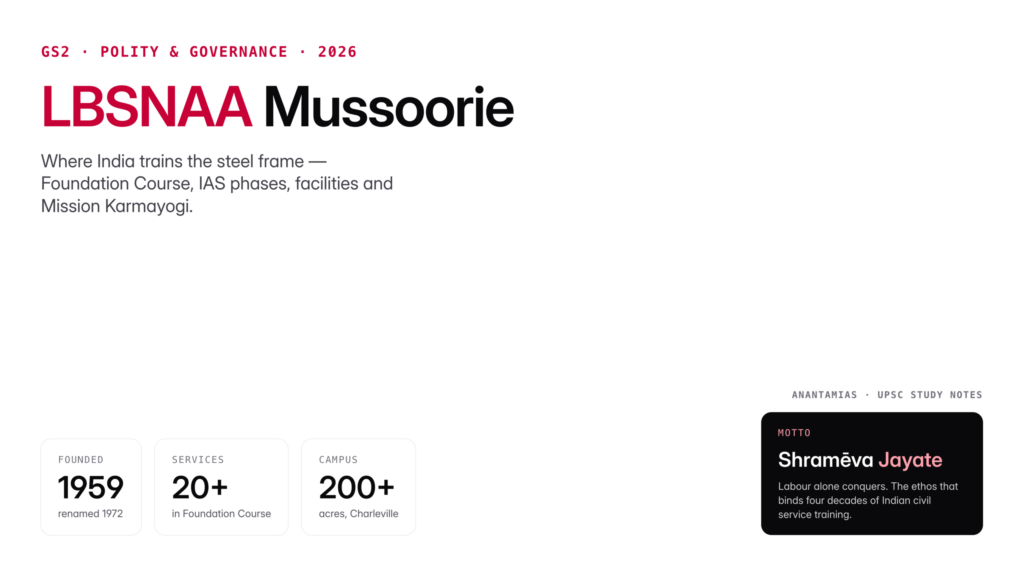
| Established | 1959 (as National Academy of Administration) |
| Renamed | 1972, in honour of former Prime Minister Lal Bahadur Shastri |
| Location | Charleville Estate, Mussoorie, Uttarakhand |
| Parent ministry | Department of Personnel and Training, Ministry of Personnel |
| Current Director (2026) | Sriram Taranikanti, IAS (as per DoPT notification) |
| Main building | Karmashila (formerly Charleville Hotel, 1901 origin) |
| Flagship programme | Foundation Course for All India Services and Central Services |
| Services trained on campus | IAS Phase I and Phase II; Foundation Course for 20+ services |
| Motto | Shramēva Jayate (Labour Alone Conquers) |
Background and Historical Context
The Academy traces its lineage to two earlier institutions. In 1947 the IAS Training School was set up at Metcalfe House, Delhi, under the stewardship of Sardar Vallabhbhai Patel, the first Home Minister. A year later the IAS Staff College was established at Simla to offer mid-career training. In 1958 a review recommended merging the two, and in 1959 the National Academy of Administration was inaugurated at the Charleville Estate in Mussoorie, a former British-era hotel that had hosted viceregal visitors. The Home Minister at the time, Govind Ballabh Pant, presided over the inauguration.
In 1972 Prime Minister Indira Gandhi renamed the institution the Lal Bahadur Shastri National Academy of Administration after the late Prime Minister, whose simple living and high thinking were held up as the model for the Indian civil service. Two decades later the campus was significantly expanded under the Director V. Ramachandran and has since been enlarged with state-of-the-art classrooms, a modern sports complex, a Gandhi Smriti library of over 175,000 volumes and a cyber library cluster.
LBSNAA has always balanced two missions. The first is to transmit the ethos of the “steel frame” founded by Warren Hastings in the late eighteenth century and refined by the Government of India Acts. The second is to renew that frame for the challenges of each decade, from the green revolution of the 1960s to liberalisation in the 1990s, digital government in the 2000s and today’s climate, capacity and Karmayogi reforms. Ministers and committees, including the Second Administrative Reforms Commission (2005-2009), have repeatedly recommended deeper interdisciplinary training, feeding back into the Academy’s evolving syllabus.
Key Features of LBSNAA Training
Foundation Course
The Foundation Course is LBSNAA’s signature programme. It runs for roughly three months each autumn and brings together probationers from the IAS, IPS, IFS (Foreign and Forest), Indian Revenue Service, Indian Audit and Accounts Service, Indian Railway services and others. The course seeks to create an espirit de corps across services before each cadre disperses to its specialised academy. Subjects include public administration, Indian history and constitution, law, management, economics and ethics. Physical training, horse riding, trekking in the Garhwal Himalaya and cultural programmes are integral to the module.
IAS Professional Training — Phase I
After the Foundation Course, IAS probationers remain at Mussoorie for Phase I, a 26-week programme that dives into land revenue, district administration, criminal law, welfare programmes, finance and project management. This is the period when a Bharat Darshan tour takes probationers across the country to witness government at work. Phase I culminates in the allocation of cadres to state cadre groups such as AGMUT, UP or Tamil Nadu.
District Training
The Academy then releases probationers to their allotted states for a year of district training. They serve as Assistant Collectors under the guidance of a District Magistrate, learn revenue settlement, cattle pound administration, tahsil postings and Panchayati Raj coordination. They return to Mussoorie for IAS Phase II after the district attachment.
IAS Phase II and Mid-Career Training Programmes
IAS Phase II consolidates field experience with thematic modules on governance, economy, international relations and technology. Cross-border study tours, comparative administration seminars and dissertation presentations define this phase. Beyond the probationary window, LBSNAA also hosts Mid-Career Training Programmes at the 7-9, 14-16 and 26-28 years of service levels, mandatory for empanelment at the Joint Secretary, Additional Secretary and Secretary equivalents under Department of Personnel and Training rules.
Significance for UPSC and General Knowledge
- Directly tested in Prelims under current affairs and static GK on civil services
- Referenced in Mains GS2 questions on civil services reform and Mission Karmayogi
- Frequently cited in interview discussions on training, integrity and service ethos
- Serves as the institutional link between the Constitution’s Article 312 All India Services and their training delivery
- Provides the context for the Second ARC Report No. 10 on Refurbishing of Personnel Administration
- Aspirants are expected to know the Foundation Course syllabus and the broad phase structure
Detailed Analysis: Campus, Culture and Curriculum
The Charleville Estate that houses LBSNAA spreads over more than 200 acres along the Mussoorie ridge. The principal building, Karmashila, is a Victorian gabled structure preserved as national heritage. Around it cluster Indira Bhawan for senior faculty, the Gandhi Smriti and Darshan Samiti library, the computer centre, the Sri Lal Bahadur Shastri auditorium and a modern gymnasium named after Sardar Patel. Probationers live in seven messes arranged into houses named after Himalayan peaks such as Nilgiri, Annapurna, Kanchenjunga and Dhaulagiri, a touch borrowed from the British regimental system that still shapes Academy social life.
Training pedagogy combines classroom instruction, guest lectures from serving and retired officers, simulation exercises and field visits. A typical day begins with yoga or PT at 0600, followed by three forty-five minute sessions before lunch, then two more in the afternoon and dedicated sports time in the evening. Officers-on-Special-Duty drawn from IAS batches of seven to fifteen years of service run each course, supported by academic faculty in public administration, economics, law and political science. Guest speakers in recent years have included former Cabinet Secretaries, the Comptroller and Auditor General, chief election commissioners and Nobel laureates in economics.
The curriculum has been revised multiple times, most recently to align with Mission Karmayogi, the National Programme for Civil Services Capacity Building launched in 2020. The iGOT Karmayogi digital platform now delivers modular courses that complement the in-person Academy experience, emphasising frameworks, attitudes and role-based competencies. Behavioural modules include empathy, negotiation, digital fluency and crisis communication. The Foundation Course has increasingly incorporated field immersions with NGOs and village homestays to bring probationers closer to the realities of rural India.
Beyond formal training, the Academy offers cultural immersion. The annual Half Marathon on the Mussoorie-Dehradun descent, the 125-km trek to Har-ki-Dun, the cultural evenings showcasing folk arts from different states, and the Republic Day parade at the Polo Ground have become institutional traditions. For many probationers, the friendships forged at LBSNAA survive across three decades of posting, becoming the informal network that the “steel frame” depends on.
Comparative Perspective
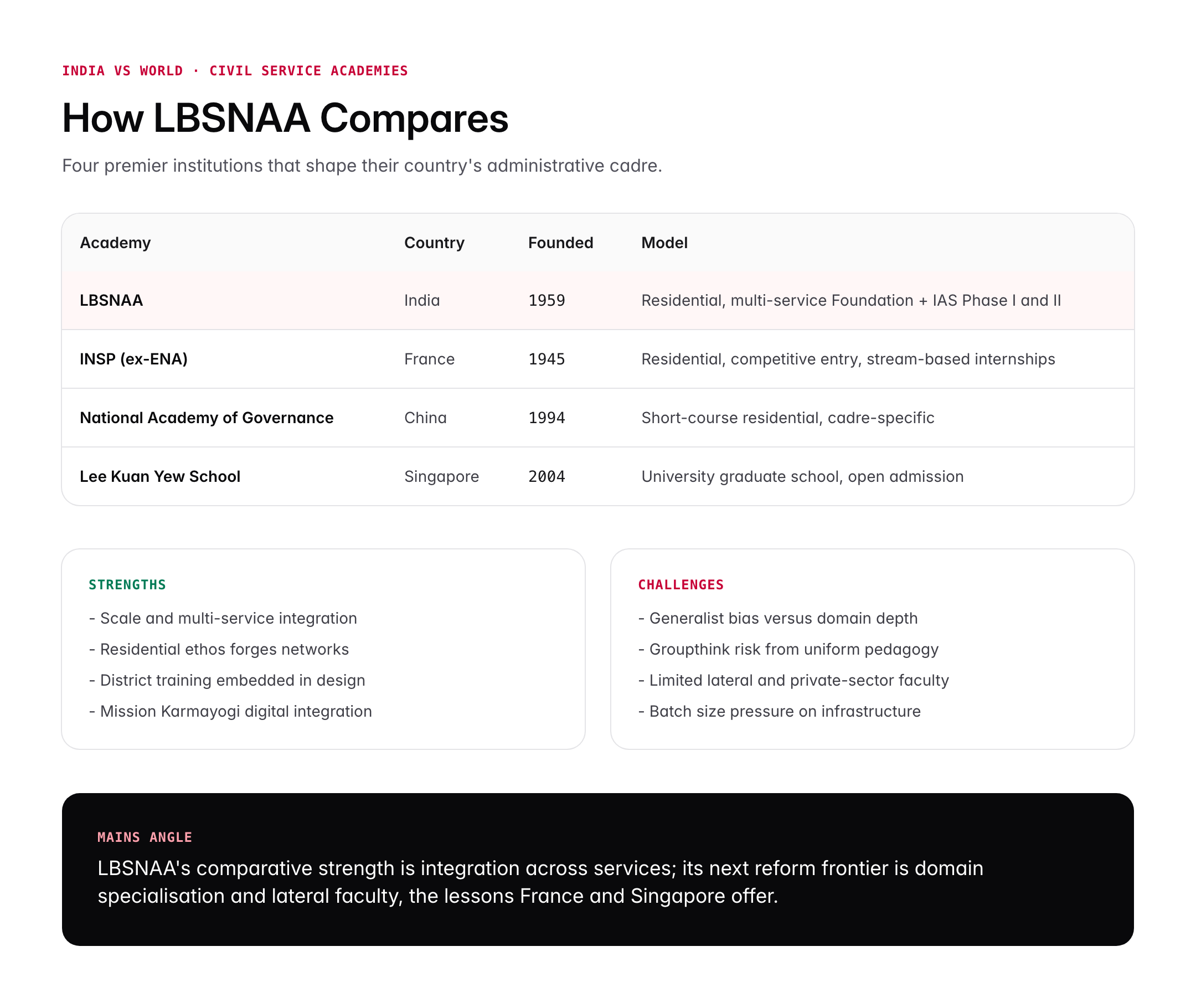
LBSNAA occupies a distinctive position in the global civil service training landscape. France’s Institut National du Service Public, formerly École Nationale d’Administration, is often cited as the classical analogue, training énarques through a rigorous selection-plus-training model. The UK abolished its Civil Service College in 2012 and moved towards a networked Civil Service Learning model, a shift often contrasted with LBSNAA’s continued residential approach. China’s National Academy of Governance at Beijing, founded in 1994, prepares cadres for both party and state positions.
| Academy | Country | Founded | Delivery model |
|---|---|---|---|
| LBSNAA | India | 1959 | Residential, multi-service Foundation Course plus IAS Phase I and II |
| Institut National du Service Public | France | 1945 (as ENA) | Residential, competitive entry, stream-based internships |
| National Academy of Governance | China | 1994 | Short-course residential, cadre-specific |
| Lee Kuan Yew School of Public Policy | Singapore | 2004 | University graduate school, open admission |
The Indian model’s strength is scale and integration across services; its criticism is insufficient specialisation and limited use of lateral faculty from the private sector. Comparative reviews by the Department of Personnel and Training in 2018 and 2022 recommended closer integration of Indian School of Business-style case method teaching, an idea that is now feeding into the Karmayogi framework.
Challenges and Criticisms
The Academy is not without its critics. A recurring complaint is the uniformity of outcomes: officers emerge with broadly similar worldviews, which can breed groupthink at senior levels. A second concern is the balance between generalist and specialist training; the IAS is a generalist service, but the demands of 2026 governance, from climate adaptation to data protection, require deeper domain expertise than three months of Foundation Course material can provide. The Second Administrative Reforms Commission noted that mid-career training needed strengthening, a recommendation that is only partly fulfilled.
Episodes of controversy have also dotted the Academy’s record. In 2022 a probationer’s letter complaining of mess food and hostel conditions went viral on social media and drew ridicule for the cohort. More seriously, gender and caste sensitivity issues have surfaced, with some women officers writing about feeling excluded from informal spaces that still carry a masculine and Delhi-elite flavour. The Academy has responded with formal complaint committees, sensitisation modules and an expanded share of field visits to marginalised communities. Infrastructure stress from larger batch sizes, land-related disputes with the Uttarakhand government and the need to refresh digital learning platforms complete the agenda for reform.
Prelims Pointers
- LBSNAA established in 1959 at Mussoorie
- Renamed in 1972 after Prime Minister Lal Bahadur Shastri
- Located at Charleville Estate, Uttarakhand
- Parent department: Department of Personnel and Training
- Main heritage building: Karmashila
- Motto: Shramēva Jayate (Labour Alone Conquers)
- Foundation Course covers over 20 services
- IAS training is in two phases separated by one-year district attachment
- Gandhi Smriti Library is the principal library on campus
- Houses are named after Himalayan peaks such as Nilgiri, Dhaulagiri, Kanchenjunga
- The Academy is the anchor delivery partner for Mission Karmayogi
- Article 312 of the Constitution creates All India Services trained here
Mains Practice Questions
Q1. Evaluate the role of the Lal Bahadur Shastri National Academy of Administration in shaping the ethos of the Indian Administrative Service. How can its curriculum adapt to the challenges of 2026? (15 marks, 250 words)
- Trace the Academy’s role in building an all-India cadre identity through the Foundation Course and Phase I and II
- Assess strengths: shared ethos, Bharat Darshan, residential immersion, and Mission Karmayogi integration
- Suggest reforms: deeper domain specialisation, lateral faculty, behavioural science, climate and digital governance modules
Q2. “Civil service training must balance generalist ethos with technical specialisation.” Analyse with reference to LBSNAA. (10 marks, 150 words)
- Define the generalist tradition and the Article 312 mandate
- Identify 2026 governance demands requiring specialisation: data protection, climate, public health
- Recommend a tiered model of Foundation generalist training plus post-Phase II specialised tracks
Conclusion
LBSNAA is both an institution and an idea. As a physical campus on the Mussoorie ridge, it trains roughly 400 to 450 probationers each year across the All India Services and many Central Services, binding them together in a residential experience that shapes friendships and professional networks for decades. As an idea, it embodies the Indian state’s belief that a shared ethos, forged through disciplined training in a hill station away from political pressure, is worth the investment.
The Academy’s future will turn on whether it can update that ethos for the India of 2026 and beyond. Mission Karmayogi, new behavioural modules, more diverse faculty and a sharper focus on outcomes are all moving in the right direction. For UPSC aspirants, understanding LBSNAA is not just about scoring a current-affairs mark; it is about recognising the institution that will, if they succeed, become the first chapter of their own public service story.
Frequently Asked Questions
What is LBSNAA?
LBSNAA stands for the Lal Bahadur Shastri National Academy of Administration, the premier civil services training institution of India. Located at Charleville Estate in Mussoorie, Uttarakhand, it trains Indian Administrative Service probationers through Phase I and Phase II, and runs the multi-service Foundation Course for over twenty All India and Central Services.
Why is LBSNAA important for UPSC aspirants?
LBSNAA is the destination every UPSC Civil Services Examination topper is heading towards if they choose the IAS. It is also a testable GS2 topic on civil services reform, referenced in interview discussions of training and integrity, and linked to Mission Karmayogi. Aspirants should know its history, structure and ongoing reforms.
How is LBSNAA related to Mission Karmayogi?
LBSNAA is the anchor residential partner for Mission Karmayogi, the National Programme for Civil Services Capacity Building launched in 2020. The Academy integrates the iGOT Karmayogi digital platform into its curriculum, delivers role-based competency modules on the frameworks, attitudes and knowledge pillars, and helps translate the scheme’s capacity goals into day-to-day training.
When was LBSNAA established and renamed?
LBSNAA was established in 1959 at Mussoorie as the National Academy of Administration, merging the earlier IAS Training School at Delhi (1947) and the IAS Staff College at Simla (1948). It was renamed the Lal Bahadur Shastri National Academy of Administration in 1972 in honour of the late Prime Minister, whose ethos of simple living and high thinking it seeks to embody.
What is the Foundation Course at LBSNAA?
The Foundation Course is a roughly three-month residential programme held each autumn that brings together probationers from the IAS, IPS, Indian Foreign Service, Indian Forest Service, Indian Revenue Service and several other Central Services. It covers public administration, law, economics, ethics, history and Constitution, alongside physical training, trekking and cultural activities to build inter-service camaraderie.
What is the training structure for IAS officers at LBSNAA?
IAS probationers attend the Foundation Course, then IAS Professional Phase I for about 26 weeks at Mussoorie, followed by one year of district training in their allotted state cadre as Assistant Collectors. They return for IAS Phase II, which consolidates field experience with thematic modules. Mid-career programmes follow at the 7-9, 14-16 and 26-28 years of service levels.
Who manages LBSNAA and where is it located?
LBSNAA is managed by the Department of Personnel and Training under the Ministry of Personnel, Public Grievances and Pensions. It is located at Charleville Estate in Mussoorie, Uttarakhand, on a campus of over 200 acres. The Director is typically a senior IAS officer, supported by Officers on Special Duty drawn from the IAS and academic faculty.
What are some criticisms of LBSNAA?
Common criticisms include overly uniform outcomes breeding groupthink, insufficient specialisation for modern governance challenges such as data protection or climate adaptation, and episodic issues around gender and caste sensitivity. The Second Administrative Reforms Commission flagged weaknesses in mid-career training, and commentators have urged deeper use of lateral faculty and case-method pedagogy.
Tell Google you want more of this.
Add Anantam IAS as a preferred sourceOne tap, and this site shows up more often in your own Top Stories, AI Overviews and AI Mode. Remove it any time.