Introduction
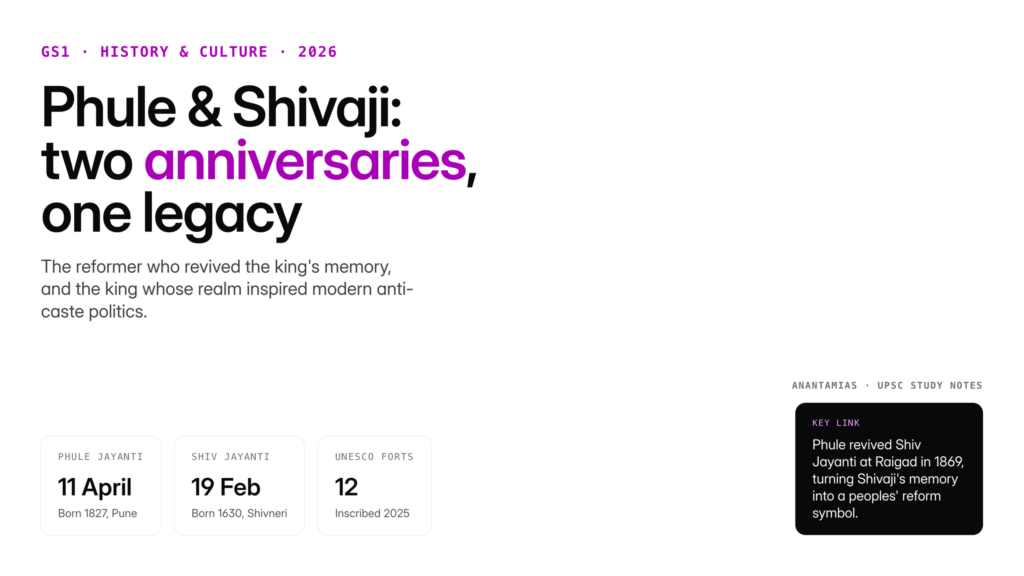
Mahatma Phule Jayanti, observed on 11 April every year, commemorates the birth of Jyotirao Govindrao Phule (1827-1890), the pioneering social reformer, thinker and anti-caste activist of nineteenth-century Maharashtra. Shiv Jayanti, observed on 19 February as the state holiday in Maharashtra and on tithi-based dates elsewhere, marks the birth of Chhatrapati Shivaji Maharaj (1630-1680), founder of the Maratha Empire. For UPSC aspirants, these two anniversaries provide entry points to two vital strands of Indian history: the social reform movement of colonial India and the mediaeval consolidation of indigenous sovereignty.
The pairing is not coincidental. Jyotirao Phule himself revived public celebration of Shivaji in 1869, publishing a famous ballad (povada) that framed the Maratha king as a people’s ruler committed to welfare of peasants and lower castes. Understanding both leaders together enables GS1 answers on modern Indian history, social reform and mediaeval Indian administration with proper continuity.
Quick Facts at a Glance
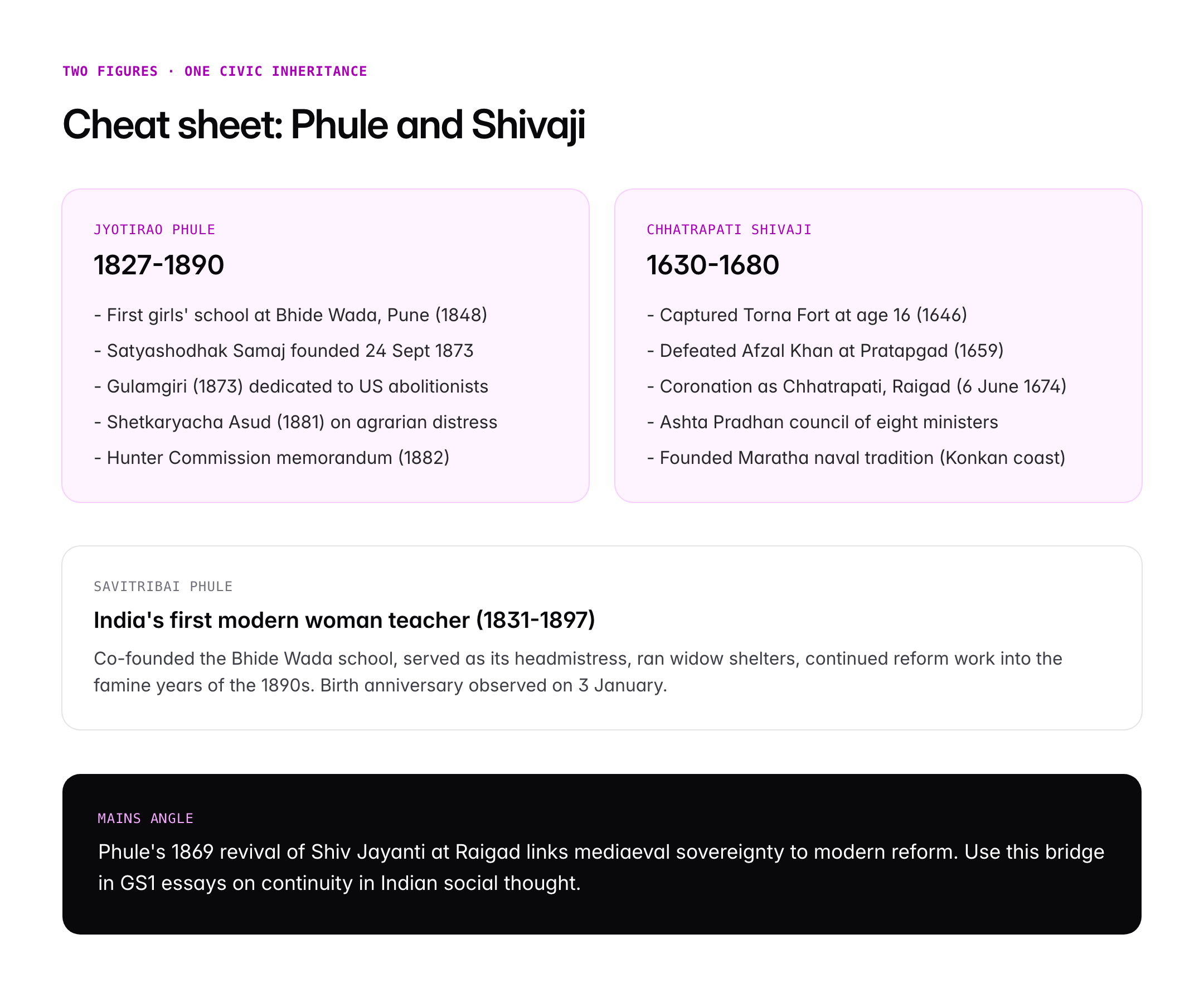
| Figure | Born | Died | Observed on | Core contribution |
|---|---|---|---|---|
| Jyotirao Phule | 11 April 1827, Pune | 28 November 1890, Pune | 11 April (Phule Jayanti) | Anti-caste reform, girls’ education, Satyashodhak Samaj |
| Savitribai Phule | 3 January 1831 | 10 March 1897 | 3 January (Savitribai Jayanti) | First female teacher in modern India, co-founder of reforms |
| Chhatrapati Shivaji | 19 February 1630, Shivneri Fort | 3 April 1680, Raigad Fort | 19 February (Shiv Jayanti, Maharashtra) | Founder, Maratha Empire; coronation 1674 |
Background and Historical Context
Jyotirao Phule was born into a Mali (gardener caste) family in Pune, which under Peshwa rule had experienced intense caste restrictions. British colonial rule from 1818 onwards had opened new avenues in education and administration even as social hierarchies persisted. Phule attended a Scottish missionary school in Pune, where he encountered Thomas Paine’s Rights of Man and developed a critique of Brahmanical patriarchy and caste hierarchy.
In 1848, Jyotirao and his wife Savitribai Phule opened the first school for girls in Pune at Bhide Wada, a landmark in Indian education history. They faced violent opposition from orthodox sections but persisted, opening additional schools and a shelter for widows. In 1873, Phule founded the Satyashodhak Samaj (Truth-seekers’ Society) to promote social equality, rationalism and access to education for non-Brahmin communities.
Shivaji’s context is the seventeenth-century Deccan, where the Bijapur Sultanate, the Mughal Empire under Aurangzeb and Portuguese enclaves contested territory and revenue. Born to Shahaji Bhonsale and Jijabai at Shivneri Fort in 1630, Shivaji grew up on the Pune jagir that his mother managed. From the capture of Torna Fort in 1646 he began building a territorial base that would eventually coalesce into an independent Maratha kingdom, formalised by his coronation as Chhatrapati at Raigad on 6 June 1674.
Phule’s revival of Shiv Jayanti in 1869 at Raigad was itself a reform act: by excavating Shivaji’s samadhi and composing a Marathi ballad about his reign, he claimed Shivaji as a leader of peasants, Shudras and Ati-Shudras rather than only of Maratha aristocracy. Bal Gangadhar Tilak later expanded public Shiv Jayanti observance in 1895 as a nationalist mobilisation device.
Key Features of the Phule Reforms and Shivaji’s Administration
Phule’s Educational Work
Between 1848 and 1852, the Phules opened three schools for girls and several for Mahar and Mang children in Pune. Savitribai became the first Indian woman headmistress. In 1855 they set up a night school for working adults. Their 1863 shelter for upper-caste child widows (home for pregnant widows) was radical for its time.
Satyashodhak Samaj (1873)
Founded on 24 September 1873, the Samaj’s three-fold programme included:
- Social equality: rejection of caste hierarchy and Brahmin priestly monopoly.
- Educational access: schooling for girls and lower castes as a civic right.
- Religious rationalism: simplified, priest-free marriage ceremonies in vernacular Marathi.
Phule’s Writings
Gulamgiri (Slavery, 1873) was dedicated to American abolitionists and compared caste oppression to racial slavery. Shetkaryacha Asud (Cultivator’s Whip, 1881) analysed agrarian distress and critiqued land revenue policy. Sarvajanik Satya Dharma Pustak (1891, posthumous) set out a universalist ethical framework.
Shivaji’s Administration
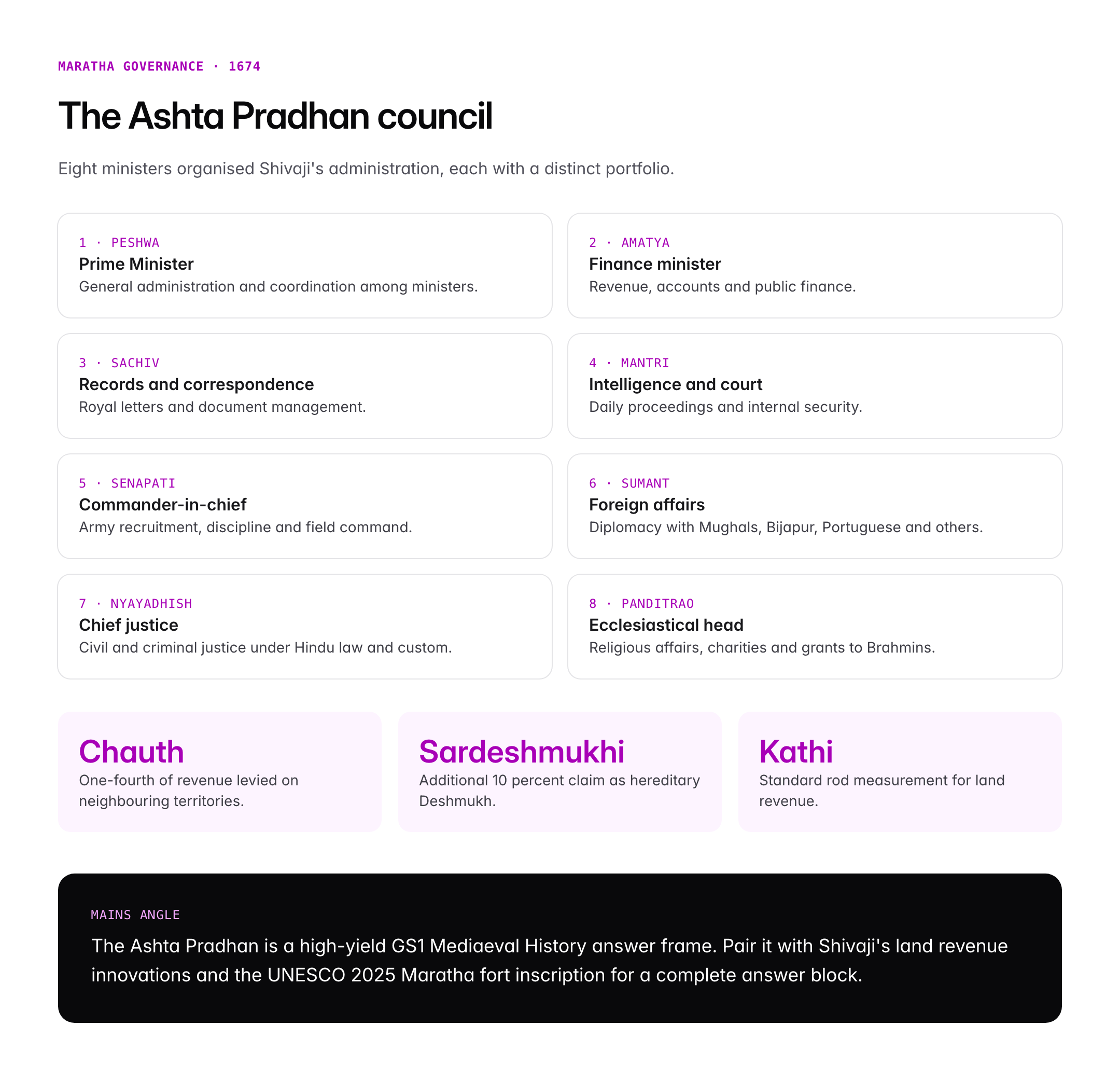
Shivaji organised governance under the Ashta Pradhan council of eight ministers, each with specific portfolios including Peshwa (Prime Minister), Amatya (finance), Sachiv (records), Mantri (intelligence), Senapati (army), Sumant (foreign affairs), Nyayadhish (justice) and Panditrao (religion). His land revenue system under the Ryotwari-like Kathi measurement used direct collection from peasants at around 33 percent of produce, adjusted upward to 40 percent after abolishing zamindars in core territories.
Military Innovation
Shivaji pioneered guerrilla warfare adapted to the Deccan terrain, using mobile light infantry (infantry units called paik) and a disciplined cavalry divided into bargirs and silahdars. He built or captured over 300 forts including Raigad, Pratapgad, Sinhagad, Panhala and Torna. His naval force under admirals like Kanhoji Angre secured the Konkan coast and is often called the founding moment of modern Indian naval tradition.
Religious and Social Policy
Shivaji granted protection to temples and mosques, forbade conversion during conquest and returned captured Islamic religious texts and prayer-beads to holders. Women captured in war were returned with honour, a policy notably applied after the 1664 Surat campaign. He issued hukumnamas on local administration, justice and welfare of peasants.
Significance for UPSC and General Knowledge
- Jyotirao Phule is a compulsory name in GS1 Modern Indian History and GS1 Indian Society modules on caste and social reform.
- Savitribai Phule’s role as India’s first woman teacher anchors questions on education and gender.
- Shivaji’s Ashta Pradhan system is a stock GS1 Mediaeval History reference on indigenous administration.
- Phule’s 1869 revival of Shiv Jayanti demonstrates linkage between social reform and cultural nationalism.
- Both figures feature on currency, stamps and as NCERT chapter subjects; Prelims questions draw on anniversaries and organisation names.
- Phule’s writings influenced Dr B. R. Ambedkar’s constitutional thinking on caste and education.
Detailed Analysis: Reformers and Rulers in Indian Memory
Phule’s significance lies in combining educational activism with ideological critique. Unlike contemporary reformers Raja Rammohan Roy and Ishwar Chandra Vidyasagar who worked within elite frameworks, Phule mobilised from below. His 1873 Satyashodhak Samaj explicitly targeted Brahmin priestly intermediaries, arguing that direct access to scriptures, rituals and civic life was the birthright of every human being. This analysis prefigured the Dalit political awakening of the twentieth century.
The Hunter Commission on Education (1882) received Phule’s written memorandum urging compulsory primary education, state funds for vernacular schools and special provision for girls and lower castes. Several of his recommendations were echoed in the 1902-1904 Indian Universities Commission and ultimately in Article 21A of the Indian Constitution (Right to Education).
Shivaji’s administrative legacy extended far beyond the Maratha Empire. His land-revenue and military arrangements influenced Maharaja Ranjit Singh’s Sikh confederacy, the Peshwa-era administration and the revenue settlements of British collector officers in western India. The Chauth (one-quarter share) and Sardeshmukhi (additional ten percent) that Shivaji levied on neighbouring territories became the fiscal spine of later Maratha expansion under Bajirao I and Madhavrao I.
In cultural memory, both figures are invoked in very different registers. Phule is claimed by anti-caste movements, Ambedkarite thought and feminist history. Shivaji is invoked in regional Maratha pride, Hindu nationalist narratives, and in scholarly accounts of indigenous sovereignty before British rule. The 2024 renaming of the Rajpath area’s administrative precinct and the 2024 inauguration of the Chhatrapati Shivaji memorial at Arvi in Raigad district have kept his memory in current-affairs discussions.
UNESCO in 2025 inscribed twelve forts of the Maratha Military Landscape of India as a World Heritage Site, including Raigad, Pratapgad, Panhala, Shivneri, Lohgad, Salher, Sindhudurg, Suvarnadurg, Vijaydurg, Khanderi, Rajgad and Gingee. This is a high-probability Prelims and GS1 culture topic.
Comparative Perspective
| Dimension | Jyotirao Phule | Chhatrapati Shivaji |
|---|---|---|
| Era | Colonial modern (19th century) | Mediaeval (17th century) |
| Arena | Social reform, education, writing | Kingdom building, military, governance |
| Institution founded | Satyashodhak Samaj (1873) | Maratha Empire; coronation 1674 |
| Core idea | Caste equality and mass education | Sovereign Hindawi Swarajya |
| Relation between them | Phule revived Shiv Jayanti in 1869 | Shivaji became the reformers’ idiom of people’s king |
| UPSC paper connection | GS1 Modern History, GS1 Society | GS1 Mediaeval History, GS1 Art and Culture |
Challenges and Criticisms
Phule’s radicalism attracted orthodox backlash throughout his life. His schools faced stoning, social boycott forced his family out of the ancestral home in 1849 and opponents filed legal complaints. Later critics have questioned whether the Satyashodhak Samaj’s rationalist programme adequately addressed questions of class exploitation and communal relations. In response, Phule’s later writing on agrarian distress and his defence of Muslim and tribal cultivators offered a more comprehensive vision.
Debates around Shivaji are primarily about his appropriation in contemporary politics. Historians like Sir Jadunath Sarkar, Sumit Guha, Rosalind O’Hanlon and Prachi Deshpande have produced nuanced scholarship. Controversies in public life around textbook content, statues, film depictions and ceremonial forms continue to generate debate. The 2023 and 2024 parliamentary debates on Shivaji’s legacy and Afzal Khan-related commemorations illustrate the live political salience.
Critics of Phule Jayanti observance argue it has become tokenistic in some official celebrations, detached from the substantive educational and caste-reform agenda. Supporters counter that every public commemoration creates pedagogical opportunity for new generations.
Prelims Pointers
- Jyotirao Phule was born on 11 April 1827 in Pune and died on 28 November 1890.
- Savitribai Phule was born on 3 January 1831; she was the first woman teacher in modern India.
- The first school for girls opened at Bhide Wada, Pune, in 1848.
- Satyashodhak Samaj was founded on 24 September 1873.
- Phule’s book Gulamgiri (1873) was dedicated to American abolitionists.
- Shivaji was born on 19 February 1630 at Shivneri Fort (Julian date; Gregorian adjustments vary).
- Shivaji’s coronation as Chhatrapati took place on 6 June 1674 at Raigad Fort.
- The Ashta Pradhan was Shivaji’s eight-minister council of advisers.
- Shivaji captured Torna Fort in 1646 at the age of 16.
- The Battle of Pratapgad (1659) saw Shivaji defeat Afzal Khan of Bijapur.
- Kanhoji Angre was the Maratha admiral associated with the Konkan coastline.
- UNESCO inscribed 12 Maratha Military Landscape forts on the World Heritage list in 2025.
Mains Practice Questions
- “Jyotirao Phule’s social reform agenda anticipated many principles that later found expression in the Indian Constitution.” Discuss with reference to his educational and anti-caste contributions.
- Educational: Bhide Wada 1848, Hunter Commission memorandum 1882, later link to Article 21A.
- Anti-caste: Satyashodhak Samaj, Gulamgiri, influence on Ambedkar.
- Constitutional linkages: Articles 14, 15, 17, 21A, 46 and Directive Principles.
- Examine the administrative and military innovations of Chhatrapati Shivaji and their relevance to the concept of indigenous statecraft.
- Ashta Pradhan council, Kathi land revenue, Chauth and Sardeshmukhi.
- Guerrilla warfare doctrine, fort network, naval force foundation.
- Legacy: influence on later Maratha confederacy, Sikh polity, modern naval symbolism.
Conclusion
Mahatma Phule Jayanti and Shiv Jayanti together frame an arc from mediaeval sovereignty to modern social reform in the Marathi-speaking regions of India. The thoughtful student sees them not as discrete commemorations but as two chapters of an unbroken conversation about justice, governance and public welfare. Phule’s decision to honour Shivaji at Raigad in 1869 was an act of historical interpretation, one that opened space for every subsequent generation to claim the reformer-king as a common civic inheritance.
For UPSC preparation, these anniversaries reward close study rather than rote memorisation. Facts about dates, forts, books and organisations matter for Prelims; the layered relationship between caste, education, indigenous administration and cultural memory unlocks strong Mains essays in GS1 Modern History, GS1 Mediaeval History, GS1 Indian Society and the Essay Paper alike.
Frequently Asked Questions
What is Mahatma Phule Jayanti?
Mahatma Phule Jayanti, observed on 11 April every year, commemorates the birth anniversary of Jyotirao Govindrao Phule (1827-1890), the pioneering Maharashtrian social reformer, anti-caste thinker and founder of the Satyashodhak Samaj. The day is a state holiday in Maharashtra and is marked across India by educational institutions, Dalit organisations and social reform groups.
Why is Mahatma Phule Jayanti important for UPSC aspirants?
Jyotirao Phule features prominently in GS1 Modern Indian History and GS1 Indian Society questions on social reform, caste and education. His Satyashodhak Samaj, his writings including Gulamgiri and Shetkaryacha Asud, and his educational work with Savitribai Phule are high-probability Prelims topics and strong Mains material, with direct linkages to Articles 17, 21A and 46 of the Indian Constitution.
How is Mahatma Phule related to Shivaji Jayanti?
Jyotirao Phule revived public observance of Shiv Jayanti in 1869 by excavating Shivaji’s samadhi at Raigad and composing a Marathi ballad that framed Shivaji as a peoples’ king committed to peasants and lower castes. Bal Gangadhar Tilak later expanded Shiv Jayanti in 1895 as a nationalist mobilisation platform, making the two anniversaries historically linked through a reformist and then nationalist lineage.
When is Shiv Jayanti observed?
Shiv Jayanti is officially observed on 19 February in Maharashtra as the state holiday marking the Gregorian-aligned birth anniversary of Chhatrapati Shivaji Maharaj, born at Shivneri Fort in 1630. Some communities observe it on the tithi (Hindu lunar date), which varies year to year, typically falling in March or April. The Maharashtra government fixes 19 February as the official state observance.
Who was Savitribai Phule and what did she do?
Savitribai Phule (1831-1897) was Jyotirao Phule’s wife and India’s first woman teacher in the modern era. She co-founded India’s first school for girls at Bhide Wada in Pune in 1848, served as its headmistress, opened a shelter for widows and continued social reform work after her husband’s death. Her birth anniversary on 3 January is observed as Savitribai Phule Jayanti.
What was the Satyashodhak Samaj?
The Satyashodhak Samaj (Truth-seekers’ Society) was founded by Jyotirao Phule on 24 September 1873 in Pune. It promoted social equality, rejected caste hierarchy and Brahmin priestly monopoly, advocated education for girls and lower castes, and introduced simplified priest-free marriages in Marathi. It was among the earliest organised anti-caste movements and influenced later Dalit and Bahujan political mobilisation.
What were Chhatrapati Shivaji’s key administrative innovations?
Shivaji organised governance through the Ashta Pradhan council of eight ministers including the Peshwa, Amatya, Sachiv, Mantri, Senapati, Sumant, Nyayadhish and Panditrao. He introduced the Kathi land-revenue measurement collected directly from peasants, levied Chauth and Sardeshmukhi on neighbouring territories, built a fort network of over 300 strongholds and founded the Maratha naval tradition under admirals like Kanhoji Angre.
Which Shivaji-era forts are now UNESCO World Heritage Sites?
In 2025 UNESCO inscribed the Maratha Military Landscape of India comprising twelve forts: Raigad, Pratapgad, Panhala, Shivneri, Lohgad, Salher, Sindhudurg, Suvarnadurg, Vijaydurg, Khanderi, Rajgad and Gingee in Tamil Nadu. The inscription recognises Shivaji’s fort network as a distinctive military landscape integrating hill, coastal and inland defences, and is a high-probability Prelims topic.
Tell Google you want more of this.
Add Anantam IAS as a preferred sourceOne tap, and this site shows up more often in your own Top Stories, AI Overviews and AI Mode. Remove it any time.