Introduction
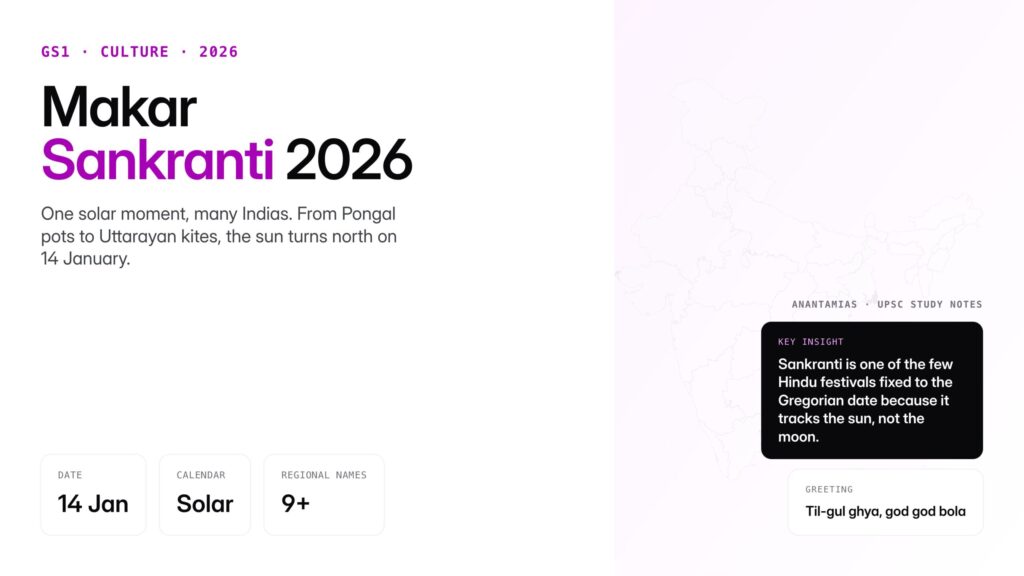
Every January, as the sun begins its apparent northward journey, India celebrates one of its oldest and most unifying festivals, Makar Sankranti. In 2026, the festival falls on Wednesday, 14 January, with the sacred bath or Punya Kaal beginning in the pre-dawn hours. Marking the sun’s transit into the zodiac sign of Makara (Capricorn), the day is a solar event observed across faiths, languages and climates, from kite-filled skies in Gujarat to bonfires in Punjab and bubbling pots of Pongal in Tamil Nadu.
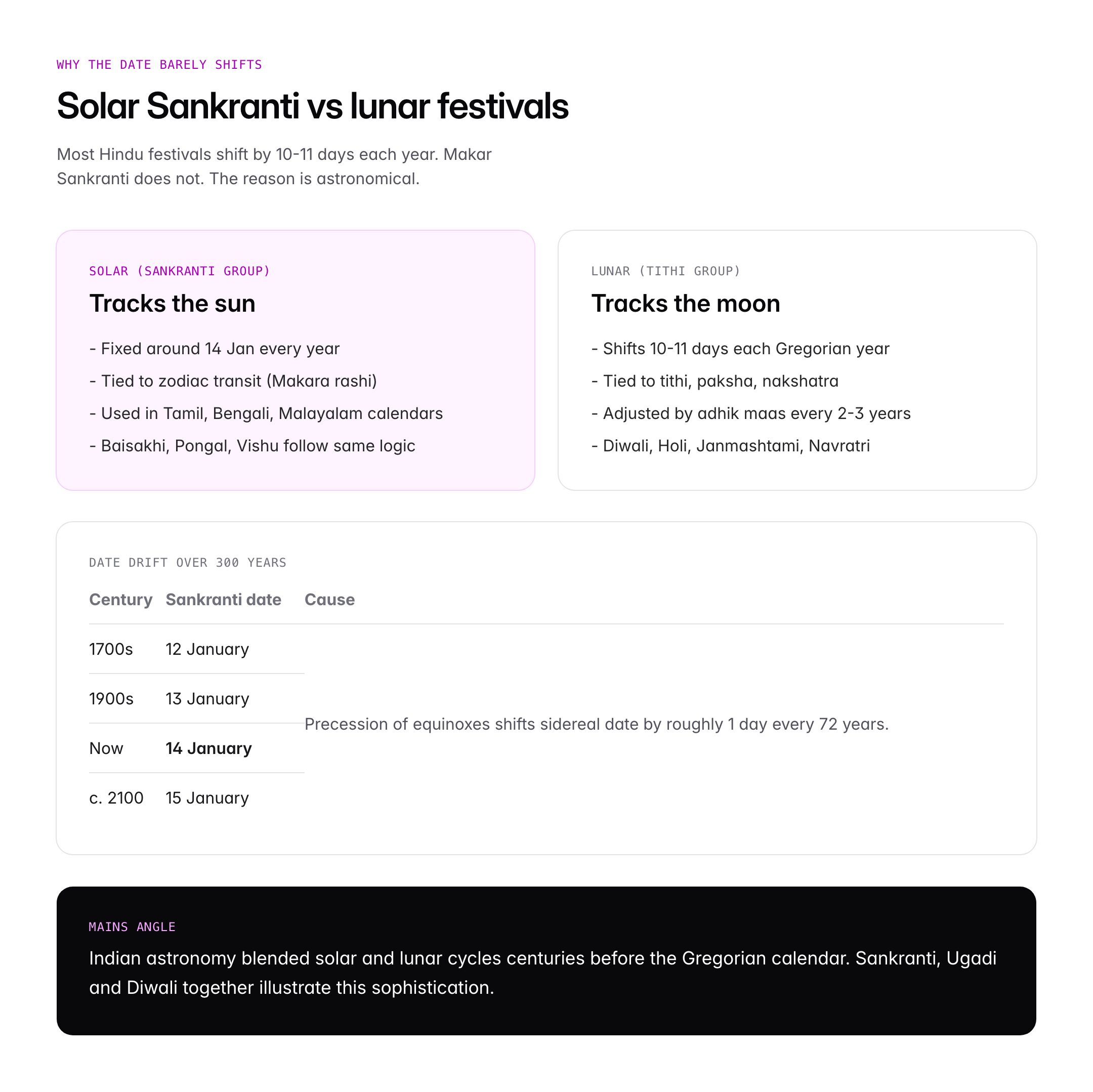
For UPSC aspirants studying Indian culture, Makar Sankranti offers a rich case of how astronomy, agriculture and religion weave together into a single festival with many regional expressions. It also reveals how Indian calendars balance the lunar cycle used by most Hindu festivals with the solar cycle that governs seasons, making Sankranti one of the few Hindu festivals whose date in the Gregorian calendar barely shifts from year to year.
Quick Facts at a Glance
| Attribute | Detail |
|---|---|
| Festival name | Makar Sankranti |
| Date in 2026 | 14 January (Wednesday) |
| Astronomical event | Sun enters Makara (Capricorn) rashi |
| Calendar type | Solar (not lunar) |
| Also known as | Uttarayan, Pongal, Lohri, Magh Bihu, Khichdi Parv |
| Season marked | End of winter solstice phase, start of harvest |
| Primary crop celebrated | Rice, sugarcane, sesame |
| Signature food | Til-gud laddoo, khichdi, pongal, chikki |
| Sacred rivers for bath | Ganga, Yamuna, Godavari, Krishna, Kaveri |
| Major mela | Gangasagar Mela, West Bengal (second-largest after Kumbh) |
| UNESCO link | Kumbh Mela (inscribed 2017) |
| Kite festival hub | Ahmedabad, Gujarat (International Kite Festival) |
Background and Historical Context
Makar Sankranti is one of the few Hindu festivals tied to the solar calendar rather than the lunar calendar. The word sankranti in Sanskrit means “to move across” and refers to the sun’s transit from one zodiac sign to the next. There are twelve sankrantis each year, but Makar Sankranti, marking entry into Capricorn, is considered the most auspicious. It coincides with the end of the month of Paush and the start of Magha in the Hindu lunisolar calendar.
Historically, Makar Sankranti also marked the start of Uttarayan, the six-month period during which the sun appears to move northward. In the Mahabharata, Bhishma Pitamaha is said to have waited on his bed of arrows for Uttarayan before giving up his life, because the period was considered especially auspicious for attaining moksha. The Rig Veda mentions solar transits, and ancient Indian astronomers including Aryabhata, Varahamihira and Bhaskara computed sankranti dates with remarkable precision.
The festival’s importance grew with India’s agrarian calendar. Across much of the subcontinent, Makar Sankranti falls during the harvest of the kharif crop, particularly paddy, sugarcane and pulses. Thanksgiving to the sun god Surya, to cattle and to the earth became central to celebrations. Because the solar year has a very gradual precession, the Gregorian date of the festival has slowly drifted forward. In the early 20th century it fell on 13 January; today it is firmly on 14 January, and astronomers predict it will shift to 15 January later this century.
Key Features of the Festival
Astronomical Meaning
Makar Sankranti marks the moment when the sun enters Makara rashi, the Capricorn zodiac. In sidereal Indian astronomy, this happens around 14 January. The event is distinct from the winter solstice, which actually occurs on 21 or 22 December in the tropical calendar. The gap of roughly 23 days is due to the precession of the equinoxes over centuries, which modern Indian astronomy accounts for by using the sidereal zodiac.
Ritual Core
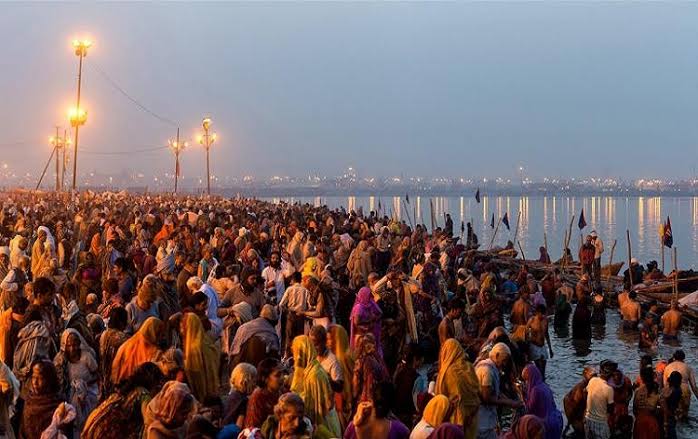
The day begins with a holy dip in sacred rivers, most famously at Prayagraj (where Magh Mela is held every year and Kumbh Mela every twelve years) and at Gangasagar in West Bengal. Devotees offer arghya (water) to the sun, donate til (sesame), jaggery, blankets and grains, and recite the Aditya Hridaya Stotra. Til-gud sweets symbolise the wish that words between people remain sweet through the new season.
Kite Flying
In Gujarat, Rajasthan and parts of Maharashtra, Makar Sankranti is celebrated as Uttarayan through mass kite flying. Ahmedabad hosts the International Kite Festival, drawing participants from over forty countries. Kites are said to honour Surya and bid farewell to winter gloom.
Cattle Veneration
In rural India, bullocks, cows and buffaloes are bathed, painted, garlanded and fed sweet rice as thanks for their role in the harvest. The tradition is strongest in Tamil Nadu’s Mattu Pongal, the third day of the four-day Pongal festival.
Fire and Community
In Punjab and Haryana, Lohri, celebrated on 13 January, features community bonfires fuelled with til, sugarcane and popcorn, and the singing of the folk ballad of Dulla Bhatti. In Assam, Magh Bihu is marked by meji bonfires and community feasts.
Significance for UPSC and General Knowledge
- Illustrates the solar dimension of the Hindu calendar, making it a rare pan-India festival with a fixed Gregorian date.
- Connects art and culture syllabus topics with Indian astronomy, agriculture and regional diversity.
- Anchors the Gangasagar Mela and Magh Mela, two major religious gatherings relevant to GS1 culture and GS2 disaster management.
- Shows the federal and cultural pluralism of India through multiple regional variants under one astronomical event.
- Provides material for essays on unity in diversity, continuity of civilisational practices and harvest economy.
- Links to economic and environmental themes such as kite-string injuries, crop residue burning and river pollution.
Detailed Analysis: Regional Variants Across India
Few festivals showcase India’s federal cultural landscape as vividly as Makar Sankranti. The astronomical event is one, but the celebrations multiply by region.
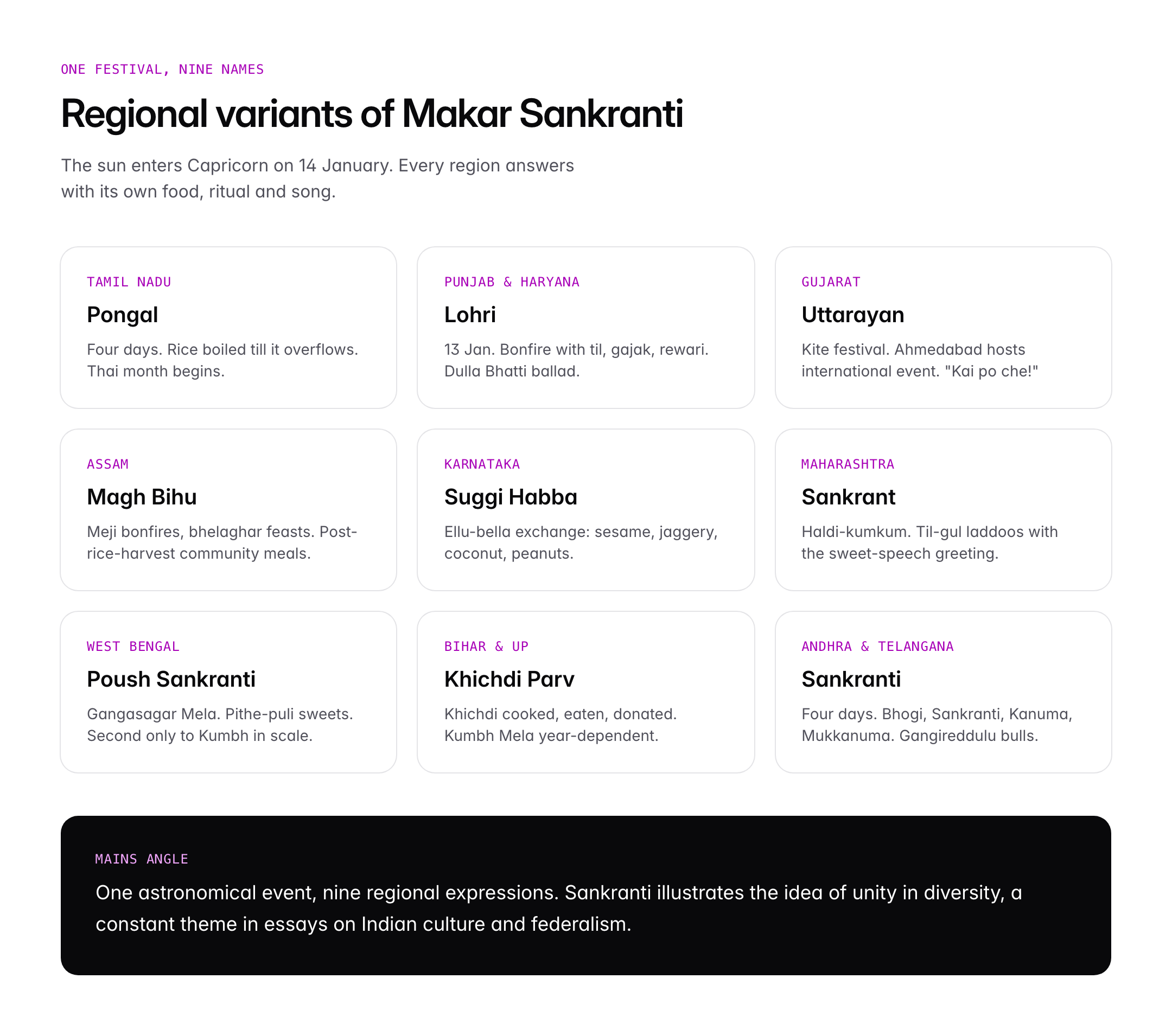
In Tamil Nadu, Puducherry and parts of Sri Lanka, the festival is called Pongal, celebrated over four days: Bhogi Pongal, Thai Pongal, Mattu Pongal and Kaanum Pongal. On Thai Pongal, families cook freshly harvested rice with milk and jaggery in earthen pots, letting it overflow as an auspicious sign of prosperity. The month of Thai, beginning on this day, is considered so favourable that Tamil tradition says, “Thai pirandhaal vazhi pirakkum” (the birth of Thai brings a new path).
In Karnataka, the festival is Suggi Habba, marked by the exchange of ellu-bella, a mixture of sesame, jaggery, coconut and peanuts. Women visit neighbours carrying small plates of this mixture, symbolising goodwill for the coming year.
In Andhra Pradesh and Telangana, Sankranti spans four days with special emphasis on ancestor worship (Bhogi), kite flying, rangoli (muggu) and the famous Gangireddulu bull procession. In Maharashtra and Goa, women gather for haldi-kumkum ceremonies and exchange til-gul laddoos with the phrase “til-gul ghya, god god bola” (take these sweets and speak sweetly).
In Gujarat, Uttarayan transforms into a two-day kite festival. Rooftops across Ahmedabad, Surat and Vadodara fill with competitive kite fliers and cries of “kai po che” when an opponent’s string is cut. In West Bengal, pilgrims throng Gangasagar at the confluence of the Ganga and the Bay of Bengal for a holy dip, with over a million devotees gathering annually.
In Punjab and Haryana, the night before Sankranti is Lohri, a winter-farewell festival centred on bonfires and folk songs. In Assam, Magh Bihu or Bhogali Bihu features elaborate community feasts after the rice harvest, with temporary structures called meji and bhelaghar built for the occasion. In Bihar and Jharkhand, the day is Khichdi Parv, named after the khichdi eaten and donated. In Odisha, it is Makar Sankranti with rituals at Konark Sun Temple and special makar chaula prepared with fresh rice, banana, jaggery and sesame.
The NSO Time Use Survey and various cultural studies show that Makar Sankranti sees the highest participation in community rituals in January across rural India. Migration data from Indian Railways consistently records traffic surges in mid-January as workers return home for the festival, comparable to Diwali and Chhath.
Comparative Perspective
India’s harvest festivals cluster in two periods: mid-January (solar) and April (spring equinox). The table compares key harvest festivals.
| Festival | Region | Time | Astronomical basis | Signature practice |
|---|---|---|---|---|
| Makar Sankranti | Pan-India | 14 Jan | Solar transit into Capricorn | Holy dip, til-gud, kites |
| Pongal | Tamil Nadu | 14-17 Jan | Same as Sankranti | Rice boiled till overflow |
| Lohri | Punjab, Haryana | 13 Jan | Winter solstice folk marker | Bonfire, Dulla Bhatti song |
| Magh Bihu | Assam | 14-15 Jan | Same as Sankranti | Meji bonfire, community feast |
| Baisakhi | Punjab | 13-14 Apr | Solar transit into Aries | Wheat harvest, Khalsa Panth |
| Pohela Boishakh | West Bengal | 14-15 Apr | Bengali new year | Halkhata, processions |
| Vishu | Kerala | 14-15 Apr | Same as Baisakhi | Vishukkani arrangement |
| Puthandu | Tamil Nadu | 14 Apr | Tamil new year | Kani arrangement, kolam |
Makar Sankranti and Baisakhi frame the year’s two solar pivots. Where Sankranti thanks the sun for the kharif harvest, Baisakhi celebrates the rabi wheat harvest and, for Sikhs, the founding of the Khalsa in 1699.
Challenges and Debates
Despite its celebratory mood, Makar Sankranti raises serious contemporary concerns. Kite-string injuries caused by glass-coated manja have killed people and birds across Gujarat, Rajasthan and Delhi. The National Green Tribunal banned nylon and synthetic manja in 2017, but enforcement remains patchy. Rescue centres like Jivdaya Charitable Trust in Ahmedabad treat thousands of injured birds each January.
River pollution is another concern. Holy dips at Prayagraj, Gangasagar and other ghats add biological load to already stressed rivers. The Namami Gange programme includes festival-period interventions, but managing crowds exceeding a million remains difficult. Stubble burning in Punjab peaks around October and November, not January, yet Lohri bonfires add to winter particulate loads in North India during a period already prone to severe air pollution.
Questions of caste and inclusion also surface. Some communities have historically been excluded from main ghats and temples. Judicial rulings, temple entry reforms and civil society campaigns have expanded access, but gaps persist. On the cultural side, debates continue over regional names (Pongal versus Sankranti in bilingual states) and commercial dilution of traditional foods by packaged snacks.
Prelims Pointers
- Makar Sankranti is celebrated on 14 January 2026 and marks the sun’s entry into Makara (Capricorn) zodiac.
- It is one of the few Hindu festivals based on the solar calendar, keeping its Gregorian date nearly fixed.
- Uttarayan refers to the sun’s apparent northward journey, beginning around Makar Sankranti.
- Pongal in Tamil Nadu is a four-day festival starting with Bhogi and concluding with Kaanum Pongal.
- Lohri is celebrated on 13 January, primarily in Punjab and Haryana.
- Magh Bihu or Bhogali Bihu is the Assamese harvest festival coinciding with Sankranti.
- Gangasagar Mela at Sagar Island in West Bengal is among India’s largest annual pilgrimages.
- The International Kite Festival is held annually at Ahmedabad, Gujarat.
- In Karnataka, the festival is Suggi Habba; in Maharashtra, women greet with “til-gul ghya, god god bola”.
- Bhishma Pitamaha in the Mahabharata chose Uttarayan for his death.
- Konark Sun Temple in Odisha holds special Sankranti observances.
- The National Green Tribunal banned nylon manja kite strings in 2017.
Mains Practice Questions
- “Makar Sankranti is a single astronomical event expressed through many regional cultures.” Discuss the cultural significance of the festival across Indian regions and its relevance in understanding Indian pluralism. (250 words)
- Explain the solar-calendar basis and common ritual core.
- Map regional variants from Pongal to Magh Bihu with distinctive practices.
- Connect to the constitutional idea of unity in diversity.
- Examine the environmental and safety challenges associated with modern celebrations of Makar Sankranti. Suggest policy interventions. (250 words)
- Identify issues: glass-coated manja, river pollution, air quality, bird injuries.
- Review existing responses such as the NGT ban and Namami Gange.
- Recommend biodegradable materials, eco-certifications, community-led rescue and awareness campaigns.
Conclusion
Makar Sankranti is a festival that has adapted across four millennia without losing its core. The solar moment it commemorates, the turning of the sun toward the north, remains as dependable now as when Vedic astronomers first plotted it. Around that moment, India has built a remarkable tapestry of food, fire, rivers, songs and skies filled with kites, each region contributing its own thread. Pongal, Lohri, Magh Bihu, Suggi Habba and Uttarayan are not different festivals; they are different dialects of the same cosmic sentence.
For the UPSC aspirant, Makar Sankranti offers a window into how Indian civilisation has synthesised astronomy, agriculture and spirituality into a living calendar. For policy-makers, it is a reminder that tradition and sustainability need not be adversaries. A kite flown on a biodegradable string, a holy dip in a cleaner river and a bonfire of well-seasoned wood can carry the same blessings while leaving the land, air and water in better shape for the next Sankranti.
Frequently Asked Questions
What is Makar Sankranti?
Makar Sankranti is a Hindu harvest festival celebrated when the sun enters the zodiac sign of Makara (Capricorn), marking the beginning of Uttarayan or the sun’s northward journey. It is one of the few Hindu festivals based on the solar calendar, so it consistently falls around 14 January each year. It is observed pan-India under different regional names.
When is Makar Sankranti 2026?
Makar Sankranti 2026 falls on Wednesday, 14 January. The sankranti moment, when the sun transits into Capricorn, occurs in the pre-dawn hours, and the Punya Kaal for holy dips and donations extends through the morning. Because it is a solar festival, the date barely shifts from year to year, unlike most Hindu festivals that follow the lunar calendar.
Why is Makar Sankranti important for UPSC aspirants?
It connects GS1 Indian culture with astronomy, agriculture and regional diversity. Aspirants can use it to illustrate the solar calendar, federal cultural variants like Pongal and Bihu, and the Gangasagar Mela. It also raises policy issues on environmental safety (manja bans), river pollution at pilgrimage sites and management of mass religious gatherings.
How is Makar Sankranti related to Uttarayan?
Uttarayan means the sun’s six-month northward apparent movement. In Indian sidereal astronomy, it is taken to begin on Makar Sankranti, when the sun enters Capricorn. The tropical winter solstice actually occurs around 22 December, but due to precession, the sidereal date has drifted to 14 January. In Gujarat, Uttarayan is the popular name of the festival.
Why does Makar Sankranti fall on almost the same date every year?
Unlike most Hindu festivals that follow a lunar calendar and shift by ten to eleven days each year, Makar Sankranti is tied to a solar event. It marks the sun’s transit into Makara rashi, which happens on nearly the same Gregorian date annually. Over centuries, precession shifts it by roughly a day every 72 years, moving it from 13 January in the early 1900s to 14 January today.
What are the regional names of Makar Sankranti in India?
The same astronomical event is celebrated as Pongal in Tamil Nadu, Makara Sankranti in Karnataka and Odisha, Suggi Habba in parts of Karnataka, Uttarayan in Gujarat, Lohri (on 13 January) in Punjab and Haryana, Magh Bihu or Bhogali Bihu in Assam, Poush Sankranti in West Bengal, and Khichdi Parv in Bihar and Uttar Pradesh. Each region brings distinctive foods, rituals and folk songs.
What foods are associated with Makar Sankranti?
Signature foods use sesame (til), jaggery (gur) and freshly harvested rice. Common preparations include til-gud laddoos and chikki, khichdi in North India, sweet Pongal with rice and moong dal in Tamil Nadu, ellu-bella in Karnataka, pitha (rice cakes) in Assam, puran poli in Maharashtra and makar chaula in Odisha. These foods warm the body and use the winter harvest.
What are the major environmental concerns around Makar Sankranti?
Three key concerns are glass-coated nylon manja kite strings, which injure and kill birds and people and were banned by the National Green Tribunal in 2017; river pollution from mass bathing at Gangasagar and Prayagraj, partially addressed under the Namami Gange Mission; and winter bonfires that add to North India’s already poor air quality during January.
Tell Google you want more of this.
Add Anantam IAS as a preferred sourceOne tap, and this site shows up more often in your own Top Stories, AI Overviews and AI Mode. Remove it any time.