Introduction
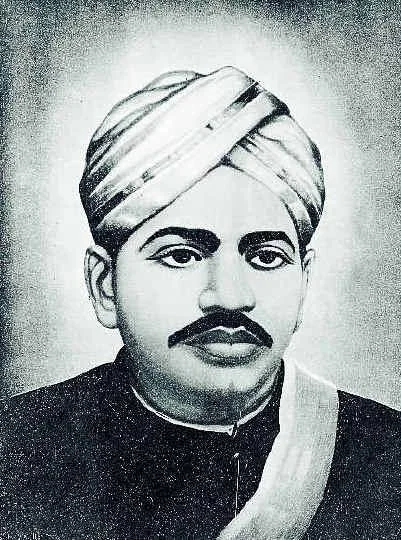
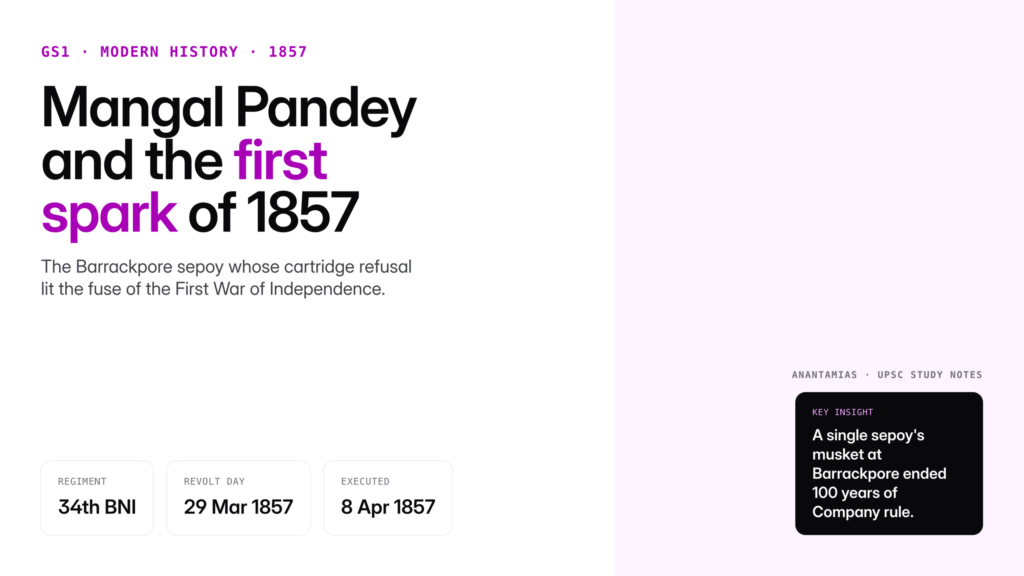
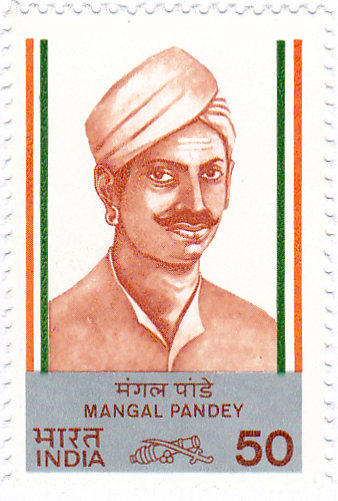
On the afternoon of 29 March 1857, a sepoy of the 34th Bengal Native Infantry walked onto the parade ground at Barrackpore near Calcutta, musket in hand, and fired on his British officers. That single act, by a 29-year-old Brahmin soldier from Ballia in present-day Uttar Pradesh, is widely regarded as the opening shot of the Revolt of 1857, the uprising that later historians and Indian nationalists would rename the First War of Indian Independence. The sepoy was Mangal Pandey, and within eleven days the Company had him hanged.
For UPSC aspirants, Mangal Pandey is far more than a name in a chronology. He sits at the intersection of military history, colonial policy, religious sensibility and the long arc of Indian nationalism. His story explains how a single greased cartridge could ignite an empire, why the East India Company collapsed within a year of his death, and how the Crown took direct charge of India through the Government of India Act, 1858. Understanding the man and the moment is essential groundwork for GS1 Modern History and for essay and interview rounds that test your grasp of India’s freedom struggle.
Quick Facts at a Glance
| Attribute | Detail |
|---|---|
| Full name | Mangal Pandey |
| Born | 19 July 1827, Nagwa village, Ballia district, present-day Uttar Pradesh |
| Died | 8 April 1857, Barrackpore (hanged) |
| Regiment | 34th Bengal Native Infantry, 5th Company |
| Rank | Sepoy (private) |
| Religion and caste | Hindu, Bhumihar Brahmin |
| Trigger incident | Refusal to bite Enfield P-53 greased cartridges |
| Date of Barrackpore incident | 29 March 1857 |
| Date of execution | 8 April 1857 |
| Officers attacked | Lieutenant Baugh, Sergeant-Major James Hewson |
| Key witness | Shaikh Paltu (restrained Pandey) |
| Trial | Court-martial, 6 April 1857 |
| Symbolic status | First martyr of the 1857 Revolt |
Background and Historical Context
By 1857 the East India Company had spent a century expanding from a trading factory in Surat into the paramount power of the subcontinent. Its Bengal Army, raised largely from the upper-caste peasantry of Awadh and Bihar, numbered close to 1.4 lakh sepoys. These men joined for steady pay, pension and a limited definition of service, and they carried strong caste and religious identities onto the parade ground. Over the 1840s and 1850s a series of reforms, annexations and cultural intrusions eroded the old compact between sepoy and sarkar.
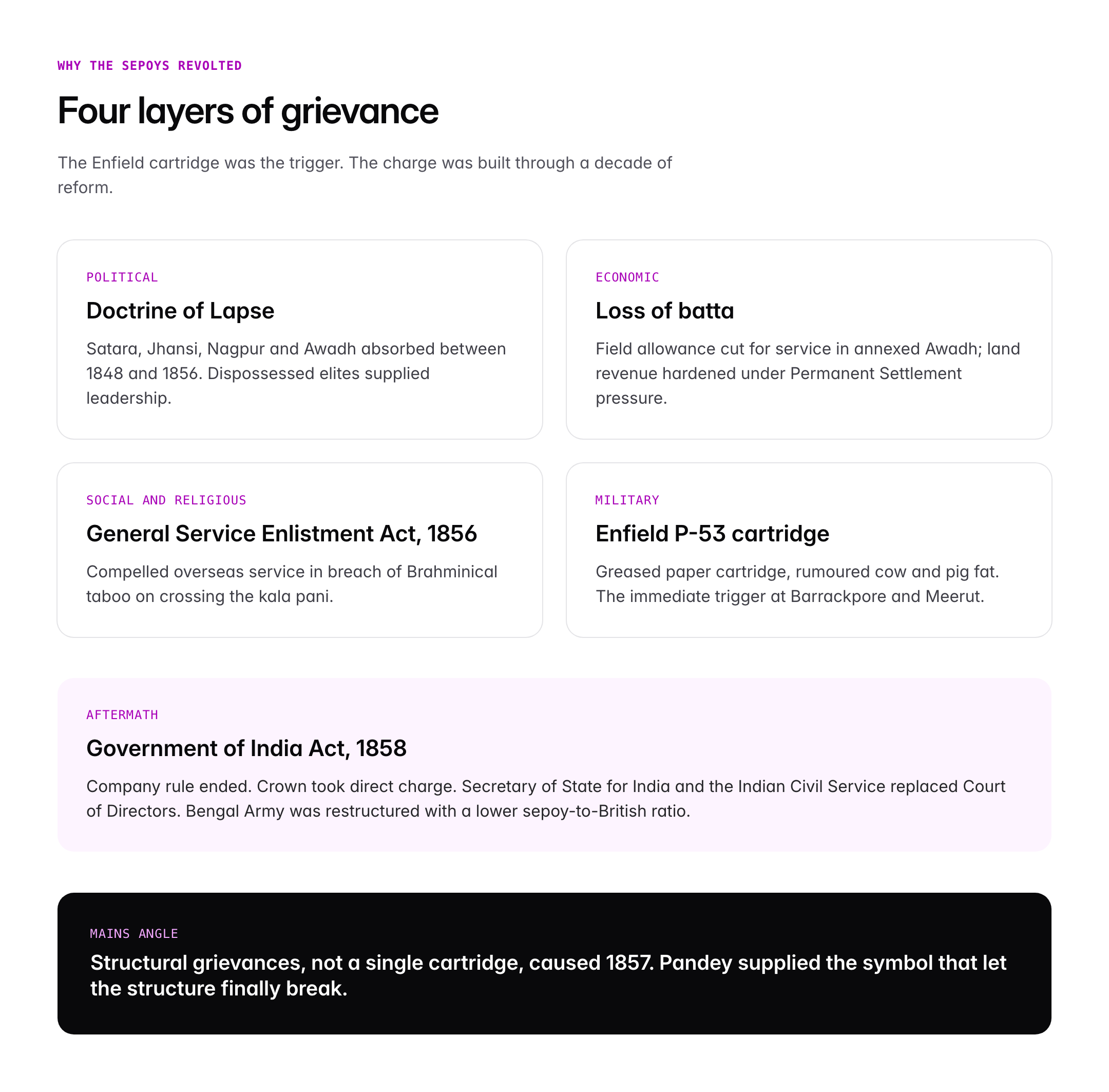
Lord Dalhousie‘s Doctrine of Lapse absorbed Satara, Jhansi and Nagpur. The annexation of Awadh in 1856 on grounds of misgovernance struck directly at the home districts of most Bengal sepoys. The General Service Enlistment Act of 1856 required new recruits to serve overseas, violating the Brahminical taboo on crossing the kala pani. Christian missionaries preached openly in cantonments. Pay grievances, the loss of the batta allowance for service in annexed Awadh, and the humiliation of caste rules in the barrack mess simmered for years.
The immediate trigger came from Enfield. The new P-53 rifle, introduced in 1856, used a paper cartridge whose end had to be bitten off before loading. Rumours spread through the cantonments that the grease was a mixture of cow fat and pig lard, defiling Hindu and Muslim sepoys alike. The Company denied it, then switched greases, then allowed sepoys to tear cartridges by hand, but by then trust had collapsed. Into this atmosphere walked Mangal Pandey on 29 March 1857.
Key Features of the Barrackpore Incident
The man and his regiment
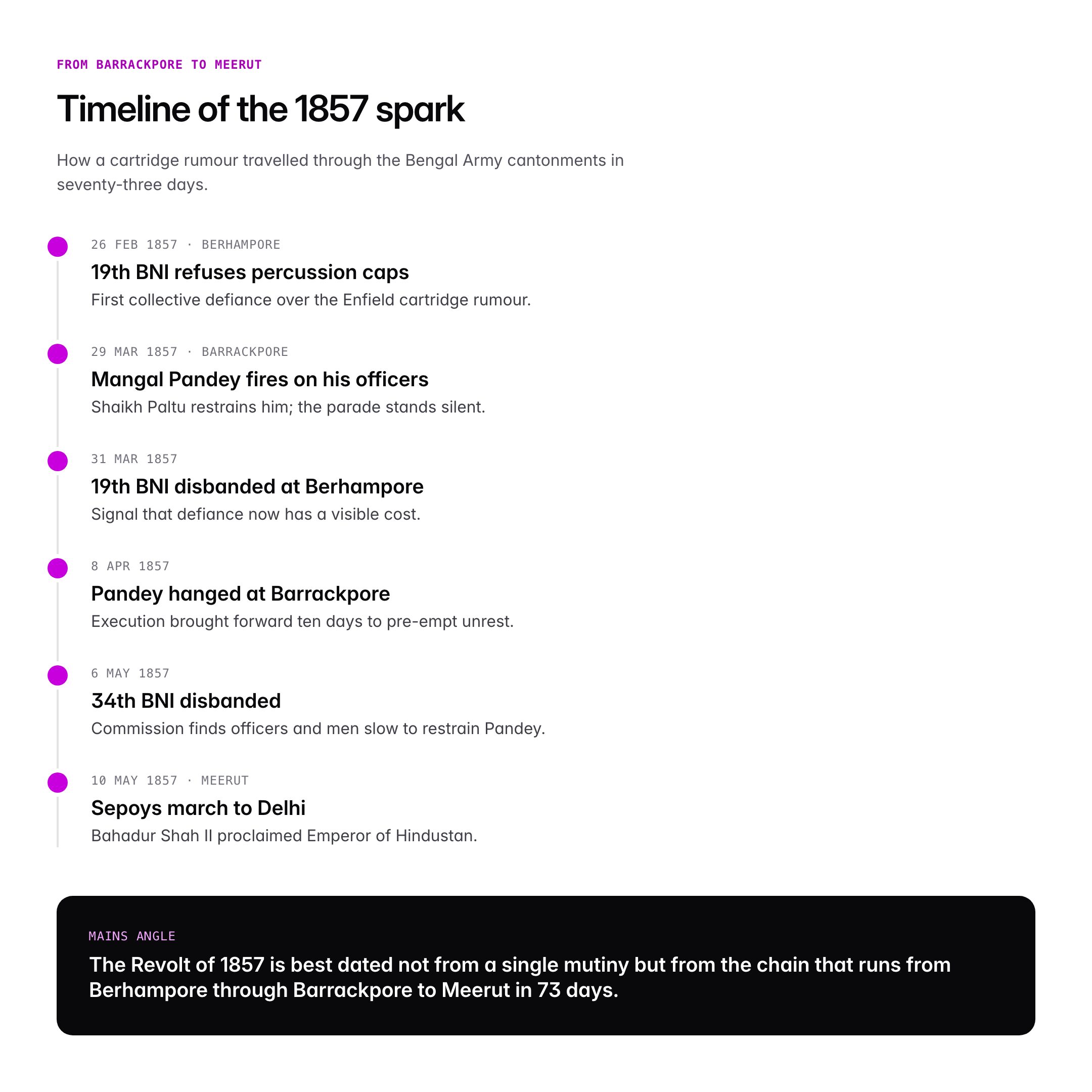
Mangal Pandey enlisted in the 34th Bengal Native Infantry in 1849 at around the age of twenty-two. Contemporary records describe him as tall, wiry and deeply religious. He was posted at Barrackpore, the large cantonment twenty-four kilometres north of Calcutta that served as the nerve centre of the Bengal Army. In March 1857 his regiment was already restive, having heard the cartridge rumours from the neighbouring 19th BNI at Berhampore, which had itself mutinied on 26 February.
The afternoon of 29 March 1857
On a warm Sunday afternoon, Pandey appeared near the quarter-guard of the 34th BNI armed with a loaded musket and his regimental talwar. Reports, including those compiled in Sir John Kaye’s History of the Sepoy War, describe him as agitated, possibly under the influence of bhang, calling on his comrades to rise against the Company and declaring that the cartridges would destroy their caste. Lieutenant Baugh, the adjutant, rode up on horseback and was shot at. Sergeant-Major Hewson followed; both were wounded. A sepoy named Shaikh Paltu intervened, restraining Pandey until the Jemadar Ishwari Prasad and other sepoys reluctantly arrived. Pandey tried to shoot himself but only wounded his chest.
Trial and execution
A court-martial convened on 6 April 1857 found Pandey guilty of mutiny and attempted murder. He was hanged on 8 April at Barrackpore, ten days before the scheduled date, because the authorities feared wider unrest. Jemadar Ishwari Prasad was hanged on 21 April for failing to control his men. The 34th BNI was disbanded on 6 May 1857. Shaikh Paltu, who had saved the British officers, was promoted to Havildar but was murdered within weeks by fellow sepoys.
From Barrackpore to Meerut
Barrackpore did not ignite a general mutiny, but it telegraphed through the cantonment system. On 10 May 1857, the sepoys at Meerut broke into open revolt, marched to Delhi, and proclaimed Bahadur Shah II as Emperor of Hindustan. The chain that ran from Pandey’s cartridge to the siege of Delhi is, in the nationalist reading, unbroken.
Significance for UPSC and General Knowledge
- Pandey is the standard textbook answer for the immediate trigger of the 1857 Revolt in the Bengal Army and a frequent Prelims one-liner.
- His case illustrates how religious and caste sentiment interacted with colonial military reform, a GS1 essay staple.
- The Barrackpore incident helps you contextualise the Berhampore mutiny of February 1857 and the Meerut outbreak of May 1857 as a continuum.
- Pandey’s legacy ties into debates on who qualifies as the first freedom fighter of India, comparing him with Tilka Manjhi, Veer Narayan Singh and Rani Channamma.
- V. D. Savarkar’s 1909 book The Indian War of Independence, 1857 reframes Pandey as a nationalist hero, which is itself a historiography question.
- The episode feeds directly into the Government of India Act, 1858 and the end of Company rule, a standard Mains linkage.
Detailed Analysis: Reign of Rumour and the Sepoy Mind
The Barrackpore incident is not explicable as the act of a lone unstable soldier. British records from the time, including depositions before the court of inquiry, show that rumours about the greased cartridges had been circulating in the Dum Dum arsenal, Barrackpore and Berhampore since January 1857. A low-caste lascar at Dum Dum is said to have taunted a Brahmin sepoy about sharing a lota of water, provocatively asking how caste could be preserved once the cartridges were bitten. The rumour travelled faster than official clarifications.
Pandey’s act must also be read against the backdrop of the 19th BNI’s defiance at Berhampore on 26 February 1857, when sepoys refused to accept percussion caps. The regiment was disbanded on 31 March, just two days after Pandey’s outbreak, strengthening the view among sepoys that collective protest was safer than individual compliance. Within the 34th BNI itself, the reluctance of officers and men to seize Pandey, documented in the subsequent enquiry, points to a silent sympathy that the British read as complicity.
Historians C. A. Bayly, Rudrangshu Mukherjee and Tapti Roy have each argued that the 1857 Revolt cannot be collapsed into a single cause. It was simultaneously a sepoy mutiny, a peasant uprising in Awadh, a dispossessed-aristocracy revolt in Jhansi and Kanpur, and, in Delhi, a last stand for the Mughal idea. What Pandey supplied was not the cause but the symbol: a sepoy in uniform, turning his issued musket against his officers on religious grounds, telegraphing to every cantonment that the Company was no longer sovereign over the loyalty of its own army. That symbolism, more than the military outcome at Barrackpore, is why the Revolt is dated from his act.
Comparative Perspective
Pandey is often invoked as India’s first freedom fighter, but the title is contested. Comparing him with earlier rebels brings out what is specifically new about 1857 and what continues older traditions of resistance.
| Figure | Year and region | Nature of resistance | Scale |
|---|---|---|---|
| Tilka Manjhi | 1784, Santhal Pargana | Adivasi uprising against Company oppression | Regional, tribal |
| Velu Nachiyar | 1780s, Sivaganga | Queen’s armed campaign against Company | Princely state |
| Paika Rebellion | 1817, Odisha | Militia uprising against revenue settlement | Regional |
| Veer Narayan Singh | 1857, Chhattisgarh | Zamindar-led grain redistribution | District |
| Mangal Pandey | 1857, Barrackpore | Individual sepoy mutiny | Symbolic, empire-wide trigger |
The comparison shows that armed resistance against the Company predates 1857 by almost eight decades. What Pandey represents is the first act inside the Bengal Army, the institutional spine of Company power. Earlier revolts were localised and suppressible; a mutiny in the Bengal Army threatened the Company’s monopoly on organised violence, which is why the response was so swift and so brutal.
Controversies and Debates
Pandey’s biography has been shaped as much by nationalist reconstruction as by archival fact. British accounts from 1857 and the Kaye-Malleson volumes of the 1860s portray him as a deranged and intoxicated fanatic, a convenient pathology that absolved the Company of structural blame. Indian nationalist writers, beginning with Savarkar in 1909, reversed the portrayal into conscious revolutionary heroism.
The historical record sits in between. The court-martial papers and the enquiry conducted by Major-General Hearsey establish the facts of the incident, the identity of those involved and the chain of events, but they do not establish Pandey’s interior motives. Whether he acted alone, whether he had coordinated with the 19th BNI, whether the bhang story was fabrication or fact, and whether he said the words attributed to him on the parade ground are all matters of reasonable doubt. Recent scholarship by Rudrangshu Mukherjee and Kim Wagner has urged caution against both the colonial and the nationalist caricatures.
A second debate is whether Pandey deserves the specific title of first freedom fighter. For the Santhal and Adivasi tradition, Tilka Manjhi precedes him by seventy-three years. For the princely-state tradition, Velu Nachiyar and Rani Channamma precede him. The preferred formulation in recent NCERT and ICHR materials is that Pandey was the first sepoy martyr of the 1857 Revolt, a narrower but defensible claim.
Prelims Pointers
- Mangal Pandey was born on 19 July 1827 in Nagwa village, Ballia district, in present-day Uttar Pradesh.
- He was a sepoy in the 5th Company of the 34th Bengal Native Infantry.
- The Barrackpore incident took place on 29 March 1857.
- He attacked Lieutenant Baugh and Sergeant-Major Hewson.
- Shaikh Paltu restrained Pandey and was later killed by fellow sepoys.
- Pandey was hanged on 8 April 1857 at Barrackpore.
- Jemadar Ishwari Prasad of the 34th BNI was hanged on 21 April 1857.
- The 34th BNI was disbanded on 6 May 1857.
- The 19th BNI at Berhampore had mutinied earlier, on 26 February 1857.
- The Meerut mutiny that triggered the wider revolt occurred on 10 May 1857.
- The Enfield P-53 rifle and its greased cartridge formed the immediate trigger.
- A commemorative postage stamp on Mangal Pandey was issued in 1984; Shaheed Mangal Pandey Maha Udyan at Barrackpore marks the execution site.
Mains Practice Questions
- Examine the role of the sepoy grievances of the Bengal Army in the outbreak of the Revolt of 1857. How far does the case of Mangal Pandey capture the longer-term causes of the uprising?
- Identify short-term causes, including the Enfield cartridge, the General Service Enlistment Act and pay reductions.
- Link to long-term causes, including the Doctrine of Lapse, the annexation of Awadh and missionary activity.
- Argue that Pandey’s act symbolised structural grievance rather than personal deviance and set the pattern for Meerut, Delhi and Awadh.
- The description of Mangal Pandey as India’s first freedom fighter has been contested by historians. Discuss, with reference to both pre-1857 resistance movements and the historiography of 1857.
- Survey earlier armed resistance including Tilka Manjhi, the Paika Rebellion and Velu Nachiyar.
- Compare colonial, nationalist and subaltern-school readings of Pandey.
- Conclude that Pandey is best read as the first sepoy martyr of 1857 rather than the absolute first freedom fighter.
Conclusion
Mangal Pandey’s story is short in calendar time and vast in consequence. In just over ten days in the spring of 1857, a single sepoy walked onto a parade ground, fired on his officers, was tried and was hanged. Within weeks his regiment was disbanded; within months the Company’s army was in open revolt from Meerut to Lucknow; within a year the Company itself was finished, and India passed to the Crown. Few individual acts in modern Indian history have travelled this distance from cause to consequence.
For the UPSC aspirant, remembering Pandey is not about memorising his birth village or the date of his hanging. It is about seeing how an institutional grievance inside the Bengal Army, compounded by annexations and a careless ordnance decision, could find expression in a single symbolic act and then propagate through the sinews of an imperial army. That mechanism, in which structure, symbol and chance combine to produce revolt, is what links Pandey to every later moment in the Indian freedom struggle, from the Swadeshi movement to Quit India.
Frequently Asked Questions
Who was Mangal Pandey?
Mangal Pandey was a sepoy of the 5th Company of the 34th Bengal Native Infantry who, on 29 March 1857 at Barrackpore near Calcutta, attacked his British officers in protest against the greased Enfield cartridges. Tried by court-martial, he was hanged on 8 April 1857, becoming the first sepoy martyr of the Revolt of 1857.
Why is Mangal Pandey important for UPSC?
Pandey anchors several GS1 Modern History topics: the immediate trigger of the 1857 Revolt, the role of Bengal Army sepoy grievances, the end of East India Company rule under the Government of India Act, 1858, and the historiography of the First War of Indian Independence. He is a recurring Prelims one-liner and a reliable Mains essay example.
What happened at Barrackpore on 29 March 1857?
Mangal Pandey appeared near the quarter-guard of the 34th BNI, armed with a musket and a talwar, and fired on Lieutenant Baugh and Sergeant-Major Hewson. Sepoy Shaikh Paltu restrained him. Pandey attempted suicide but survived, was court-martialled on 6 April and hanged on 8 April. Jemadar Ishwari Prasad was hanged on 21 April.
How is Mangal Pandey related to the greased cartridge controversy?
Pandey’s uprising was directly linked to the Enfield P-53 rifle introduced in 1856, whose paper cartridges were believed to be greased with cow and pig fat. The rumour offended Hindu and Muslim sepoys alike. Pandey publicly invoked caste and religion as justification for his attack, making the cartridge the defining symbol of sepoy grievance.
Was Mangal Pandey really India’s first freedom fighter?
The claim is contested. Earlier rebels such as Tilka Manjhi in 1784, the Paika Rebellion of 1817 and Velu Nachiyar in the 1780s preceded him. Modern NCERT and ICHR formulations describe Pandey more precisely as the first sepoy martyr of the 1857 Revolt, acknowledging older traditions of armed resistance against the East India Company.
What was the fate of the 34th Bengal Native Infantry?
The regiment was disbanded on 6 May 1857 after a commission of enquiry concluded that officers and men had been slow in restraining Pandey. Other sepoys from the regiment carried the story into neighbouring cantonments, contributing to the general disaffection that broke into open revolt at Meerut on 10 May 1857.
How did the British portray Mangal Pandey in their official records?
British sources, including Sir John Kaye’s History of the Sepoy War, portrayed Pandey as a fanatic acting under the influence of bhang and religious mania. This framing suited colonial purposes by reducing a political act to personal pathology. Later nationalist writers, beginning with V. D. Savarkar in 1909, reinterpreted him as a conscious revolutionary.
How is Mangal Pandey commemorated today?
Independent India has honoured Pandey through a 1984 commemorative postage stamp, the Shaheed Mangal Pandey Maha Udyan memorial park at Barrackpore, the naming of parks and roads in Ballia and the 2005 biographical film Mangal Pandey: The Rising. His name features in state and national textbooks as the symbolic starter of the 1857 Revolt.
Tell Google you want more of this.
Add Anantam IAS as a preferred sourceOne tap, and this site shows up more often in your own Top Stories, AI Overviews and AI Mode. Remove it any time.