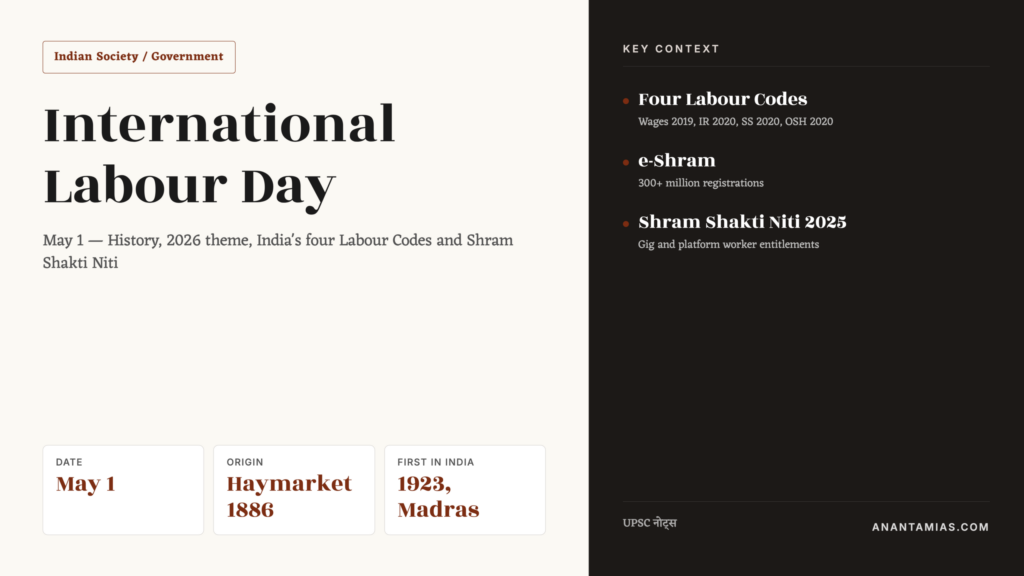
International Labour Day 2026 falls on Friday, 1 May 2026. The day, also called May Day, International Workers' Day or Shram Divas in India, marks the anniversary of the 1 May 1886 general strike in the United States that culminated in the Haymarket affair in Chicago and gave birth to the eight-hour working day movement. India's first observance was on 1 May 1923 in Madras, where Comrade Singaravelar of the Labour Kisan Party of Hindustan hoisted a red flag on the beach and demanded that the day be declared a national holiday. For UPSC aspirants, May Day 2026 is a compact lens through which to revise labour history, the International Labour Organization (ILO) framework, India's four Labour Codes, the new Shram Shakti Niti, e-Shram registration data and the rapidly evolving rights of gig and platform workers.
2026 Theme and Observance
The ILO traditionally announces the May Day theme close to the date. As of late April 2026 the 2026 theme is awaited from ILO; the most recent ILO flagship publication, the State of Social Justice 2025 report, has framed the year's discourse around closing the social-protection gap for informal and platform workers, and the May Day 2026 communications are expected to build on that agenda. India's Ministry of Labour and Employment marks the day with a tripartite address from the Union Labour Minister, e-Shram outreach drives and central trade union rallies in Delhi, Mumbai, Chennai, Kolkata and Bengaluru.
Quick Facts at a Glance
- Also known as: International Workers' Day, May Day, Shram Divas, Labours Day
- Date: 1 May every year
- Origin event: Haymarket affair, Chicago, 4 May 1886
- Declared by: Second International, Paris Congress, 1889
- Core demand: Eight-hour working day
- First Indian observance: Madras (Chennai), 1 May 1923
- Indian pioneer: Comrade M Singaravelar (Singaravelu Chettiar)
- ILO established: 1919, Treaty of Versailles
- India and ILO: Founder member, 1919
- Indian Labour Codes: 4 (Code on Wages 2019; IR Code, SS Code, OSH Code — all 2020)
- e-Shram registrations: over 30 crore as of 2025-26
- PLFS unemployment FY 2024-25: ~3.2% (usual status, all-India)
- Female LFPR (2023-24): ~37%
- Constitutional basis: Concurrent List; Articles 14, 16, 19, 21, 23, 24, 38, 39, 41, 42, 43, 43A
- Maharashtra and Gujarat foundation: 1 May 1960
Background and Historical Context
The campaign for the eight-hour day took shape in industrial America in the 1860s. The Federation of Organized Trades and Labor Unions in 1884 resolved that from 1 May 1886 the legal working day would be eight hours, backed by strike action if necessary. On that day, between three and five lakh workers across the United States walked off the job, with Chicago emerging as the epicentre. A rally at Haymarket Square on 4 May 1886 ended in violence after a bomb was thrown at police; the subsequent gunfire killed several officers and civilians, and the state's execution of labour leaders, including August Spies and Albert Parsons, became a cause célèbre for the international socialist movement. Eugene Debs, who would later contest the United States presidency, drew political education from the trial.
The Second International, meeting in Paris in 1889 to commemorate the centenary of the French Revolution, declared 1 May an international day for labour demonstrations and chose the date to honour the Haymarket martyrs. The Brussels Congress of 1891 made it a recurring annual observance. By the early twentieth century May Day parades had become a fixture across Europe, Latin America and large parts of Asia.
India's encounter with the day was shaped by the early communist movement. Comrade Singaravelar (Malayapuram Singaravelu Chettiar) organised the first Indian celebration on 1 May 1923 — one meeting at the Triplicane beach and another opposite the Madras High Court — under the banner of the Labour Kisan Party of Hindustan. He hoisted the red flag for the first time in public in India and passed a resolution demanding that the government declare 1 May a national holiday for workers. Within a decade the Communist Party of India and trade union centres including the All India Trade Union Congress (AITUC, founded 1920 with NM Joshi and Lala Lajpat Rai among the initiators) had institutionalised May Day rallies. Post-Independence, the tradition continued through the central trade unions — INTUC, CITU, HMS, BMS and AITUC.
Key Features of May 1 Labour Day
Global Observance
Over 80 countries mark 1 May as a public holiday — the European Union, most Commonwealth nations in Asia and Africa, Russia, China, Cuba and most of Latin America observe the day through rallies, cultural events and trade-union meetings. The United States and Canada, ironically, celebrate Labor Day on the first Monday of September, partly to disassociate from the radical politics of the Haymarket affair.
Role of the International Labour Organization
The ILO, established under the Treaty of Versailles in 1919, is the specialised UN agency for labour matters and the only one with a tripartite structure of governments, employers and workers. India is a founder member. ILO conventions on core labour standards — Conventions 87 and 98 (freedom of association and collective bargaining), 29 and 105 (forced labour), 100 and 111 (equal remuneration and non-discrimination), 138 and 182 (minimum age and worst forms of child labour) — provide the normative framework that national labour laws, including India's, draw upon. India ratified Conventions 138 and 182 in 2017, taking its tally of ratified conventions to 47.
Connection to India's Constitution
Labour is a Concurrent List subject under the Seventh Schedule. Key constitutional provisions include Article 19(1)(c) (freedom to form associations), Article 23 (prohibition of traffic in human beings and forced labour), Article 24 (prohibition of employment of children below 14 in hazardous work), and Articles 38, 39(d-e), 41, 42, 43 and 43A in the Directive Principles, mandating humane conditions of work, equal pay for equal work, living wage, maternity relief, and participation of workers in management.
India's Four Labour Codes — Status in 2026
The Ministry of Labour and Employment consolidated 29 existing central labour laws into four umbrella codes — the Code on Wages, 2019, the Industrial Relations Code, 2020, the Code on Social Security, 2020, and the Occupational Safety, Health and Working Conditions Code, 2020. Implementation has proceeded in phases as states issue implementing rules. As of 2026, almost all states and Union Territories have pre-published rules under the four Codes, but full nationwide notification continues to be uneven, with Kerala, West Bengal and a handful of north-eastern states still calibrating their state-level rules.
Shram Shakti Niti 2025
The Shram Shakti Niti 2025 — India's National Labour Policy approved by the Cabinet in 2025 — sits above the four Codes as a normative roadmap. It commits to universal social security coverage by 2030, formalisation of at least 50 per cent of unorganised workers, integration of e-Shram with EPFO, ESIC and the Ayushman Bharat databases, and a tripartite National Labour Council to monitor implementation.
Symbols and Practices
The red flag, the clenched fist, and the song The Internationale are long-standing May Day symbols. In Indian cities the day is marked by trade union rallies, seminars on labour policy and, increasingly, by attention to gig and platform workers, who in 2026 organise their own visible mobilisations outside aggregator offices in Bengaluru, Gurugram and Mumbai.
Significance for UPSC and General Knowledge
- May 1 Labour Day is directly testable as a Prelims static date and as a Mains theme under social justice and governance.
- It anchors GS-II questions on the ILO and its core conventions, plus the Constitution's Directive Principles.
- It is a live GS-II governance topic via the four Labour Codes, Shram Shakti Niti 2025 and state-level innovations.
- It connects to GS-III on employment, gig economy regulation and the PLFS data.
- It provides historical grounding for GS-I questions on the trade union movement, AITUC (1920) and the Indian National Congress's 1929 Lahore session endorsement of labour rights.
- It links to gender questions through female LFPR data and the Maternity Benefit framework.
Detailed Analysis: India's Four Labour Codes
The four Labour Codes represent the most significant rationalisation of Indian labour law since Independence. The Code on Wages, 2019 consolidates the Minimum Wages Act 1948, the Payment of Wages Act 1936, the Payment of Bonus Act 1965 and the Equal Remuneration Act 1976. It introduces the concept of a statutory national floor wage below which no state can fix minimum wages and extends wage protection to all workers regardless of sectoral coverage.
The Industrial Relations Code, 2020 merges the Industrial Disputes Act 1947, the Trade Unions Act 1926 and the Industrial Employment (Standing Orders) Act 1946. Its most debated feature is the raising of the threshold for seeking prior government permission for retrenchment and closure from 100 to 300 workers, which industry argues aids formalisation while unions contend it weakens job security. The Code also institutionalises fixed-term employment with full statutory benefits and creates a formal procedure for the recognition of negotiating unions. For deeper background, see our notes on the Industrial Disputes Act 1947 and the analysis of the Labour Codes.
The Code on Social Security, 2020 brings the EPF, ESI, Gratuity, Maternity Benefit, Employees Compensation and other social security laws under a single framework and, significantly, extends coverage to gig workers, platform workers and unorganised workers through a new social security fund financed by a mix of employer, government and aggregator contributions. The e-Shram portal, launched in August 2021, provides the operational backbone for registration of unorganised workers; by early 2026 it has crossed 30 crore registrations and is being progressively linked with EPFO, ESIC and the Ayushman Bharat databases under the Shram Shakti Niti 2025 framework.
The Occupational Safety, Health and Working Conditions Code, 2020 consolidates 13 laws including the Factories Act 1948, the Mines Act 1952, the Contract Labour Act 1970 and the Inter-State Migrant Workmen Act 1979. It introduces uniform definitions of establishments, standardises safety norms and brings inter-state migrant workers under a single portable registration regime.
Critics highlight three concerns. First, operationalisation depends on state rules and several states are still calibrating their notifications. Second, the raised thresholds on retrenchment and standing orders could enlarge the informal-by-choice segment. Third, social security for platform workers depends heavily on aggregator contribution rates and enforcement, both of which remain contested. Supporters argue that the Codes are evolutionary, deliberately designed to allow phased adjustment while extending the net of formal protection. The wider debate on dignity of work also intersects with questions of bonded labour and the feminization of informal labour, both of which remain on the policy agenda.
Gig and Platform Workers in 2026
The Code on Social Security 2020 was globally among the earliest legislations to formally name gig workers and platform workers. In 2026 two state laws have moved ahead of the central framework. The Rajasthan Platform Based Gig Workers (Registration and Welfare) Act 2023 introduced a Welfare Board, a welfare fee on aggregator transactions and a state-managed welfare fund. The Karnataka Platform-Based Gig Workers (Social Security and Welfare) Act 2024 went further by mandating contracts, grievance redressal, transparent algorithmic decisions and a 1–5 per cent transaction-level welfare fee. Telangana and Tamil Nadu are reportedly preparing their own bills, modelled on the Karnataka law.
The central Social Security Code pegs aggregator contributions at 1 to 2 per cent of turnover, subject to 5 per cent of annual wages paid. The Shram Shakti Niti 2025 instructs the Centre to operationalise the central social security fund for gig and platform workers in FY 2026-27, link it with e-Shram, and extend Ayushman Bharat coverage to all registered platform workers. ILO's State of Social Justice 2025 has highlighted India's gig-worker framework as a notable South-Asian template.
Employment and Labour Force in 2026
The Periodic Labour Force Survey (PLFS) FY 2024-25 estimates the all-India unemployment rate at about 3.2 per cent on the usual-status basis, the lowest in over a decade. The Labour Force Participation Rate (LFPR) has risen to about 60.1 per cent overall, with the female LFPR climbing to about 37 per cent in 2023-24 — a notable improvement from sub-25 per cent levels in the late 2010s, though still well short of the ILO global average. Worker Population Ratio is at a multi-year high, but the share of self-employed and unpaid family workers remains elevated, particularly in rural areas. For broader context, see our notes on the female labour force participation trend.
The Ministry of Statistics and Programme Implementation (MoSPI) launched a high-frequency monthly PLFS in 2025, and the Reserve Bank of India's KLEMS database now provides quarterly employment trackers. The combined picture for 2026 is one of declining headline unemployment but persistent under-employment, informality and a clear gender gap.
Comparative Perspective
| Feature | India (Labour Codes) | ILO Benchmarks | Germany | United States |
|---|---|---|---|---|
| Weekly hours | 48, daily 8–9 cap | 40 reference | 40 standard | 40 with overtime |
| Minimum wage | National floor + state | Not mandatory | Statutory since 2015 | Federal + state |
| Union recognition | Negotiating union mechanism | Conventions 87, 98 | Works councils | NLRA framework |
| Social security | EPFO, ESIC, e-Shram | Convention 102 | Bismarck model | Social Security Act 1935 |
| Gig workers | SS Code 2020 + state Acts | R205 Recommendation | Scheinselbständig reforms | State-level patchwork |
| Retrenchment threshold | 300 workers | Not prescribed | Works council consent | At-will employment |
The comparison shows that India is attempting a middle path between the continental European model of strong social protection and the flexible American model of at-will hiring, with the added challenge of covering a very large informal workforce.
Controversies and Debates
India's Labour Codes have generated prolonged debate. Central trade unions have called multiple all-India strikes — most recently the joint platform action of 2024 and 2025 — demanding reconsideration of provisions on retrenchment, fixed-term employment, the dilution of the inspector regime to an "inspector-cum-facilitator" model, and the perceived weakening of the right to strike. Employers' associations have welcomed consolidation but asked for quicker harmonisation of state rules and a single compliance interface.
A second debate concerns gig and platform workers. While the 2020 Code formally names them, the mechanism for aggregator contributions remains under-implemented. Karnataka's 2024 law and Rajasthan's 2023 Act have moved ahead of the Centre, raising federal-coordination questions.
A third concern is gender equality at work. The Codes retain the Maternity Benefit Act's 26-week entitlement but do not mandate creche facilities as universally as unions have demanded. The Supreme Court's 2023 Aureliano Fernandes judgement and ongoing POSH Act enforcement add parallel pressure for workplace-safety reform. The persistently low female LFPR — even at 37 per cent it lags BRICS peers — keeps gendered labour-market design firmly on the May Day agenda.
Maharashtra Day and Gujarat Day
Because the bilingual Bombay State was reorganised on 1 May 1960 into Maharashtra and Gujarat under the Bombay Reorganisation Act 1960, both states observe 1 May as their statehood day. Maharashtra Day is marked by an official parade at Shivaji Park, Mumbai, and Gujarat Day by ceremonies in Gandhinagar. In practice the observance is merged with the May Day public holiday in both states.
Prelims Pointers
- May 1 Labour Day commemorates the 1886 Haymarket affair in Chicago.
- The Second International declared 1 May an international labour day at its 1889 Paris Congress.
- First Indian May Day was organised by Comrade Singaravelar in Madras on 1 May 1923.
- AITUC, the first central trade union in India, was founded on 31 October 1920.
- The ILO was established in 1919 under the Treaty of Versailles and India is a founder member.
- India ratified ILO Conventions 138 and 182 in 2017.
- Labour is a Concurrent List subject under the Seventh Schedule.
- Article 23 prohibits forced labour; Article 24 prohibits child labour in hazardous work.
- Maharashtra Day and Gujarat Day fall on 1 May, commemorating the 1960 reorganisation.
- India has consolidated 29 central labour laws into 4 Labour Codes (2019–2020).
- The Code on Wages 2019 introduces a statutory national floor wage.
- The Social Security Code 2020 brings gig and platform workers under formal coverage.
- The e-Shram portal was launched in August 2021; over 30 crore registrations by 2026.
- The Shram Shakti Niti 2025 is India's National Labour Policy.
- Karnataka enacted a Platform-Based Gig Workers Act in 2024; Rajasthan's Act dates to 2023.
- PLFS FY 2024-25 unemployment rate is about 3.2 per cent on usual status.
- Female LFPR in 2023-24 is about 37 per cent.
Mains Practice Questions
- The four Labour Codes seek to balance ease of doing business with worker protection. Critically examine in the context of India's informal workforce and the Shram Shakti Niti 2025. (250 words)
- Summarise the architecture of the four Codes and the laws they subsume.
- Discuss contentious provisions — retrenchment thresholds, fixed-term employment, platform-worker coverage.
- Evaluate state-level innovations in Karnataka and Rajasthan, with reference to ILO standards and India's federal structure.
- International Workers' Day of 1 May is more than a symbolic observance. Discuss its relevance to India's social justice agenda in 2026. (150 words)
- Trace origins from Haymarket to the Second International and the 1923 Madras observance.
- Connect to constitutional labour provisions and the Directive Principles.
- Link to current debates on gig workers, female LFPR, e-Shram coverage and the Shram Shakti Niti.
Conclusion
May 1 is a date that compresses more than a century of struggle, from the Haymarket victims of 1886 to the Madras beachfront rally of 1923 to the contemporary gig-worker mobilisations outside aggregator offices in 2026. For the UPSC aspirant, the day offers a single file in which to hold history, constitutional provisions, the ILO framework, the four Labour Codes, the new Shram Shakti Niti, the e-Shram architecture and the rights of platform workers.
The Codes are not the end of the story. Their success will depend on state-level rule-making, aggregator compliance, trade union engagement and the state's capacity to enforce social security for hundreds of millions of informal and platform workers. Read against that backdrop, International Labour Day 2026 is less a ceremonial pause and more a recurring reminder that the boundary between ease of doing business and dignity of labour must be actively negotiated every year.
Frequently Asked Questions
What is International Labour Day 2026?
International Labour Day 2026, observed on Friday 1 May 2026, is the global commemoration of the labour movement also called May Day, International Workers' Day or Shram Divas. It marks the anniversary of the 1886 Haymarket general strike in Chicago and the workers who died in the agitation for an eight-hour working day. Over 80 countries observe it as a public holiday.
Why is May Day celebrated on 1 May?
On 1 May 1886, between three and five lakh workers across the United States launched a general strike demanding an eight-hour working day. Chicago was the epicentre, and a rally at Haymarket Square on 4 May ended in violence. The Second International, meeting in Paris in 1889, chose 1 May to commemorate the Haymarket martyrs and to globalise the eight-hour-day demand.
When did India first celebrate Labour Day?
India's first May Day was organised on 1 May 1923 in Madras (now Chennai) by Comrade Singaravelar of the Labour Kisan Party of Hindustan. Two meetings were held — one at Triplicane beach and another opposite the Madras High Court. Singaravelar hoisted the red flag for the first time in public in India and passed a resolution demanding that the government declare 1 May a national holiday for workers.
What is the Labour Day theme for 2026?
As of late April 2026, the ILO has not formally announced a single global theme for International Workers' Day 2026. The wider 2026 ILO discourse builds on the State of Social Justice 2025 report, focused on closing the social-protection gap for informal, gig and platform workers. The official theme will be updated when ILO releases it.
What are India's four Labour Codes?
India has consolidated 29 central labour laws into four Labour Codes — the Code on Wages 2019, the Industrial Relations Code 2020, the Code on Social Security 2020 and the Occupational Safety, Health and Working Conditions Code 2020. Together they introduce a statutory floor wage, recognise gig and platform workers, and revise thresholds on retrenchment, fixed-term employment and inspections. As of 2026, most states have pre-published rules but full notification continues to be uneven.
What is the Shram Shakti Niti 2025?
The Shram Shakti Niti 2025 is India's National Labour Policy, approved by the Cabinet in 2025. It commits to universal social security coverage by 2030, formalisation of at least 50 per cent of unorganised workers, integration of e-Shram with EPFO, ESIC and Ayushman Bharat, and a tripartite National Labour Council to monitor implementation of the four Labour Codes.
How many workers are registered on e-Shram?
The e-Shram portal, launched in August 2021 by the Ministry of Labour and Employment, had crossed 30 crore registered unorganised workers by 2026. It is the world's largest single registry of informal workers and is being progressively linked with EPFO, ESIC, Ayushman Bharat and state welfare boards under the Shram Shakti Niti 2025 framework.
How are gig workers covered under Indian law in 2026?
The Code on Social Security 2020 explicitly defines gig workers and platform workers and empowers the Centre to notify schemes on life, disability, accident and health insurance, old-age protection and creches funded through a Social Security Fund. Aggregator contributions are pegged at 1 to 2 per cent of turnover, capped at 5 per cent of annual wages paid. Rajasthan's 2023 Act and Karnataka's 2024 law go further with welfare boards, transaction-level fees and algorithmic-transparency mandates.
Why do Maharashtra and Gujarat celebrate 1 May?
On 1 May 1960 the bilingual Bombay State was reorganised along linguistic lines into Maharashtra and Gujarat under the Bombay Reorganisation Act 1960. Both states observe 1 May as their foundation day — Maharashtra Day and Gujarat Day respectively. The observance is typically merged with the May Day public holiday in both states.
What does PLFS say about unemployment in FY 2024-25?
The Periodic Labour Force Survey (PLFS) for FY 2024-25, released by MoSPI, estimates the all-India unemployment rate at about 3.2 per cent on the usual-status basis — the lowest in over a decade. The overall LFPR is about 60.1 per cent and the female LFPR is about 37 per cent (2023-24). The PLFS is now released monthly under MoSPI's revised survey design.
Tell Google you want more of this.
Add Anantam IAS as a preferred sourceOne tap, and this site shows up more often in your own Top Stories, AI Overviews and AI Mode. Remove it any time.