Introduction
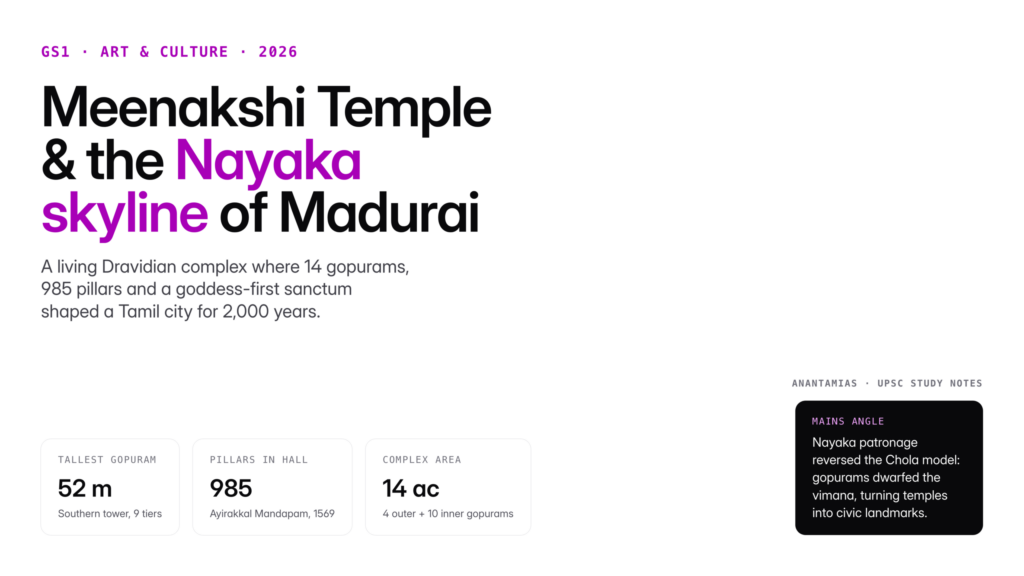
On the southern bank of the Vaigai river, in the temple city of Madurai, rises a cluster of sculpted towers so dense with imagery that pilgrims have called it “the stone ocean.” This is the Meenakshi Sundareswarar Temple, better known simply as the Meenakshi Temple, a living ritual complex dedicated to goddess Meenakshi, a form of Parvati, and her consort Sundareswarar, a form of Shiva. Few monuments in India compress as much architectural ambition, mythic memory and living devotion into a single walled enclosure as this Nayaka-era masterpiece.
For UPSC aspirants, the Meenakshi Temple is a case study in the Dravidian temple tradition, the Nayaka school of architecture, and the political economy of temple urbanism in early modern South India. It also features in the tangible heritage debates around the Archaeological Survey of India, the 2017 UNESCO “best swachh iconic place” recognition, and the larger question of how temple complexes continue to shape the urban form of Indian cities. This guide walks aspirants through its history, layout, iconography, significance, and the key prelims-mains pointers every serious candidate should know.
Quick Facts at a Glance
| Attribute | Detail |
|---|---|
| Location | Madurai, Tamil Nadu, on the south bank of the Vaigai |
| Main deities | Meenakshi (Parvati) and Sundareswarar (Shiva) |
| Architectural style | Dravidian, Nayaka school |
| Principal builders | Pandya kings (original), Vishwanatha Nayaka and Tirumala Nayaka (present form, 16th-17th century CE) |
| Number of gopurams | 14, including 4 tall outer gopurams |
| Tallest gopuram | Southern gopuram, approximately 52 metres |
| Hall of 1000 pillars | Ayirakkal Mandapam, built around 1569 CE |
| Annual festival | Meenakshi Tirukalyanam (Chithirai festival, April-May) |
| Governing body | Hindu Religious and Charitable Endowments (HR and CE) Department, Tamil Nadu |
| UNESCO status | Nominated for World Heritage; recognised as “Best Swachh Iconic Place” (2017) |
Background and Historical Context
The religious origins of Madurai predate written history. Tamil Sangam literature, especially the Silappatikaram and later the Tiruvilaiyadal Puranam, references a shrine to Shiva and a goddess at Madurai, the seat of the Pandya dynasty. The city itself is sometimes called Koodal, the meeting place of three Tamil Sangams, and its very layout, a concentric grid of streets with the temple at the core, reflects the Vastu ideal of the temple as the cosmic centre of the settlement.
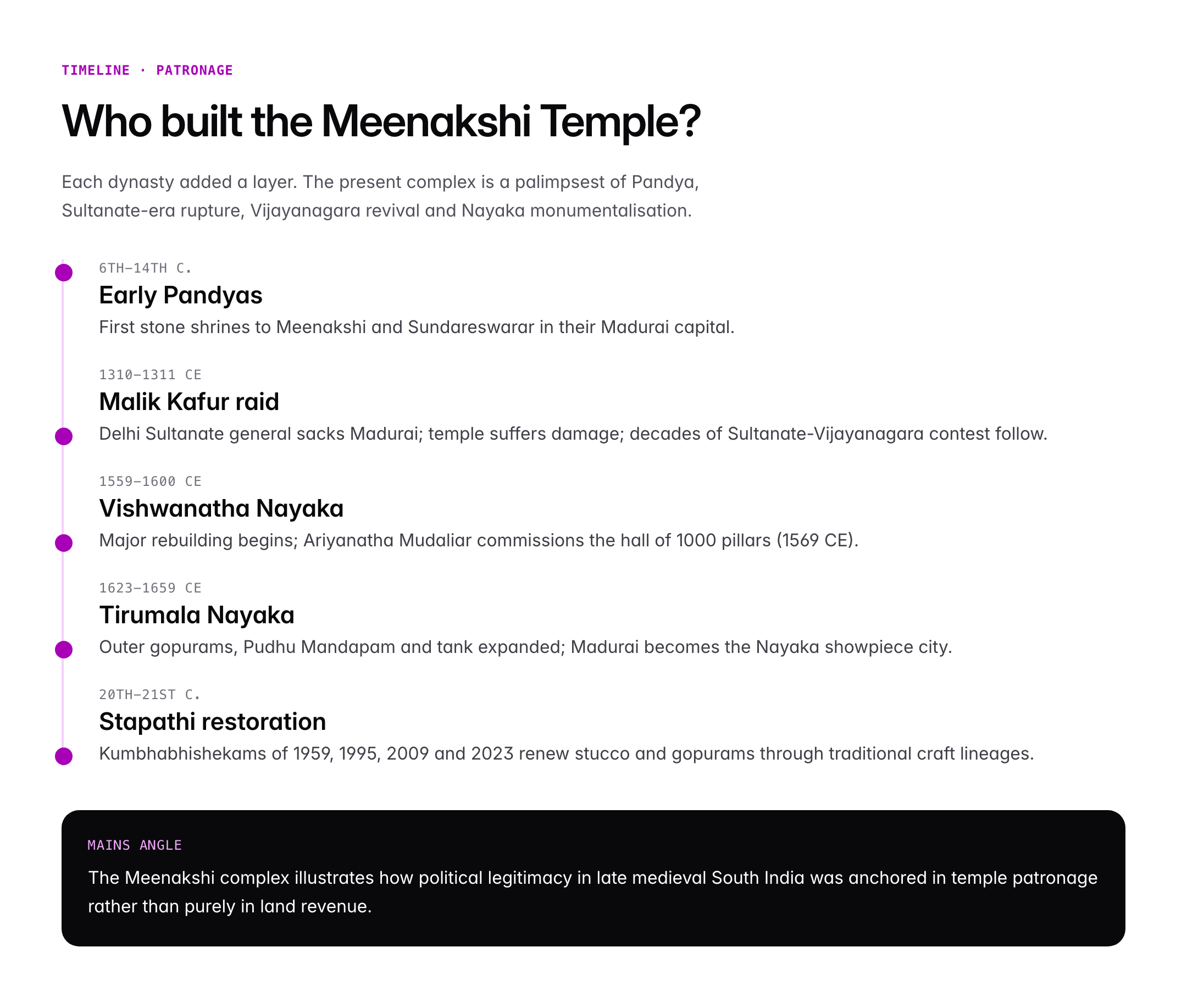
The first major stone shrine is attributed to the early Pandyas, who ruled from Madurai intermittently from the 6th to the 14th century CE. However, the temple as aspirants encounter it today is largely a Nayaka creation. When the Delhi Sultanate general Malik Kafur raided the Deccan and Tamil country in 1310-1311 CE, Madurai and its temple complex suffered extensive damage. For much of the 14th century, the region was contested between the Madurai Sultanate and the Vijayanagara Empire, until Vijayanagara forces decisively integrated the Tamil heartland.
After the Battle of Talikota in 1565 CE, Vijayanagara’s governors in the south, the Madurai Nayakas, became effectively independent. Under Vishwanatha Nayaka and especially Tirumala Nayaka (reigned 1623-1659 CE), the Meenakshi temple was rebuilt on a monumental scale. The Nayakas added the towering gopurams, the Ayirakkal Mandapam or hall of 1000 pillars, the golden Potramarai Kulam (lotus tank), and the outer prakaras. Later Maratha governors, British surveyors, and 20th-century stapathis continued the tradition of restoration, culminating in the famous 1959-1963 kumbhabhishekam (consecration) and the more recent 2009 and 2023 consecrations.
Key Features
The urban plan and enclosure
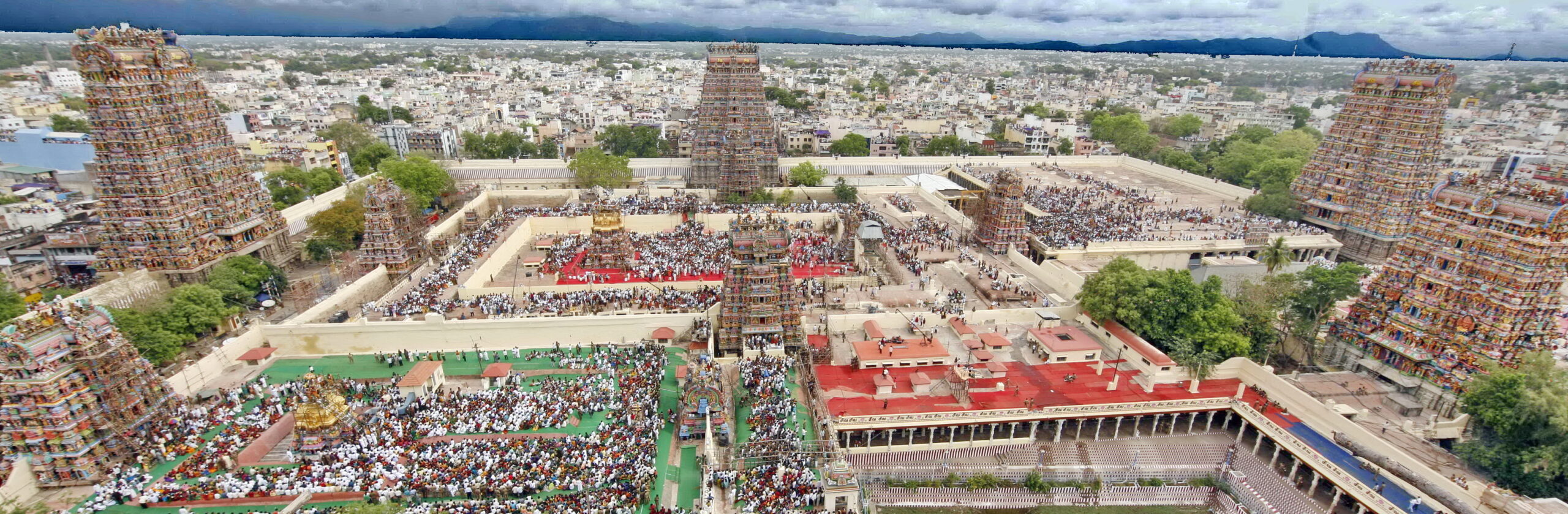
The temple sits within a near-rectangular compound of roughly 14 acres, surrounded by four tall outer gopurams aligned to the cardinal directions. The southern gopuram is the tallest at about 52 metres with nine tiers and more than 1500 sculpted figures. Around this temple core, Madurai’s streets form a Vaastu mandala of concentric rectangles, a pattern retained through 2500 years of urban life.
The two sanctums
Unlike most Shaiva temples, Meenakshi Amman, not Shiva, is the first and foremost deity worshipped. Her green-stone icon sits in a west-facing sanctum. Sundareswarar, her consort, occupies a parallel east-facing sanctum. This layout, where the goddess has equal or primary status, is distinctive and reflects the strong Shakta undercurrent of Tamil Shaivism.
Gopurams and vimanas
The temple has 14 gopurams in total. The four outer gopurams rise between 45 and 52 metres and are covered in brightly painted stucco sculptures depicting deities, mythic scenes, dancers and animals. The inner vimanas over the two main sanctums are gold-plated, following the Dravidian convention of a modest sanctum shikhara subordinated to the massive entry gopurams.
Ayirakkal Mandapam
The hall of 1000 pillars, built in 1569 CE by Ariyanatha Mudaliar, a general of Vishwanatha Nayaka, actually contains 985 pillars. Each pillar is carved as an independent sculptural composition, featuring yalis, deities and portraits. A set of musical pillars nearby produces distinct notes when struck, a hallmark of Nayaka craftsmanship.
Potramarai Kulam and the Kilikoondu Mandapam
The Potramarai Kulam or Golden Lotus Tank in the centre of the complex is where, according to legend, Sangam poets tested the merit of their compositions. The Kilikoondu Mandapam, literally “cage of parrots,” once housed trained parrots who were taught to chant the goddess’s name, a tradition revived periodically.
Ritual and festival cycle
The temple follows the Shaiva Siddhanta ritual tradition with six daily pujas. The flagship festival is the Meenakshi Tirukalyanam, the celestial wedding of Meenakshi and Sundareswarar, celebrated during the Chithirai festival in April-May. It draws over a million pilgrims and features a temple-car procession through the four mada streets.
Significance for UPSC and General Knowledge
- Represents the mature Dravidian temple form, with the gopuram replacing the vimana as the visual climax, a hallmark of late medieval Tamil architecture.
- Exemplifies the Nayaka architectural idiom: massive mandapas, densely sculpted pillars, painted stucco gopurams and large tanks.
- Embodies the Shakta-Shaiva synthesis of Tamil religion, with a goddess who is both warrior queen and consort.
- Serves as an urban-planning model: Madurai’s concentric mada street pattern survives as a living textbook of Vaastu-based town planning.
- Illustrates heritage management challenges: balance between ritual use, tourism, accessibility and conservation under the HR and CE Department.
- Recognised as the 2017 best Swachh Iconic Place under the Swachh Bharat Mission, linking heritage and sanitation policy.
Detailed Analysis: Architecture and Sculptural Programme
The Meenakshi Temple is usually cited as the clearest extant expression of the Nayaka style, the final major phase of Dravidian temple building. Three architectural features define this phase and are visible across the Meenakshi complex.
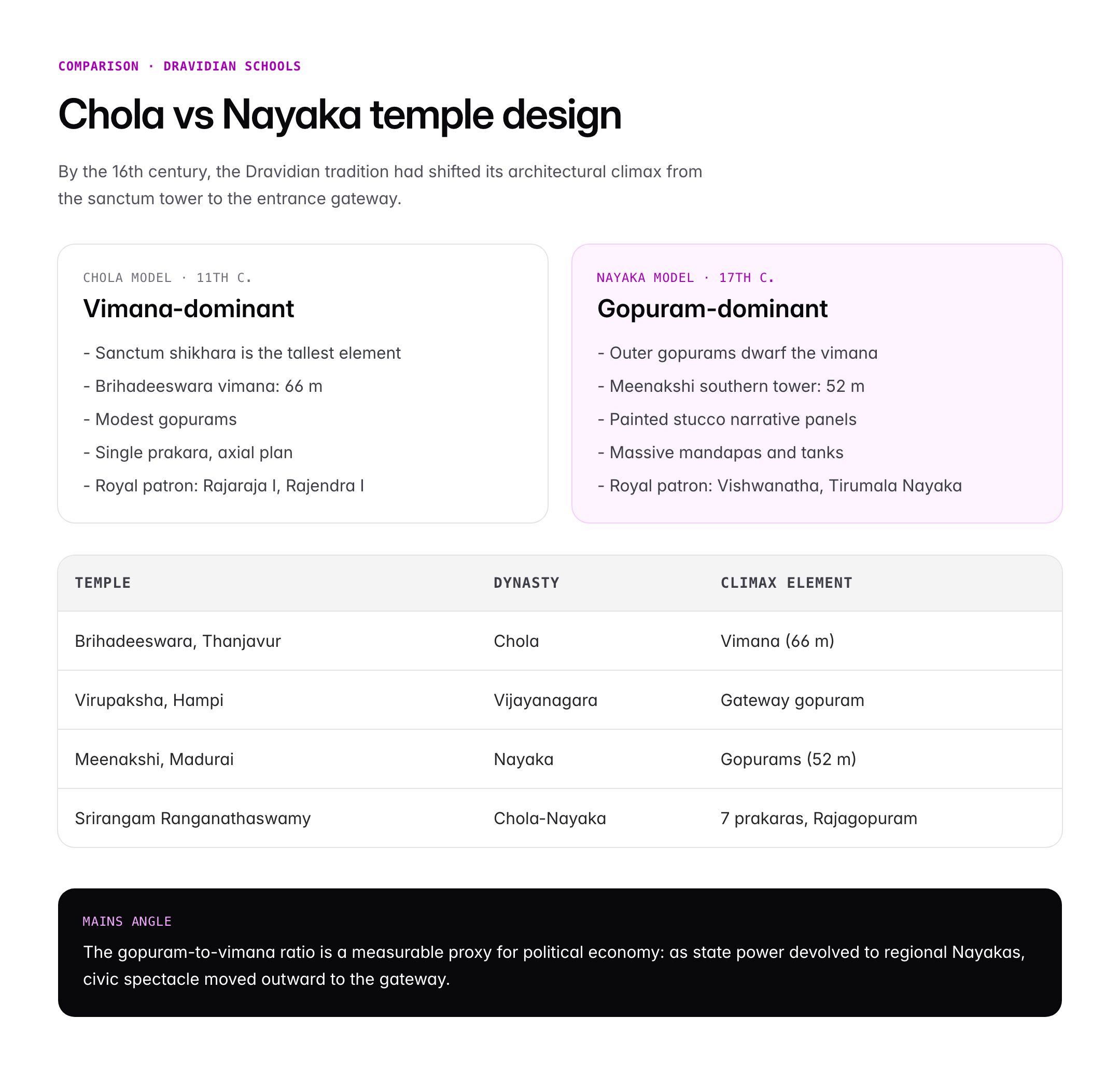
First, the gopuram reversal: where early Chola temples, such as the Brihadeeswara at Thanjavur, placed their tallest structure directly over the garbhagriha, later Pandya and Nayaka builders shifted the visual climax outward. The gopurams at the cardinal entrances became the towers seen from kilometres away, while the vimana over the sanctum remained modest. At Meenakshi, the southern gopuram is roughly five times the height of the gold-plated vimana over the goddess.
Second, the mandapa explosion. The Nayakas added massive pillared halls, or mandapas, for ritual, civic and political functions. The hall of 1000 pillars, the Pudhu Mandapam in front of the eastern gopuram, the Kambathadi Mandapam with its 8 yali pillars, and the Ashta Shakti Mandapam combine devotional, educational and commercial roles. These halls hosted discourses, music performances, coronations and even markets, showing the temple as a multifunctional urban institution.
Third, the sculptural density and painted stucco. Each gopuram carries over a thousand painted figures arranged in tiers that narrate Puranic stories, royal genealogies and local Sthalapurana episodes from the Tiruvilaiyadal Puranam, such as the 64 leelas or divine plays of Shiva. The polychrome stucco technique, periodically restored, is itself an intangible craft tradition passed through stapathi lineages.
Beyond these features, the temple is known for its musical pillars, ceiling paintings in the Kilikoondu and Meenakshi Nayakar Mandapams, and portrait sculptures of Nayaka rulers. The temple tank, the gold-plated Kodi Maram (flagstaff) and the sculpted Nandi shrines complete the ensemble. Later additions, such as the Rani Mangammal Choultry and 20th-century restorations by stapathis like Muthiah Sthapati, continued the sculptural idiom into modern times.
Comparative Perspective
The Meenakshi Temple is best understood alongside other great South Indian temples across dynasties. The comparison below clarifies how architectural priorities shifted over time.
| Temple | Dynasty / Period | Dominant element | UPSC-relevant feature |
|---|---|---|---|
| Brihadeeswara, Thanjavur | Chola, 11th century | Vimana over sanctum (66 m) | UNESCO World Heritage site, Great Living Chola Temples |
| Meenakshi, Madurai | Pandya-Nayaka, 16th-17th century | Gopurams (up to 52 m), mandapas | Mature Nayaka style, urban plan |
| Virupaksha, Hampi | Vijayanagara, 15th century | Layered gopuram, ritual complex | Part of Hampi UNESCO site |
| Srirangam Ranganathaswamy | Chola-Nayaka, expanded 14th-17th century | Seven concentric prakaras | Largest functioning Hindu temple |
| Ramanathaswamy, Rameswaram | Pandya-Nayaka, 12th-17th century | Longest temple corridor | Pilgrimage circuit, Char Dham link |
Meenakshi’s distinctiveness lies in its balance: it is neither the tallest vimana (that is Thanjavur) nor the largest complex (that is Srirangam), but it integrates urban planning, sculpted stucco gopurams, a goddess-primary iconography and a continuous ritual tradition more completely than any of its peers.
Challenges and Controversies
The temple, for all its grandeur, faces a set of contemporary challenges that frequently appear in governance and heritage questions.
Conservation versus ritual use is a recurring tension. Over-application of lime plaster, synthetic paints and incense soot have damaged original stone surfaces. Periodic kumbhabhishekam ceremonies, while religiously essential, sometimes involve restoration choices that conflict with international conservation norms laid out by bodies such as ICOMOS. The Archaeological Survey of India has only limited jurisdiction, since the temple is a living place of worship under the state HR and CE Department, not a protected monument.
Accessibility and dress-code controversies have also surfaced. High Court rulings on dress codes, entry for non-Hindus to inner prakaras, and the role of women in certain rituals have drawn public attention. The temple’s large footfall, estimated at 15000 to 25000 pilgrims daily and several times that on festival days, strains sanitation, fire safety and crowd management systems. Encroachments along the four mada streets and the proposed conservation of the surrounding urban fabric have pitted heritage advocates against commercial interests, making Madurai a test case for the Heritage By-Laws issued under the AMASR Act and state town planning laws.
Prelims Pointers
- Main deities: Meenakshi (Parvati) and Sundareswarar (Shiva).
- Architectural style: Dravidian, Nayaka school.
- Primary patrons of present form: Vishwanatha Nayaka and Tirumala Nayaka.
- Number of gopurams: 14 (4 outer, 10 inner).
- Tallest gopuram: southern, around 52 metres, 9 tiers.
- Hall of 1000 pillars, Ayirakkal Mandapam, has 985 pillars, built 1569 CE.
- Sacred tank: Potramarai Kulam, the Golden Lotus Tank.
- Flagship festival: Meenakshi Tirukalyanam during the Chithirai festival (April-May).
- Managed by: Tamil Nadu HR and CE Department.
- First raided by Malik Kafur in 1310-1311 CE.
- Awarded Best Swachh Iconic Place in 2017 under Swachh Bharat Mission.
- Sangam-era references: Silappatikaram; later Tiruvilaiyadal Puranam.
Mains Practice Questions
- The Meenakshi Temple at Madurai represents the culmination of the Dravidian temple tradition under the Nayakas. Discuss with reference to its architectural and sculptural features. (GS1, 15 marks)
- Trace Dravidian evolution from Pallava-Chola vimana-centric to Nayaka gopuram-centric models.
- Describe features: gopurams, mandapas including Ayirakkal Mandapam, sculptural iconography, painted stucco.
- Link to urban planning and the temple as a political-economic institution.
- Heritage management of living temple complexes in India requires a balance between ritual continuity and conservation science. Critically examine with reference to the Meenakshi Temple. (GS1 / GS2, 15 marks)
- State the legal framework: AMASR Act, HR and CE Department, ICOMOS guidelines.
- Issues: restoration choices, crowd management, encroachments, accessibility debates.
- Way forward: heritage by-laws, trained stapathis, community participation, integrated urban conservation.
Conclusion
The Meenakshi Temple is not a monument frozen in the past but a living, breathing civic organism that has shaped the city of Madurai for more than two millennia. Its gopurams anchor the skyline, its mandapas host discourses, weddings and commerce, and its ritual calendar sets the rhythm of the Tamil month. For aspirants, it is simultaneously a specimen of Dravidian-Nayaka architecture, a case in heritage governance, and a window into the social and cultural history of South India.
Understanding Meenakshi means grasping how Indian civilisation has, for centuries, located political legitimacy, artistic expression and everyday devotion inside a single walled enclosure. Preserving that legacy, while adapting it to a 21st-century city, is the challenge that heritage policy and ordinary pilgrims share in equal measure.
Frequently Asked Questions
What is the Meenakshi Temple?
The Meenakshi Temple, officially the Meenakshi Sundareswarar Temple, is a major Hindu temple in Madurai, Tamil Nadu, dedicated to goddess Meenakshi, a form of Parvati, and her consort Sundareswarar, a form of Shiva. Rebuilt on a monumental scale by the Madurai Nayakas in the 16th and 17th centuries, it is regarded as the finest surviving example of the late Dravidian, Nayaka-style temple complex.
Why is the Meenakshi Temple important for UPSC?
The temple appears under GS1 Art and Culture for Dravidian and Nayaka architecture, urban planning and Tamil devotional history. It also features in governance questions on heritage management, the HR and CE Department, AMASR Act, and the Swachh Iconic Places initiative. Its sculptural programme, festival economy and urban mandala layout make it a frequent prelims and mains reference point.
Who built the present Meenakshi Temple?
While Pandya kings built the earliest shrines, the present complex is largely the work of the Madurai Nayakas, especially Vishwanatha Nayaka in the late 16th century and Tirumala Nayaka in the early to mid 17th century. Their patronage produced the towering outer gopurams, the hall of 1000 pillars and the outer prakaras that define the temple today.
How tall is the tallest gopuram of the Meenakshi Temple?
The southern gopuram is the tallest, rising to approximately 52 metres across nine diminishing tiers. It is covered with more than 1500 painted stucco figures arranged in narrative registers that retell Puranic and Sthalapurana stories. It is visible from several kilometres around Madurai and anchors the city’s skyline.
How is the Meenakshi Temple related to Dravidian architecture?
The temple represents the mature phase of Dravidian architecture, where the gopuram over the gateway replaced the vimana over the sanctum as the dominant visual element. It also exemplifies the Nayaka innovations: massive mandapas, densely sculpted pillars, gold-plated sanctum roofs, large temple tanks and concentric prakaras integrated with the surrounding city grid.
What is the hall of 1000 pillars in the Meenakshi Temple?
The hall of 1000 pillars, known as the Ayirakkal Mandapam, was built around 1569 CE by Ariyanatha Mudaliar, a general of Vishwanatha Nayaka. It actually houses 985 pillars, each carved as an independent sculpture featuring yalis, deities and portraits. It now also hosts a temple art museum and is famous for its nearby musical pillars that produce distinct notes when tapped.
Is the Meenakshi Temple a UNESCO World Heritage Site?
The Meenakshi Temple is on India’s tentative list for UNESCO World Heritage nomination but has not yet been inscribed. However, it was recognised in 2017 as India’s Best Swachh Iconic Place under the Swachh Bharat Mission. Its living ritual status means it is managed by the Tamil Nadu HR and CE Department rather than the Archaeological Survey of India.
What is the Meenakshi Tirukalyanam festival?
Meenakshi Tirukalyanam is the celestial wedding of goddess Meenakshi and Sundareswarar, celebrated during the Chithirai festival in April or May. It is the flagship annual festival of Madurai, draws over a million pilgrims, and features a temple-car procession through the four mada streets. The event is a major case study of festival tourism and urban crowd management in Tamil Nadu.
Tell Google you want more of this.
Add Anantam IAS as a preferred sourceOne tap, and this site shows up more often in your own Top Stories, AI Overviews and AI Mode. Remove it any time.