Merger of Public Sector Banks: 27 to 12 Consolidation Explained
Merger of Public Sector Banks explained for UPSC: phased consolidation from 27 to 12 PSBs between 2017 and 2020, the anchor banks, rationale, outcomes, and governance reform.
The Merger of Public Sector Banks reshaped India’s banking landscape in a single short stretch between 2017 and 2020. In four years, the number of state-owned commercial banks shrank from 27 to 12, with four “Big” anchor banks emerging as the new pillars of public banking. The exercise was the largest consolidation in Indian financial sector history, larger in scale than the 1969 nationalisation in terms of branch network rationalisation.
For UPSC, the topic sits at the intersection of GS Paper 3 economy questions on banking reform and GS Paper 2 governance questions on PSU restructuring. The Merger of Public Sector Banks pulled together strands of the Indradhanush programme, the Banks Board Bureau recommendations, and the recapitalisation cycle that followed the Asset Quality Review of 2015. Examiners have asked about rationale, outcomes, and the regulatory architecture more than once.
This explainer walks through the phases of the Merger of Public Sector Banks, the anchor-bank logic, the operational mechanics, and the governance reforms it triggered. It also flags what worked, what didn’t, and where the consolidation conversation is headed next.
Quick Facts on PSB Merger
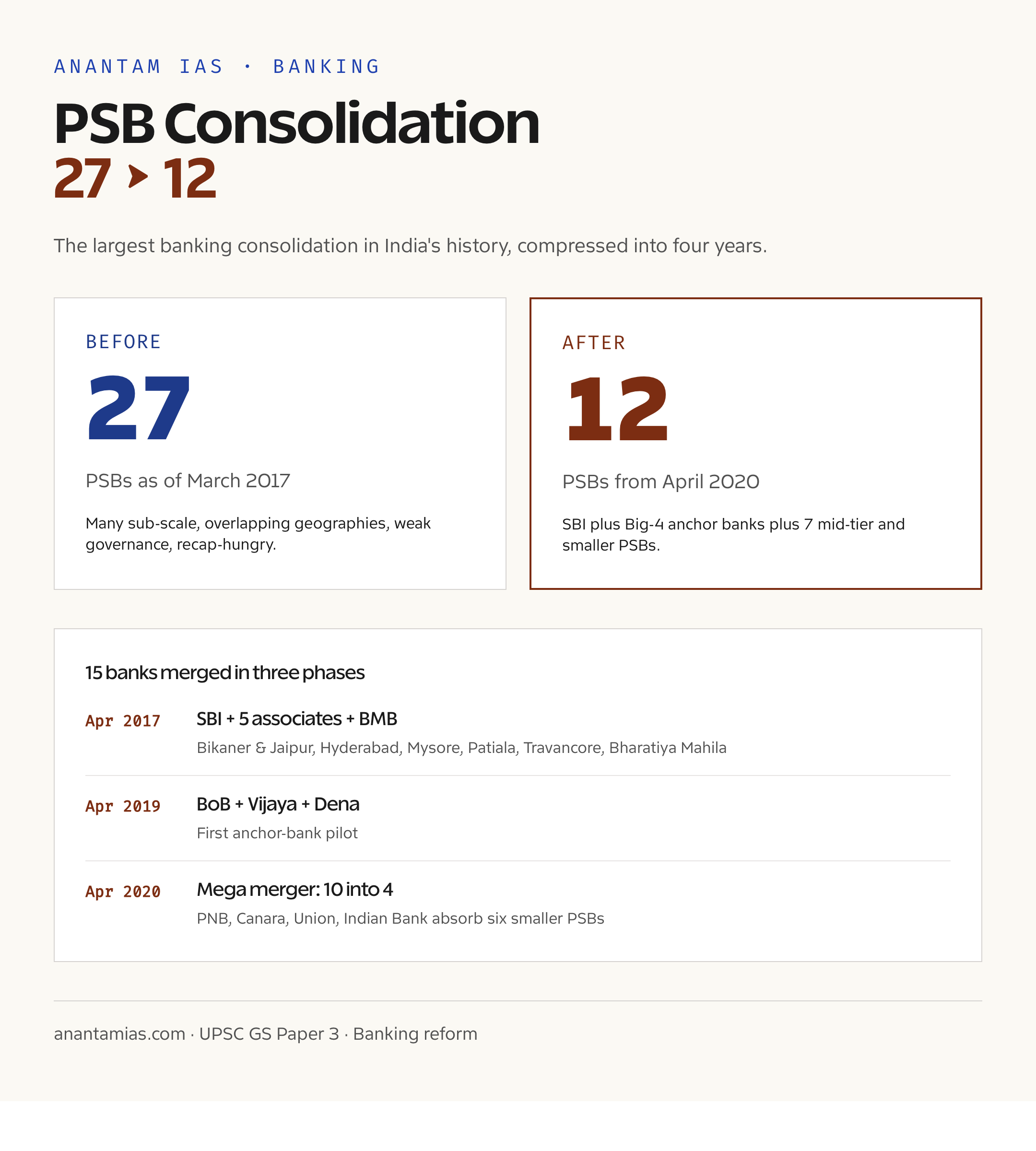
- Pre-merger. 27 public sector banks operated in India in 2017.
- Post-merger (April 2020). 12 PSBs remain, including SBI as the largest.
- Anchor banks (Big-4 of the 2019 round). PNB, BoB, Canara, Union Bank of India.
- First phase. SBI absorbed its 5 associate banks and Bharatiya Mahila Bank on 1 April 2017.
- Second phase. Bank of Baroda absorbed Vijaya Bank and Dena Bank on 1 April 2019.
- Third phase. Mega merger of 10 PSBs into 4 on 1 April 2020.
- Trigger framework. Indradhanush plan (August 2015) and Alternative Mechanism (2017).
What the Merger of Public Sector Banks Means
The Merger of Public Sector Banks refers to the consolidation of weaker and mid-size public banks into larger anchor banks through share-swap schemes notified by the central government. The mergers were carried out under Section 9 of the Banking Companies (Acquisition and Transfer of Undertakings) Acts, 1970 and 1980, which empower the government to draw up amalgamation schemes for nationalised banks after consulting the RBI.
The process was not a simple takeover. Each merger involved a swap ratio worked out by independent valuers, board approvals at both the anchor and the amalgamating bank, RBI no-objection, Cabinet clearance, and a final gazette notification. Employees, branches, customers, deposits, and loan books moved to the anchor bank from the appointed date.
The Merger of Public Sector Banks was not a one-shot event. It came in three distinct phases, each with its own logic. The SBI consolidation in 2017 was about removing the anomaly of associate banks. The BoB-Vijaya-Dena merger in 2019 was a pilot for the anchor-bank model. The 2020 mega merger was the strategic redesign that gave India its current Big-4 PSB structure outside SBI.
Background and Historical Context
The roots of the Merger of Public Sector Banks go back to the Narasimham Committee II report in 1998, which first recommended a three-tier banking structure with 3 international banks, 8 to 10 national banks, and a large number of regional banks. The committee argued that India had too many small PSBs, each weakly capitalised, with overlapping geographies and weak governance.
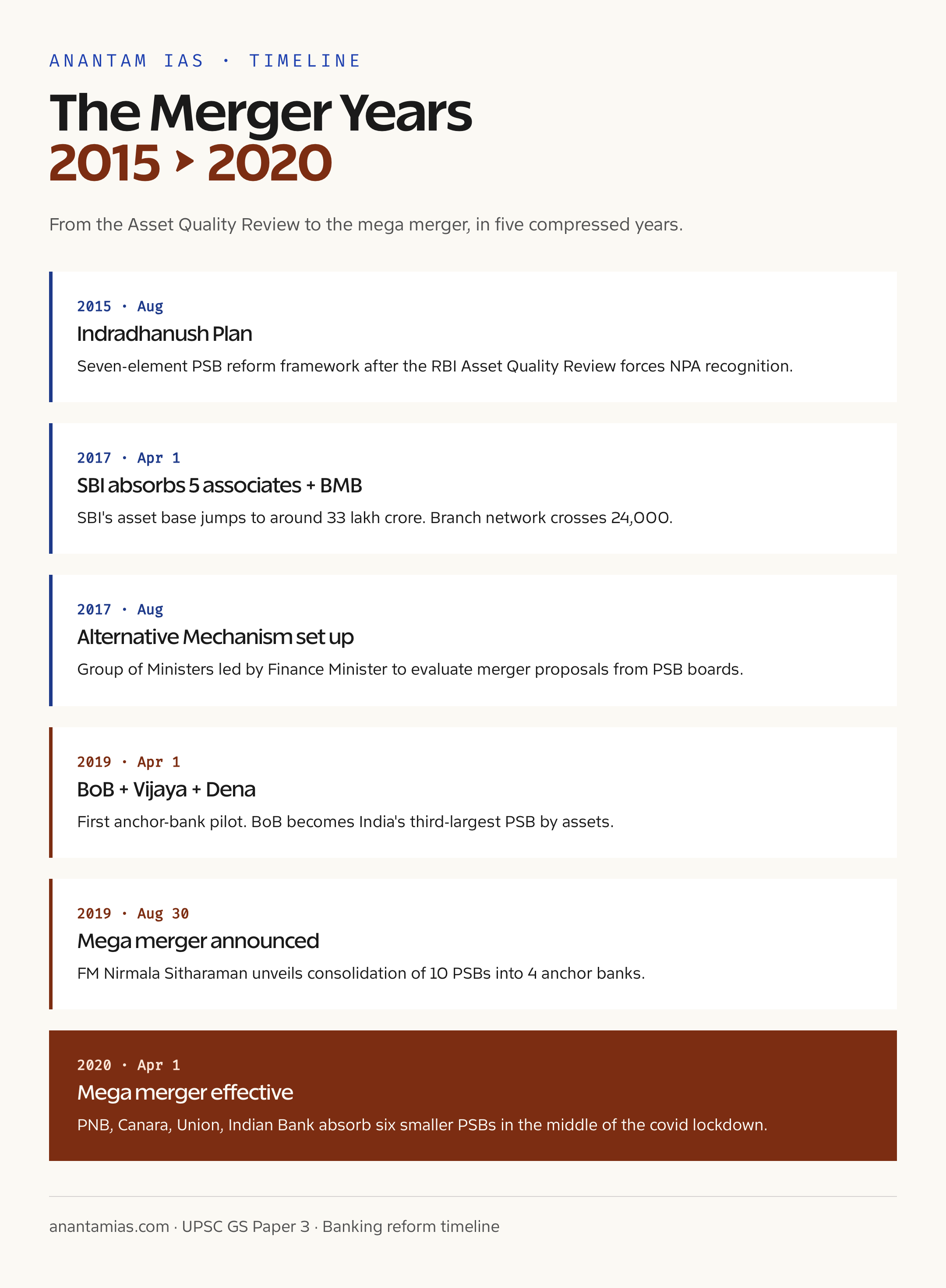
The recommendation stayed on paper for nearly two decades. The trigger came after the 2014-15 Asset Quality Review by RBI Governor Raghuram Rajan, which forced PSBs to recognise stressed loans that had been ever-greened for years. Gross NPAs of PSBs jumped from 5.4% in March 2015 to over 14% by March 2018. The government responded with the Indradhanush plan in August 2015, with seven elements covering Appointments, Banks Board Bureau, Capitalisation, De-stressing, Empowerment, Framework of accountability, and Governance reforms.
Indradhanush created the foundation. The actual consolidation began in 2017, when the SBI board first proposed absorbing its associate banks — State Bank of Bikaner and Jaipur, State Bank of Hyderabad, State Bank of Mysore, State Bank of Patiala, State Bank of Travancore — along with Bharatiya Mahila Bank. The Cabinet cleared the scheme in February 2017 and the merger took effect on 1 April 2017.
In August 2017, the Cabinet approved the “Alternative Mechanism”, a Group of Ministers chaired by the Finance Minister, to oversee future PSB mergers. The mechanism took proposals from bank boards, evaluated synergies, and recommended schemes for Cabinet approval. This created a standardised pipeline for the next two rounds.
Key Provisions and the Three Phases
The Merger of Public Sector Banks unfolded in three clean phases. Each round was larger and more strategically ambitious than the last.
Phase 1: SBI consolidation (1 April 2017). SBI absorbed its 5 associate banks and Bharatiya Mahila Bank. Pre-merger, SBI had assets of around 27 lakh crore. Post-merger it jumped to around 33 lakh crore. The branch network crossed 24,000, the customer base touched 50 crore, and SBI’s position as one of the world’s top 50 banks by assets was cemented.
Phase 2: BoB-Vijaya-Dena merger (1 April 2019). Bank of Baroda absorbed Vijaya Bank, a profitable South-based PSB, and Dena Bank, then under RBI’s Prompt Corrective Action framework. The swap ratios were 402 BoB shares for every 1,000 Vijaya shares and 110 BoB shares for every 1,000 Dena shares. The new BoB became the third-largest PSB by assets after SBI and PNB.
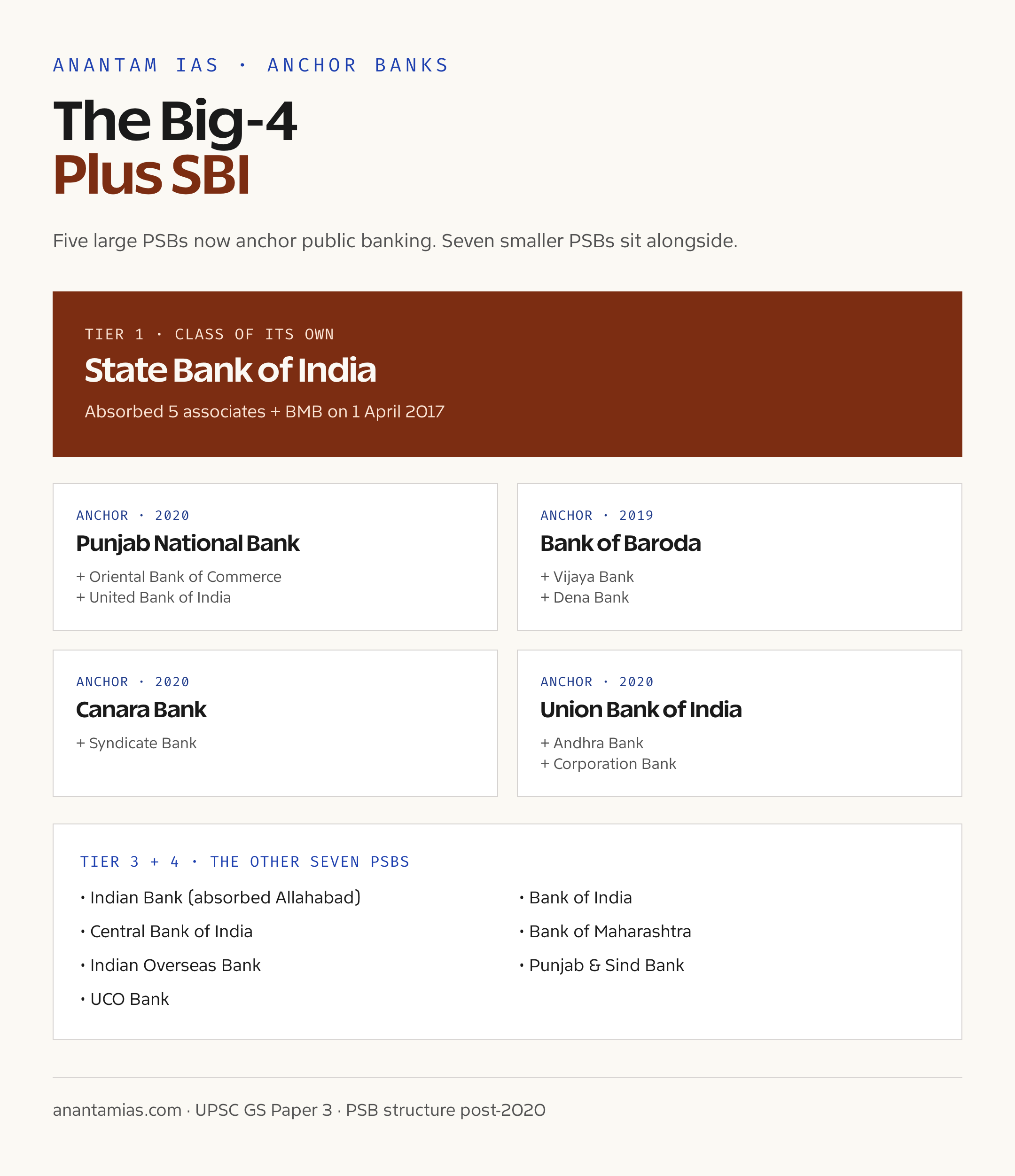
Phase 3: Mega merger (1 April 2020). The Finance Minister announced on 30 August 2019 that 10 PSBs would be consolidated into 4 anchor banks. This was the structural redesign that produced today’s Big-4 (excluding SBI):
- PNB absorbed Oriental Bank of Commerce and United Bank of India to become the second-largest PSB.
- Canara Bank absorbed Syndicate Bank.
- Union Bank of India absorbed Andhra Bank and Corporation Bank.
- Indian Bank absorbed Allahabad Bank.
The Cabinet cleared the schemes in March 2020, and the mergers took effect on 1 April 2020, in the middle of the covid-19 lockdown. RBI was consulted at every step, and the share swap ratios were determined by independent valuers Ernst & Young, Deloitte, and SBI Capital Markets.
Why It Matters: Rationale Behind the PSB Merger
The Merger of Public Sector Banks was driven by five interlocking arguments that the government and the RBI repeated through 2017 to 2020.
First, scale economics. Larger banks have lower cost-to-income ratios, can invest in core banking systems and analytics, and can fund larger single-borrower exposures without breaching prudential limits. India’s largest PSBs were sub-scale compared with peers in China, the US, and Japan.
Second, risk diversification. Merging banks with overlapping geographies but different sectoral loan mixes reduces concentration risk. A regionally concentrated PSB like Andhra Bank gained from joining Union Bank of India’s pan-India footprint.
Third, technology consolidation. Each PSB was running its own core banking platform, often on legacy software. Merging into a common technology stack cut duplicate licence fees, simplified compliance, and enabled the kind of digital products fintech competitors were already offering.
Fourth, governance reform. The 2017-2020 mergers were paired with the Banks Board Bureau, the appointment of non-executive chairmen, longer terms for managing directors, and performance-linked compensation. Merging weak banks into stronger ones diluted the bad governance practices that had built up in some PSBs.
Fifth, fiscal cost. Recapitalisation through bonds had become a heavy annual ask on the fiscal deficit. Larger, profitable PSBs need less government capital, freeing space for India’s multi-pillar pension landscape reform and capital expenditure.
Detailed Analysis of the 12 Surviving PSBs
After the mergers, the surviving 12 public sector banks split into clear tiers.
- Tier 1 (above 12 lakh crore assets). State Bank of India.
- Tier 2 anchor banks (Big-4 of 2019). Punjab National Bank, Bank of Baroda, Canara Bank, Union Bank of India.
- Tier 3 mid-size PSBs. Indian Bank, Bank of India, Central Bank of India.
- Tier 4 smaller PSBs. Bank of Maharashtra, Indian Overseas Bank, Punjab & Sind Bank, UCO Bank.
Each tier has a distinct profile. SBI is in a class of its own with the deepest CASA base, the largest digital platform in YONO, and the widest branch network. The Big-4 PSBs after merger now compete with the top private banks in corporate lending, SME credit, and rural reach. The mid-tier PSBs like Indian Bank and Bank of India have leaner balance sheets and better return on assets after the merger-induced cleanup.
The smaller PSBs — Bank of Maharashtra, IOB, P&S, UCO — are now profitable and have exited RBI’s Prompt Corrective Action framework, but they remain candidates for the next round of consolidation. The Finance Ministry has indicated more than once that the long-term goal is a handful of large PSBs of global scale.
Comparison: Pre-Merger vs Post-Merger Structure
| Year | Number of PSBs | Largest 5 by assets | Average asset size |
|---|---|---|---|
| March 2017 (pre) | 27 | SBI, PNB, BoB, Canara, BoI | Approx. 4 lakh crore |
| April 2020 (post) | 12 | SBI, PNB, BoB, Canara, Union | Approx. 9 lakh crore |
| March 2024 | 12 | SBI, PNB, BoB, Union, Canara | Approx. 11 lakh crore |
The average PSB asset size roughly doubled, the cost-to-income ratio fell from above 50% in FY18 to around 45% in FY24, and the combined PSB profit moved from a loss of around 85,000 crore in FY18 to a profit of over 1.4 lakh crore in FY24.
The performance gap between PSBs and private banks has narrowed sharply. Return on assets at the merged PSBs has crossed 1% for the first time in over a decade, though it still trails the 1.5% to 1.8% range typical of large private banks.
Challenges Faced During and After the Merger
The Merger of Public Sector Banks was not painless, and several of its challenges still shape PSB performance.
- Human resource integration. Employees from the amalgamating bank often had different pay scales, posting policies, and union affiliations. Some merged entities saw temporary productivity dips and union litigation.
- Branch rationalisation. Overlapping branches in metro areas were closed or relocated. The government promised no involuntary job loss, but transfers and role changes were widespread.
- Technology migration. Moving customers from the legacy bank’s core banking system to the anchor bank’s platform caused service disruptions, especially in 2020 when phase 3 took effect during the lockdown.
- Customer attrition. Some corporate borrowers shifted business to private banks during the uncertainty.
- Asset Quality Review legacy. Most of the merging banks were still digesting the bad loans recognised in the 2015 AQR cycle, which meant the merged balance sheets carried higher provisioning costs for years.
- Cultural fit. Banks with strong regional identities, like Allahabad Bank or Vijaya Bank, struggled to absorb into pan-India anchor cultures.
- Brand goodwill loss. Names like Bank of India’s older “Tara” logo or Andhra Bank’s deep Telugu-state goodwill disappeared in the merger.
Prelims Pointers
- The SBI Act 1955 and the Banking Companies (Acquisition and Transfer of Undertakings) Acts 1970 and 1980 govern PSBs.
- The Banks Board Bureau replaced the Appointments Board in April 2016.
- The Alternative Mechanism for PSB mergers is chaired by the Finance Minister.
- Bharatiya Mahila Bank was set up in November 2013 and merged with SBI in April 2017.
- Vijaya Bank, headquartered in Bengaluru, was the only profitable bank in the BoB merger.
- Indradhanush plan was announced in August 2015 by then Finance Minister Arun Jaitley.
- The 1969 nationalisation covered 14 banks; the 1980 round added 6 more.
Mains Questions
- The Merger of Public Sector Banks between 2017 and 2020 was the largest consolidation in India’s banking history. Examine the rationale, outcomes, and unfinished agenda. GS Paper 3.
- Discuss how the Asset Quality Review of 2015 and the Indradhanush plan together set the stage for PSB consolidation. Was the merger an adequate response to the NPA problem? GS Paper 3.
- “Bigger PSBs are not necessarily better PSBs.” Critically evaluate the post-merger performance of public sector banks in India. GS Paper 3.
- Examine the governance reforms that accompanied the Merger of Public Sector Banks. To what extent have they reduced political interference in PSB decision-making? GS Paper 2.
Way Forward
The Merger of Public Sector Banks completed the structural redesign that the Narasimham II report had recommended two decades earlier. The next conversation is about ownership and competition. Privatisation of two PSBs was announced in the FY22 budget, but the legislative changes — amending the Banking Companies (Acquisition and Transfer of Undertakings) Acts and the Banking Regulation Act — are still pending. IDBI Bank’s strategic sale is the closest live test case.
Beyond ownership, the agenda is performance. The merged PSBs must close the productivity gap with private banks on cost ratios, fee income, and digital throughput. Resolution of legacy NPAs through the Insolvency and Bankruptcy Code, the coal gasification scheme and infrastructure-heavy programmes will be key revenue drivers in the coming years.
For aspirants, the takeaway is to track three indicators alongside the Merger of Public Sector Banks story: PSB credit-deposit ratios, gross and net NPAs, and the pace of capital adequacy build-up under Basel III. These tell you whether the consolidation has actually delivered the stronger banking system it promised.
Frequently Asked Questions
How many public sector banks are there in India after the merger?
There are 12 public sector banks in India after the April 2020 mega merger. They are SBI, PNB, BoB, Canara Bank, Union Bank of India, Indian Bank, Bank of India, Central Bank of India, Bank of Maharashtra, Indian Overseas Bank, Punjab & Sind Bank, and UCO Bank.
When did the SBI merger with associate banks take place?
SBI absorbed its 5 associate banks and Bharatiya Mahila Bank on 1 April 2017. The 5 associates were State Bank of Bikaner and Jaipur, State Bank of Hyderabad, State Bank of Mysore, State Bank of Patiala, and State Bank of Travancore.
What are the Big-4 anchor PSBs after the 2020 merger?
The Big-4 anchor banks of the 2019 round, which became operational on 1 April 2020, are Punjab National Bank, Bank of Baroda, Canara Bank, and Union Bank of India. SBI is in a separate class above these four by asset size.
Why did the government merge public sector banks?
The rationale was scale economics, risk diversification, technology consolidation, governance reform, and lower fiscal cost on recapitalisation. Larger PSBs were also expected to fund single borrowers of bigger size, which India’s growth ambitions need.
Which banks did Bank of Baroda absorb?
Bank of Baroda absorbed Vijaya Bank and Dena Bank on 1 April 2019. Vijaya Bank was profitable while Dena Bank was under RBI’s Prompt Corrective Action framework when the merger was announced.
What is the Alternative Mechanism for PSB mergers?
The Alternative Mechanism is a Group of Ministers chaired by the Finance Minister, set up in August 2017, to evaluate merger proposals from PSB boards and recommend amalgamation schemes for Cabinet approval. It standardised the consolidation pipeline.
What is the Indradhanush plan?
Indradhanush is the August 2015 seven-element framework for PSB reform covering Appointments, Banks Board Bureau, Capitalisation, De-stressing, Empowerment, Framework of accountability, and Governance reforms. It set the foundation for the later mergers.
How were swap ratios for PSB mergers decided?
Share swap ratios were determined by independent valuers like Ernst & Young, Deloitte, and SBI Capital Markets based on net asset value, market price, and earnings multiples. The ratios were vetted by RBI and approved by the boards of both banks before Cabinet clearance.
Did employees lose jobs in the PSB merger?
The government committed to no involuntary job loss in the mergers. Employees were transferred to the anchor bank with their service conditions protected, although roles, postings, and pay structures had to be harmonised over time.
Is further PSB consolidation expected?
The Finance Ministry has indicated that the long-term goal is a handful of large PSBs of global scale. Smaller PSBs like Bank of Maharashtra, IOB, Punjab & Sind, and UCO are seen as candidates for the next round, though no timeline has been announced.