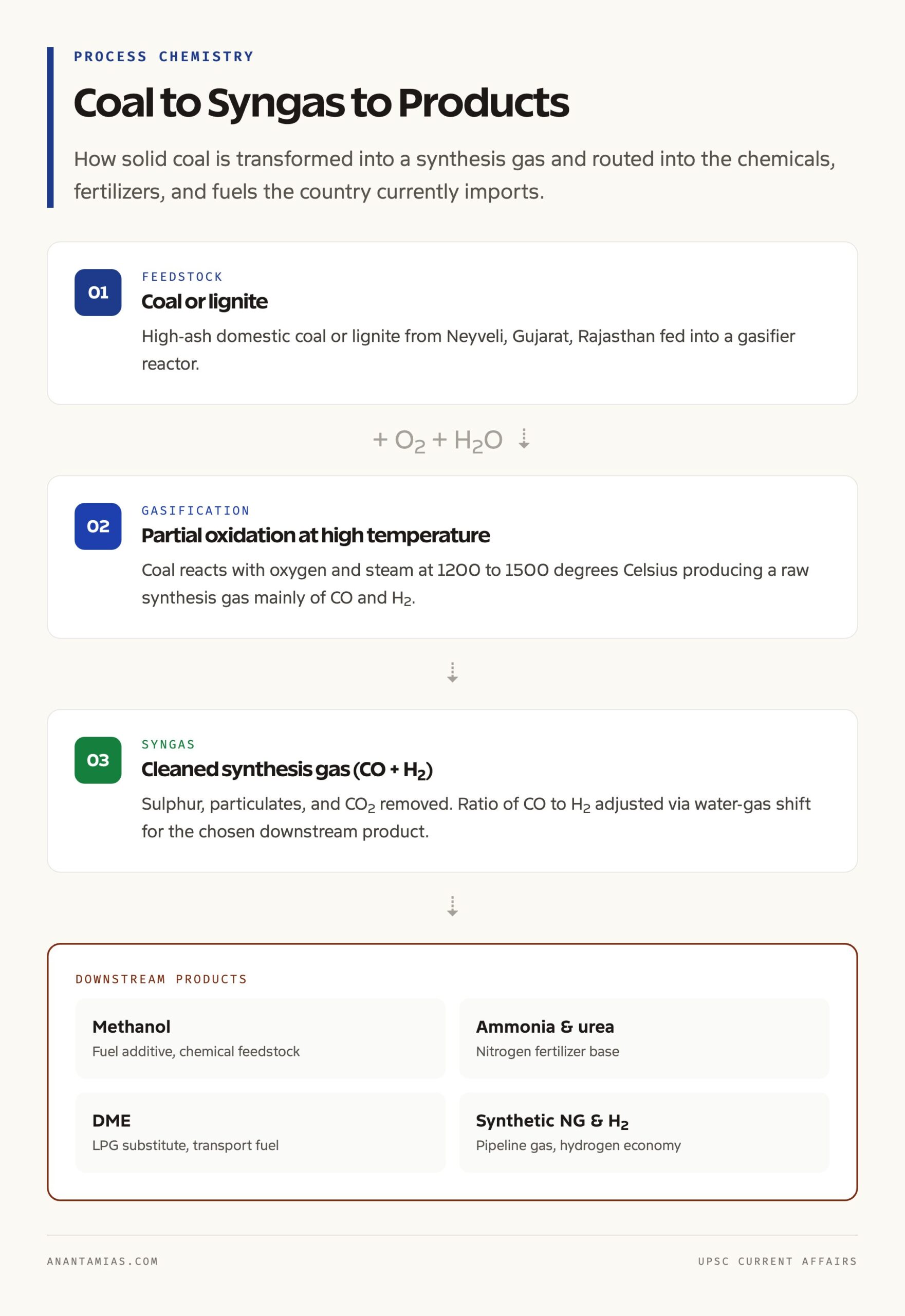
The Coal Gasification Scheme 2026 marks one of the more unusual industrial bets the Union government has placed in recent years. Approved by the Union Cabinet on 13 May 2026 with an outlay of Rs 37,500 crore, the scheme tries to keep India’s massive coal sector economically relevant while peeling some of its emissions and import dependence away. The basic idea is straightforward. Instead of burning coal to make electricity, gasify it. Convert solid coal into a synthesis gas, then route that syngas into chemicals, fertilizers, transport fuels, and synthetic natural gas that the country currently imports in large volumes.
This is not a new technology. China runs the world’s largest coal-to-chemicals industry and South Africa’s Sasol has done coal-to-liquids commercially for decades. What’s new is India’s willingness to spend serious capital on it at a moment when most of the world is winding down coal investment. The scheme reflects a specific reading of India’s energy and industrial situation: the coal reserves are real, the import bill for methanol and ammonia is real, and a clean retirement of coal will take longer than the climate calendar suggests. The Coal Gasification Scheme 2026 is essentially a hedge.
The scheme also lands at a time when Indian energy strategy is actively splitting. Renewables get one set of policies. Hydrogen gets another. Nuclear gets a third. And coal, which still produces over 70 percent of the country’s electricity, is getting a fourth track that tries to transform it rather than simply phase it down.
Quick Facts
- Scheme: Coal Gasification Scheme 2026
- Outlay: Rs 37,500 crore over the scheme period
- Approving authority: Union Cabinet
- Approval date: 13 May 2026
- Nodal ministry: Ministry of Coal
- Objective: Convert coal and lignite to syngas for downstream chemicals and fuels
- Coverage: PSU projects, private sector projects, and demonstration units
- Target: Cumulative gasification capacity of around 100 million tonnes per annum by 2030
- Key feedstocks: Coal (high-ash domestic varieties) and lignite (Neyveli, Gujarat, Rajasthan)
- Outputs: Methanol, ammonia, urea, dimethyl ether, synthetic natural gas, hydrogen
What Just Happened
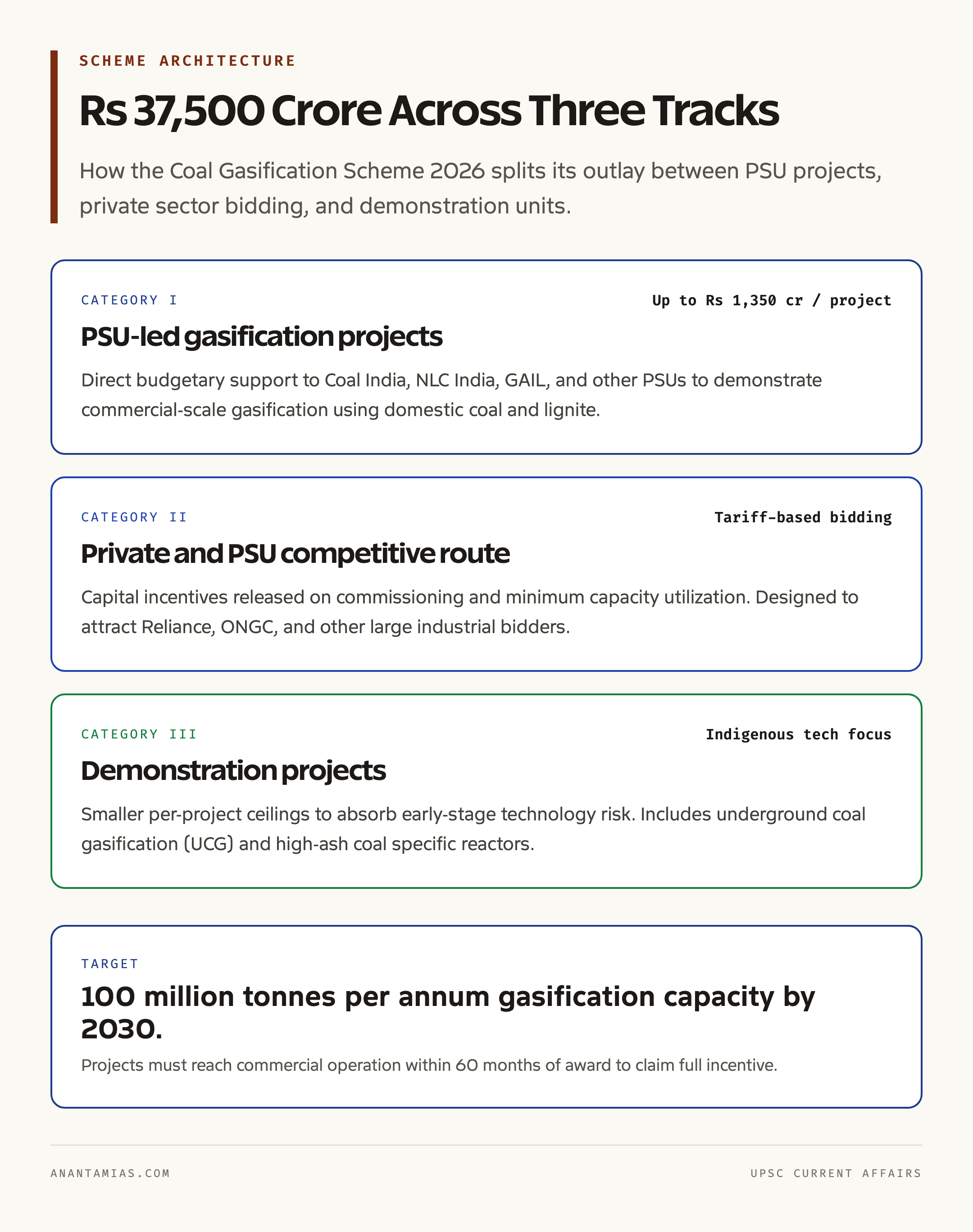
On 13 May 2026 the Cabinet Committee on Economic Affairs cleared the Coal Gasification Scheme 2026 with a financial commitment of Rs 37,500 crore. The scheme provides budgetary support across three categories of projects. Category one covers public sector undertaking projects with up to Rs 1,350 crore per project. Category two covers private sector and PSU projects through a tariff-based competitive bidding route. Category three supports demonstration projects to test indigenous gasification technologies, with smaller per-project ceilings designed to absorb early-stage technology risk.
The scheme also extends concessions on coal block auctions for gasification end-use, allows rebates on revenue share, and gives priority allocation of coal to gasification projects that meet defined milestones. Coal India Limited, NLC India Limited, and several private players including Reliance, GAIL, and ONGC are expected to be early users of the framework. The Ministry of Coal is the nodal ministry, working with the Ministry of Petroleum and Natural Gas on downstream offtake.
Background and Historical Context
India’s interest in coal gasification has been on and off for nearly five decades. The Fertilizer Corporation of India ran coal-based ammonia plants in the 1970s and 80s, but most were shut as natural gas became the dominant feedstock. The conversation revived in 2020 when the government laid out a target of 100 million tonnes per annum of coal gasification by 2030, set against rising coking coal and methanol import bills.
The Coal Gasification Scheme 2026 is the financial backbone of that target. Earlier announcements lacked a structured incentive layer. Without budgetary support, coal gasification struggled against cheaper imported natural gas and against the steep capital cost of gasification plants, which can run two to three times higher per unit of output than conventional steam reforming. The new scheme tries to close that gap with explicit central assistance and policy carve-outs in coal block allocation.
The scheme also has to be read alongside the country’s National Hydrogen Mission, the PLI scheme for specialty chemicals, and the broader push to reduce dependence on imported urea and methanol. India imports almost all its methanol requirement and a significant share of its ammonia. Domestic syngas could in principle replace a meaningful chunk of those imports while creating downstream chemical industry capacity.
Key Provisions of the Coal Gasification Scheme 2026
The scheme is structured around incentives rather than direct production targets. The core provisions include:
- Category I: Up to Rs 1,350 crore per project for PSU-led gasification, with a focus on demonstrating scale.
- Category II: Private sector and PSU projects awarded through tariff-based competitive bidding with capital incentives tied to project commissioning and minimum capacity utilization.
- Category III: Demonstration projects for indigenous gasification technologies including underground coal gasification and high-ash coal specific reactors.
- Coal block concessions: Rebate of up to 50 percent on revenue share for coal extracted for gasification end-use, with priority linkage from Coal India.
- Technology agnostic design: Both surface gasification and underground coal gasification (UCG) routes are eligible.
- Output flexibility: Eligible end uses include methanol, ammonia, urea, dimethyl ether, synthetic natural gas, hydrogen, and downstream chemicals.
- Domestic content preference: Plants that source pressure vessels, gasifiers, and air separation units from domestic vendors get an extra incentive layer.
- Timeline: Projects must achieve commercial operation within 60 months of award to claim full incentive.
Why It Matters
Three things make the Coal Gasification Scheme 2026 strategically interesting for India.
First, import substitution. India spends a large amount of foreign exchange every year on methanol, ammonia, and synthetic chemicals. Coal gasification can theoretically displace a meaningful share of that. Even if it doesn’t reach the full 100 MTPA target, partial displacement frees up scarce foreign exchange for higher-end imports.
Second, coal sector transition. India’s coal industry employs a large workforce and underpins the economies of Jharkhand, Odisha, Chhattisgarh, and West Bengal. A pure phase-down of coal would be politically and economically wrenching. Gasification gives the sector a second life, particularly for high-ash domestic coal that struggles in export markets.
Third, strategic optionality on synthetic fuels. As global aviation moves toward sustainable aviation fuel and shipping moves toward methanol bunker fuel, coal-derived methanol with carbon capture could play a transitional role. Without an industrial base in syngas, India would be locked out of that supply chain.
The trade-off is honest. Coal gasification is more carbon intensive than natural gas reforming and significantly more so than green hydrogen routes. Whether the scheme stays climate compatible depends entirely on whether carbon capture and storage gets bolted on at scale.
Detailed Analysis
The economics of the Coal Gasification Scheme 2026 are tight. Capital expenditure on a commercial gasification plant typically runs Rs 8,000 to 12,000 crore for a million-tonne-per-annum methanol facility. Even with Rs 1,350 crore of central support, the bulk of project cost has to come from equity and debt at returns that depend on syngas pricing.
Three risks dominate. Feedstock quality risk: Indian coal is high in ash and low in calorific value. Most international gasifier technologies are designed for lower-ash coal. Indigenous gasifier development for high-ash coal is still maturing, which is exactly why Category III demonstration projects exist. Carbon policy risk: A future carbon border adjustment mechanism in the EU or a domestic carbon price could erode the cost advantage of coal-derived chemicals overnight. Offtake risk: Methanol blending mandates and DME demand are still policy-driven. Without firm offtake contracts, project financing becomes hard.
On the upside, an integrated coal-to-chemicals complex can vertically integrate up to fertilizers, specialty chemicals, and even synthetic fuels, capturing margins across the chain. This is the model Sasol pioneered and what large Chinese players have replicated.
Comparative Perspective
India is hardly first to this game. China operates over 100 large-scale coal gasification facilities and produces tens of millions of tonnes of methanol from coal every year. South Africa’s Sasol runs the world’s most established coal-to-liquids complex. The United States ran several federally supported coal gasification programs in the 1980s, most of which were eventually shelved as natural gas prices collapsed.
The Indian variant differs in two ways. The scheme is built around incentives rather than government ownership, unlike the Chinese model. And it explicitly leaves the door open for underground coal gasification, which would let the country exploit deep seams that are uneconomic to mine conventionally.
Challenges and Concerns
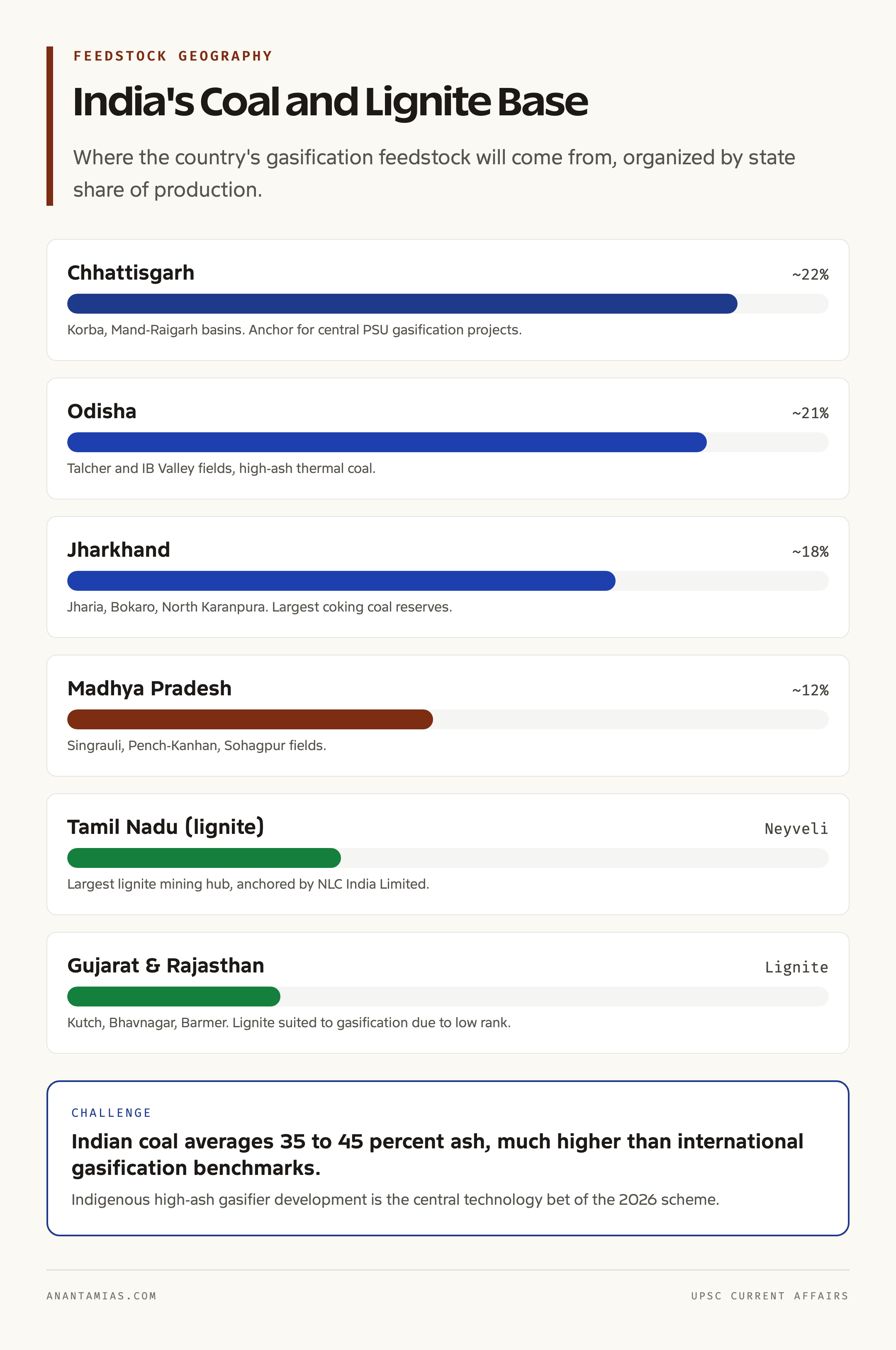
Environmental opposition is a real headwind. Coal gasification produces large volumes of CO2 alongside its syngas, and unless coupled with carbon capture, it can be more emissions-intensive than direct combustion. Water demand is also significant, raising local concerns in already water-stressed coal belts. Land acquisition for integrated gasification complexes has been a friction point in earlier projects.
Technology risk is the second concern. Indigenous high-ash gasifiers are not yet at full commercial scale. If the scheme ends up dominated by imported technology, the value-add to the Indian engineering sector will be limited. The demonstration project category exists to address this, but five years is a short window for moving from pilot to commercial reactor.
Finally, the scheme depends on a stable downstream demand for methanol and DME. Methanol blending policies have been on paper for years without crossing single-digit adoption. Unless transport fuel policy moves in step with the gasification push, supply could outrun demand.
Prelims Pointers
- Approval date: 13 May 2026 by the Cabinet
- Outlay: Rs 37,500 crore
- Ministry: Ministry of Coal
- Target: 100 MTPA coal gasification by 2030
- Categories: PSU projects, private sector competitive bidding, and demonstration projects
- Eligible feedstocks: Coal and lignite
- Key end-products: Methanol, ammonia, urea, DME, synthetic natural gas, hydrogen
- Major lignite zones: Neyveli (Tamil Nadu), Kutch (Gujarat), Barmer (Rajasthan)
- UCG: Underground coal gasification, eligible under demonstration category
Mains Questions
- GS Paper III (Energy): Discuss the rationale, design, and trade-offs of the Coal Gasification Scheme 2026 in the context of India’s energy transition. (15 marks, 250 words)
- GS Paper III (Industry): Coal gasification can play a role in reducing India’s chemical and fertilizer import bill. Examine the technological and policy challenges that need to be addressed. (10 marks, 150 words)
- GS Paper III (Environment): “Clean coal” technologies present a paradox in the context of India’s net-zero commitments. Critically evaluate. (15 marks, 250 words)
- GS Paper III (Economy): Compare India’s coal gasification approach with China and South Africa. What lessons can policy design draw from international experience? (10 marks, 150 words)
Way Forward
The Coal Gasification Scheme 2026 will succeed or fail on three things. Indigenous gasifier technology has to reach commercial readiness within the scheme window, otherwise the value chain leaks abroad. Carbon capture has to be planned into projects from day one rather than retrofitted, because retrofitting roughly doubles capital cost. And downstream demand policy, especially methanol blending and DME for cooking, has to move with similar urgency to soak up the syngas output. If these three move together, the scheme can be a credible bridge. If they don’t, it risks becoming an expensive defense of an industry the country eventually has to wind down.
A linked policy review framework, perhaps under the NITI Aayog, would help track these three dimensions. The Coal Gasification Scheme 2026 is also a useful test case for how India will structure other industrial decarbonization schemes, including steel decarbonization and cement decarbonization, where the underlying tension between domestic industry and climate goals is similar.
For UPSC aspirants, this scheme connects energy, industry, environment, and federalism, since most coal-producing states are also among the country’s poorer ones. Read it alongside the National Hydrogen Mission and the National Steel Policy to see how the government’s industrial decarbonization strategy is being stitched together.
You can also see how India’s broader energy strategy is unfolding through our pieces on the India pension landscape for fiscal context, the Delhi EV policy 2026 for transport-side transition, and the agni missile family for an example of indigenous heavy-engineering capability building.
Frequently Asked Questions
What is the Coal Gasification Scheme 2026?
It is a Rs 37,500 crore central scheme approved by the Union Cabinet on 13 May 2026 to support the conversion of coal and lignite into syngas, which can then be used to produce methanol, ammonia, urea, DME, synthetic natural gas, and hydrogen.
Who is the nodal ministry?
The Ministry of Coal is the nodal ministry, working in coordination with the Ministry of Petroleum and Natural Gas and the Ministry of Chemicals and Fertilizers.
What is the gasification target for India?
The country has set a target of around 100 million tonnes per annum of coal gasification by 2030.
Is underground coal gasification (UCG) eligible?
Yes. UCG is eligible under the demonstration project category, allowing exploitation of deep coal seams that are uneconomic to mine conventionally.
Why is coal gasification controversial?
It is more carbon intensive than natural gas reforming and significantly more so than green hydrogen, and it can therefore conflict with India’s net-zero pathway unless coupled with carbon capture and storage.
How does this scheme help reduce imports?
India imports almost all its methanol and a large share of its ammonia. Coal-derived syngas can substitute a portion of these imports and free up foreign exchange.
What are the three project categories under the scheme?
PSU-led projects with capital support up to Rs 1,350 crore each, private and PSU projects through tariff-based competitive bidding, and demonstration projects for indigenous gasification technologies.
Which major companies are likely to participate?
Coal India Limited, NLC India Limited, GAIL, ONGC, Reliance, and other large industrial players that have shown interest in coal-to-chemicals integration.
What is the relationship with the National Hydrogen Mission?
Coal gasification can produce hydrogen, often called “grey hydrogen” or “blue hydrogen” if combined with carbon capture. The Hydrogen Mission focuses on green hydrogen, so the two are complementary rather than substitutes.
What is the timeline for project completion?
Projects must achieve commercial operation within 60 months of award to claim full central incentive under the scheme.
Tell Google you want more of this.
Add Anantam IAS as a preferred sourceOne tap, and this site shows up more often in your own Top Stories, AI Overviews and AI Mode. Remove it any time.