Introduction
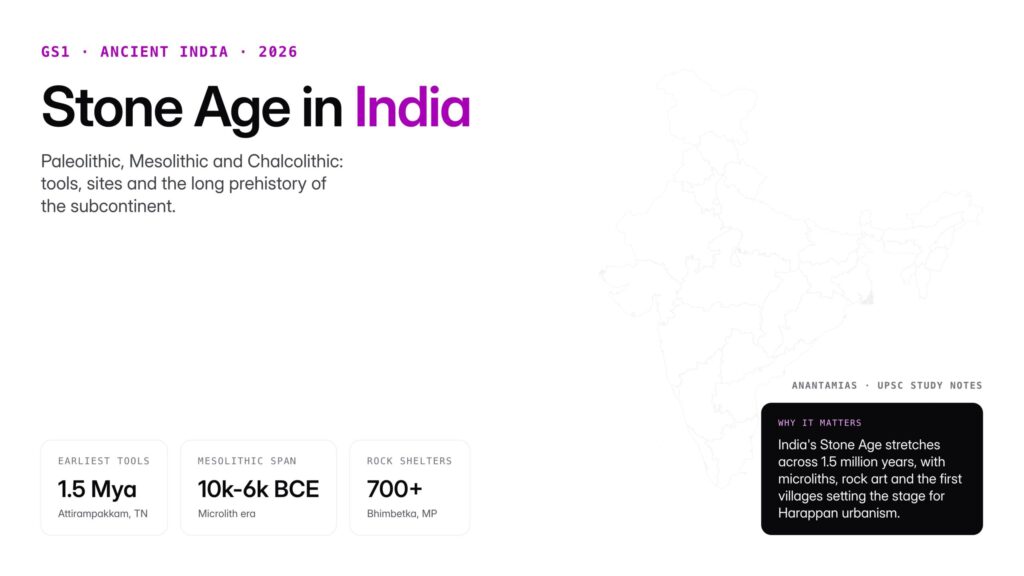
The Stone Age forms the deepest layer of India’s cultural past, stretching from roughly 2 million years ago to the dawn of metal use around 3,000 BCE. It is the period that introduces us to the first toolmakers on the subcontinent, to the earliest hunters, fishers and painters, and to the slow emergence of settled village life. For an UPSC aspirant, understanding the Mesolithic age in particular is the bridge between the grand canvas of the Paleolithic and the agricultural breakthroughs of the Neolithic and Chalcolithic.
This article walks through the three-fold scheme that the Archaeological Survey of India and most textbooks use: Paleolithic, Mesolithic and Chalcolithic. We will examine climate, tools, sites, art, economy and the transition to food production. The aim is to give you a single reference that answers Prelims multiple-choice questions and also gives you the conceptual depth to write a confident Mains answer on prehistoric India.
Quick Facts at a Glance
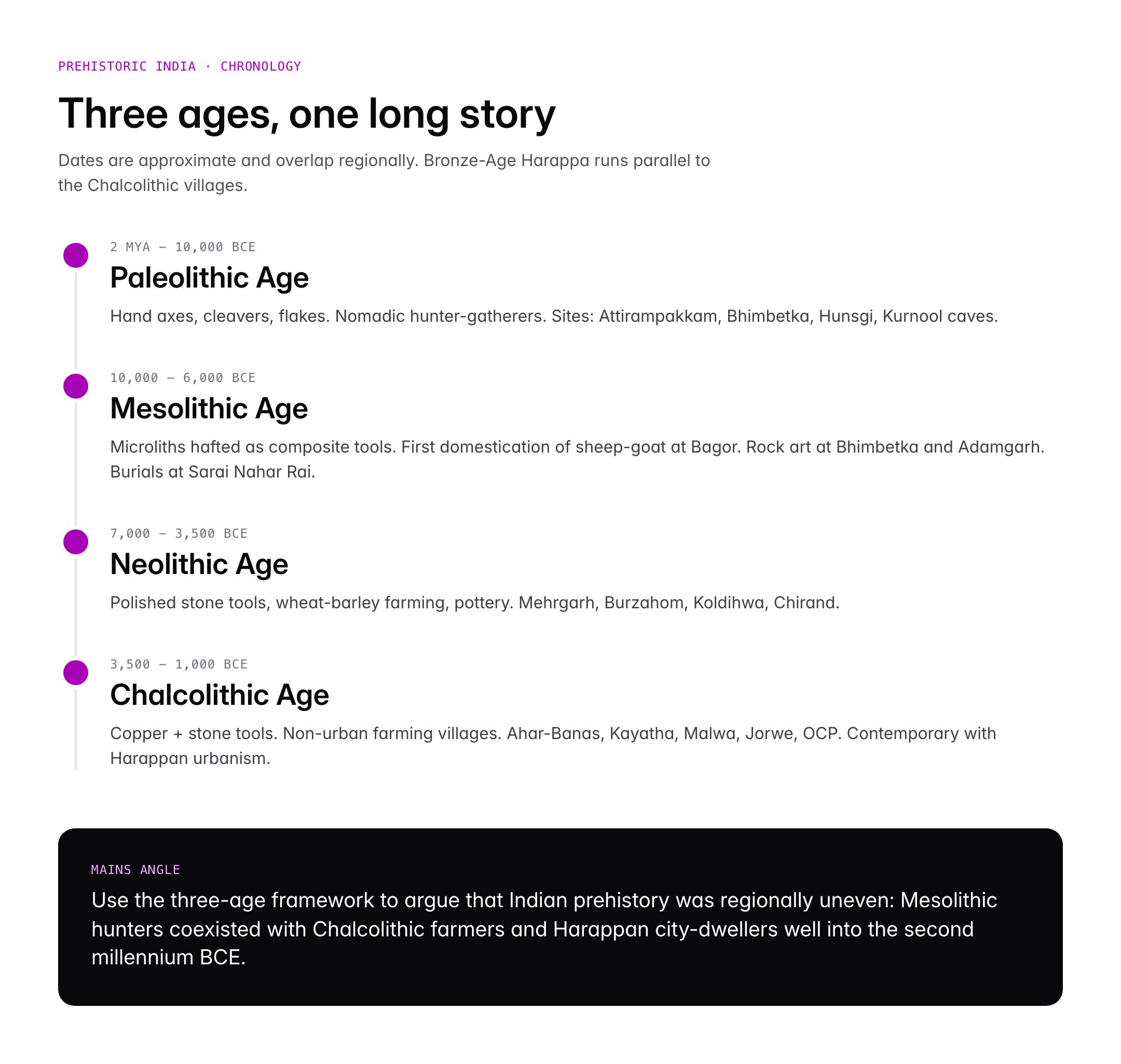
| Parameter | Paleolithic | Mesolithic | Chalcolithic |
|---|---|---|---|
| Approx. dates | 2 million – 10,000 BCE | 10,000 – 6,000 BCE | 3,500 – 1,000 BCE |
| Climate | Pleistocene, Ice Age fluctuations | Early Holocene, warmer | Holocene, stable |
| Tool type | Hand axes, cleavers, flakes | Microliths (under 5 cm) | Stone plus copper tools |
| Economy | Hunting, gathering | Hunting, fishing, early herding | Farming, herding, trade |
| Shelter | Caves, open camps | Rock shelters, temporary huts | Mud-walled villages |
| Key site | Bhimbetka, Hunsgi, Attirampakkam | Bagor, Adamgarh, Sarai Nahar Rai | Jorwe, Ahar, Malwa, Kayatha |
| Art | Rare engravings | Rich rock paintings | Painted pottery |
Background and Historical Context
The systematic study of the Indian Stone Age began in 1863, when Robert Bruce Foote, a geologist with the Geological Survey of India, picked up a hand axe at Pallavaram near Madras. This single discovery opened up a century and a half of exploration that has now mapped thousands of prehistoric sites across the subcontinent. British administrators, Indian scholars and post-independence institutions such as the Deccan College in Pune and the Archaeological Survey of India (ASI) have steadily refined the chronology.
The Indian subcontinent is unusually rich in prehistoric evidence because its geology preserves stone tools extremely well. Quartzite, chert, jasper, agate and chalcedony were the preferred raw materials, and the long dry seasons of peninsular India keep exposed surface finds intact for millennia. Excavations at Attirampakkam in Tamil Nadu have pushed the earliest human presence in India back to around 1.5 million years ago, placing the region firmly within the story of global human evolution.
Three climatic turning points shape the narrative. The first is the long Pleistocene Ice Age, during which our Paleolithic ancestors adapted to shifting monsoons and sea levels. The second is the post-glacial warming around 10,000 BCE, which drowned coastal sites, expanded forests and triggered the microlithic Mesolithic revolution. The third is the stabilisation of the Holocene climate, which allowed agriculture, domestication and eventually copper metallurgy to take root across the Indus, Ganga, Malwa, Deccan and southern peninsula. These transitions do not happen uniformly. A Chalcolithic village in Rajasthan may coexist with Mesolithic hunters in central India and Neolithic farmers in Kashmir, making India’s prehistory a mosaic rather than a single timeline.
Key Features and Tool Traditions
Paleolithic Age
The Paleolithic age in India is divided into Lower, Middle and Upper phases. The Lower Paleolithic, dominated by the Acheulian tradition, features large bifacial hand axes and cleavers, well documented at Hunsgi, Isampur, Bhimbetka and Attirampakkam. The Middle Paleolithic shifts towards flake tools made by the Levallois technique, using finer raw materials such as jasper and chert. The Upper Paleolithic, beginning around 40,000 years ago, introduces blade and burin industries and the earliest evidence of bone tools from Kurnool caves in Andhra Pradesh.
Paleolithic people were nomadic hunter-gatherers. They followed animal herds, camped near rivers and rock shelters, and left behind scant but unmistakable traces, a stone blade here, a butchered bone there. There is no pottery and no agriculture. The famous Bhimbetka rock shelters in Madhya Pradesh, a UNESCO World Heritage Site, preserve continuous occupation from the Lower Paleolithic onwards.
Mesolithic Age
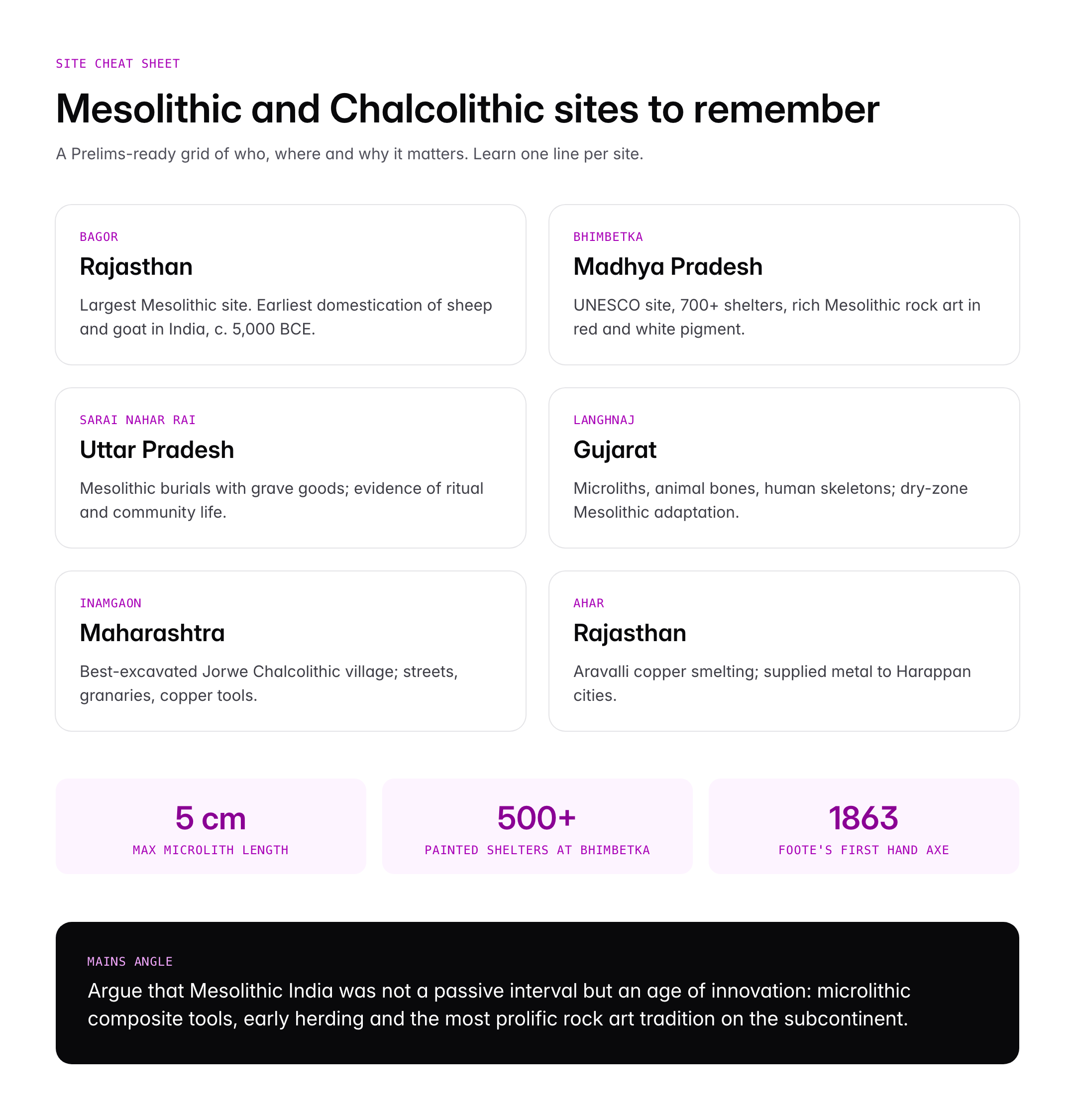
The Mesolithic age is the transitional phase between hunting-gathering and food production. Its signature tool is the microlith, a tiny geometric blade under five centimetres long, hafted in wood or bone to make composite arrows, sickles and harpoons. Major sites include Bagor (Rajasthan), Adamgarh (MP), Sarai Nahar Rai (UP), Mahadaha, Chopani Mando, Langhnaj (Gujarat) and Tilwara.
Mesolithic economies broadened sharply. Archaeology shows evidence of fishing, fowling, and the earliest domestication of sheep and goat at Bagor around 5,000 BCE. The period is also the high tide of Indian rock art. Bhimbetka alone contains over 500 painted shelters, many from the Mesolithic, depicting hunts, dances, childbirth and community rituals in red and white pigment. Burials from Sarai Nahar Rai reveal deliberate placement of the dead with grave goods, suggesting emerging ritual life.
Chalcolithic Age
The Chalcolithic age (Copper-Stone Age) sees the first use of metal alongside microliths. Regional cultures include the Ahar-Banas in Rajasthan, Kayatha and Malwa in central India, Jorwe in Maharashtra, and the OCP (Ochre Coloured Pottery) in the Ganga-Yamuna doab. Villages are larger, with mud-walled houses, storage bins, painted pottery and evidence of wheat, barley, rice, lentils and pulses cultivation.
Copper tools include flat axes, chisels, fish hooks and ornaments. Interestingly, Chalcolithic India is non-urban and runs parallel to the Bronze Age Harappan civilisation, showing that metallurgy does not automatically imply urbanism.
Significance for UPSC and General Knowledge
- Prelims frequently asks identification questions on microliths, Bhimbetka, Bagor and Chalcolithic cultures, making this topic high-yield.
- Mains GS1 syllabus on “Indian culture covering the salient aspects of Art Forms, Literature and Architecture from ancient to modern times” draws directly from Stone Age art.
- The topic anchors the entire ancient-India chronology that follows in NCERT class 11 and Tamil Nadu Board history.
- Provides comparative material for answers on early human adaptation, climate change and cultural diffusion.
- Explains why Indian civilisation is considered continuous, with Paleolithic layers beneath historical cities.
- Offers ethical and environmental angles (GS3, GS4) on sustainable hunter-gatherer lifestyles and indigenous knowledge.
Detailed Analysis: Cultural and Regional Map
The Indian Stone Age unfolds across five broad geographic zones, and UPSC questions often expect precise site-region mapping.
The Soan valley in the north-western subcontinent is classically associated with pebble and chopper tools of the Lower Paleolithic, though much of it now lies in Pakistan. The central Indian belt from Bhimbetka through Adamgarh to the Narmada valley is the richest Paleolithic-to-Mesolithic zone, with Hathnora in the Narmada valley yielding the only known hominin fossil from India, a Homo heidelbergensis skull cap dated to roughly 250,000 years ago. The eastern zone includes the Chotanagpur plateau and Singhbhum, important for Mesolithic microliths and early iron contexts. The western zone of Gujarat and Rajasthan, with Langhnaj and Bagor, documents the domestication of sheep, goat and cattle and a smooth transition to Chalcolithic Ahar-Banas. The southern peninsula from Kurnool to Attirampakkam gives us some of the oldest Acheulian dates in the world.
Regional Chalcolithic cultures display striking specialisation. Kayatha (2,450 – 1,700 BCE) in Madhya Pradesh has chocolate-slipped pottery and copper axes. Malwa (1,700 – 1,200 BCE) is famous for painted black-on-red ware and large houses at Navdatoli. Jorwe (1,400 – 700 BCE) in Maharashtra, excavated at Inamgaon by the Deccan College, shows a sophisticated village with streets, granaries and bronze-age-level craft, even as it remained non-urban. Ahar-Banas (3,000 – 1,500 BCE) smelted copper from the Aravalli ores that fed the Harappan cities of the Indus.
Tool technology evolves in clear steps. Large core tools give way to flake and blade tools, and finally to microlithic composite weapons. This progression tracks cognitive, social and economic changes that are central to any Mains answer on prehistoric continuity.
Comparative Perspective
How does the Indian Stone Age compare with global chronologies? The broad global scheme is similar, but regional timing varies because climate, raw material and diffusion differ.
| Region | Paleolithic ends | Mesolithic span | Metal age begins |
|---|---|---|---|
| India | ~10,000 BCE | 10,000 – 6,000 BCE | ~3,500 BCE (Chalcolithic) |
| West Asia (Fertile Crescent) | ~12,000 BCE | 12,000 – 9,500 BCE (Natufian) | ~5,500 BCE (Chalcolithic) |
| Europe | ~10,000 BCE | 10,000 – 5,000 BCE | ~4,500 BCE |
| China | ~10,000 BCE | 10,000 – 7,000 BCE | ~3,000 BCE (Bronze Age) |
India’s Mesolithic is notable for its long duration, its spectacular rock art, and the fact that it survives into very recent times in some tribal belts. Unlike West Asia, where the Mesolithic leads directly to sedentary agriculture, in India the transition is patchy and regional. The Indus plains leap into Bronze Age urbanism, while central Indian shelters still produce microliths well into the first millennium BCE. This uneven temporality is a uniquely Indian feature that UPSC essays can explore.
Challenges and Criticisms
Our understanding of the Indian Stone Age is incomplete and contested. First, the dating framework is still being refined. Older texts placed the Lower Paleolithic at around 500,000 years, but recent cosmogenic nuclide dating at Attirampakkam (2018, Nature) pushed the Acheulian back to 1.5 million years ago and the Middle Paleolithic to 385,000 years, reshaping the “Out of Africa” debate.
Second, the three-age system itself is a European inheritance that does not fit India perfectly. Many scholars argue for a more fluid classification that acknowledges overlapping economies and parallel cultures. Third, rock art dating is problematic because paintings rarely yield datable material, and many Bhimbetka panels may be later than originally thought. Fourth, the gendered and social life of prehistoric communities is underexplored. Most standard narratives centre on “man the hunter” and ignore plant gathering, childcare and craft done largely by women and children.
There is also a politics of prehistory. Nationalist readings sometimes project continuous Indian identity onto Stone Age peoples, while revisionist scholarship warns against such essentialism. A balanced UPSC answer should acknowledge both the continuity of occupation and the fact that identities, languages and practices have changed profoundly.
Prelims Pointers
- The earliest stone tool in India was identified by Robert Bruce Foote at Pallavaram in 1863.
- Attirampakkam (Tamil Nadu) provides evidence of human occupation from around 1.5 million years ago.
- The only hominin fossil in India is the Narmada skull from Hathnora, Madhya Pradesh.
- The Paleolithic age is divided into Lower, Middle and Upper phases.
- Microliths are tiny geometric stone blades under 5 cm, typical of the Mesolithic.
- Bagor in Rajasthan shows the earliest domestication of sheep and goat in India, around 5,000 BCE.
- Bhimbetka rock shelters are a UNESCO World Heritage Site located in the Vindhyan hills, Madhya Pradesh.
- Sarai Nahar Rai (UP) is famous for Mesolithic burials.
- The Chalcolithic cultures include Ahar-Banas, Kayatha, Malwa, Jorwe and OCP.
- Inamgaon in Maharashtra is the best-excavated Jorwe-culture site.
- Copper, not bronze, is the defining metal of the Chalcolithic age in India.
- The Kurnool caves in Andhra Pradesh yielded the earliest bone tools in India.
Mains Practice Questions
Q1. Discuss the key features of the Mesolithic age in India and evaluate its significance in the transition from hunting-gathering to settled life. (250 words)
- Outline definition, chronology (10,000 – 6,000 BCE), tool kit (microliths) and major sites such as Bagor, Bhimbetka, Sarai Nahar Rai.
- Highlight economy: broadening subsistence, early domestication, rich rock art and burial practices.
- Evaluate the Mesolithic as a bridge to the Neolithic and Chalcolithic, while noting that the transition was uneven across regions.
Q2. “The Chalcolithic cultures of India were non-urban contemporaries of the Harappan civilisation.” Critically examine. (250 words)
- Identify the major Chalcolithic cultures (Ahar-Banas, Kayatha, Malwa, Jorwe) and their regional spread.
- Show overlap in time with Mature and Late Harappan phases and the trade in copper and beads.
- Critically assess the “non-urban” label by citing Inamgaon’s planning and craft, while acknowledging the absence of large cities, script and long-distance administrative control.
Conclusion
The Indian Stone Age, from the rolling hand axes of Attirampakkam to the painted pottery of Inamgaon, is a long and layered story of human adaptation. The Mesolithic age occupies the critical middle, a time when a warming climate, new microlithic technology and the first stirrings of herding and ritual life set the stage for everything that followed. Understanding this period is not just about memorising site names, it is about appreciating how gradually, unevenly and creatively our ancestors reshaped their world.
For UPSC aspirants, the payoff is twofold. In Prelims, a firm grip on tool types, sites and chronology converts into reliable marks. In Mains, the ability to weave climate, economy, art and regional diversity into a coherent argument distinguishes a good answer from a great one. When read alongside the Indus and Vedic chapters that follow, the Stone Age gives depth and perspective to the whole sweep of Indian civilisation.
Frequently Asked Questions
What is the Mesolithic age?
The Mesolithic age is the middle Stone Age phase in India, roughly 10,000 to 6,000 BCE, marked by tiny geometric stone tools called microliths. It bridges the Paleolithic hunting-gathering era and the food-producing Neolithic and Chalcolithic periods, and features rich rock art, early animal domestication and the first clear evidence of fishing and burial rituals.
Why is the Mesolithic age important for UPSC?
The Mesolithic age is tested directly in Prelims through site and tool identification questions, and indirectly in Mains GS1 answers on ancient Indian culture and art. It anchors the transition narrative from hunting-gathering to agriculture, explains the continuity of Indian occupation and provides context for rock art at Bhimbetka, a UNESCO World Heritage Site commonly cited in essays.
How is the Mesolithic age related to the Paleolithic and Chalcolithic ages?
The Paleolithic age precedes the Mesolithic with large hand-axe tools and nomadic hunting. The Mesolithic introduces microliths, fishing and early herding. The Chalcolithic age follows with copper tools, painted pottery and settled villages such as Inamgaon and Ahar. All three together form the pre-Harappan Stone-and-Copper sequence of India.
What are microliths?
Microliths are small stone blades, typically under five centimetres, made of chert, agate, jasper or quartz. They were hafted into wood or bone shafts to create composite tools such as arrows, sickles and harpoons. Microliths are the defining technology of the Mesolithic age and are found at sites like Bagor, Adamgarh and Sarai Nahar Rai.
What are the important Mesolithic sites in India?
Key Mesolithic sites include Bagor and Tilwara in Rajasthan, Adamgarh and Bhimbetka in Madhya Pradesh, Sarai Nahar Rai, Mahadaha and Chopani Mando in Uttar Pradesh, and Langhnaj in Gujarat. Bagor shows the earliest sheep-goat domestication in India, while Bhimbetka preserves the richest Mesolithic rock art panels.
Who discovered the first stone tool in India?
The geologist Robert Bruce Foote of the Geological Survey of India discovered the first recorded Paleolithic hand axe at Pallavaram near Madras in 1863. This find opened the field of Indian prehistory and eventually led to mapping thousands of sites across the subcontinent, including Attirampakkam, Bhimbetka and the Kurnool caves.
What are the main Chalcolithic cultures of India?
The major Chalcolithic cultures are Ahar-Banas in Rajasthan, Kayatha and Malwa in central India, Jorwe in Maharashtra and the Ochre Coloured Pottery (OCP) culture in the Ganga-Yamuna doab. They used copper alongside stone tools, lived in mud-walled villages, cultivated wheat, barley and pulses, and were contemporaries of the Harappan civilisation.
What is the significance of Bhimbetka?
Bhimbetka, in the Vindhyan hills of Madhya Pradesh, is a UNESCO World Heritage Site with over 700 rock shelters and continuous human occupation from the Lower Paleolithic to the historic period. Its Mesolithic paintings depict hunts, dances and rituals in red and white pigment, and it remains the single most important prehistoric art complex in India.
Tell Google you want more of this.
Add Anantam IAS as a preferred sourceOne tap, and this site shows up more often in your own Top Stories, AI Overviews and AI Mode. Remove it any time.