Minilateralism: Small Groups, Big Diplomacy in a Fragmenting World (UPSC International Relations)
Minilateralism is the rise of small, flexible, issue-based coalitions — the QUAD, I2U2, BRICS, SCO and more — in place of slow universal bodies. Here is the full picture: what it is, why it is spreading, and how India uses overlapping groupings to keep its strategic autonomy, explained for UPSC GS2.
For most of the twentieth century, the picture of diplomacy in our heads was a vast hall: hundreds of flags, simultaneous translation, a podium at the front. The United Nations, the World Trade Organization, the climate summits — big rooms where everyone has a seat and, in theory, a say. That image still matters. But quietly, over the past fifteen years, the real action has been migrating to smaller rooms. Four foreign ministers around a table. Three heads of government on a video call. A handful of like-minded states agreeing to fix one specific thing — a supply chain, a sea lane, a solar grid — without waiting for the whole world to agree first. That shift has a name, and it has become one of the most useful single words an aspirant can carry into an international-relations answer: minilateralism.
The word matters because it captures where global cooperation is actually heading, and because India has become one of its most skilled practitioners. New Delhi sits inside an overlapping web of these small coalitions — the QUAD, I2U2, BRICS, the SCO, the International Solar Alliance — that would have looked contradictory a generation ago and looks, today, like strategy. For UPSC, minilateralism is no longer a niche term. It sits at the centre of GS2’s international-relations syllabus, it explains India’s foreign policy better than the old labels of “alliance” or “non-alignment” ever could, and it rewards a candidate who can define it sharply, trace why it rose, and judge what it costs.
What Minilateralism Actually Means
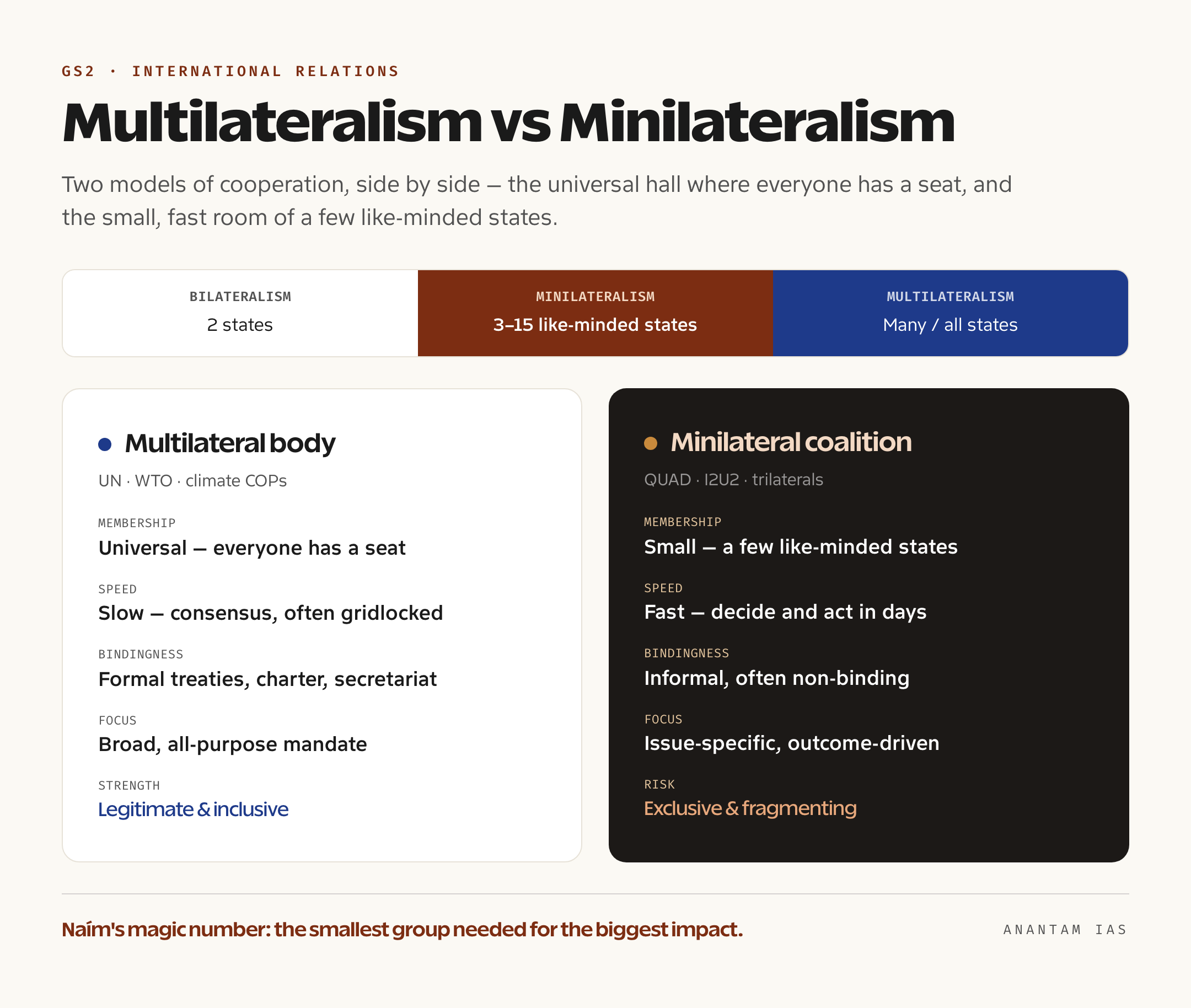
Start with the plain definition, because examiners reward precision here. Minilateralism is diplomacy conducted through small, flexible, issue-based coalitions of a few like-minded states, rather than through large, universal-membership bodies. It sits between two older forms. Bilateralism is two countries dealing directly with each other. Multilateralism is the big-hall model — many states, often all of them, bound by common rules through a formal institution like the UN. Minilateralism is the middle path: more than two, but deliberately few. Most minilateral groupings run from three to about fifteen members, assembled not by geography or ideology but by who actually has a stake in the problem at hand.
The term has a clean origin you can quote. The writer Moisés Naím coined it in a 2009 essay in Foreign Policy, arguing that the universal bodies had grown too slow and too consensus-bound to solve fast-moving global problems. His test was a question he called the “magic number” — bring to the table “the smallest possible number of countries needed to have the largest possible impact” on a particular issue, and no more. If a climate problem can be cracked by the dozen biggest emitters, you don’t need to wait for all 190-odd UN members to agree first. That single idea — the smallest group that can get the biggest result — is the DNA of every minilateral arrangement, and it is worth memorising in his words.
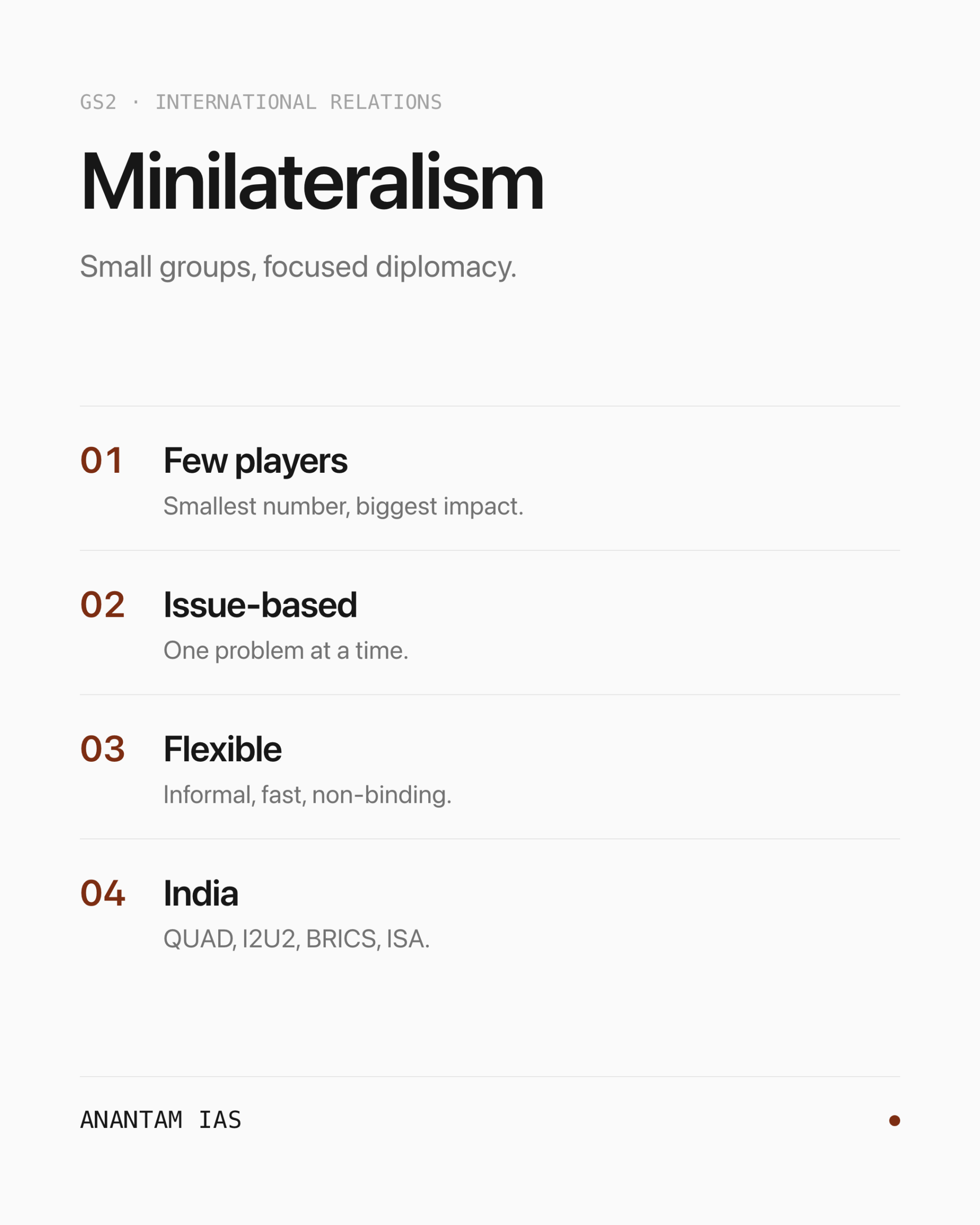
From that idea flow the features that define these groupings, and a strong answer names them. They are issue-specific: each one is built around a concrete subject — maritime security, critical minerals, food, solar power — not around a permanent, all-purpose mandate. They are outcome-driven, judged by projects delivered rather than declarations passed. They are informal and often non-binding, working through summits, joint statements and working groups rather than a treaty, a charter or a permanent secretariat. And they are flexible: members can join one coalition on trade while sitting opposite each other in another on security, because nothing locks them into a single bloc. The American writer at the Council on Foreign Relations summed up the appeal in four words — speed, flexibility, modularity, and room for experimentation — and those four are the case for minilateralism in a nutshell.
Why Minilateralism Is Rising
The deeper question, and the one that lifts an answer from descriptive to analytical, is why small groups are eating the big institutions’ lunch right now. The first reason is gridlock at the top. The UN Security Council, frozen by the veto and stalled on reform for decades, struggles to act on the crises it was built for. The WTO’s negotiating arm has been effectively paralysed for years, its dispute-settlement body hollowed out. Reform of these bodies has been promised for a generation and delivered barely at all. When the universal forum cannot move, states stop waiting for it. They take the urgent problem into a smaller room where a deal is actually possible.
The second reason is the shape of the world itself. We have moved from a clearly bipolar or American-led order into a multipolar, fragmented one, where power is spread across more centres and trust between the big players has thinned. In that kind of world, a grand bargain among rivals is hard, but a focused deal among friends is easy. Minilaterals let states cooperate with the partners they trust on the issues they care about, without pretending the whole system agrees. The World Economic Forum, surveying the landscape at the start of 2026, framed it bluntly as a year when size might stop mattering — when the nimble coalition could outperform the universal body precisely because the universal body had stopped working.
The third reason is simply speed and trust. A small group of like-minded states can decide and act in days; a universal body can take months to produce a watered-down communiqué that offends no one and commits no one. Because minilateral partners are chosen for shared interests, they skip the lowest-common-denominator bargaining that drags down consensus diplomacy. The result is cooperation that is faster, more targeted and more likely to produce something concrete — a launched project, a signed supply-chain pact — than the alternative. For a rising power in a hurry, that efficiency is the whole attraction.
India’s Web of Minilaterals
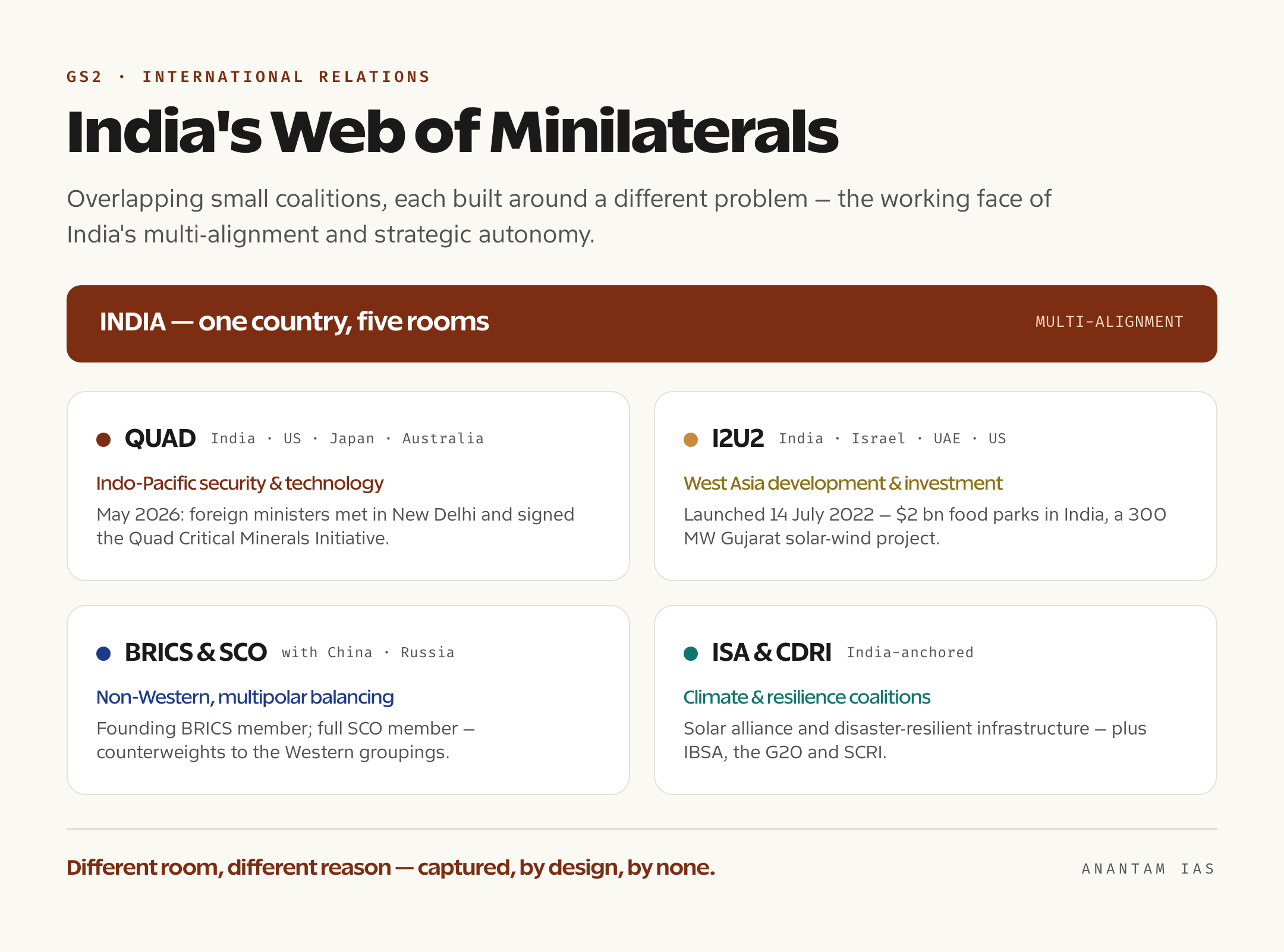
This is where the concept comes alive, because no major power works the minilateral game more deliberately than India, and naming the groupings precisely is what earns the marks. The flagship is the QUAD — the Quadrilateral Security Dialogue of India, the United States, Japan and Australia. Built around a free and open Indo-Pacific, it began as a loose maritime-security conversation and has broadened into vaccines, critical and emerging technology, infrastructure and supply chains. Its minilateral character was on full display in May 2026, when the four foreign ministers — S. Jaishankar, Marco Rubio, Toshimitsu Motegi and Penny Wong — met in New Delhi and signed a Quad Critical Minerals Initiative to secure supply chains for the metals that power clean energy and defence. No treaty, no secretariat — just four like-minded states acting on a shared problem.
Then there is I2U2, India’s minilateral in West Asia, grouping India, Israel, the UAE and the United States. Launched at its first leaders’ summit on 14 July 2022, it is explicitly economic rather than military — water, energy, food, transport, health, space and technology. Its showcase projects show the model at work: the UAE committed about $2 billion to build a chain of integrated food parks across India, and the group backed a 300-megawatt hybrid wind-and-solar project with battery storage in Gujarat. Where the QUAD is about security in the Indo-Pacific, I2U2 is about development capital in the Gulf — the same minilateral logic, a different issue. You can read the deeper case for the QUAD as a grouping separately, but the two together show how India tailors a coalition to each region’s problem.
India is just as active in the non-Western minilaterals, and that is the point of the whole strategy. It is a founding member of BRICS, the bloc of major emerging economies pushing for a more multipolar order and reform of Western-built institutions. It is a full member of the Shanghai Cooperation Organisation, the Eurasian security grouping that sits it at the same table as China and Pakistan. It hosted the G20 presidency in 2023 and used it to champion the Global South. And beyond these, India anchors issue coalitions it helped create — the International Solar Alliance for clean-energy diplomacy, the Coalition for Disaster Resilient Infrastructure for climate adaptation, IBSA with Brazil and South Africa, and the Supply Chain Resilience Initiative with Japan and Australia. India also runs a thick layer of trilaterals, knitting three-country partnerships across the Indo-Pacific and West Asia. Each grouping is a different room, entered for a different reason.
The Case For and the Case Against
A balanced answer has to weigh both sides, because minilateralism is genuinely double-edged. The case for it is the case for agility. These coalitions are fast, focused and flexible. They deliver concrete outcomes — a critical-minerals pact, a food park, a solar grid — while universal bodies are still drafting agendas. They let states pick partners by capability and trust rather than by accident of membership, and they let a country cooperate selectively, deepening ties where interests align without surrendering its freedom elsewhere. For middle and rising powers especially, minilaterals are a way to shape outcomes without the weight of a formal alliance. They are, at their best, diplomacy that actually moves.
But the criticisms are serious, and the sharper candidate raises them. The first is exclusivity: by design, these are clubs of the like-minded, which means someone is always left outside, and the excluded states — often poorer or weaker ones — can find rules being written about a problem without them in the room. The second is fragmentation. As the number of overlapping small groups multiplies, global governance splinters into a patchwork, and the world risks coalescing into rival coalitions rather than a single shared system. The third, and the deepest, is that minilateralism can hollow out universal multilateralism itself. If the powerful simply route around the UN and the WTO whenever those bodies are inconvenient, the institutions that give smaller states a voice and global rules their legitimacy are slowly starved of relevance. Critics call the result an “à la carte” order — one where great powers pick and choose the forums that suit them and ignore the rest. And because minilaterals are informal and non-binding, their commitments can be fragile, surviving only as long as the political will that created them; a change of government in one capital can quietly let a grouping fade.
For India, this tension is managed through a doctrine worth naming: multi-alignment, the modern successor to non-alignment. Rather than picking one camp, India aligns with many partners issue by issue, preserving its strategic autonomy — its freedom to decide each question on its own merits. Sitting in the QUAD with the United States and in BRICS and the SCO with China and Russia is not a contradiction in this view; it is the strategy. By keeping its coalitions issue-based rather than ideological, India cooperates on what it shares — security here, development there, climate elsewhere — while refusing to be locked into anyone’s bloc. The risk, which examiners like to probe, is that riding several boats at once invites friction when the boats head in different directions, and that India’s partners may one day demand a clearer choice. Holding that balance — reaping the gains of every grouping without being captured by any — is the central craft of contemporary Indian diplomacy.
For Your Mains Answer
This is a high-value topic for GS Paper 2, under international relations — India and its neighbourhood, bilateral and regional groupings and agreements involving India, and the role and structures of international institutions. Questions on India’s foreign policy, on the reform and relevance of the UN and WTO, on the Indo-Pacific, and on groupings like the QUAD, BRICS and the SCO can all be answered through this lens. It is also strong material for the Essay paper on themes of a changing world order and India’s place in it. The skill examiners reward is the one this article uses: define the term crisply, explain the structural reasons it is rising, illustrate with India’s own groupings, and weigh the gains against the costs.
How to Build the Answer
Open with the definition and its place between bilateralism and multilateralism, then anchor it with Naím’s “magic number.” Move in a logical chain: what minilateralism is, why it is rising (institutional gridlock, a multipolar order, speed and trust), how India practises it (name the groupings — QUAD, I2U2, BRICS, SCO, ISA), and finally the balance sheet of advantages and criticisms. Close by judging it through India’s multi-alignment doctrine. That arc — define, contextualise, illustrate, evaluate — fits almost any question on groupings or the world order.
Common Mistakes to Avoid
Don’t treat minilateralism as the opposite of multilateralism — it is a complement and sometimes a workaround, not a replacement, and the best answers say so. Don’t list groupings without explaining the logic that connects them; the examiner wants the multi-alignment thread, not a memory dump. Don’t present it as purely positive — the exclusivity and fragmentation critiques are what lift the answer. And don’t confuse minilateralism with a formal military alliance like NATO; the whole point is that these are informal, non-binding and issue-based.
A Compact Answer Spine
Minilateralism = small, flexible, issue-based coalitions of like-minded states, between bilateral and multilateral → Naím’s 2009 “magic number”: smallest group needed for the biggest impact → rising because of UNSC/WTO gridlock, a multipolar order, and the premium on speed and trust → features: issue-specific, outcome-driven, informal, flexible → India’s web: QUAD (Indo-Pacific security/tech), I2U2 (West Asia development), BRICS and SCO (non-Western balancing), G20, ISA, CDRI, IBSA, SCRI → pros: agility, flexibility, concrete delivery → cons: exclusivity, fragmentation, weakens universal bodies, “à la carte” order → India’s frame: multi-alignment and strategic autonomy → verdict: a pragmatic tool for a fragmented world, but no substitute for legitimate global institutions.
Diagram or Flowchart Idea
Draw India at the centre of a simple hub-and-spoke, with each spoke a grouping labelled by its core issue — QUAD (security), I2U2 (development), BRICS and SCO (multipolar balancing), ISA (climate). A second small panel can place minilateralism on a line between bilateralism and multilateralism. The hub-and-spoke instantly conveys overlapping, issue-based engagement, which is the heart of the topic.
A Balanced-Conclusion Line
A line that lands the marks: “Minilateralism is the diplomacy of a fragmented world — fast, focused and well suited to a multipolar order — but its rise must complement, not corrode, the universal institutions that still give the global system its legitimacy; for India, it is the practical face of strategic autonomy.”
How to Use Data Without Cramming
You need only a few anchors, not a catalogue: the 2009 origin and the “magic number” phrasing, the QUAD’s four members and its May 2026 Critical Minerals Initiative, I2U2’s 14 July 2022 launch with the $2 billion food-park and 300-MW Gujarat projects, and the multi-alignment label. Attribute them plainly — “as Moisés Naím argued in 2009,” “at the I2U2 leaders’ summit in July 2022” — rather than scattering names without a source.
Frequently Asked Questions
What is minilateralism in simple terms?
Minilateralism is diplomacy done through small, flexible coalitions of a few like-minded countries focused on a single issue, rather than through large universal bodies like the UN where every state has a seat. It sits between bilateralism (two countries) and multilateralism (many or all countries), and most minilateral groupings have three to about fifteen members. The QUAD and I2U2 are leading examples.
How is minilateralism different from multilateralism?
Multilateralism works through large, formal, treaty-based institutions with broad membership and binding rules — slower but more legitimate and inclusive. Minilateralism works through small, informal, often non-binding coalitions chosen for shared interests — faster, more focused and more likely to deliver concrete projects, but more exclusive. The writer Moisés Naím described the minilateral idea in 2009 as bringing the smallest number of countries needed to have the largest impact on a problem.
Why is minilateralism rising now?
Because the big universal institutions have stalled — the UN Security Council is frozen by the veto and stuck on reform, and the WTO’s negotiating and dispute systems are largely paralysed. In a multipolar world where trust between major powers has thinned, states prefer to fix urgent problems quickly with partners they trust rather than wait for a global consensus that may never come. Speed, flexibility and trust are the main drivers.
Which minilateral groupings does India belong to?
India sits in an overlapping web of them: the QUAD (with the US, Japan and Australia, for Indo-Pacific security and technology), I2U2 (with Israel, the UAE and the US, for West Asian development), BRICS and the Shanghai Cooperation Organisation (which balance the Western groupings), the G20, and issue coalitions like the International Solar Alliance, the Coalition for Disaster Resilient Infrastructure, IBSA and the Supply Chain Resilience Initiative. This spread is the basis of India’s “multi-alignment” strategy.
Practice Questions
Prelims MCQs
- Minilateralism in international relations is best described as which of the following?
(a) Diplomacy conducted only between two countries
(b) Cooperation through small, flexible, issue-based coalitions of a few like-minded states
(c) A formal military alliance with a permanent secretariat
(d) Universal-membership bodies governed by binding treaties
Answer: (b) Minilateralism sits between bilateralism and multilateralism, using small issue-based groupings rather than universal institutions or two-country deals. - The concept of minilateralism and its “magic number” idea was popularised in a 2009 essay by which writer?
(a) Samuel Huntington
(b) Joseph Nye
(c) Moisés Naím
(d) Francis Fukuyama
Answer: (c) Moisés Naím argued in Foreign Policy in 2009 for bringing the smallest number of countries needed to have the largest impact on a problem. - Which of the following is a minilateral grouping that India belongs to alongside Israel, the UAE and the United States?
(a) QUAD
(b) BRICS
(c) I2U2
(d) SCO
Answer: (c) I2U2 groups India, Israel, the UAE and the United States, with an economic and development focus, and held its first leaders’ summit in July 2022. - Which of the following are commonly cited reasons for the rise of minilateralism? 1. Gridlock and reform paralysis in bodies like the UN Security Council and WTO 2. A shift to a multipolar, fragmented world order 3. The premium on speed and trust among like-minded states. Select the correct answer.
(a) 1 and 2 only
(b) 2 and 3 only
(c) 1 and 3 only
(d) 1, 2 and 3
Answer: (d) All three — institutional gridlock, multipolarity and the demand for speed and trust — are standard explanations for minilateralism’s rise. - India’s practice of engaging simultaneously with the QUAD and with BRICS and the SCO, choosing partners issue by issue, is best captured by which term?
(a) Non-alignment
(b) Multi-alignment
(c) Bipolarity
(d) Containment
Answer: (b) Multi-alignment is the doctrine of aligning with many partners on an issue-by-issue basis while preserving strategic autonomy, the modern successor to non-alignment.
Mains Practice Questions
- “Minilateralism is the diplomacy of a fragmented world.” Explain the concept of minilateralism and examine the structural reasons behind its growing prominence in contemporary international relations. (15 marks, 250 words)
- Distinguish between multilateralism and minilateralism. Discuss whether the rise of issue-based coalitions strengthens or undermines the universal institutions of global governance. (15 marks, 250 words)
- Analyse how India uses overlapping minilateral groupings such as the QUAD, I2U2, BRICS and the SCO to advance its doctrine of multi-alignment and strategic autonomy. (15 marks, 250 words)
- The QUAD and I2U2 represent two distinct models of minilateral cooperation involving India. Compare their objectives and significance for Indian foreign policy. (10 marks, 150 words)
- “Minilateralism offers agility but risks fragmenting global governance.” Critically evaluate this statement with reference to India’s foreign policy choices. (15 marks, 250 words)