Context:
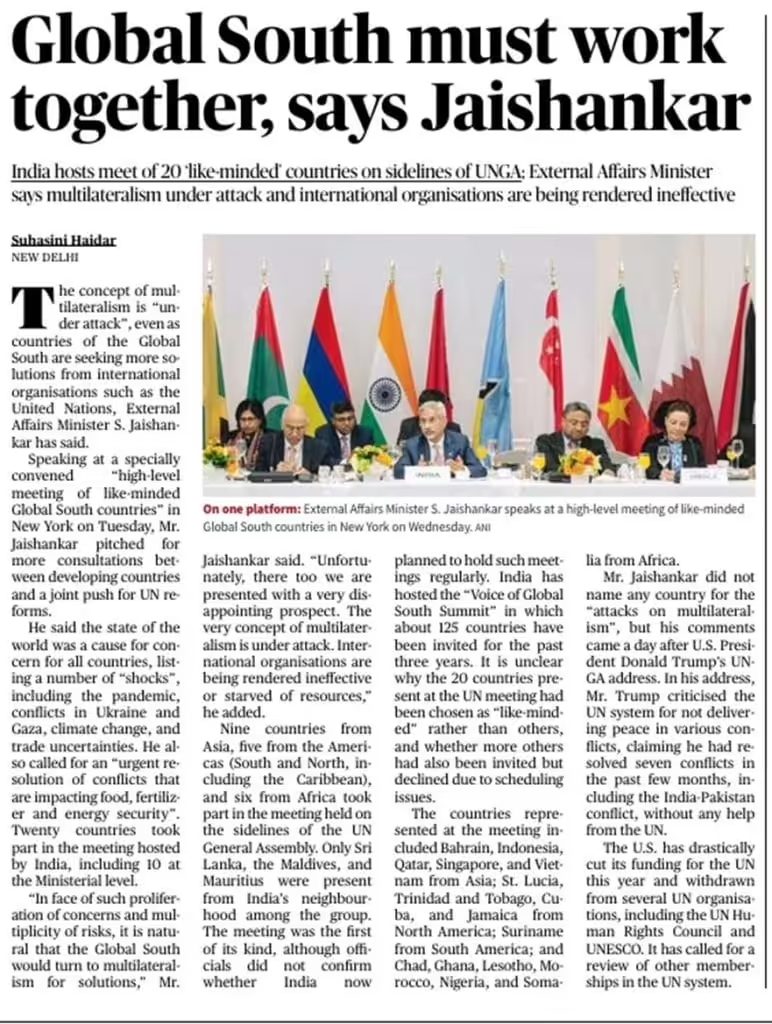
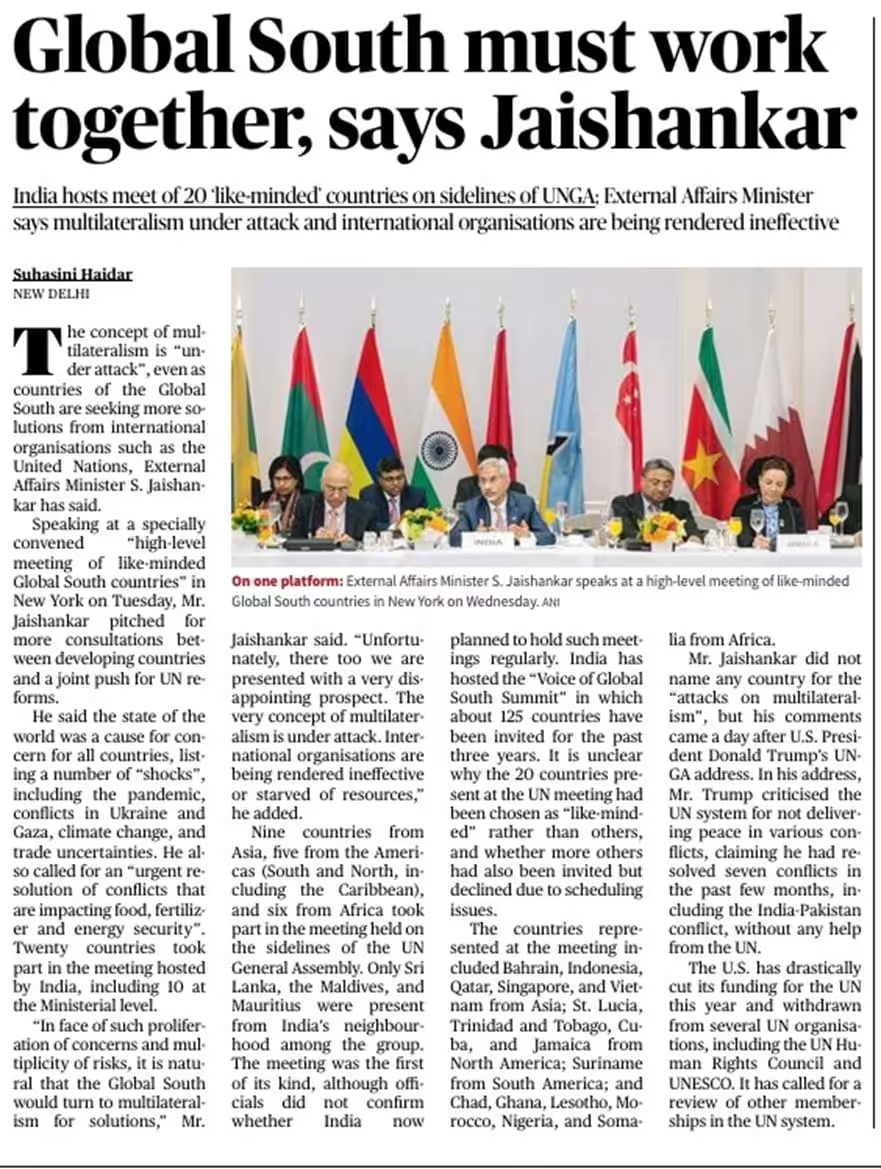
India’s foreign minister has called out the double standards of developed nations at the recent G20 Foreign Minister’s meeting.
UPSC Relevance:
Important Global Institutions.
PYQ:
In which one of the following groups are all the four countries members of G20?
(a) Argentina, Mexico, South Africa and Turkey
(b) Australia, Canada, Malaysia and New Zealand
(c) Brazil, Iran, Saudi Arabia and Vietnam
(d) Indonesia, Japan, Singapore and South Korea
About G20
- Group of Twenty (G20) is a forum for international economic cooperation consisting of 19 countries, the EU, and the African Union.
Evolution:
- G20 was founded in 1999 after the Asian financial crisis.
- It was started as a forum for Finance Ministers and Central Bank Governors to discuss global economic and financial issues.
- It was upgraded to the level of Heads of States in the wake of the 2007 global financial crisis.
- In 2009, it was designated the “premier forum for international economic cooperation”.
- It initially focused on broad macroeconomic issues but now expanded its agenda to include sustainable development, health, energy, environment, climate change, and anti-corruption.
Member Countries:
G20 Presidency
- G20 Presidency is responsible for bringing together G20 agenda in consultation with other members.
- India holds the Presidency of the G20 from 1 December 2022 to 30 November 2023.
- As the G-20 presidency, India sets the agenda for the year, identifies the themes and focus areas, conducts discussions, and works out outcome documents.
Troika:
- The Troika supports the Presidency. It consists of the previous, current, and upcoming presidency.
- During India’s Presidency, the Troika comprised of Indonesia, India, and Brazil.
G20 Sherpa
- Sherpas are special envoys of G20 leaders.
- They are representatives of member countries and are appointed directly by the Head of Government. Amitabh Kant is India’s 2023 G20 Sherpa.
Working of G20
- G20 has no fixed headquarters or a permanent Secretariat. The secretariat moves by rotation between the countries hosting the Presidency of the grouping each year.
- The G20 Presidency leads the G20 agenda for one year and hosts the Summit.
The G20 consists of two parallel tracks:
- Finance Track is led by Finance Ministers and Central Bank Governors of the member countries.
- Sherpa Track is led by the Sherpas of member countries.
- There are Working Groups in which representatives from the relevant ministries of the members, invited, and various international organisations participate.
- These working groups meet regularly throughout the term of each Presidency.
- There are Engagement Groups that bring together civil societies, parliamentarians, think tanks, women, youth, labour, businesses, and researchers of the G20 countries.
G20 Summits:
- The G20 Summit is held annually under the leadership of a rotating Presidency.
- The first G20 Summit was held in 2008 in Washington, DC.
- The US is the only country that hosted the summit twice in 2008 and 2009.
- 18th G20 Summit 2023 (Hosted by India)
- The 2023 G20 summit was India’s first G20 summit as a host country.
- India invited Bangladesh (India did not invite any other neighbour), Egypt, Mauritius, Netherlands, Nigeria, Oman, Singapore, Spain, and UAE as Guests for the 2023 G20 summit held in Kashmir.
Challenges Confronting the G20:
- Representational Inequity: Despite the inclusion of the African Union, smaller and emerging nations remain underrepresented, raising questions about equitable decision-making in the proposed “G21” framework.
- Geopolitical Rivalries: Tensions between major powers, such as the US-China competition & the Russia-Ukraine conflict, often derail discussions, making consensus-building on critical issues challenging.
- Divergent Economic Priorities: Sharp divides between developed nations focused on sustainability and developing countries prioritising growth impede agreements on climate financing and resource-sharing mechanisms.
- Structural Weaknesses: The non-binding nature of G20 decisions reduces their enforceability, weakening the forum’s ability to address pressing global challenges effectively.
- Competition from Other Platforms: Rising influence of groups like BRICS and SCO challenges the G20’s centrality in global governance, with overlapping agendas creating further fragmentation.
Way Forward:
- Global Challenges: Strengthen partnerships with international organizations to address food insecurity, and energy crises, and promote sustainable agricultural practices and clean energy solutions.
- Inclusive Climate Action: Develop inclusive frameworks that balance economic growth with climate priorities, ensuring equitable access to climate finance for all nations.
- Geopolitical Engagement: Establish specialised working groups to address persistent geopolitical conflicts like the Russia-Ukraine war, fostering diplomacy and conflict resolution.
- Accountability Mechanisms: Implement robust mechanisms to ensure accountability on climate finance, debt relief, and the achievement of sustainable development goals.
- Representation of Global South: Expand G20 membership to include more countries from the Global South and increase their advisory roles to amplify their voices in global decision-making.
- Institutional Strengthening: Set up a permanent G20 secretariat to ensure greater policy continuity, enhanced coordination, and more effective execution of global initiatives.
Tell Google you want more of this.
Add Anantam IAS as a preferred sourceOne tap, and this site shows up more often in your own Top Stories, AI Overviews and AI Mode. Remove it any time.