Introduction
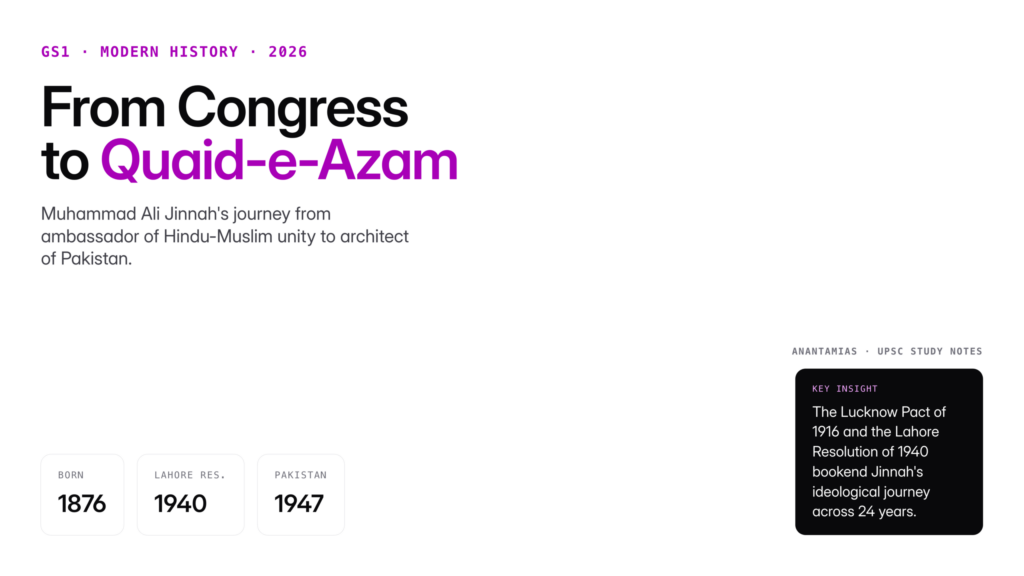
Few figures in modern South Asian history have been studied, debated and misread as often as Muhammad Ali Jinnah. Lawyer, nationalist, ambassador of Hindu-Muslim unity, and eventually the founding father of Pakistan, Jinnah’s political trajectory mirrors the break-up of the composite Indian nationalist movement into two parallel projects. For UPSC aspirants, his life offers a textbook study of how constitutional politics, communal reservation debates and leadership choices produced the Partition of 1947.
This note walks through Jinnah’s early career, his years as an Indian National Congress leader, the Lucknow Pact of 1916, his break with Gandhi-led mass politics, his reshaping of the All-India Muslim League, the articulation of the Two-Nation Theory, the Lahore Resolution of 1940 and the tragic road to Partition. It closes with the ongoing debates around his legacy and the classic Mains angles on communalism and decolonisation.
Quick Facts at a Glance
| Attribute | Detail |
|---|---|
| Born | 25 December 1876, Karachi (then Bombay Presidency) |
| Died | 11 September 1948, Karachi |
| Education | Lincoln’s Inn, London (Barrister, 1896) |
| First party | Indian National Congress, 1906 |
| Joined Muslim League | 1913 |
| Famous pact | Lucknow Pact, 1916 |
| Signature doctrine | Two-Nation Theory |
| Landmark resolution | Lahore Resolution, 23 March 1940 |
| Final role | First Governor-General of Pakistan, 1947 to 1948 |
| Popular titles | Quaid-e-Azam (Great Leader), Baba-e-Qaum (Father of the Nation) |
Background and Historical Context
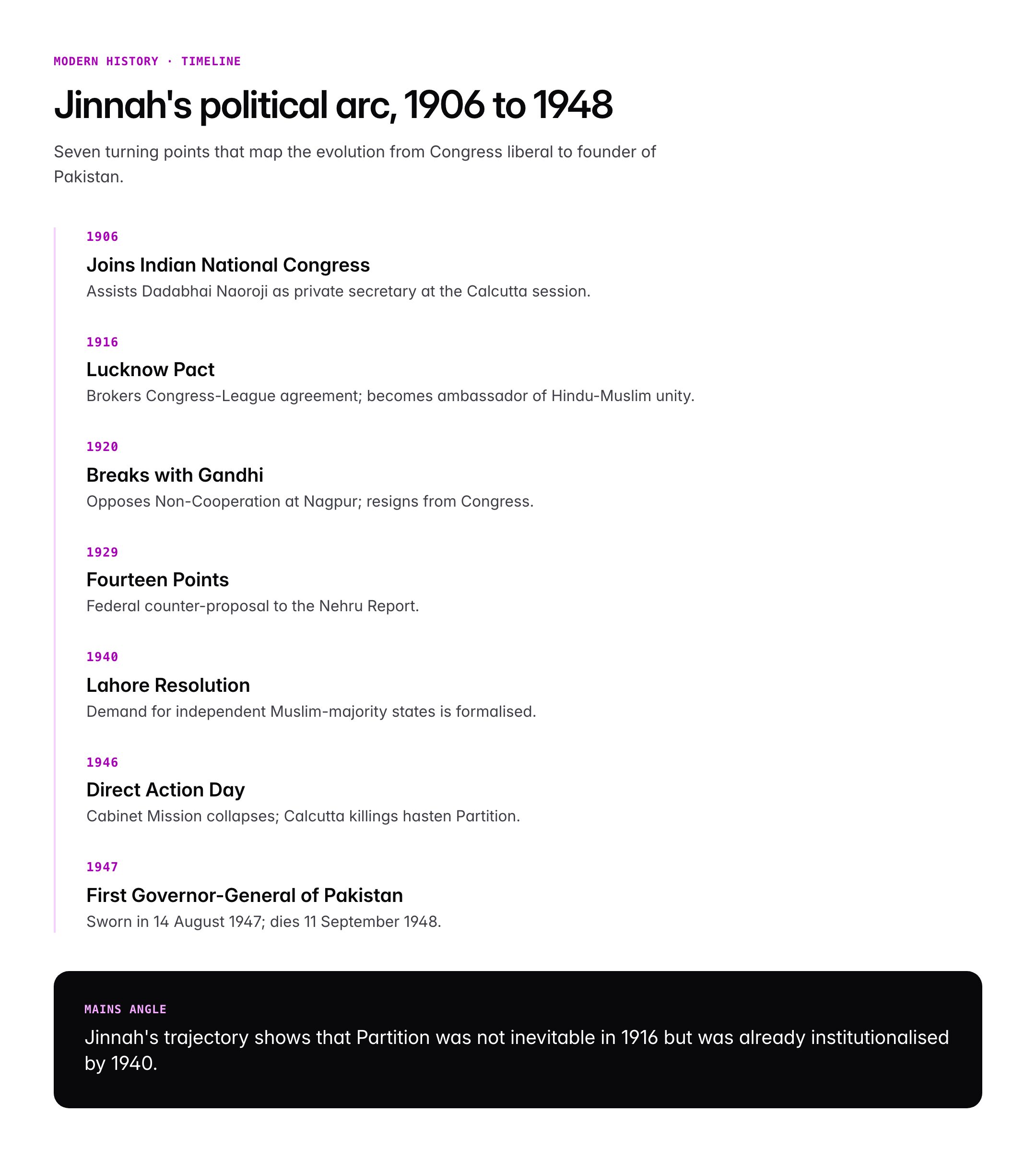
Jinnah was born in Karachi on 25 December 1876 into a Gujarati-speaking Khoja merchant family. He studied at Lincoln’s Inn in London and returned to Bombay as a barrister in 1896, quickly building a reputation for precision in constitutional law. His early political tutor was Dadabhai Naoroji, the Grand Old Man of Indian nationalism, whom he assisted as private secretary during Naoroji’s 1906 Congress presidency.
In this first phase, Jinnah was an unambiguous liberal constitutional nationalist. He joined the Indian National Congress in 1906, aligned with the Moderates against the Extremists, and opposed the principle of separate electorates introduced by the Morley-Minto Reforms of 1909. At the same time he defended secular space inside the Congress, successfully arguing against communal clauses in early drafts of party resolutions. He joined the All-India Muslim League in 1913 on the explicit condition that membership would not conflict with his primary loyalty to the broader nationalist cause.
The peak of this phase was the Lucknow Pact of 1916, which Jinnah helped negotiate between Congress and the League. It accepted separate electorates for Muslims but tied both communities to a common constitutional demand, earning Jinnah the famous epithet from Sarojini Naidu as the “ambassador of Hindu-Muslim unity”. His break with mainstream Congress came after the Nagpur Session of 1920, where he opposed Gandhi’s Non-Cooperation Movement on grounds that mass agitation would undermine constitutional politics and encourage communal fervour.
Political Contributions and Key Moments
Congress Years (1906 to 1920)
Jinnah entered politics as a disciple of Dadabhai Naoroji and Gopal Krishna Gokhale. He described Gokhale as his political ideal and modelled his parliamentary style on him. During this period he was a vocal member of the Imperial Legislative Council, sponsoring bills on child marriage reform and pushing for Indian representation in the military.
The Fourteen Points (1929)
After the failure of the Nehru Report of 1928 to accommodate Muslim concerns around federalism and reserved seats, Jinnah issued his Fourteen Points as a counter-proposal. The document sought a federal constitution, residuary powers to provinces, one-third Muslim representation at the Centre, and separation of Sind from Bombay. Rejected by the Congress, it marked a decisive shift in his strategy from integrationist bargaining to communal federalism.
Self-imposed Exile and Return (1930 to 1934)
Disillusioned, Jinnah moved to London in 1930 to practise at the Privy Council. He returned in 1934, persuaded by younger League leaders that only he could revive a demoralised party. He reorganised the All-India Muslim League, rebuilt its provincial networks and led it to an improved performance in the 1937 provincial elections, though it still trailed the Congress.
Lahore Resolution, 1940
At the Lahore session on 23 March 1940, the Muslim League passed what is now called the Lahore Resolution or Pakistan Resolution. Drafted by A. K. Fazlul Huq and endorsed by Jinnah, it demanded that areas in which Muslims were numerically a majority in the north-western and eastern zones of India should be grouped to constitute independent states. Jinnah’s presidential address articulated the full Two-Nation Theory, arguing that Hindus and Muslims were two distinct nations.
Direct Action Day and Partition
After the Cabinet Mission Plan of 1946 collapsed over issues of grouping and the Congress’s reservations, Jinnah called for Direct Action Day on 16 August 1946. The resulting Calcutta killings accelerated the slide toward partition. He accepted the Mountbatten Plan of 3 June 1947, and on 14 August 1947 took oath as the first Governor-General of Pakistan.
Significance for UPSC and General Knowledge
- Jinnah is central to Modern Indian History papers on late colonial politics and Partition.
- His career illustrates the shift from constitutional nationalism to communal federalism.
- The Lucknow Pact, Fourteen Points and Lahore Resolution are frequent Prelims triggers.
- His role is key to understanding the Two-Nation Theory and critiques of it.
- Jinnah’s 11 August 1947 Constituent Assembly speech offers a counter-narrative on secularism.
- Comparisons with Gandhi, Nehru and Maulana Azad are standard Mains essay material.
Reign and Administration: Jinnah in Power, 1947-48
Building a New State
As Governor-General from 14 August 1947, Jinnah faced the refugee crisis, integration of 562 princely states into the new dominion, economic division of assets, and the Kashmir conflict. He chaired the Constituent Assembly of Pakistan and largely dictated the shape of the Cabinet under Prime Minister Liaquat Ali Khan.
11 August 1947 Address
In his address to the Constituent Assembly of Pakistan, Jinnah famously said that citizens “may belong to any religion, caste or creed” and that this had “nothing to do with the business of the state”. This speech has been cited by critics as a contradiction of the Two-Nation Theory, and by admirers as evidence that Jinnah envisaged a secular Pakistan.
Kashmir and Foreign Policy
Jinnah backed tribal raiders in the Kashmir operations of October 1947 but was resisted by the British commanders of Pakistan’s army. The Indo-Pakistan war of 1947-48 crystallised during his tenure, and the Kashmir dispute would outlive him.
Death and Succession
Jinnah, long suffering from tuberculosis and lung cancer, died on 11 September 1948 at Karachi, barely 13 months after the creation of Pakistan. Power passed to Prime Minister Liaquat Ali Khan. His mausoleum, Mazar-e-Quaid, remains Pakistan’s central civic landmark.
Comparative Perspective
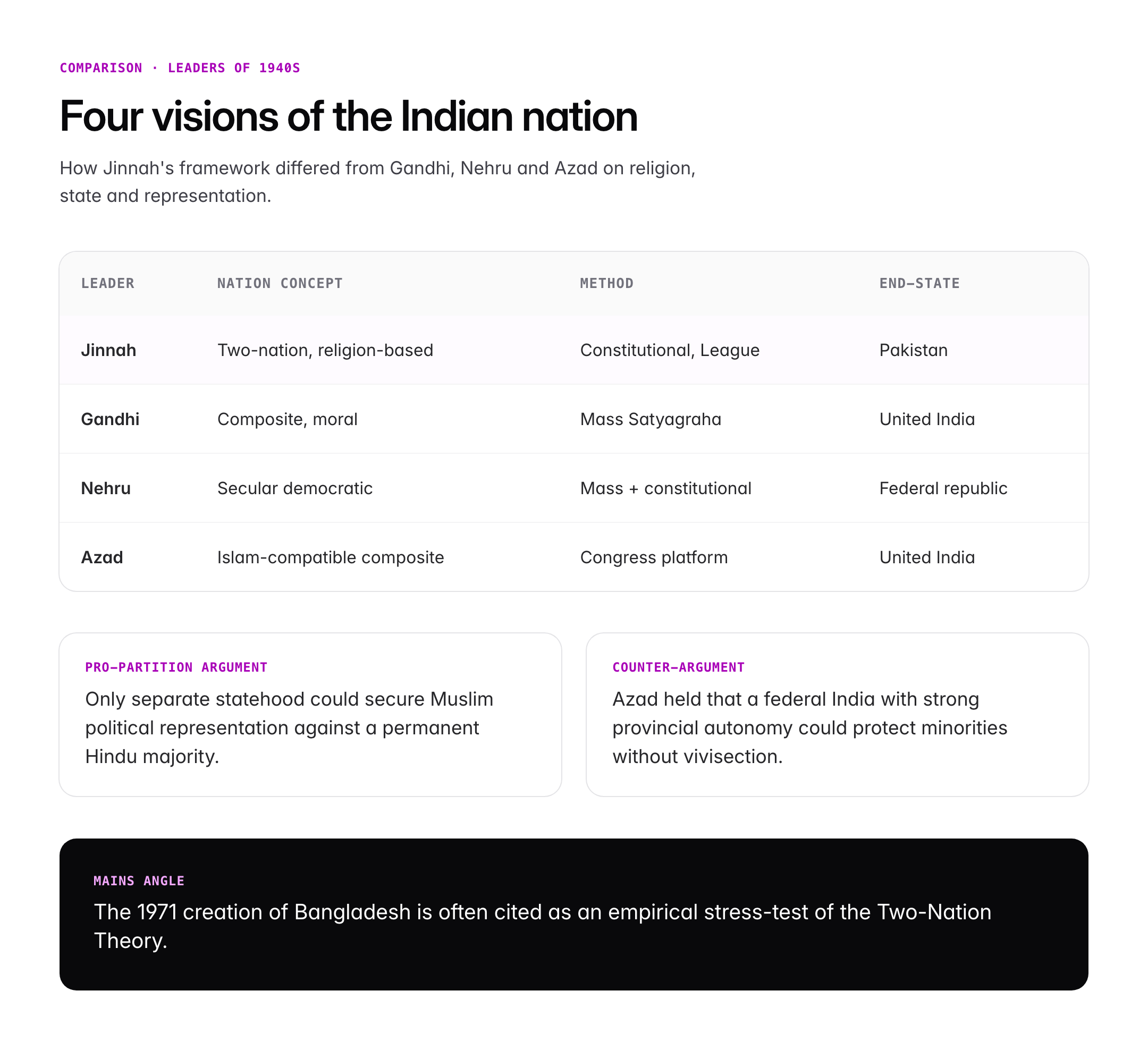
| Leader | Core Ideology | Mass Method | Relation to Jinnah |
|---|---|---|---|
| M. K. Gandhi | Satyagraha, Hind Swaraj | Mass non-violence | Ideological opposite post-1920 |
| Jawaharlal Nehru | Secular democratic socialism | Mass mobilisation | Chief Congress counterpart in 1940s |
| Maulana Azad | Composite nationalism | Congress platform | Principal Muslim critic of Partition |
| B. R. Ambedkar | Constitutional social reform | Legal and legislative | Debated Two-Nation Theory in 1940 |
Unlike Gandhi, Jinnah distrusted mass agitation. Unlike Azad, he concluded Muslims could not secure equitable representation within a Hindu-majority electorate. Unlike Ambedkar, his core category was religious rather than caste-based minority rights. The comparison clarifies why four broadly liberal leaders could not converge on a single constitutional settlement for undivided India.
Controversies and Debates
Three controversies continue to shape Jinnah’s historiography. First, the sincerity question: Was the Pakistan demand a bargaining chip for a federal settlement, as Ayesha Jalal argues in The Sole Spokesman, or a genuine ideological goal from 1940 onward, as Stanley Wolpert emphasises. Second, the responsibility for communal violence around Direct Action Day and the 1947 killings, which is contested between scholars who blame League mobilisation and those who highlight Congress and colonial administrative failure.
Third, his legacy in India. L. K. Advani’s 2005 remarks describing Jinnah as secular triggered intense political debate. School textbook controversies around Jinnah’s 11 August speech continue to recur. For UPSC writing, the test is to present the evidence fairly and avoid polemics.
Prelims Pointers
- Jinnah was born on 25 December 1876 in Karachi.
- He was called to the Bar at Lincoln’s Inn, London in 1896.
- He joined the Indian National Congress in 1906.
- He joined the Muslim League in 1913.
- Sarojini Naidu called him the ambassador of Hindu-Muslim unity.
- The Lucknow Pact was signed in 1916 between Congress and League.
- Jinnah’s Fourteen Points were issued in March 1929.
- The Lahore Resolution was passed on 23 March 1940.
- Direct Action Day was observed on 16 August 1946.
- Jinnah became the first Governor-General of Pakistan on 14 August 1947.
- He died on 11 September 1948 at Karachi.
- He is known as Quaid-e-Azam and Baba-e-Qaum in Pakistan.
Mains Practice Questions
Q1. Trace the evolution of Muhammad Ali Jinnah from an ambassador of Hindu-Muslim unity to the architect of Pakistan. What factors drove this shift?
- Outline the early Congress phase and the Lucknow Pact of 1916 as the high point of cooperation.
- Analyse the 1920 break with Gandhi, the Fourteen Points, and the revival of the Muslim League from 1934.
- Assess structural factors like communal electorates, 1937 election dynamics and Cabinet Mission failure, alongside personal conviction.
Q2. Critically examine the Two-Nation Theory as articulated by Jinnah in the 1940 Lahore Resolution.
- State the core claim that Hindus and Muslims are distinct nations by religion, culture and social life.
- Evaluate counter-arguments by Maulana Azad, Nehru and Ambedkar on composite nationalism.
- Assess historical outcomes: Partition, population transfers and the challenge to the theory posed by Bangladesh in 1971.
Conclusion
Muhammad Ali Jinnah embodies the paradox of late colonial Indian politics: a secular-living, constitutionally-minded liberal who eventually led the movement that divided the subcontinent on religious lines. His journey from Naoroji’s protege to Quaid-e-Azam is inseparable from the failure of Indian nationalist politics to craft a federal settlement acceptable to all communities.
For UPSC aspirants, studying Jinnah is not an exercise in moral scoring. It is training in evaluating leadership decisions against structural constraints, reading primary speeches with care, and writing balanced answers on Partition that neither demonise nor romanticise any single actor.
Frequently Asked Questions
Who was Muhammad Ali Jinnah?
Muhammad Ali Jinnah (1876 to 1948) was a barrister, nationalist politician and the founding father of Pakistan. He began his career in the Indian National Congress, helped negotiate the 1916 Lucknow Pact with Hindu leaders, then led the All-India Muslim League to articulate the Two-Nation Theory, resulting in the creation of Pakistan on 14 August 1947, of which he became the first Governor-General.
Why is Muhammad Ali Jinnah important for UPSC?
Jinnah is a core figure in Modern Indian History under GS Paper 1. His career maps the transition from composite nationalism to Partition, involving the Lucknow Pact, Fourteen Points, Lahore Resolution and Direct Action Day. Questions frequently test his role in Partition, the Two-Nation Theory and comparisons with Gandhi, Nehru and Azad, making him essential for Prelims facts and Mains analysis.
How was Jinnah related to Mahatma Gandhi?
Jinnah and Gandhi were both Gujarati-born barristers and Congress leaders, but clashed over method and ideology. Jinnah opposed Gandhi’s 1920 Non-Cooperation Movement, preferring constitutional politics over mass agitation. Their later Gandhi-Jinnah Talks of 1944 failed to reconcile Congress and League demands, and their divergent visions of nationalism became central to the Partition story.
What is the Two-Nation Theory?
The Two-Nation Theory, articulated by Jinnah in his 1940 Lahore presidential address, held that Hindus and Muslims of the Indian subcontinent constituted two distinct nations by religion, culture, history and social organisation. It argued that Muslims required a separate sovereign homeland where they could safeguard their political and cultural rights, and became the ideological foundation for Pakistan.
What was the Lucknow Pact of 1916?
The Lucknow Pact of 1916 was an agreement between the Indian National Congress and the All-India Muslim League, negotiated largely by Jinnah and Bal Gangadhar Tilak. It accepted separate electorates for Muslims in provincial councils and demanded joint constitutional reforms from the British. The pact marked the high point of Hindu-Muslim political unity and earned Jinnah the title of ambassador of Hindu-Muslim unity.
What was the Lahore Resolution of 1940?
Passed on 23 March 1940 at the Muslim League session in Lahore, the Lahore Resolution demanded that areas where Muslims were numerically in a majority, in the north-western and eastern zones of India, should be grouped to constitute independent states. Later popularly called the Pakistan Resolution, it formalised the League’s move from federalism to demand for a separate Muslim homeland.
What was Direct Action Day?
Direct Action Day was called by Jinnah on 16 August 1946 after the Muslim League rejected the Cabinet Mission Plan outcomes. Intended as a peaceful demonstration of Muslim political strength, it triggered widespread communal violence, especially the Calcutta Killings, in which several thousand people died. It accelerated the collapse of the united India framework and hardened the path to Partition.
What was Jinnah’s role after the creation of Pakistan?
Jinnah served as the first Governor-General of Pakistan from 14 August 1947 until his death on 11 September 1948. He chaired the Constituent Assembly, oversaw refugee rehabilitation, integration of princely states into Pakistan, economic division of undivided India’s assets and the early Kashmir conflict. His 11 August 1947 speech on religious freedom remains a touchstone in debates over Pakistan’s secular or Islamic identity.
Tell Google you want more of this.
Add Anantam IAS as a preferred sourceOne tap, and this site shows up more often in your own Top Stories, AI Overviews and AI Mode. Remove it any time.