Introduction
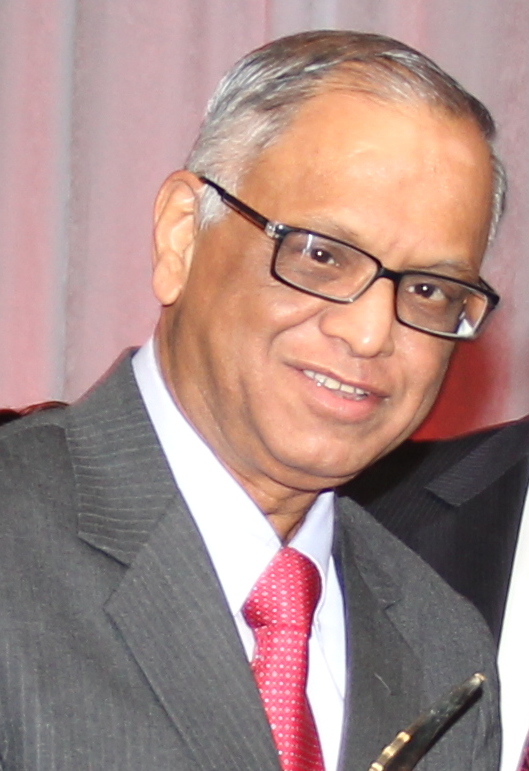
When Nagavara Ramarao Narayana Murthy borrowed ten thousand rupees from his wife Sudha Murty in 1981 to co-found Infosys, the Indian software industry did not formally exist. Four decades later, the company he built has become a global benchmark, and he himself is read as a case study in entrepreneurship, corporate governance and institution building. For aspirants, his life traces the arc of Indian liberalisation, the rise of services exports, and the ongoing debate on work, capital and public values.
This biography organises Narayana Murthy’s career into coherent phases — student, engineer, co-founder, chairman, public intellectual — and draws out the UPSC-relevant threads across GS3 economy, ethics and governance, and GS2 institutions. It concludes with Prelims pointers and Mains practice questions built on his contribution and his controversies.
Quick Facts at a Glance
| Attribute | Detail |
|---|---|
| Full name | Nagavara Ramarao Narayana Murthy |
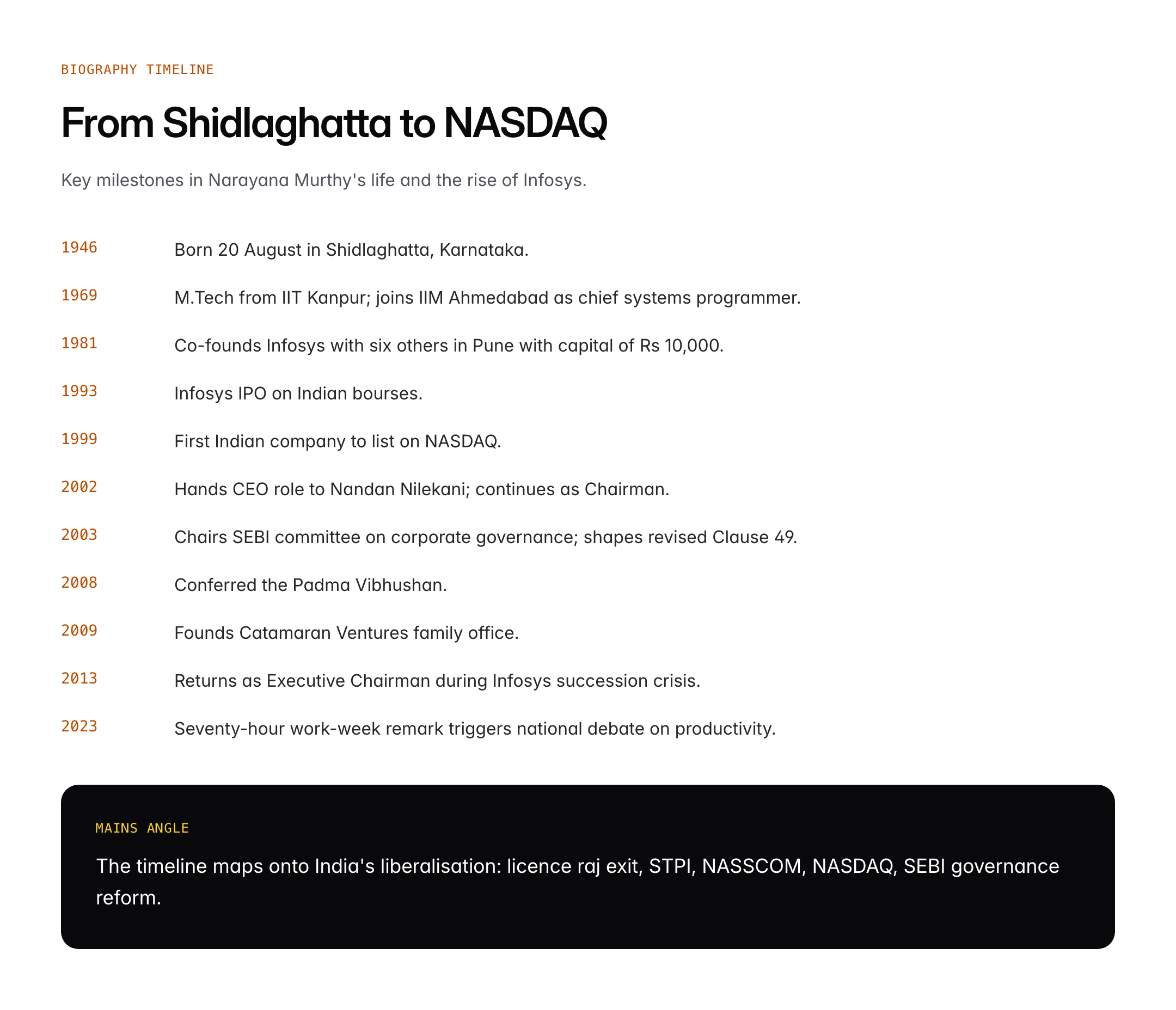
| Born | 20 August 1946, Shidlaghatta, Karnataka |
| Education | B.E. Electrical, NIE Mysore (1967); M.Tech, IIT Kanpur (1969) |
| Company | Infosys Limited, co-founded 1981 |
| Co-founders | N. S. Raghavan, Nandan Nilekani, S. Gopalakrishnan, S. D. Shibulal, K. Dinesh, Ashok Arora |
| First CEO of Infosys | Narayana Murthy (1981–2002) |
| Infosys listing | NASDAQ 1999 (first Indian IT company) |
| Net worth (approx.) | Over USD 4 billion (Forbes 2025 estimates) |
| Awards | Padma Shri 2000, Padma Vibhushan 2008, CBE 2007 |
| Spouse | Sudha Murty, author and philanthropist |
| Family | Son Rohan Murty; daughter Akshata Murty (married to former UK PM Rishi Sunak) |
Background and Historical Context
Narayana Murthy grew up in a lower middle class Kannada family in Shidlaghatta, Karnataka. His father, R. H. Kulkarni, was a schoolteacher, and young Narayana attended the National Institute of Engineering in Mysore on scholarship support. After completing his master’s at IIT Kanpur in 1969, he joined the Indian Institute of Management Ahmedabad as chief systems programmer, working on India’s first time-sharing computer.
A formative episode came in the early 1970s when he was briefly detained in communist Bulgaria after an accidental conversation on a train. The experience, he has written, converted him from a self-described confused leftist into a firm believer in what he calls compassionate capitalism. He returned to India determined to prove that honest, competitive, globally benchmarked companies could be built within the constraints of the licence raj.
In 1981 he co-founded Infosys Consultants from a small apartment in Pune with six colleagues and capital of ten thousand rupees. The early years were grim. India had foreign exchange controls, 200 per cent duties on imported computers, and a two year wait to install a telephone. The 1991 liberalisation under Finance Minister Manmohan Singh and the New Industrial Policy unlocked Infosys’s global ambitions. The company went public in 1993 and listed on NASDAQ in 1999 — the first Indian company to do so on a US stock exchange.
Biography
Early Years and Conversion to Capitalism
Born on 20 August 1946, Narayana Murthy was one of eight children. His early engagement with socialist ideology, influenced by the intellectual climate of post-independence India, gave way to free-market convictions after his Bulgaria episode. By the time he joined IIM Ahmedabad, he was already drawing a distinction between ideology and institution building.
The Founding of Infosys
On 7 July 1981, Infosys was registered in Pune with seven co-founders. Narayana Murthy served as CEO and Managing Director from 1981 to 2002, and as Chairman of the Board until 2011. He returned briefly in 2013 as Executive Chairman during a succession crisis and exited again in 2014. The company moved its headquarters to Bengaluru in 1983, setting up the campus that would become a symbol of the Indian IT boom.
Listing, Scaling and Governance
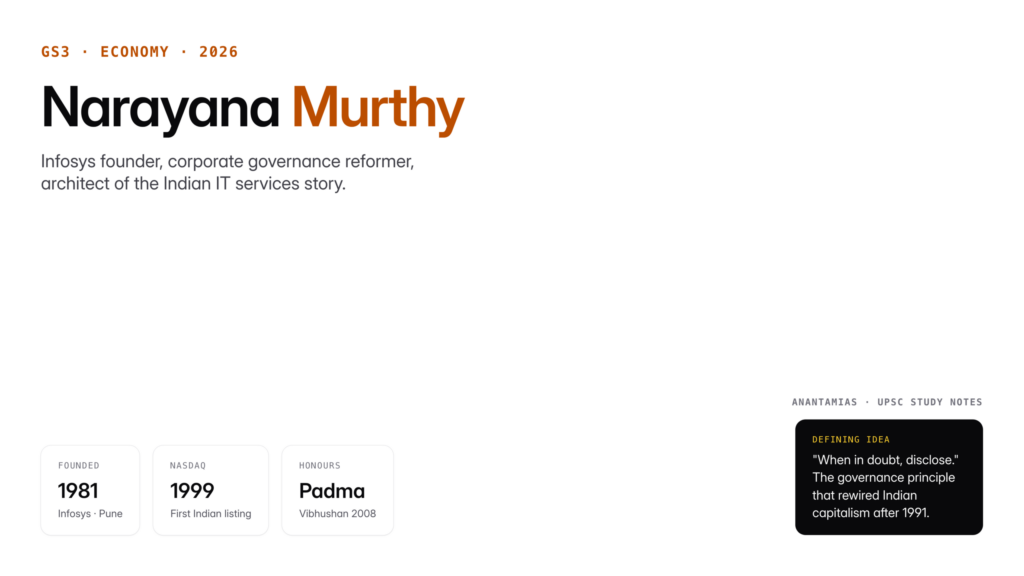
Infosys pioneered corporate governance standards in India, publishing consolidated financials in Indian and US GAAP, adopting an independent board, and voluntarily disclosing compensation of top executives. Murthy often cited “When in doubt, disclose” as the operating principle. The company’s 1999 NASDAQ listing turned it into a poster child for Indian outsourcing and helped trigger the rise of the Y2K services export wave.
Leadership Style
Murthy championed a concept he termed compassionate capitalism — wealth creation with social legitimacy. The Infosys employee stock ownership plan created what he described as roughly two thousand dollar millionaires by 2000, including drivers, clerks and engineers who had joined early. He also insisted on punctuality, humility in personal consumption, and a culture of open meetings with employees.
Beyond Infosys
After stepping back from Infosys, Murthy founded Catamaran Ventures in 2009, a family investment office that has seeded companies such as SKS Microfinance, Manthan Systems and several early stage technology ventures. He has served on the boards of HSBC, Unilever, Ford Foundation, and advisory panels at Cornell University, Wharton, and the Singapore Management University.
Honours
- Padma Shri (2000)
- Padma Vibhushan (2008)
- Commander of the Order of the British Empire (CBE) (2007)
- Legion of Honour from France (2008)
- Philanthropist of the Year, The Asian Awards (2015)
- IEEE Ernst Weber Managerial Leadership Award
Significance for UPSC and General Knowledge
- Living case study of Indian liberalisation after 1991
- Frame for corporate governance discussions and Kotak Committee reforms
- Anchor for questions on IT services, BPO and GCC strategy
- Relevant to ethics paper on integrity, disclosure, and compassionate capitalism
- Useful for essay topics on entrepreneurship, institution building, diaspora
- Example of family-to-public-office transition (Akshata Murty, Rishi Sunak link)
Detailed Analysis: Contribution to Indian IT and Public Policy
Narayana Murthy’s imprint on Indian IT operates on three levels — firm, industry and institution. At the firm level, Infosys demonstrated that an Indian company could compete globally without compromising on governance. It popularised the Global Delivery Model in which code was built in India, delivered to clients abroad, and managed through time-zone bridges. This model underpins India’s current software services exports of over USD 200 billion annually, making IT and IT-enabled services the single largest private sector employer in India.
At the industry level, Murthy played a decisive role through NASSCOM, which he chaired in 1994. NASSCOM lobbied for liberal telecom licensing, the Software Technology Parks of India (STPI) scheme, and the abolition of the ten per cent withholding tax on foreign remittances that had throttled early outsourcing. These reforms, coupled with the Special Economic Zones Act of 2005, created the regulatory platform on which companies such as Wipro, TCS, HCL and later Mindtree and MphasiS scaled.
At the institutional level, Murthy’s push for transparent quarterly disclosures, board independence and audit committee rigour was unusual in the 1990s Indian market, then dominated by promoter-led firms with opaque accounting. The Narayana Murthy Committee on Corporate Governance (2003), appointed by SEBI, tightened disclosure norms and influenced the revised Clause 49 of the listing agreement. Much of the subsequent governance architecture — independent directors, whistleblower policy, related party transaction approval — traces back to that committee’s recommendations.
His public interventions have also shaped debates on higher education and research. The Murty Classical Library of India, endowed by his son Rohan Murty at Harvard University Press, publishes critical editions of classical Indian texts across Sanskrit, Pali, Prakrit, Tamil and Urdu. The Infosys Science Foundation grants the Infosys Prize, one of India’s most prestigious academic awards, across six disciplines including humanities and social sciences.
Comparative Perspective
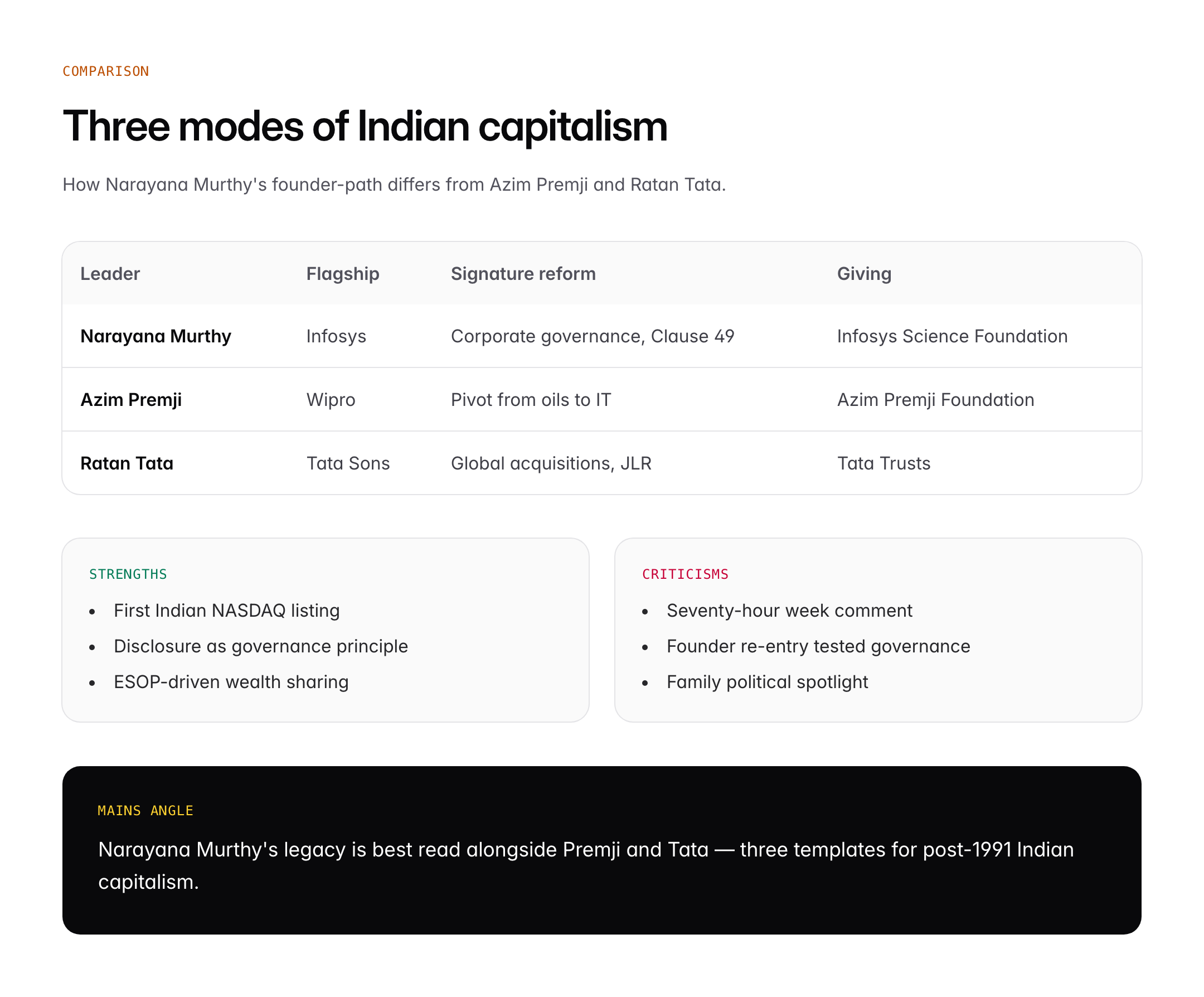
| Parameter | Narayana Murthy | Azim Premji | Ratan Tata |
|---|---|---|---|
| Flagship | Infosys (co-founder) | Wipro (chairman, inheritor) | Tata Sons (chairman) |
| Origin | First-generation entrepreneur | Inheritor, transformed from oils to IT | Legacy group, fourth-generation leader |
| Signature reform | Corporate governance, disclosure | Philanthropy, Azim Premji Foundation | Globalisation, JLR acquisition |
| Giving vehicle | Infosys Science Foundation, Catamaran | Azim Premji Foundation, Premji Invest | Tata Trusts |
| Governance profile | SEBI committee 2003 | Low-key long-term giving | SEBI-era structural reforms at Tatas |
Among India’s first generation post-liberalisation business leaders, Murthy occupies a particular slot — the first-generation entrepreneur who codified global governance standards into Indian boardrooms. Azim Premji complements this contribution with the largest sustained philanthropy in Indian history. Ratan Tata, working from a legacy group, drove global acquisitions. Together they define three modes of Indian capitalism that UPSC frequently tests through comparative questions.
Controversies and Debates
Murthy’s public statements have repeatedly provoked national debate. The most widely discussed is his 2023 remark that Indians must work seventy hours a week to raise productivity to global levels. Critics, including labour economists and medical associations, argued that the statement ignored research on burnout, the unpaid domestic labour that women perform, and the structural drivers of low productivity such as capital shallowness and infrastructure gaps. Supporters argued that the comment was aimed narrowly at founders and early-stage employees and reflected a generational discipline ethic.
A second theme is succession at Infosys. After his return as Executive Chairman in 2013, the firm went through turbulent changes in CEO and board, with Vishal Sikka’s 2017 resignation highlighting tensions between founders and the professional management. Corporate governance observers have debated whether founder-led intervention, even with shareholder support, undermines the independent-board model Murthy himself had pioneered.
Finally, the political dimension of his family ties has generated discussion. His daughter Akshata Murty, a shareholder in Infosys, is married to former UK Prime Minister Rishi Sunak. Her non-domiciled tax status in the UK triggered a 2022 controversy. Murthy has publicly distanced himself from political positions, but commentators note the inevitable complexity of global elite families and soft power.
Prelims Pointers
- Born 20 August 1946 in Shidlaghatta, Karnataka
- Co-founded Infosys in 1981 with seven other engineers
- Served as CEO of Infosys from 1981 to 2002
- Infosys was the first Indian company listed on NASDAQ (1999)
- Chaired the SEBI Committee on Corporate Governance in 2003
- Received Padma Shri in 2000 and Padma Vibhushan in 2008
- Received CBE from the United Kingdom in 2007
- Founded Catamaran Ventures in 2009
- Wife Sudha Murty is an author and former head of the Infosys Foundation
- Daughter Akshata Murty is married to former UK PM Rishi Sunak
- The Murty Classical Library of India is published by Harvard University Press
- NASSCOM chairman in 1994, helped push STPI and telecom liberalisation
Mains Practice Questions
Q1. “Narayana Murthy’s greatest contribution to India is not Infosys but the codification of corporate governance standards.” Critically examine. (250 words)
- Trace Infosys listing, governance disclosures and SEBI 2003 committee
- Weigh against the job-creation and export contribution of Infosys
- Conclude on balanced legacy of firm, industry and institution
Q2. Discuss the role of first-generation technology entrepreneurs in shaping India’s post-1991 economic trajectory. (250 words)
- Use Infosys, Wipro, HCL case studies
- Link to STPI, NASSCOM, SEZ Act 2005
- Address limitations — concentrated in services, limited product innovation
Conclusion
Narayana Murthy is a useful symbol precisely because he resists simplification. He is both the compassionate capitalist who argued for employee stock ownership and the stern taskmaster who calls for seventy-hour weeks. He is the first-generation founder who codified independent-board governance and the returning chairman who tested that very governance when Infosys faltered. For UPSC preparation, his life is an opportunity to hold these contradictions in mind while drawing on concrete examples of corporate governance, industry policy and the Indian diaspora.
Four decades after that small loan from Sudha Murty, the arc of Infosys and of its first CEO offers the clearest available illustration of how policy, institutions and entrepreneurship intersected in post-liberalisation India. Aspirants who understand this arc also understand, in miniature, the rise of modern Indian capitalism and the unresolved debates about what it owes to workers, citizens and the state.
Frequently Asked Questions
What is N. R. Narayana Murthy known for?
Narayana Murthy is known as the co-founder and first CEO of Infosys Limited, which he helped establish in 1981. He is credited with shaping Indian corporate governance standards, popularising the Global Delivery Model for IT services, and mentoring an entire generation of Indian technology entrepreneurs. He has received the Padma Shri, Padma Vibhushan and the CBE.
Why is Narayana Murthy important for UPSC?
Narayana Murthy is a recurring reference across GS3 economy, GS4 ethics, and GS2 institutions. His life illustrates India’s post-1991 liberalisation, the growth of IT services exports, corporate governance reform under the SEBI committee he chaired in 2003, and debates on compassionate capitalism and work culture relevant to essay and interview preparation.
How is Narayana Murthy related to Infosys and Indian IT?
Narayana Murthy co-founded Infosys in 1981 along with N. S. Raghavan, Nandan Nilekani, S. Gopalakrishnan, S. D. Shibulal, K. Dinesh and Ashok Arora. He served as CEO until 2002 and Chairman until 2011. Under his leadership Infosys became the first Indian company to list on NASDAQ (1999), setting global benchmarks for the Indian IT industry.
What did Narayana Murthy do before founding Infosys?
Before Infosys, Narayana Murthy worked at the Indian Institute of Management Ahmedabad as chief systems programmer, where he helped build India’s first time-sharing computer system. He then joined Patni Computer Systems in Pune, where he met the co-founders with whom he would later establish Infosys in 1981.
What is the Narayana Murthy Committee on Corporate Governance?
In 2002 SEBI appointed Narayana Murthy to chair a committee on corporate governance. Its 2003 report recommended reforms including stricter disclosure norms, independent directors, whistleblower policy and tighter audit committees. These recommendations were incorporated into a revised Clause 49 of the listing agreement and shaped Indian corporate governance for the next two decades.
Why did Narayana Murthy’s seventy-hour work week remark cause controversy?
In 2023 Narayana Murthy suggested young Indians should work seventy hours a week to close productivity gaps. Critics cited research on burnout, the burden on women who perform unpaid domestic labour, and structural drivers of low productivity such as capital shallowness. Supporters framed the remark as narrowly aimed at founders and early-stage employees.
Who are Narayana Murthy’s family members?
Narayana Murthy is married to Sudha Murty, an author, philanthropist and former head of the Infosys Foundation. They have two children — son Rohan Murty, founder of the Murty Classical Library of India, and daughter Akshata Murty, who is married to former UK Prime Minister Rishi Sunak. Akshata also holds a significant shareholding in Infosys.
What awards and honours has Narayana Murthy received?
Narayana Murthy has received the Padma Shri (2000) and Padma Vibhushan (2008) from the Government of India. The United Kingdom conferred the honorary CBE in 2007, and France awarded him the Legion of Honour in 2008. He has also received the IEEE Ernst Weber Managerial Leadership Award and multiple honorary doctorates from global universities.
Tell Google you want more of this.
Add Anantam IAS as a preferred sourceOne tap, and this site shows up more often in your own Top Stories, AI Overviews and AI Mode. Remove it any time.