National Disaster Response Force (NDRF): Battalions, Mandate, and Deployment
National Disaster Response Force explained for UPSC: DM Act 2005 origin, 16 battalions, training, NDMA hierarchy, domestic operations, and international deployments.
The National Disaster Response Force (NDRF) is the world’s largest dedicated disaster response agency and the operational arm of India’s disaster management architecture. It was raised in 2006 under the Disaster Management Act 2005 and currently comprises sixteen battalions drawn from five central armed police forces, with personnel trained to respond to natural and man-made disasters across the full spectrum, from earthquakes and floods to chemical, biological, radiological, and nuclear (CBRN) incidents.
The National Disaster Response Force sits beneath the National Disaster Management Authority (NDMA), which is chaired by the Prime Minister, and reports operationally through the Director General who is an officer of the rank of Additional Director General of Police. The force has trained almost the entire national disaster management vocabulary into a single uniformed cadre. Every battalion holds the same equipment table, the same training certifications, and the same response time targets.
This explainer covers the legal basis for the National Disaster Response Force, its battalion structure and parent forces, the deployment regime in India and abroad, the training infrastructure at the National Institute of Disaster Management and the NDRF Academy at Nagpur, and the UPSC-relevant angles on disaster governance.
Quick Facts on the National Disaster Response Force
- Raised. 2006 under Section 44 of the Disaster Management Act 2005.
- Headquarters. New Delhi.
- Director General. Officer of the rank of Additional Director General of Police, drawn from the IPS.
- Battalions. 16, drawn from BSF, CRPF, CISF, ITBP, SSB, and Assam Rifles.
- Battalion strength. Each battalion has 18 specialised search and rescue teams of 47 members each, approximately 1,149 personnel per battalion.
- Total personnel. Approximately 18,000.
- Training academy. NDRF Academy, Nagpur (operational since 2014).
- Reports to. Ministry of Home Affairs, through NDMA.
- First international deployment. Japan (after the 2011 Tohoku earthquake and tsunami).
- 2026 deployments. Türkiye-Syria earthquake response (Operation Dost), Nepal earthquakes, Myanmar floods, Sri Lanka landslides.
Origin: The Disaster Management Act 2005
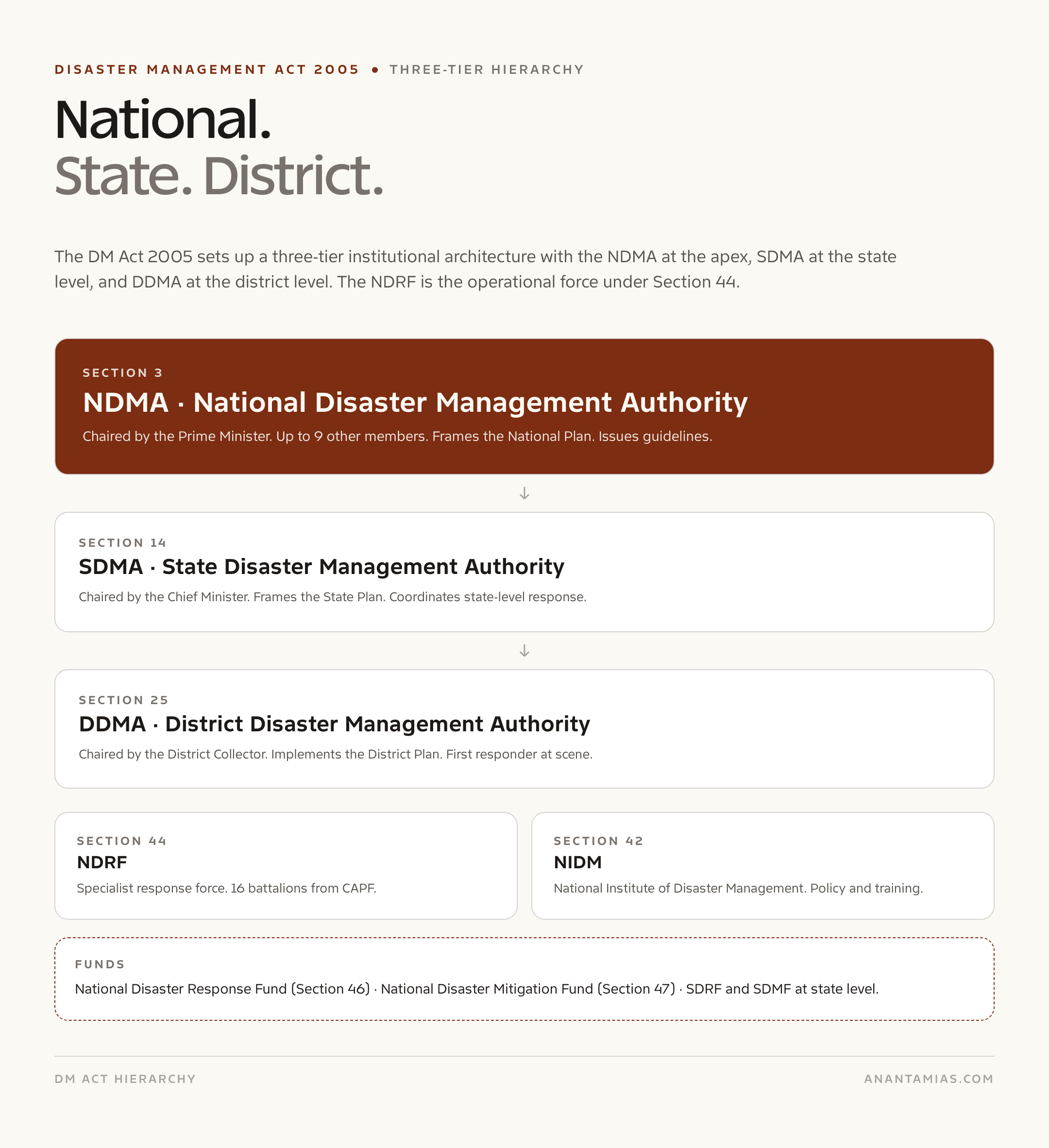
The National Disaster Response Force is a creature of the Disaster Management Act 2005. The Act was passed in the aftermath of the Indian Ocean tsunami of December 2004 and the Bhuj earthquake of January 2001, which together exposed the limits of an ad-hoc, state-by-state, ministry-by-ministry response system. Parliament created a three-tier disaster management architecture under the Act.
At the apex, Section 3 sets up the National Disaster Management Authority, chaired by the Prime Minister, with up to nine other members. Below the NDMA, Section 14 sets up the State Disaster Management Authority chaired by the Chief Minister of each state, and Section 25 sets up the District Disaster Management Authority chaired by the District Collector.
Section 44 then authorises the Central Government to constitute “for the purpose of specialist response to a threatening disaster situation or disaster, a force to be known as the National Disaster Response Force.” Section 45 makes the force’s command structure a matter for central government rules. The Disaster Management (NDRF) Rules 2008 set out the establishment, recruitment, and conditions of service.
The force became operational in 2006 with eight battalions. The strength was raised to ten in 2010, twelve in 2018, and sixteen by 2026.
The Sixteen Battalions and Their Parent Forces
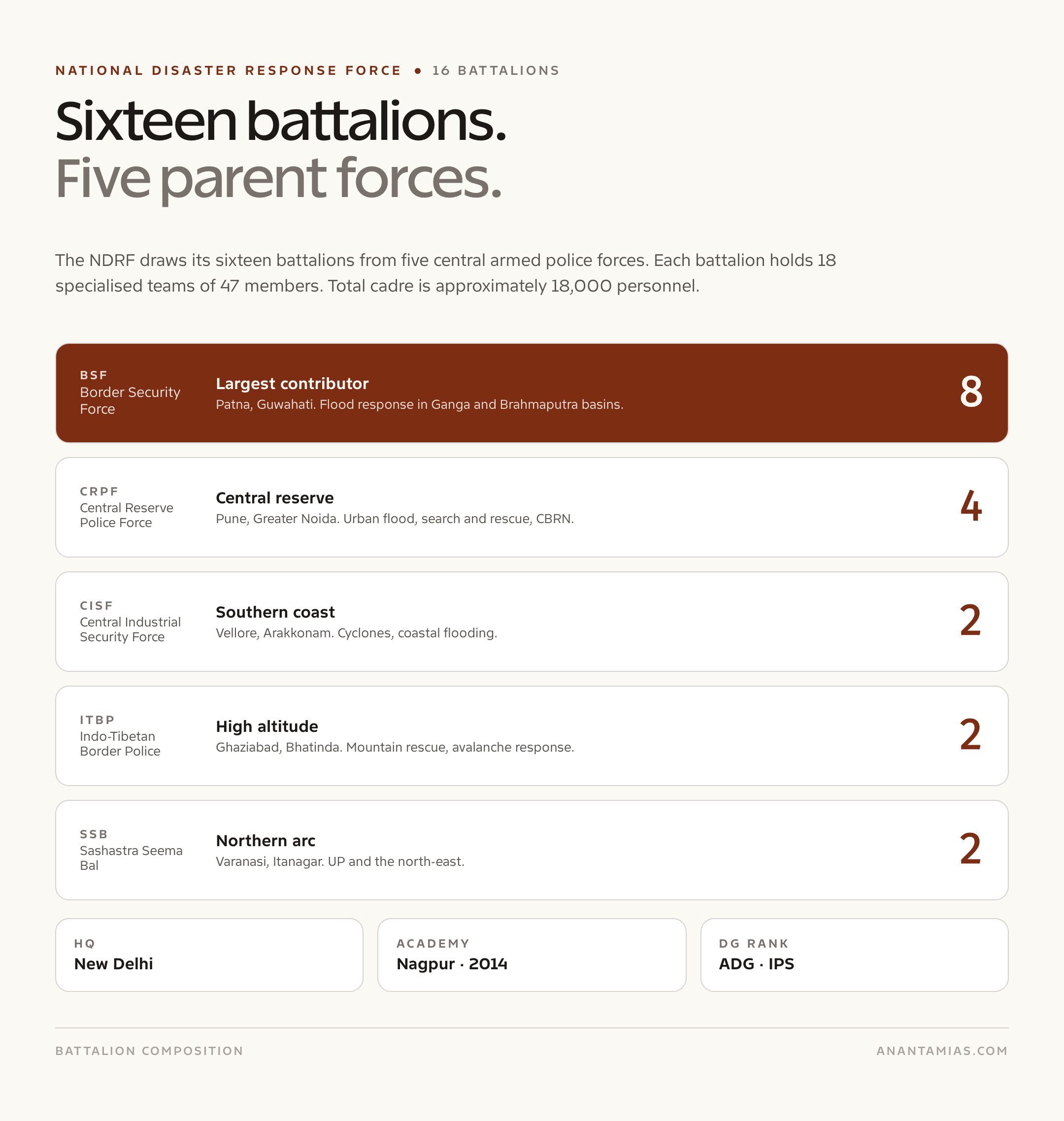
Each NDRF battalion is drawn from one of the central armed police forces but functions under NDMA command for disaster operations. The distribution of the sixteen battalions across the parent forces is as follows.
BSF (8 battalions). The Border Security Force contributes the largest share. BSF battalions are located at Patna, Guwahati, and other forward locations and specialise in flood response, particularly in the Ganga and Brahmaputra basins.
CRPF (4 battalions). The Central Reserve Police Force battalions are located at Pune, Greater Noida, and other central locations. They handle urban flood, search and rescue, and CBRN response in the western and central zones.
CISF (2 battalions). The Central Industrial Security Force battalions are at Vellore and Arakkonam, covering the southern coastal belt and specialising in cyclone and coastal flooding.
ITBP (2 battalions). The Indo-Tibetan Border Police battalions are at Ghaziabad and Bhatinda, with mountain-warfare specialisation that translates into high-altitude rescue and avalanche response.
SSB (2 battalions). The Sashastra Seema Bal battalions at Varanasi and Itanagar handle north and north-eastern operations.
Some NDMA literature also lists Assam Rifles as a contributing force for north-eastern operations, though the bulk of the sixteen battalions are split across BSF, CRPF, CISF, ITBP, and SSB.
Geographical Deployment Across India
The sixteen battalions are positioned to give every state a maximum two-hour helicopter response time and a maximum eight-hour road response time. The standard deployment map runs from the north-east at Itanagar and Guwahati, through the Indo-Gangetic plain at Patna, Varanasi, Greater Noida, and Ghaziabad, into the western zone at Bhatinda and Pune, and down the eastern and southern coasts at Bhubaneswar, Arakkonam, and Vellore.
The 4th Battalion at Vellore handles Tamil Nadu, Kerala, and Puducherry, the cyclone- and tsunami-prone south. The 5th Battalion at Pune covers Maharashtra, Goa, and Karnataka. The 6th Battalion at Vadodara covers Gujarat. The 9th Battalion at Patna covers Bihar and Jharkhand, the recurrent monsoon-flood zone. The 10th Battalion at Vijayawada covers Andhra Pradesh and Telangana.
The 1st Battalion at Guwahati and the 12th Battalion at Itanagar cover the north-east, including areas with special administrative arrangements under the Sixth Schedule of the Indian Constitution. The 11th Battalion at Varanasi handles Uttar Pradesh. The 7th and 13th Battalions provide the northern reserve at Bhatinda and Ghaziabad. The 14th, 15th, and 16th Battalions, raised most recently, fill the central reserve, the Himalayan corridor, and the Andaman and Nicobar Islands.
Pre-positioning during the monsoon and cyclone season is now an annual feature. The NDRF coordinates with the India Meteorological Department‘s cyclone forecast bulletins and moves teams to landfall coordinates 48 to 72 hours in advance.
Training Architecture: NDRF Academy and NIDM

Training is centralised at the NDRF Academy at Nagpur, which became fully operational in 2014. The academy runs basic, advanced, and specialist courses for NDRF personnel, state disaster response force personnel, foreign trainees from neighbouring countries under the SAARC and BIMSTEC framework, and civilian first-responders from state administrations.
Specialised modules cover collapsed structure search and rescue (CSSR), medical first response (MFR), CBRN response, deep water diving, mountain rescue, urban flood rescue, and helicopter sling operations. Each battalion is required to complete the INSARAG (International Search and Rescue Advisory Group) certification cycle, and the NDRF was one of the first agencies in Asia to achieve INSARAG Heavy classification.
The National Institute of Disaster Management (NIDM) at New Delhi, established under Section 42 of the DM Act, handles policy training, post-disaster review, capacity building of state administrators, and academic research. The NIDM publishes the National Disaster Management Plan, last revised in 2024, and runs short courses for IAS, IPS, IFS, and state service officers.
Equipment and Response Capability
Each NDRF battalion is equipped with a standardised inventory: collapsed-structure search and rescue tools (concrete cutters, hydraulic spreaders, victim-location cameras), water rescue gear (inflatable boats, life jackets, dewatering pumps), medical first-response kits, CBRN detection and decontamination equipment, and communication assets including INMARSAT terminals and HF radios.
The 47-member team is self-sufficient for 72 hours of independent operation. The team’s composition includes structural engineers, doctors and paramedics, electricians, divers, mountain-warfare specialists, communication operators, and dog handlers. Each battalion maintains a kennel of trained search-and-rescue dogs, predominantly Labradors and Belgian Malinois, certified to find live victims under collapsed debris.
The standard response time targets are six hours from alert to wheels-up by air and eight hours from alert to first boots on the ground by surface. Pre-positioned teams during cyclone or monsoon alerts can reach the disaster site in under an hour.
Domestic Operations: A Selected Record
The National Disaster Response Force has been the operational backbone of every major disaster response in India since 2008. A selected record gives a sense of the operational tempo.
Kosi floods (2008). First large-scale river deployment, with eight battalions involved in evacuation across Bihar.
Uttarakhand flash floods (2013). Largest helicopter-supported civilian rescue operation in Indian history, with NDRF teams coordinating with the Indian Air Force.
Hudhud cyclone (2014). Pre-positioned response in Visakhapatnam, with seven battalions deployed before landfall.
Chennai floods (2015). Urban flood rescue across the city, with NDRF teams using inflatable boats in flooded residential colonies.
Kerala floods (2018). Largest domestic deployment to date, with all sixteen battalions sending teams or pre-positioning equipment.
Cyclone Fani (2019), Amphan (2020), Yaas (2021), Biparjoy (2023), Michaung (2023). Pre-landfall evacuation and post-landfall search and rescue across eastern and western coastal states.
Sikkim flash flood and Joshimath subsidence (2023). High-altitude mountain rescue and structural evacuation.
Wayanad landslide (2024) and Brahmaputra floods (2025). Combined search-and-rescue and medical first response.
International Deployments and Soft Power
The Disaster Management Act 2005 anticipated international response. Section 35(2) lets the Central Government send NDRF abroad on a humanitarian mission with the consent of the receiving state. The first such deployment was to Japan after the 2011 Tohoku earthquake and tsunami.
Subsequent international missions include Nepal (2015 Gorkha earthquake and 2023 western Nepal earthquake), the Maldives (2014 water crisis), Bangladesh (2017 Rohingya humanitarian response), Mozambique (Cyclone Idai 2019), Türkiye and Syria (Operation Dost after the February 2023 earthquake), Myanmar (2024 floods), and Sri Lanka (2025 monsoon landslides).
Operation Dost in Türkiye and Syria was the largest single international deployment, with three battalions and a field hospital sent within 24 hours of the request from Ankara. The mission recovered survivors, treated casualties, and was cited by the Indian Ministry of External Affairs as a key humanitarian-diplomacy success.
NDRF deployments have become a regular element of Indian soft-power projection in the Indian Ocean and South-East Asian region.
Relationship with State Disaster Response Forces
Each state is required to constitute a State Disaster Response Force (SDRF) under Section 44 read with the DM Rules. The SDRFs are trained by the NDRF Academy and follow the same equipment standards and operational protocols, with adaptations for state-specific disaster profiles.
The SDRFs handle the first 24 to 48 hours of any disaster within the state, after which the NDRF takes over the lead role if the scale exceeds state capacity. In recurrent disasters such as Odisha cyclones and Assam floods, the SDRF and NDRF operate as a coordinated force, with the NDRF providing specialist equipment and the SDRF providing local knowledge and faster initial response.
This federalised model has been one of the more successful pieces of cooperative federalism in the Indian public-administration record.
UPSC Angles on the National Disaster Response Force
For prelims, the National Disaster Response Force is tested on the year of constitution, the legal basis (Section 44 of the DM Act 2005), the number of battalions, the parent CAPFs, the rank of the Director General, and the location of the training academy.
For mains GS-III, the disaster management section asks about institutional architecture, the NDMA-SDMA-DDMA hierarchy, the role of the NDRF in cyclone and earthquake response, the comparative position with other countries’ disaster forces such as FEMA in the United States or the Japan Self-Defence Forces’ disaster brigade, and the ecological context examined in pieces like the ecological energy pyramid. The discussion of international deployments fits into GS-II under India’s foreign policy and humanitarian diplomacy, and is sometimes paired with internal-security force comparisons including the Indian Air Force ranks hierarchy in mixed prelims questions on uniformed services.
For ethics, the conduct of NDRF personnel during the Uttarakhand floods of 2013 and the Türkiye earthquake of 2023 has been cited as a case study in selfless public service. The chapter on probity in public life draws on the institutional culture the NDRF has built.
Frequently Asked Questions
What is the National Disaster Response Force?
The National Disaster Response Force is a specialist disaster-response agency of India, constituted under Section 44 of the Disaster Management Act 2005 and operationalised in 2006. It comprises sixteen battalions drawn from central armed police forces and responds to natural and man-made disasters domestically and abroad.
Under which Act was the NDRF raised?
The National Disaster Response Force was raised under the Disaster Management Act 2005, specifically Section 44, which empowers the Central Government to constitute a force for specialist response to disaster situations.
How many battalions does the NDRF have?
The NDRF currently has sixteen battalions, drawn from BSF (8), CRPF (4), CISF (2), ITBP (2), and SSB (2), with some operational contributions from Assam Rifles.
Who heads the NDRF?
The Director General of the NDRF is an officer of the rank of Additional Director General of Police, drawn from the Indian Police Service, reporting to the Ministry of Home Affairs through the National Disaster Management Authority.
Where is the NDRF Academy located?
The NDRF Academy is at Nagpur, Maharashtra, operational since 2014. It runs training for NDRF and SDRF personnel and offers courses to neighbouring SAARC and BIMSTEC countries.
What are the major international deployments of the NDRF?
Major international deployments include Japan (2011), Nepal (2015 and 2023), Mozambique (2019), Türkiye and Syria (2023, Operation Dost), Myanmar (2024), and Sri Lanka (2025). The Türkiye mission was the largest single international deployment.
What is the difference between NDRF and SDRF?
The NDRF is a central force constituted under the DM Act 2005 and deployable nationwide and abroad. The SDRF is a state force constituted by each state under the same Act, trained to NDRF standards, that handles the initial state-level response before national assets arrive.