Introduction
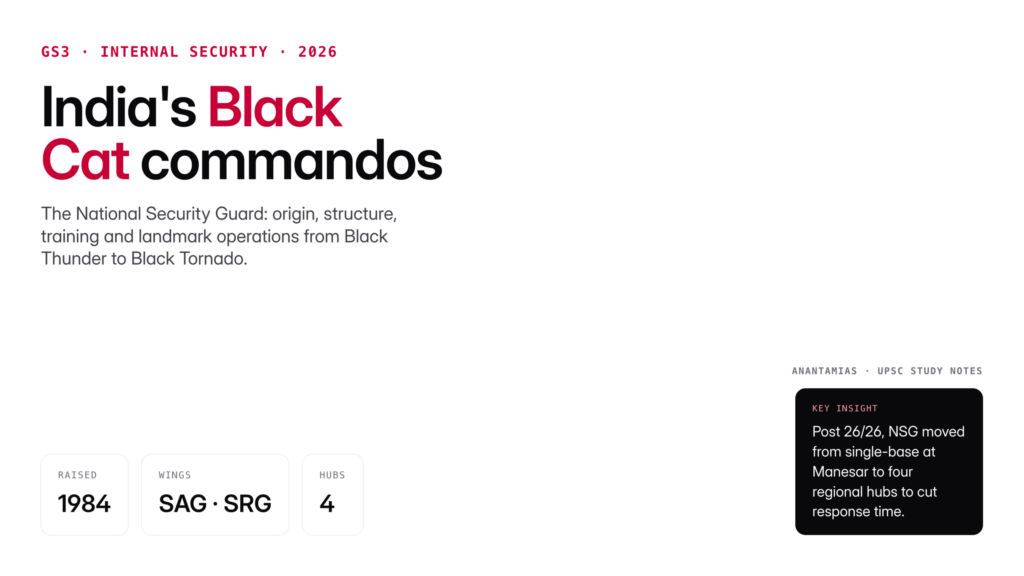
The National Security Guard, popularly known by its iconic black combat dress as the Black Cat commandos, is India’s apex counter-terrorism and hostage rescue force. Raised in the aftermath of Operation Blue Star, the NSG sits at the sharpest end of the Indian security architecture, tasked with missions that conventional police or military units are neither structured nor trained to execute. For UPSC aspirants preparing General Studies Paper 3 under internal security, a precise understanding of the NSG is indispensable.
This guide walks through the history of the NSG, its two-tier structure of the Special Action Group and Special Ranger Group, the grueling selection and training cycle, landmark operations from the Akshardham attack to Mumbai 26/26, and the persistent debates around its deployment pattern and VIP security duties. The aim is to help candidates build a ready-to-recall mental map for Prelims multiple-choice questions and a nuanced argument for Mains answers on counter-terrorism capacity.
Quick Facts at a Glance
| Attribute | Detail |
|---|---|
| Full name | National Security Guard (NSG) |
| Raised | 16 October 1984 |
| Statutory basis | National Security Guard Act, 1986 |
| Parent ministry | Ministry of Home Affairs |
| Motto | Sarvatra Sarvottam Suraksha (Omnipresent, Omnipotent Security) |
| Headquarters | Manesar, Haryana |
| Current strength | Approximately 10,000 personnel |
| Chief | Director General (DG), rank of DGP |
| Key units | Special Action Group (SAG), Special Ranger Group (SRG) |
| Recruitment | On deputation from Army, CAPFs and state police |
| Famous nickname | Black Cat commandos |
Background and Historical Context
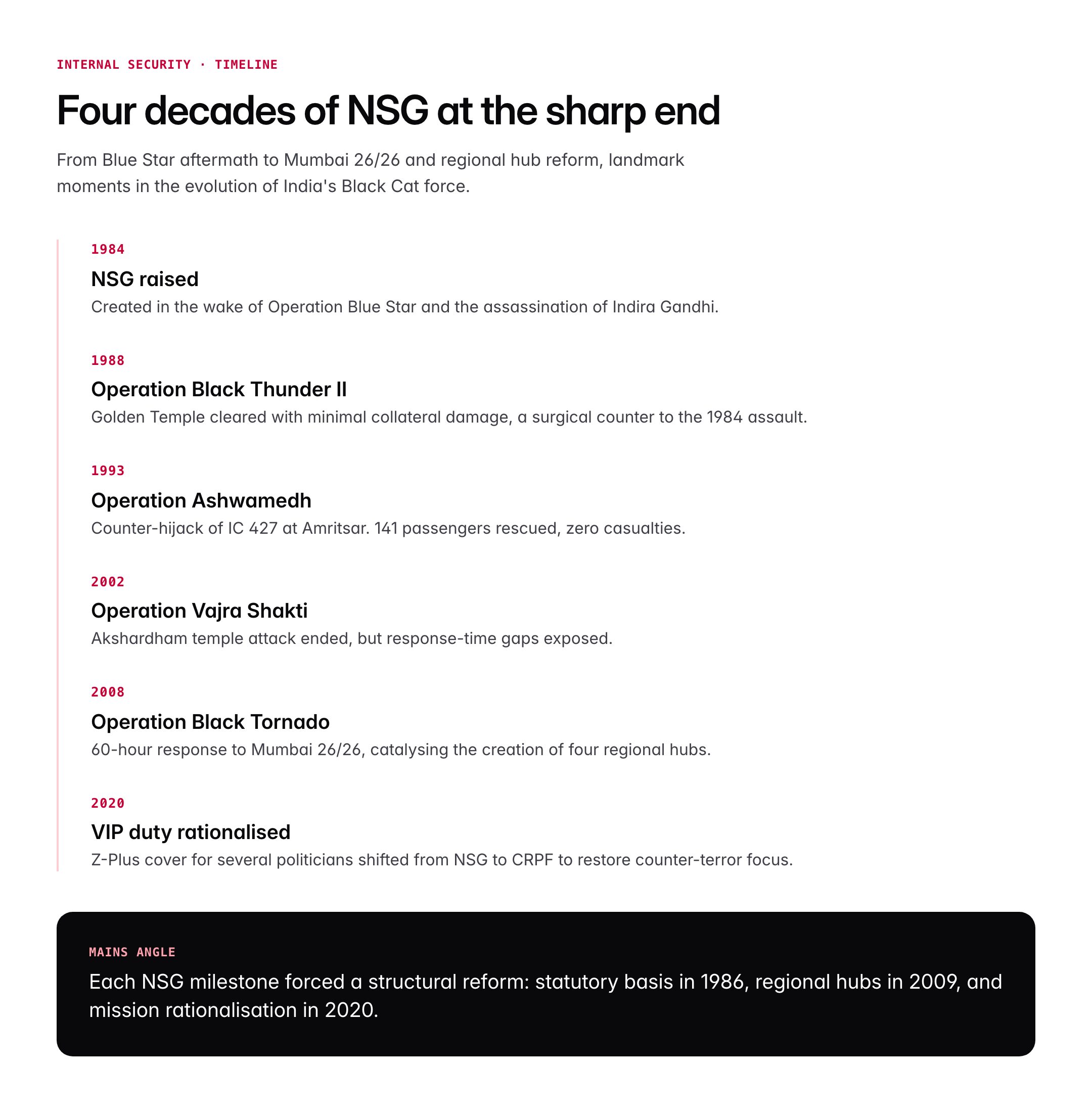
The NSG was created in direct response to two traumatic security failures. Operation Blue Star in June 1984, involving the storming of the Golden Temple complex in Amritsar, demonstrated that the Indian Army was not the ideal instrument for precision counter-terror missions inside civilian spaces. The assassination of Prime Minister Indira Gandhi later that year deepened the sense that India needed a dedicated, specially trained federal contingency force for low-intensity, high-stakes operations.
The Cabinet Committee on Political Affairs approved the creation of the NSG in 1984, and the force was formally raised on 16 October 1984. Parliament provided its statutory footing with the National Security Guard Act, 1986, which placed it under the Ministry of Home Affairs and gave the DG operational authority. The organisational template was drawn partly from Germany’s GSG 9 and the British SAS, adapted to Indian conditions of urban density, religious sensitivity and federal politics.
During the late 1980s and 1990s, the NSG was battle-hardened in Punjab during the post-Blue Star insurgency, in hijack situations and in repeated temple hostage scenarios. Over time the force also took on VIP close protection for individuals under the highest threat categories, though this role has attracted criticism. Operation Vajra Shakti during the 2008 Mumbai terror attacks was a turning point, leading to decentralisation through four regional hubs at Mumbai, Chennai, Hyderabad and Kolkata, so that no future Indian city has to wait several hours for commandos to arrive from Manesar.
Key Features
Two-Tier Structure
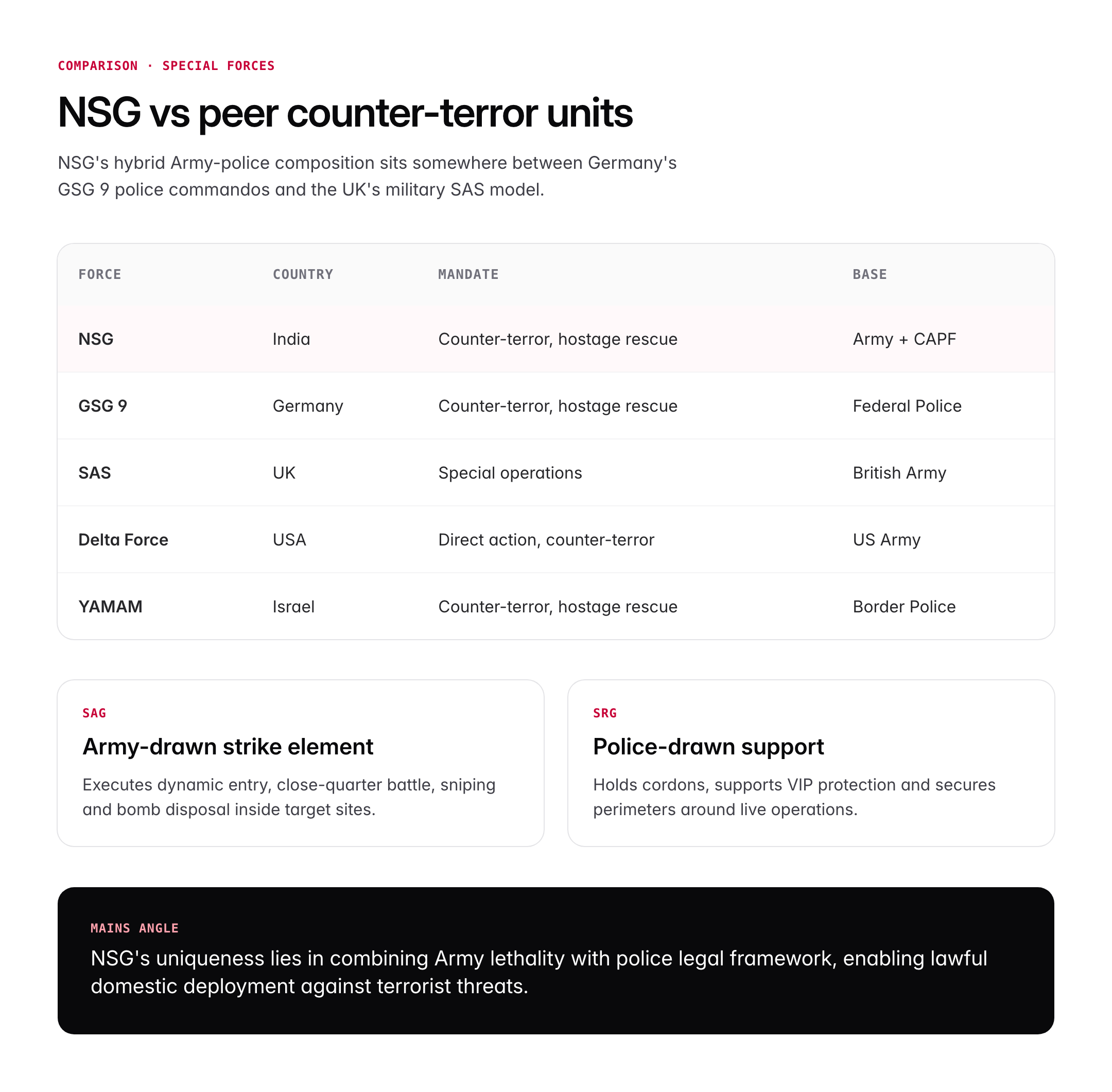
The NSG is built around two specialised wings. The Special Action Group (SAG) is drawn entirely from the Indian Army and forms the main strike element, handling counter-terrorism, counter-hijack and hostage rescue. The Special Ranger Group (SRG) is drawn from the Central Armed Police Forces and state police, and provides perimeter security, VIP protection and tactical support to SAG.
Command and Control
The NSG is headed by a Director General of the rank of Director General of Police, usually drawn from the Indian Police Service. The DG reports directly to the Union Home Secretary. Day-to-day tactical command during operations is held by the on-scene incident commander, who coordinates with state police and local administration under the broad framework of the National Crisis Management Committee.
Regional Hubs
After 26/26, four regional hubs were set up at Mumbai, Chennai, Hyderabad and Kolkata, each with a quick-response detachment capable of reaching most metros in under an hour. The headquarters at Manesar retains the core strategic reserve and the training centre.
Equipment and Tactics
NSG personnel are equipped with Heckler and Koch MP5 sub-machine guns, Glock 17 pistols, Tavor TAR-21 assault rifles, Barrett M82A1 sniper rifles, night-vision kits and ballistic protection. Doctrine emphasises close-quarter battle, dynamic entry, sniping and high-risk bomb disposal, with dedicated K9 and EOD squads for explosive threats.
VIP Protection
Until a 2020 policy review, NSG also provided Z-Plus Special Protection Group style cover to several politicians. The government has since largely shifted this task to the Central Reserve Police Force to let NSG focus on counter-terrorism, though a residual VIP role continues.
Significance for UPSC and General Knowledge
- NSG is a frequently tested entity in Prelims under Internal Security and organisations under the MHA.
- It illustrates the concept of a specialised federal contingency force, distinct from CAPFs like CRPF or BSF.
- Understanding NSG helps candidates analyse India’s counter-terrorism doctrine post-26/26.
- The SAG-SRG model is a case study in inter-service integration between Army and police.
- Deployment debates around VIP duty raise governance issues around mission drift.
- Operations like Black Thunder and Vajra Shakti feed into Mains answers on hostage rescue capability.
Reign and Administration: Famous Operations
Operation Black Thunder I and II (1986, 1988)
Both operations were conducted to clear militants from the Golden Temple complex. Operation Black Thunder II, led by then DG KPS Gill with NSG at the sharp end, was widely considered a textbook counter-insurgency operation, with minimal damage to the temple and few civilian casualties, in deliberate contrast to Operation Blue Star.
Operation Ashwamedh (1993)
NSG commandos stormed a hijacked Indian Airlines flight IC 427 at Amritsar airport. All 141 passengers were rescued without a single casualty, and the lone hijacker was neutralised within seconds of entry. It remains a showcase of NSG’s counter-hijack drill.
Operation Vajra Shakti (2002)
After terrorists attacked the Akshardham temple complex in Gandhinagar, Gujarat, NSG teams engaged them in a prolonged gunfight, rescued trapped devotees and ended the siege, though not without casualties. The operation exposed response-time gaps that would recur six years later.
Operation Black Tornado (2008)
The most visible NSG operation was the response to the 26 November 2008 Mumbai attacks by Lashkar-e-Taiba. NSG’s Operation Black Tornado at the Taj Mahal Palace, Oberoi Trident and Nariman House ran for nearly 60 hours. The operation ended the attack but highlighted the cost of Manesar-only basing, prompting the creation of regional hubs.
Training Deployments
NSG has also trained the SPG, state SWAT teams and has participated in bilateral counter-terrorism exercises with forces like the US Special Forces, French GIGN and Israeli YAMAM.

Comparative Perspective
| Force | Country | Primary Role | Recruitment Base |
|---|---|---|---|
| NSG | India | Counter-terror, hostage rescue | Army plus CAPF plus police |
| GSG 9 | Germany | Counter-terror, hostage rescue | Federal Police |
| SAS | UK | Special operations, counter-terror | British Army |
| Delta Force | USA | Direct action, counter-terror | US Army |
| YAMAM | Israel | Counter-terror, hostage rescue | Border Police |
NSG closely tracks the GSG 9 model of a civilian-command police commando force for domestic use, while also borrowing the SAS ethos of endurance training. Unlike Delta Force, NSG is explicitly not meant for cross-border offensive operations. This hybrid Army-police composition is unusual globally and gives NSG both military hard skills and police legal frameworks for domestic deployment.
Challenges and Criticisms
Three criticisms dominate expert debate. First, the VIP protection drift, where scarce commandos were tied down guarding politicians rather than training for terror scenarios, diluting the force’s strategic purpose. The 2020 rationalisation eased but did not fully resolve this.
Second, the deployment lag, painfully visible during 26/26 when NSG had to be flown from Manesar, arriving in Mumbai nearly ten hours after the attacks began. The four regional hubs partly address this, but Tier-2 cities remain vulnerable to delay.
Third, questions around accountability and oversight. Because NSG operates under the Home Ministry with limited parliamentary visibility, Standing Committee reports have repeatedly flagged the need for better manpower auditing, faster equipment procurement and more transparent inter-agency drills with state police.
Prelims Pointers
- NSG was raised on 16 October 1984 under the Ministry of Home Affairs.
- National Security Guard Act, 1986 provides its statutory basis.
- Headquarters is at Manesar, Haryana.
- It has two wings: Special Action Group (Army) and Special Ranger Group (CAPF and police).
- Popular nickname: Black Cat commandos.
- Motto: Sarvatra Sarvottam Suraksha.
- DG is of the rank of Director General of Police.
- Regional hubs exist at Mumbai, Chennai, Hyderabad and Kolkata.
- Operation Black Thunder II in 1988 cleared the Golden Temple.
- Operation Vajra Shakti was the Akshardham response in 2002.
- Operation Black Tornado responded to the 26/26 Mumbai attacks.
- NSG is modelled partly on Germany’s GSG 9.
Mains Practice Questions
Q1. Examine the role of the National Security Guard in India’s counter-terrorism architecture since 1984. What reforms are needed to enhance its effectiveness?
- Trace origin from Operation Blue Star and 1984 context, statutory footing through the 1986 Act.
- Analyse structure (SAG and SRG), key operations (Black Thunder, Vajra Shakti, Black Tornado) and post-26/26 reforms like regional hubs.
- Suggest reforms: end mission drift on VIP duty, faster procurement, joint drills with state SWAT, expansion to more Tier-2 cities.
Q2. “A specialised counter-terror force can only be as effective as its integration with local police.” Discuss with reference to the NSG.
- Argue that NSG’s strike capability depends on accurate intelligence and cordon support from state police.
- Cite 26/26 coordination gaps and post-2008 institutional responses like NIA, multi-agency centres and regional NSG hubs.
- Recommend regular joint exercises, data-sharing protocols and clearer chain-of-command doctrine under the MHA.
Conclusion
The NSG occupies a unique space in India’s security matrix: a commando force that is legally civilian, operationally military, and tactically the option of last resort when terror strikes high-value targets. Its operations from Black Thunder to Black Tornado have built a brand of reliability that few federal agencies match.
For UPSC aspirants, the NSG is more than a trivia set. It is a lens into how India organises internal security, balances federalism with central response capability, and learns from each operational shortfall. Mastering its structure, famous operations and reform debates will serve both Prelims precision and Mains depth.
Frequently Asked Questions
What is an NSG commando?
An NSG commando is a member of India’s National Security Guard, a federal counter-terrorism and hostage rescue force raised in 1984 under the Ministry of Home Affairs. Popularly called Black Cat commandos due to their black combat uniform, they are drawn from the Indian Army, Central Armed Police Forces and state police, and specialise in high-risk missions like counter-hijack and VIP protection.
Why is the NSG important for UPSC preparation?
The NSG is a core topic in GS Paper 3 under internal security. It illustrates India’s counter-terrorism architecture, the role of specialised federal forces and post-26/26 reforms like regional hubs. Questions may test its statutory basis, structure, famous operations and deployment issues, making it relevant for both Prelims factual questions and Mains analytical answers.
How is the NSG related to the SPG and CRPF?
NSG, SPG and CRPF are all federal armed forces under the MHA but with distinct mandates. SPG protects only the Prime Minister and former PMs. CRPF is a general-purpose paramilitary force for internal law and order. NSG is a specialised commando force for counter-terrorism, hostage rescue and bomb disposal, deployed only in extreme situations rather than routine policing.
What is the Black Cat commando unit?
Black Cat is the popular nickname for NSG commandos, derived from their black combat dungarees, balaclavas and assault gear. The moniker became iconic during the Mumbai 26/26 response. Within the NSG, the Special Action Group, which executes the actual assault and rescue in hostage scenarios, is most associated with the Black Cat image.
How does one become an NSG commando?
There is no direct recruitment into the NSG. Candidates must first join the Indian Army or a Central Armed Police Force or state police, serve a minimum tenure, and then apply for deputation. Selection involves a grueling multi-phase test of physical endurance, marksmanship, psychological screening and close-quarter battle ability, with reported dropout rates exceeding 50 percent.
What weapons and equipment do NSG commandos use?
NSG commandos use Heckler and Koch MP5 sub-machine guns, Glock 17 pistols, Tavor TAR-21 rifles, Barrett sniper systems and modern ballistic protection. They also field night-vision devices, breaching tools, K9 units and explosive detection and disposal gear. Equipment is regularly upgraded in line with counter-terrorism doctrine and import clearances from the Ministry of Home Affairs.
What were NSG’s most famous operations?
Key NSG operations include Operation Black Thunder I and II at the Golden Temple in 1986 and 1988, Operation Ashwamedh counter-hijack at Amritsar in 1993, Operation Vajra Shakti at Akshardham temple in 2002 and Operation Black Tornado during the Mumbai 26/26 attacks in 2008. Each operation shaped NSG doctrine and led to procedural or structural reforms.
Why did the government reduce NSG’s VIP protection duties?
Standing Committee reports and independent experts flagged that deploying NSG for routine VIP protection diluted its counter-terrorism readiness. In 2020, the Home Ministry shifted Z-Plus protection for several politicians from NSG to the CRPF, freeing commandos for training and anti-terror tasks. This reform aimed to restore NSG’s original mandate as a last-resort strike force.
Tell Google you want more of this.
Add Anantam IAS as a preferred sourceOne tap, and this site shows up more often in your own Top Stories, AI Overviews and AI Mode. Remove it any time.