Introduction
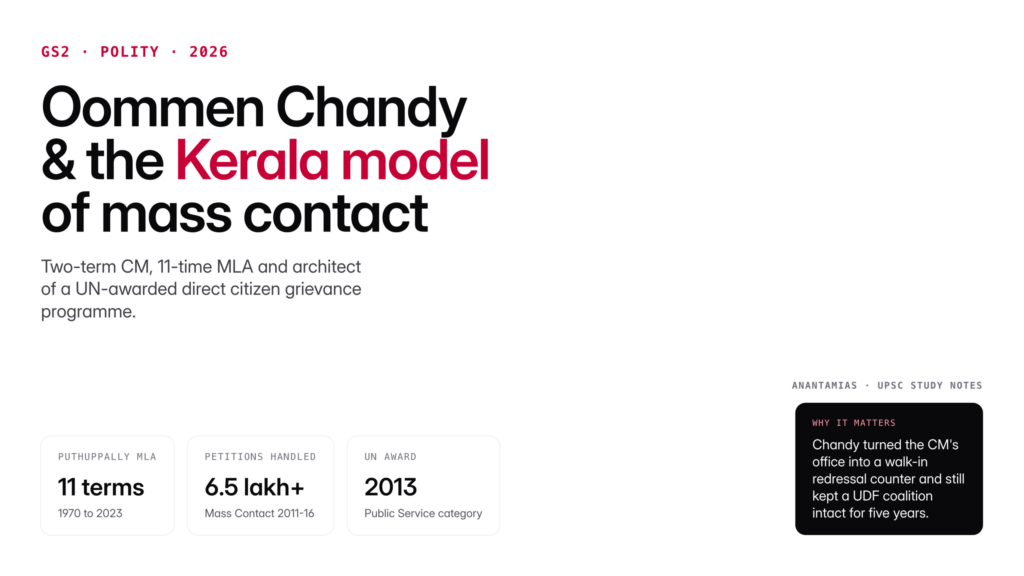
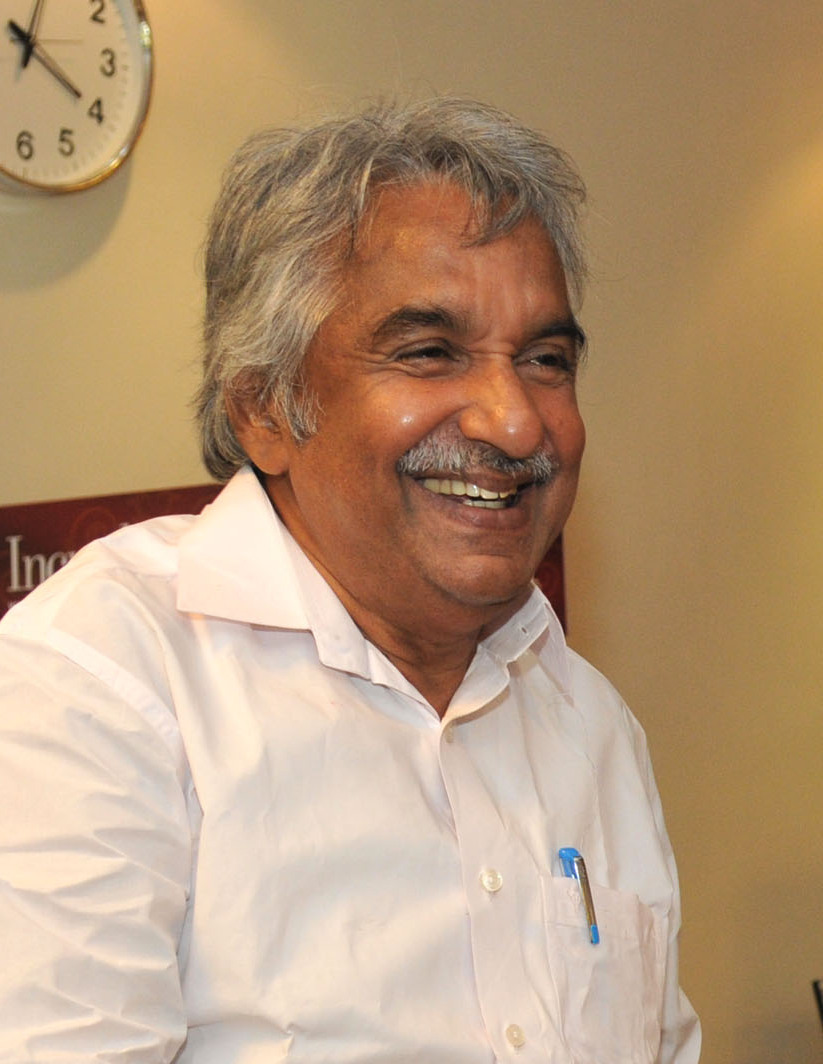
Oommen Chandy remains one of the most distinctive public figures in post-liberalisation Kerala politics. A leader who represented the Puthuppally assembly constituency for more than five decades without a single defeat, he served twice as Kerala Chief Minister and twice as Leader of the Opposition, and he designed administrative experiments that were copied well beyond his state. For the UPSC aspirant studying Indian Polity (GS2) and post-Independence history, Chandy offers a case study in coalition leadership, welfare delivery and accessible governance.
His career also maps the evolution of the Indian National Congress in Kerala and the architecture of the Congress-led United Democratic Front (UDF). From a student-union organiser in 1960s Kottayam to a statesman praised by the United Nations for his Mass Contact Programme, Chandy’s trajectory raises substantive questions about political accountability, subsidy design and the federal character of Indian democracy.
Quick Facts at a Glance
| Attribute | Detail |
|---|---|
| Born | 31 October 1943, Kumarakom, Kerala |
| Died | 18 July 2023, Bengaluru |
| Party | Indian National Congress |
| Constituency | Puthuppally (Kottayam district) |
| MLA tenure | 1970 to 2023 (11 consecutive terms) |
| Chief Minister | 2004 to 2006; 2011 to 2016 |
| Notable award | United Nations Public Service Award (2013) |
| Signature initiative | Mass Contact Programme |
| Alliance | United Democratic Front (UDF) |
Background and Historical Context
Oommen Chandy was born on 31 October 1943 in Kumarakom, Kottayam district, into a Syrian Christian family associated with the Puthuppally church. Kerala in the 1950s was undergoing its formative political churn after the 1957 election of the world’s first democratically elected Communist government and the subsequent “liberation struggle” of 1959. Chandy came of age in that ferment, drawn into student activism through the Kerala Students Union (KSU), the student wing of the Congress.
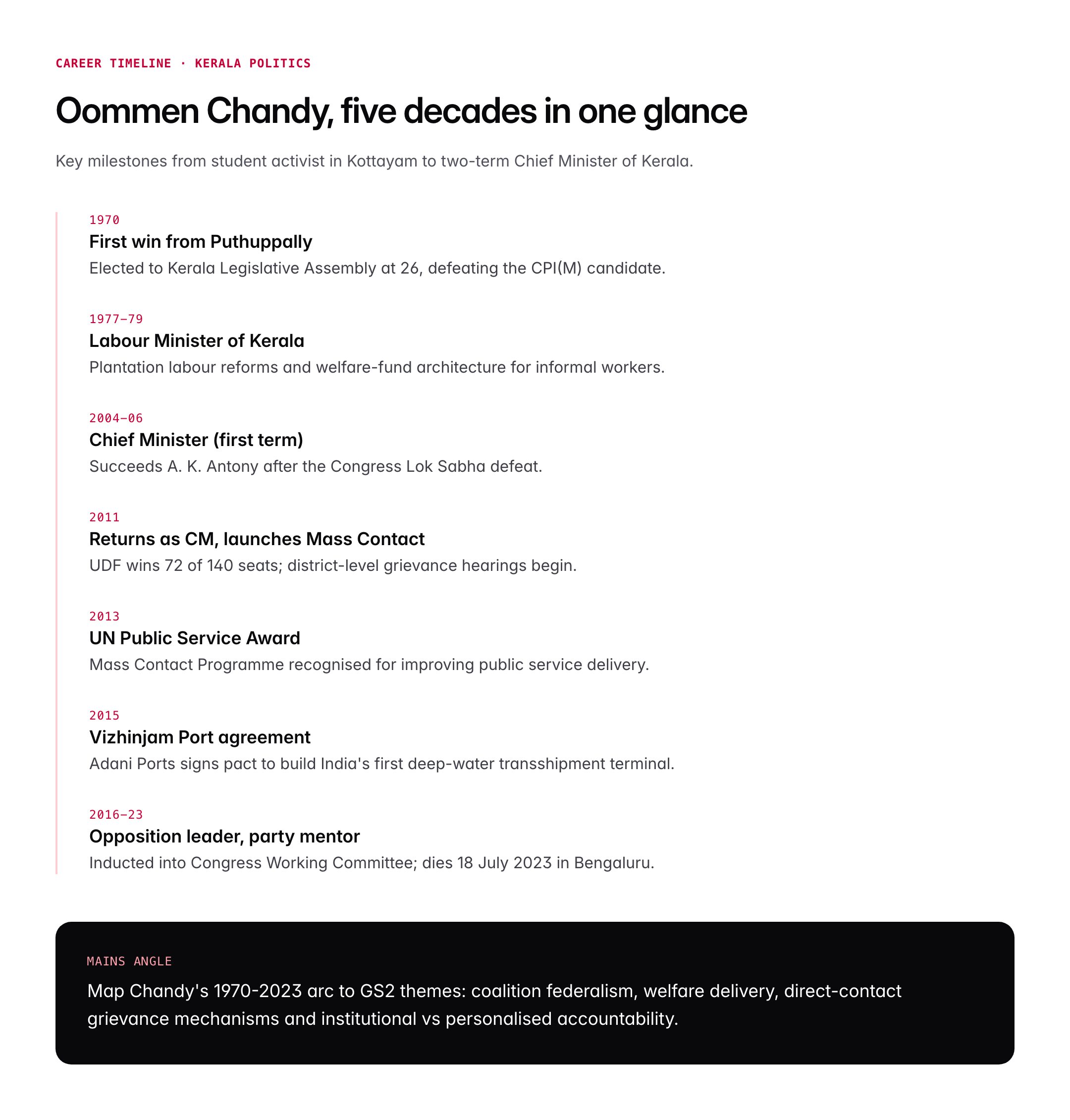
He served as KSU president and then as Youth Congress president in Kerala, building the cadre networks that would define his politics. In 1970, aged 26, he won the Puthuppally assembly seat against the Communist Party of India (Marxist) candidate and began a record uninterrupted tenure that would span fifty-three years and eleven elections.
The 1970s and 1980s shaped his administrative worldview. As Kerala Labour Minister (1977 to 1979) and later Finance Minister under chief ministers K. Karunakaran and A. K. Antony, Chandy worked on plantation labour reform, stamp duty rationalisation and early welfare-fund architecture for informal workers. He was widely credited as a key strategist behind the UDF’s electoral revivals in 1991 and 2001, stitching together the Congress with the Muslim League, Kerala Congress factions and smaller allies.
When A. K. Antony resigned the chief ministership in August 2004 over the Congress rout in the Lok Sabha polls, Chandy took over for the first time. He then led the UDF to a narrow 72-68 victory in 2011, becoming Chief Minister for a full term.
Key Features of the Chandy Model
Mass Contact Programme
The Mass Contact Programme (MCP), launched in 2011, became Chandy’s defining administrative innovation. District-level public hearings were held where citizens submitted petitions directly to the Chief Minister, who cleared decisions on the spot with assembled secretaries and department heads. Over his 2011 to 2016 term, the programme processed more than 6.5 lakh petitions with a reported disposal rate above 90 percent. The United Nations Public Service Award (2013) recognised the MCP under the category “Improving the Delivery of Public Services”.
Welfare Expansion
Chandy’s governments scaled Kerala’s already-dense welfare architecture. The Karunya Benevolent Fund (2012) financed treatment for patients with cancer, kidney, heart and brain disease through a state-run lottery. The Comprehensive Health Insurance Scheme extended Rashtriya Swasthya Bima Yojana coverage to above-poverty-line families. Pensions for agricultural labourers, fishermen, toddy workers and unorganised workers were revised upward.
Infrastructure Push
Signature projects included the Kochi Metro (foundation 2012, commissioning 2017), the Vizhinjam International Seaport agreement with Adani Ports in 2015, the Kannur International Airport and Kochi Smart City with TECOM of Dubai. The Kasaragod Development Package addressed endosulfan-affected districts.
Political Management
Chandy was the quintessential coalition technician. He maintained the UDF through perpetual negotiation with the Indian Union Muslim League, Kerala Congress (M), Kerala Congress (Jacob), Revolutionary Socialist Party of Kerala and the Communist Marxist Party. His willingness to share chief-ministerial travel with allies, to accommodate cabinet reshuffles and to personally phone district committee workers made him unusually durable.
Significance for UPSC and General Knowledge
- Demonstrates how coalition federalism works in a polarised two-front state like Kerala, relevant to GS2 syllabus on coalition governments.
- The Mass Contact Programme is a citable example under “mechanisms for citizen-charter and grievance redressal” in GS2 governance.
- UN Public Service Award recognition connects Indian sub-national innovation to SDG 16 on accountable institutions.
- Illustrates the Kerala model’s continuous welfare expansion through both Left and Congress-led governments, useful for GS1 society and GS3 economy.
- Case study in handling scandal-driven political pressure while maintaining legislative majority (Solar scam, bar bribery allegations).
- Shows how social capital built over five decades of constituency work translates into electoral resilience.
Detailed Analysis: Political Contributions and Challenges
Chandy’s 2011 to 2016 term is the heart of his contribution. Inheriting a razor-thin 72-seat majority in a 140-seat assembly, he governed without losing a single confidence vote or by-election despite the 2013 Solar scam, which alleged that a woman accused of financial fraud had accessed the chief minister’s office. A judicial commission (Sivarajan Commission) submitted its report in 2017 after his term, and the Kerala government under Pinarayi Vijayan referred allegations to the Central Bureau of Investigation. Chandy consistently denied wrongdoing and no court convicted him during his lifetime.
On the economic front, the Chandy government pursued the controversial liquor policy of 2014, which revoked licences of all bars below the five-star category. The policy, intended to move Kerala toward prohibition in a decade, generated intense criticism from the hospitality industry and a bribery allegation against the finance minister K. M. Mani. The State Bank of India-supported Emerging Kerala investor summit in 2012 attempted to reposition the state as a knowledge economy destination.
Welfare data from the 2011 to 2016 period showed measurable results. The Aardram health mission precursor investments, the state-funded palliative-care network expansion and the 24-hour Revenue District grievance cells were inherited and renamed by successor governments. Literacy-driven initiatives like the She-Pad free sanitary-napkin scheme for schoolgirls predated the national SBM menstrual hygiene focus.
Chandy’s political contribution to the Congress nationally was also notable. He was inducted into the Congress Working Committee multiple times and served as general secretary in charge of Andhra Pradesh after the state bifurcation, a politically sensitive assignment. His style of listening-first, consensus-led leadership contrasted with the high-command reflexes of the national party.
Comparative Perspective
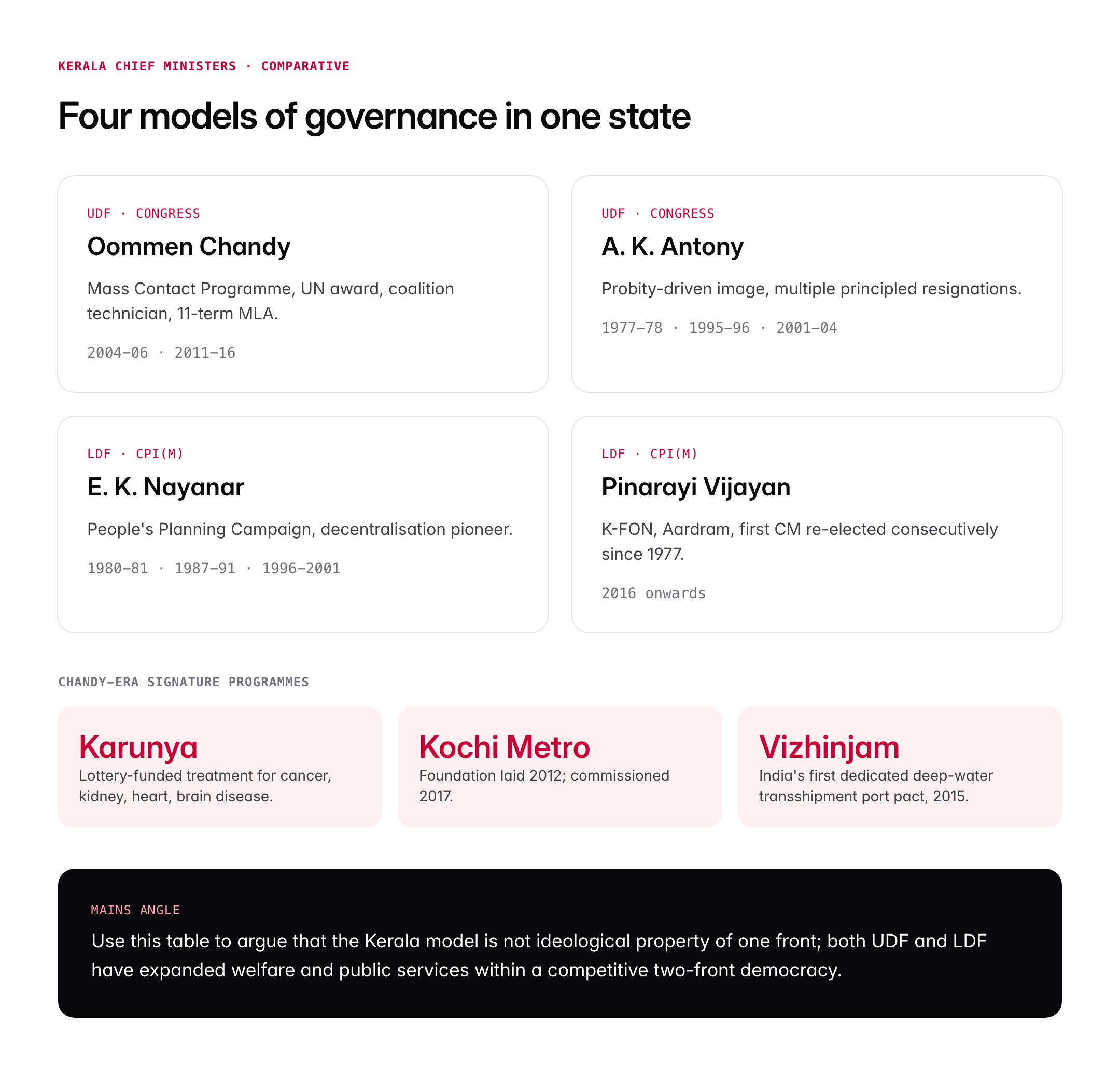
| Chief Minister | Party | Tenure years | Signature governance model | Notable recognition |
|---|---|---|---|---|
| Oommen Chandy | INC (UDF) | 2004-06; 2011-16 | Mass Contact Programme | UN Public Service Award 2013 |
| E. K. Nayanar | CPI(M) (LDF) | 1980-81; 1987-91; 1996-2001 | People’s Planning Campaign | Decentralisation pioneer |
| A. K. Antony | INC (UDF) | 1977-78; 1995-96; 2001-04 | Probity-driven administration | Clean image, multiple resignations |
| Pinarayi Vijayan | CPI(M) (LDF) | 2016 to present | Kerala Development Programme, K-FON | First CM re-elected consecutively in Kerala since 1977 |
Against national contemporaries, Chandy’s MCP sits alongside Andhra Pradesh’s Janmabhoomi, Madhya Pradesh’s Jan Shikayat Nivaran and Odisha’s Mo Sarkar as state-level direct-grievance platforms. Where MCP differed was in the physical presence of the Chief Minister at every district sitting, not merely a digital or call-centre interface. This made it costly in ministerial time but high in legitimacy dividend.
Controversies and Debates
The Solar scam (2013) dominated Chandy’s second term. Saritha S. Nair, accused of duping investors under the pretext of solar-panel contracts, alleged improper access to the Chief Minister’s office. Judicial inquiries continued after Chandy left office. The CBI in 2021 declined to register an FIR citing insufficient evidence for predicate offences, and no conviction was recorded.
The bar bribery allegation against Finance Minister K. M. Mani led to his resignation in 2015. Critics argued the Chandy cabinet’s 2014 liquor policy, while morally signalled, created rent-seeking opportunities during the bar-relicensing window. The Left Front used both controversies to drive its 2016 electoral campaign.
Policy critics also argued that Chandy’s mass-contact approach centralised grievance redressal in the Chief Minister’s person rather than strengthening institutional channels like the State Information Commission, the Lok Ayukta and local self-governments. Supporters countered that in a state with high citizen expectations and an adversarial Opposition, the MCP filled a real gap that bureaucracies did not.
Prelims Pointers
- Oommen Chandy represented Puthuppally constituency continuously from 1970 to 2023 (11 terms).
- He served as Kerala Chief Minister in 2004 to 2006 and 2011 to 2016.
- The Mass Contact Programme was launched in 2011 and received the UN Public Service Award in 2013.
- Karunya Benevolent Fund (2012) was funded by a dedicated state lottery for treatment of major illnesses.
- Kochi Metro foundation stone was laid during his second tenure; it commissioned in 2017.
- Vizhinjam International Seaport agreement with Adani Ports was signed in August 2015.
- Chandy received the Padma Shri-equivalent recognition from multiple civic bodies but no national Padma award during his lifetime.
- He was Leader of the Opposition in Kerala Legislative Assembly from 2006 to 2011 and again briefly after 2016.
- The UDF under Chandy won 72 of 140 seats in 2011, a one-seat working majority.
- He died on 18 July 2023 in Bengaluru after a prolonged illness.
- The Kerala government in 2023 renamed the Puthuppally-Kottayam road as Oommen Chandy Road.
- His son Chandy Oommen won the Puthuppally bypoll in September 2023.
Mains Practice Questions
- Discuss the strengths and limitations of direct citizen-grievance mechanisms such as Kerala’s Mass Contact Programme as tools of democratic accountability.
- Define direct-contact governance and cite the MCP (2011-2016) with its 6.5 lakh petition volume.
- Strengths: visible executive accountability, compressed response times, legitimacy for coalition governments.
- Limitations: personalisation over institutionalisation, scalability beyond chief-ministerial bandwidth, risk of by-passing local self-government.
- “Coalition governance in Indian states tests both political skill and constitutional morality.” Analyse with reference to Kerala’s United Democratic Front experience.
- Structural features of UDF coalition: INC-led with IUML, Kerala Congress factions, smaller allies.
- Chandy’s techniques: cabinet accommodation, informal conclaves, constituency adjustments.
- Tensions: portfolio bargaining, ally scandals (bar bribery), policy consistency challenges.
Conclusion
Oommen Chandy’s political life maps both the possibilities and the fragilities of state-level democratic leadership in India. He made the Chief Minister’s office physically accessible to citizens in ways that formal institutions had not, and he demonstrated that coalition governance could deliver welfare expansion even amid scandal-driven political pressure. His defeat of every Communist challenger in Puthuppally for over half a century rests less on ideology than on a distinctive practice of presence and patience.
For UPSC preparation, Chandy is not a single-line entry but a full case study. His MCP informs GS2 governance, his welfare schemes inform GS1 society and GS2 social-justice, and his coalition management informs federalism and party-system analysis. Studying his legacy thoughtfully equips aspirants to engage questions about accountability, citizen participation and sub-national innovation with concrete Indian evidence rather than abstract models.
Frequently Asked Questions
Who was Oommen Chandy?
Oommen Chandy was an Indian politician from Kerala who served twice as Chief Minister, from 2004 to 2006 and 2011 to 2016, and as the MLA of Puthuppally for eleven consecutive terms between 1970 and 2023. He belonged to the Indian National Congress and led the state’s United Democratic Front coalition.
Why is Oommen Chandy important for UPSC aspirants?
Chandy offers a ready case study for GS2 governance and GS1 post-Independence history. The Mass Contact Programme, his coalition management techniques and welfare schemes like the Karunya Benevolent Fund illustrate citizen-grievance redressal, coalition federalism and sub-national welfare innovation in concrete Indian terms useful for both Prelims factual questions and Mains analytical answers.
How is Oommen Chandy related to the Mass Contact Programme?
Chandy designed and personally led the Mass Contact Programme in his second term as Kerala Chief Minister from 2011 onwards. District-level public hearings processed over 6.5 lakh citizen petitions with on-the-spot decisions, and the United Nations recognised the programme with the UN Public Service Award in 2013 under the public service delivery category.
How many times did Oommen Chandy win the Puthuppally constituency?
Chandy won the Puthuppally assembly constituency in Kottayam district eleven consecutive times from 1970 to 2021, never losing an election there across more than five decades. His son Chandy Oommen subsequently won the Puthuppally by-election in September 2023 after the elder Chandy’s death.
What was the Solar scam during Chandy’s tenure?
The Solar scam (2013) involved allegations that accused fraudster Saritha S. Nair had improperly accessed the Chief Minister’s office in Kerala under the pretext of solar-panel contracts. Judicial inquiries continued after Chandy’s tenure; the CBI in 2021 declined to register an FIR, and no court convicted him during his lifetime.
What international recognition did Oommen Chandy receive?
His Mass Contact Programme won the United Nations Public Service Award in 2013 under the category Improving the Delivery of Public Services. The award acknowledged the programme’s innovation in making the state’s highest executive directly accessible to citizens and processing a high volume of petitions with measurable disposal rates.
What were the major infrastructure projects launched during Chandy’s second term?
Key projects during 2011 to 2016 included the Kochi Metro (foundation stone in 2012, commissioned 2017), the Vizhinjam International Seaport agreement signed in 2015, Kannur International Airport development and the Kochi Smart City joint venture with TECOM of Dubai. The Kasaragod Development Package addressed endosulfan-affected areas.
How did Oommen Chandy’s political style differ from other Kerala Chief Ministers?
Chandy practised listening-first, consensus-driven coalition leadership, maintaining the UDF alliance through perpetual negotiation with the Muslim League, Kerala Congress factions and smaller allies. Compared to the more ideologically assertive style of CPI(M) chief ministers or the probity-driven image of A. K. Antony, Chandy’s distinctive trait was constant physical presence among citizens and party workers.
Tell Google you want more of this.
Add Anantam IAS as a preferred sourceOne tap, and this site shows up more often in your own Top Stories, AI Overviews and AI Mode. Remove it any time.