Introduction
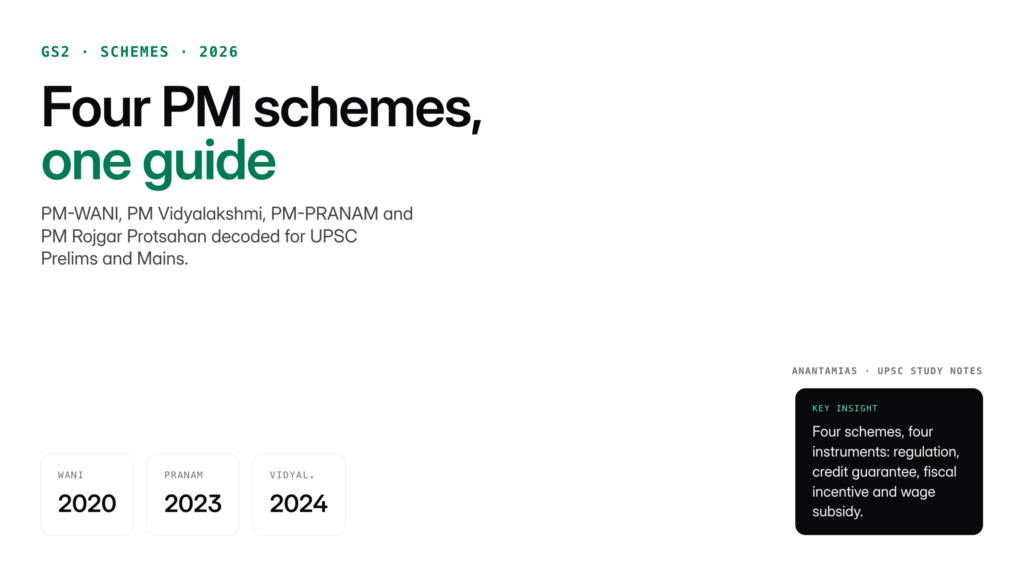
“PM-WANI, PM Vidyalakshmi, PM-PRANAM, PM Rojgar Protsahan” — four acronyms that routinely turn up in UPSC Prelims and in Mains GS2 questions on governance schemes. Aspirants often conflate them because the PM prefix creates a lookalike cluster. Each scheme, however, sits in a different ministry, addresses a different problem, and has a distinct implementation architecture.
This guide consolidates the essentials of these four flagship schemes in one place, along with a quick list of India’s Prime Ministers for context. The focus is on what Prelims examiners ask (launch year, nodal ministry, outlay, beneficiary), what Mains examiners reward (policy rationale, implementation challenges, comparative federalism), and how to retain the acronyms without mixing them up.
Quick Facts at a Glance
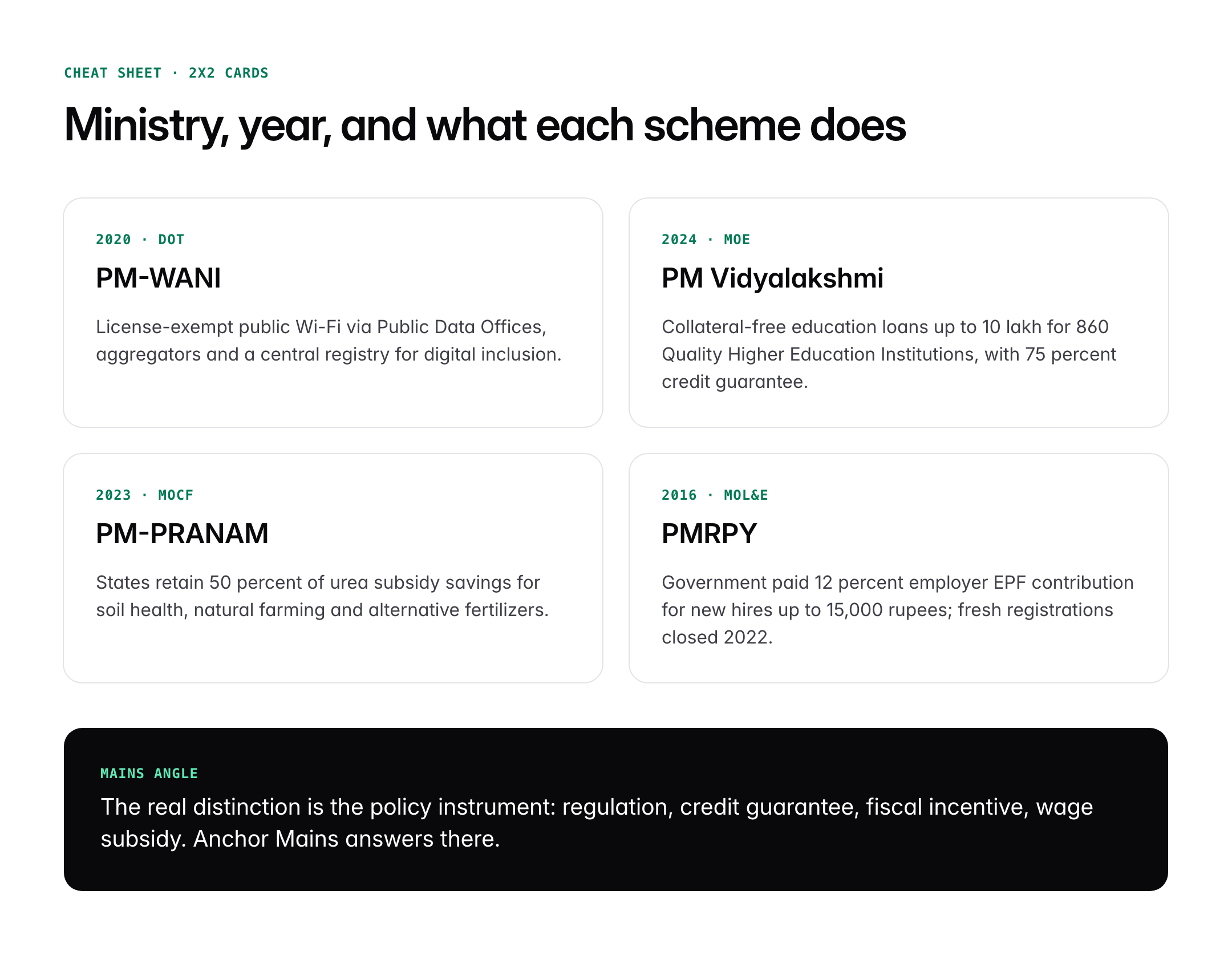
| Scheme | Full Form | Launch | Ministry |
|---|---|---|---|
| PM-WANI | Prime Minister Wi-Fi Access Network Interface | December 2020 | Department of Telecommunications |
| PM Vidyalakshmi | PM Vidyalakshmi Education Loan Scheme | November 2024 | Ministry of Education, DFS |
| PM-PRANAM | PM Programme for Restoration, Awareness, Nourishment and Amelioration of Mother Earth | June 2023 | Ministry of Chemicals and Fertilizers |
| PM Rojgar Protsahan Yojana | PMRPY | April 2016 | Ministry of Labour and Employment |
Background and Historical Context
Each of these schemes responds to a distinct pressure point. PM-WANI emerged from the Telecom Regulatory Authority of India’s 2017 recommendation to create public Wi-Fi hotspots as a digital inclusion layer beyond mobile data. With 4G and 5G penetration uneven in rural India, unlicensed, low-cost Wi-Fi access through small entrepreneurs was seen as the cheapest path to last-mile internet.
PM Vidyalakshmi grew out of the 2015 Vidya Lakshmi portal, which had become a one-stop platform for education loans but offered no additional financial cover. With the National Education Policy 2020 targeting gross enrolment of 50 percent in higher education by 2035, a more generous loan plus interest subvention scheme was overdue. The Union Cabinet approved the revamped PM Vidyalakshmi in November 2024.
PM-PRANAM flows from concerns about soil degradation caused by excessive urea and DAP use, coupled with a fertilizer subsidy bill that crossed 2.5 lakh crore rupees in 2022-23. The scheme incentivises states to cut chemical fertilizer use by letting them retain half of the subsidy savings for agri-ecological interventions. PMRPY, launched in 2016, tackles informal employment by subsidising employer EPF contributions for new low-wage hires.
Key Features and Provisions
PM-WANI (2020)
PM-WANI creates a framework of Public Data Offices (PDOs), Public Data Office Aggregators (PDOAs), app providers and a central registry. Any small shop can function as a PDO, offering public Wi-Fi without a telecom licence. The Department of Telecommunications runs the Central Registry through C-DoT. As of recent government statements, over 2.5 lakh PDO hotspots have been deployed, though usage numbers remain patchy.
Key features:
- License-exempt public Wi-Fi framework.
- Interoperability across apps via a central registry.
- Small entrepreneurs as PDOs earning revenue.
- Complement, not replacement, for mobile data.
PM Vidyalakshmi (2024)
PM Vidyalakshmi targets students admitted to top 860 Quality Higher Education Institutions (QHEIs) as per NIRF and other parameters. It offers collateral-free and guarantor-free loans up to 10 lakh rupees, with a 75 percent credit guarantee by the Centre.
Key features:
- Covers students up to an annual family income of 8 lakh rupees for full interest subvention during moratorium for loans up to 10 lakh rupees.
- Aligned with the National Education Policy 2020 mass higher-education target.
- Outlay of 3,600 crore rupees for 2024-25 to 2030-31.
- Implemented via the existing Vidya Lakshmi portal, coordinated with Department of Financial Services.
PM-PRANAM (2023)
PM-PRANAM incentivises states to reduce chemical fertilizer consumption. Approved by Cabinet in June 2023 alongside a package for urea subsidy continuation.
Key features:
- States that reduce chemical fertilizer use below a baseline share retain 50 percent of subsidy savings as grant.
- 70 percent of the retained grant must fund asset creation for alternative fertilizers, natural farming and soil health.
- Promotes bio-fertilizers, nano-urea and balanced nutrient use.
- Complements the Soil Health Card scheme and the Paramparagat Krishi Vikas Yojana.
PM Rojgar Protsahan Yojana (2016 to 2022)
PMRPY subsidised the entire employer’s EPF contribution (12 percent) for new employees earning up to 15,000 rupees per month. It sought to formalise the informal workforce and reduce payroll costs for MSMEs. Fresh registrations closed on 31 March 2022, though existing beneficiaries continue to receive support for their three-year eligibility window. The scheme has since been succeeded by the new Employment Linked Incentive scheme announced in Budget 2024.
Significance for UPSC and General Knowledge
- PM-WANI exemplifies the BharatNet and Digital India stack for digital inclusion.
- PM Vidyalakshmi connects directly to NEP 2020 and to GS2 education policy questions.
- PM-PRANAM is a test case for cooperative fiscal federalism on agricultural subsidies.
- PMRPY is a standard Mains example for employment generation policy and EPF formalisation.
- The schemes together offer a cross-ministry picture of current welfare-plus-growth mix.
- Knowing their exact ministries prevents common Prelims elimination errors.
Detailed Analysis: Ministries, Outlays, and Federal Interface
Nodal Ministries
PM-WANI is implemented by the Department of Telecommunications under the Ministry of Communications. PM Vidyalakshmi is led by the Department of Higher Education in the Ministry of Education, with the Department of Financial Services acting as the implementing authority for the banking leg. PM-PRANAM is run by the Department of Fertilizers under the Ministry of Chemicals and Fertilizers. PMRPY is under the Ministry of Labour and Employment, with EPFO as the disbursing body.
Financial Outlays
PM-WANI itself has modest direct outlay because it is a regulatory framework, though it draws on Universal Service Obligation Fund (USOF) for backbone connectivity. PM Vidyalakshmi is budgeted at 3,600 crore rupees for 2024-25 to 2030-31, expected to benefit around 7 lakh students a year. PM-PRANAM operates on redistribution of urea subsidy savings rather than fresh outlay. PMRPY cumulatively disbursed over 8,300 crore rupees to more than 1.21 crore beneficiaries before closure.
Federal Interface
Only PM-PRANAM has explicit cooperative federalism architecture, because its incentive model depends on state-level fertilizer consumption data. PM-WANI, though centrally regulated, relies on state ICT ecosystems and local entrepreneurs. PM Vidyalakshmi flows through scheduled commercial banks regulated by the RBI, with Department of Financial Services providing the guarantee layer. PMRPY was a fully centrally funded intervention routed through the EPFO.
Implementation Status
Uptake has been mixed. PM-WANI adoption has lagged projections because of tariff competition from cheap 4G data. PM Vidyalakshmi is new but builds on a functional Vidya Lakshmi portal. PM-PRANAM’s first tranche disbursal awaits baseline fixation. PMRPY was judged partially successful in formalising low-wage employment but closed to new registrations.
Comparative Perspective
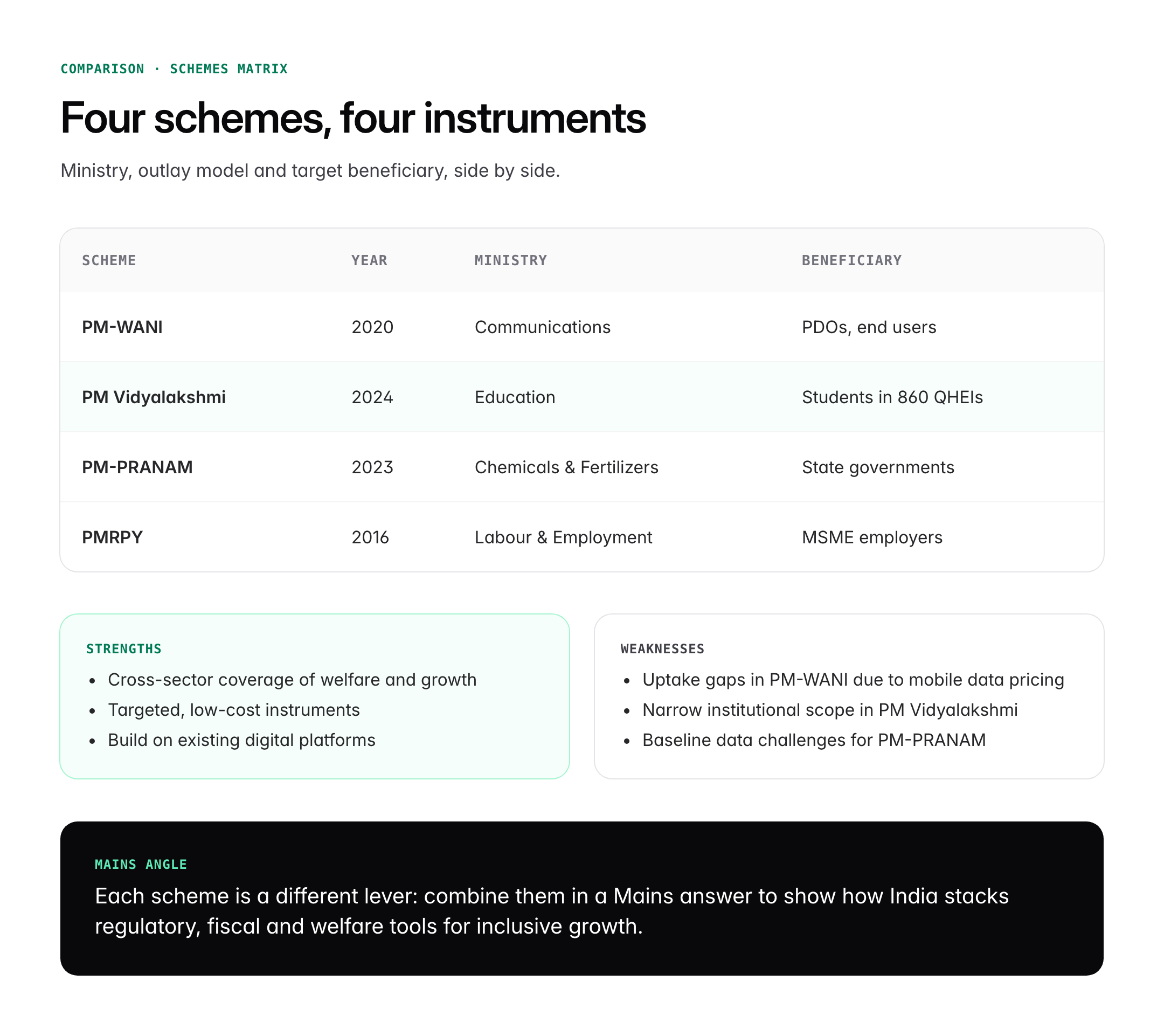
| Scheme | Year | Type | Target group | Funding model |
|---|---|---|---|---|
| PM-WANI | 2020 | Regulatory + enabling | Small PDOs, end users | License-exempt, USOF support |
| PM Vidyalakshmi | 2024 | Credit guarantee + subvention | Students in top 860 QHEIs | Central outlay |
| PM-PRANAM | 2023 | State incentive | State governments | Subsidy savings redistribution |
| PMRPY | 2016 | Wage subsidy | MSME employers | Central outlay via EPFO |
The cluster illustrates four different policy tools: a regulatory framework, a credit instrument, a federal incentive, and a direct wage subsidy. For Mains, this differentiation is what separates a high-scoring answer from a generic list.
Challenges and Criticisms
PM-WANI’s main challenge is economic viability for small PDOs in a market flooded with cheap mobile data; critics have flagged that without a strong rural content layer, Wi-Fi hotspots remain under-used. PM Vidyalakshmi is criticised for narrowing focus to 860 institutions, potentially excluding students from state universities outside NIRF rankings. PM-PRANAM is constrained by data quality on fertilizer consumption and by political incentives to keep urea cheap. PMRPY, while useful, had limited effect on genuine formalisation since many beneficiary jobs reverted to informality after the three-year support ended.
Prelims Pointers
- PM-WANI was launched in December 2020 under the Department of Telecommunications.
- PDO stands for Public Data Office under PM-WANI.
- PM Vidyalakshmi was approved in November 2024.
- PM Vidyalakshmi covers students in 860 Quality Higher Education Institutions.
- PM-PRANAM was approved in June 2023.
- Under PM-PRANAM, states retain 50 percent of subsidy savings.
- PMRPY was launched in April 2016; fresh registrations closed on 31 March 2022.
- PMRPY subsidised the 12 percent employer EPF contribution.
- PM-PRANAM falls under the Ministry of Chemicals and Fertilizers.
- PM Vidyalakshmi is implemented through the Vidya Lakshmi portal.
- PMRPY is administered by EPFO under Labour Ministry.
- India’s current Prime Minister, as of 2026, is Narendra Modi, the 14th PM.
Mains Practice Questions
Q1. Evaluate PM-PRANAM as an instrument of cooperative fiscal federalism in India’s agricultural policy.
- Outline the scheme’s 50 percent savings retention model and its alignment with soil health goals.
- Analyse federal interface issues including baseline setting, data verification and political economy of urea.
- Suggest strengthening mechanisms through soil health card integration and Finance Commission performance incentives.
Q2. Discuss the relevance of PM-WANI in the context of India’s digital inclusion strategy. What are the reasons behind its slow uptake?
- Describe the PDO, PDOA, app provider and registry architecture.
- Identify reasons for slow uptake: cheap mobile data, content gap, limited backhaul in rural areas.
- Recommend integrating PM-WANI with BharatNet, Common Service Centres and localised content.
Conclusion
The PM-prefix cluster of schemes is less confusing once you treat each scheme on its own structural terms. PM-WANI is a digital inclusion framework, PM Vidyalakshmi is a higher-education credit instrument, PM-PRANAM is a federal fertilizer incentive, and PMRPY is a wage subsidy tool now largely replaced by the Employment Linked Incentive.
For UPSC purposes, the aim is not to memorise outlays in isolation but to map each scheme to its ministry, its policy problem and its implementation architecture. Doing so converts four easily confused acronyms into four sharp, interview-ready policy case studies.
Frequently Asked Questions
What is PM-WANI Yojana?
PM-WANI, or Prime Minister Wi-Fi Access Network Interface, is a scheme launched by the Department of Telecommunications in December 2020 to expand public Wi-Fi hotspots across India. It permits small shops and entrepreneurs to function as Public Data Offices offering Wi-Fi without a telecom licence, with aggregators and app providers governed by a central registry to ensure interoperability and digital inclusion.
Why is PM-WANI important for UPSC preparation?
PM-WANI is a frequent GS2 and GS3 topic covering governance, digital inclusion and regulatory innovation. It illustrates how India uses license-exempt frameworks to expand last-mile connectivity. Aspirants should remember its launch year, nodal ministry, PDO architecture and the challenges of uptake, since questions often combine factual Prelims triggers with Mains discussion on Digital India.
How is PM Vidyalakshmi different from the earlier Vidya Lakshmi portal?
The original Vidya Lakshmi portal launched in 2015 was merely a single-window online platform to apply for education loans. The PM Vidyalakshmi scheme approved in November 2024 adds a 75 percent credit guarantee for loans up to 10 lakh rupees and full interest subvention during moratorium for families earning under 8 lakh rupees annually, for students in 860 Quality Higher Education Institutions.
What is the PM-PRANAM scheme?
PM-PRANAM stands for PM Programme for Restoration, Awareness, Nourishment and Amelioration of Mother Earth. Approved in June 2023 by the Ministry of Chemicals and Fertilizers, it incentivises states to reduce chemical fertilizer use by letting them retain 50 percent of the resulting urea subsidy savings, of which 70 percent must fund alternative fertilizers, natural farming and soil health initiatives.
What was the PM Rojgar Protsahan Yojana?
Launched in April 2016 under the Ministry of Labour and Employment, PMRPY subsidised the entire 12 percent employer contribution to Employees’ Provident Fund for new employees earning up to 15,000 rupees a month. It aimed to formalise low-wage jobs and reduce payroll burden on MSMEs. Fresh registrations closed on 31 March 2022 and the scheme is succeeded by the Employment Linked Incentive scheme.
Which ministry implements each scheme?
PM-WANI is run by the Department of Telecommunications under Ministry of Communications. PM Vidyalakshmi is implemented by the Ministry of Education with support from the Department of Financial Services. PM-PRANAM falls under the Department of Fertilizers within the Ministry of Chemicals and Fertilizers. PMRPY was administered by the Ministry of Labour and Employment through the Employees’ Provident Fund Organisation.
How many Prime Ministers has India had?
India has had 14 Prime Ministers as of 2026, starting with Jawaharlal Nehru in 1947. Other notable PMs include Lal Bahadur Shastri, Indira Gandhi, Morarji Desai, Rajiv Gandhi, P. V. Narasimha Rao, Atal Bihari Vajpayee, Manmohan Singh and Narendra Modi, who has served since 2014. The full list is a high-frequency Prelims factual question.
How do these schemes connect for UPSC Mains answers?
Together, these schemes showcase four distinct policy instruments: PM-WANI uses regulatory enablement, PM Vidyalakshmi uses credit guarantee and interest subvention, PM-PRANAM uses fiscal incentive to states, and PMRPY used wage subsidy. A strong Mains answer contrasts these tools, links them to Digital India, NEP 2020, natural farming and formalisation of employment, and evaluates implementation gaps using public data from the respective ministries.
Tell Google you want more of this.
Add Anantam IAS as a preferred sourceOne tap, and this site shows up more often in your own Top Stories, AI Overviews and AI Mode. Remove it any time.