Introduction
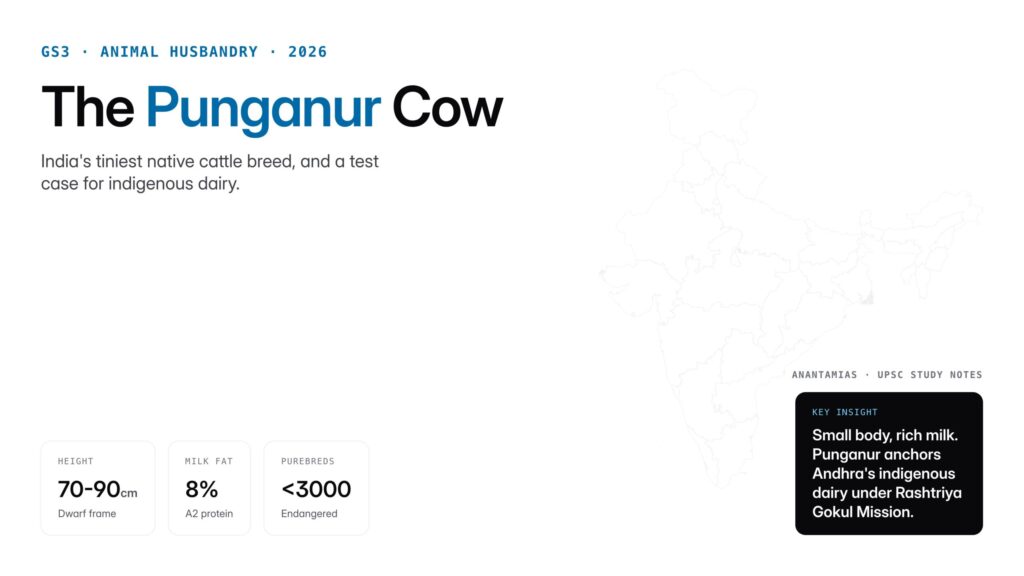
The Punganur cow is one of India’s smallest indigenous cattle breeds and among the rarest in the world. Named after the town of Punganur in Chittoor district of Andhra Pradesh, this dwarf breed has a compact frame, high-fat milk and a striking aesthetic that has won it national attention. In January 2024 the Prime Minister fed Punganur cows at his residence, and the image circulated widely, pushing this obscure breed into the mainstream.
For UPSC aspirants, Punganur is more than a curiosity. It sits at the intersection of agriculture, animal husbandry, biodiversity conservation and the politics of A2 versus A1 milk. The breed features in the Rashtriya Gokul Mission, in National Bureau of Animal Genetic Resources registrations, and in debates over whether India should prioritise high-yield exotic breeds or preserve native genetic pools. This article covers characteristics, history, conservation efforts, and the deeper GS Paper 3 relevance.
Quick Facts at a Glance
| Attribute | Detail |
|---|---|
| Breed name | Punganur |
| Region of origin | Punganur, Chittoor district, Andhra Pradesh |
| Scientific group | Bos indicus (Zebu cattle) |
| Average height | 70-90 cm |
| Average weight | 115-200 kg |
| Daily milk yield | 1-3 litres |
| Milk fat content | 8 percent (among the highest globally) |
| Milk type | A2 milk |
| Registration | NBAGR recognised indigenous breed |
| Conservation status | Endangered, under 3000 purebred animals |
| Mission | Rashtriya Gokul Mission (2014) |
Background and Historical Context
The Punganur breed traces back several centuries to the royal patronage of the zamindars of the Punganur estate in the Rayalaseema region of Andhra Pradesh. The estate, established under the Vijayanagara successors, maintained these compact cattle for temple rituals, household milk and ceremonial processions. Unlike draught-heavy breeds such as Ongole or Hallikar, Punganur was bred for easy handling in dry, hilly terrain and for high-fat milk that could be used in ghee preparation and temple offerings.
Colonial and post-independence cattle policy largely ignored indigenous dwarf breeds. The White Revolution of the 1970s, led by Verghese Kurien and Operation Flood, prioritised crossbreeding with Holstein-Friesian and Jersey cattle to raise milk yields. As cooperatives pushed exotic genetics, native breeds like Punganur, Vechur in Kerala and Malnad Gidda in Karnataka declined sharply. By the 1980s, field surveys in Chittoor found fewer than a hundred purebred Punganur cows.
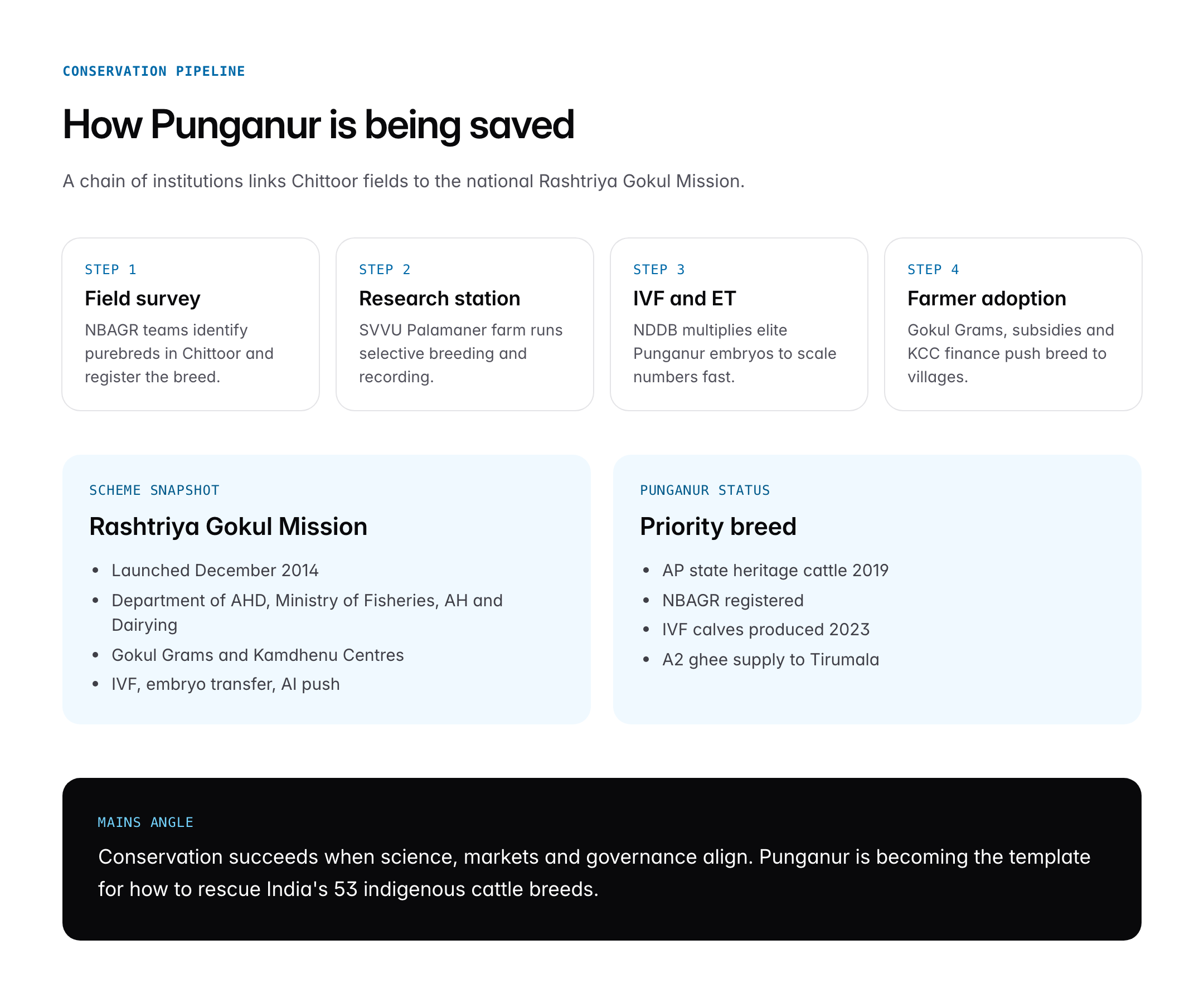
The recovery began with Sri Venkateswara Veterinary University in Tirupati and the Livestock Research Station at Palamaner, which launched conservation breeding programmes in the early 2000s. The breed was formally registered by the National Bureau of Animal Genetic Resources (NBAGR) at Karnal, Haryana. In 2014 the central government launched the Rashtriya Gokul Mission under the Department of Animal Husbandry and Dairying, with dedicated funding for indigenous breed development, gokul grams and IVF interventions. Punganur became one of the flagship breeds under this mission.
Key Characteristics
Physical Features
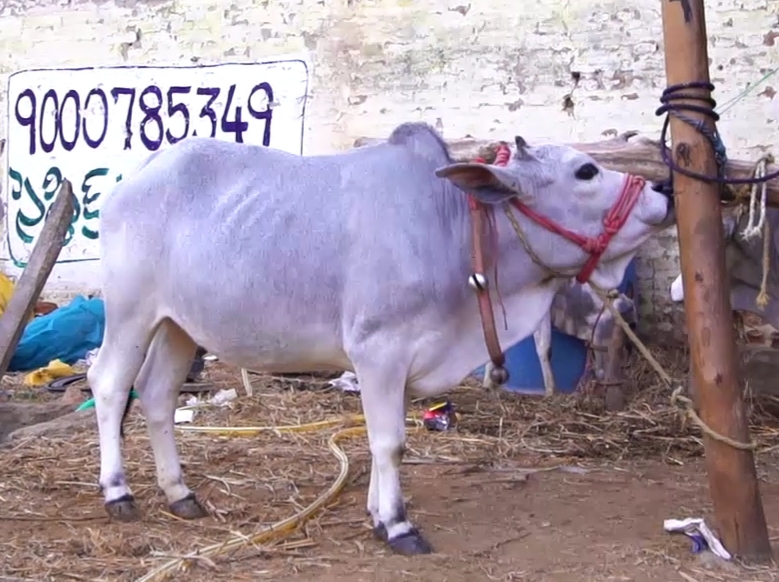
The Punganur cow is a dwarf breed with an adult cow height between 70 and 90 centimetres and body weight of roughly 115 to 200 kilograms. The coat colour ranges from white and grey to brown and red, often with patches. Horns are short, crescent-shaped and curve outward and upward. The forehead is broad and slightly convex, the dewlap is pronounced, and the hump is modest compared to Ongole or Gir cattle.
Calves are remarkably small at birth, weighing around 8 to 10 kilograms. The breed’s compact frame lets it thrive on modest fodder and limited grazing land, which makes it well suited to small and marginal farmers.
Milk and Nutritional Profile
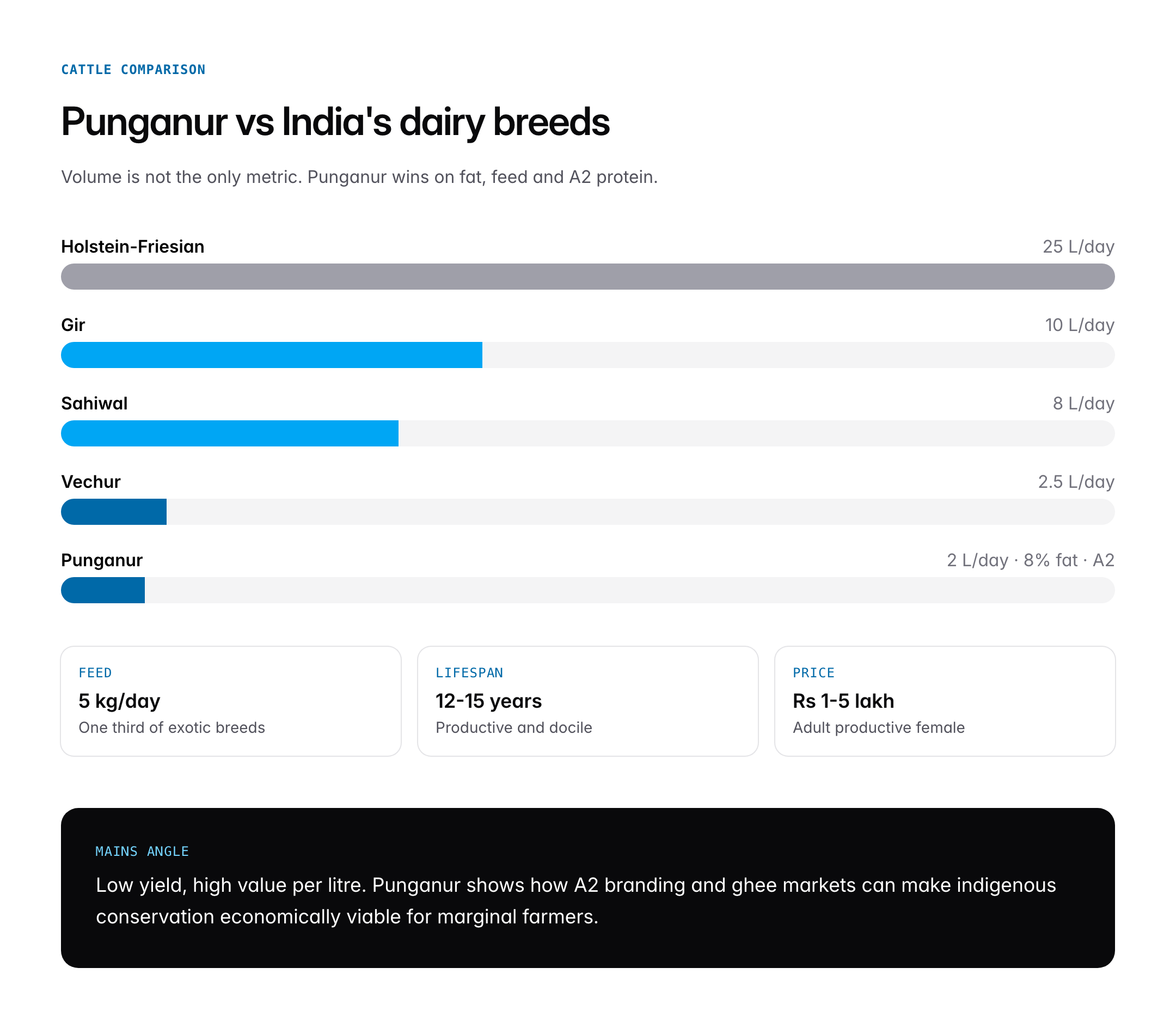
Punganur cows yield only 1 to 3 litres of milk per day, far below the 15 to 20 litres of Holstein-Friesian crossbreds. However, the milk fat content is 8 percent or higher, almost double that of most commercial dairy breeds. The milk is classified as A2 milk, containing the A2 beta-casein protein variant that some studies associate with easier digestibility compared to A1 milk found in many European breeds.
The high fat makes Punganur milk ideal for ghee, khoa and traditional sweets. Ghee from Punganur milk commands a premium in Andhra Pradesh’s Tirumala temple supply chain.
Adaptation and Temperament
Punganur is highly heat tolerant and drought resistant, traits typical of zebu cattle. It has strong resistance to tick-borne diseases and foot-and-mouth disease compared with exotic breeds. The temperament is docile, which suits family farms and urban gaushalas. It has a long productive life of 12 to 15 years.
Economic Value
A purebred Punganur calf sells for 25000 to 75000 rupees, and a productive female can fetch between one and five lakh rupees. The breed has also emerged as a status symbol, with wealthy patrons and gaushalas in North India purchasing pairs for private herds, which has driven up prices and occasionally strained conservation efforts.
Significance for UPSC and General Knowledge
- GS Paper 3 covers animal husbandry, agriculture and allied activities where indigenous breeds carry direct weight.
- The Rashtriya Gokul Mission, its components and outlay are high-frequency Prelims and Mains material.
- A2 versus A1 milk debates link to food safety, FSSAI standards and consumer rights.
- NBAGR registration, genetic resource conservation and biodiversity obligations connect to the Convention on Biological Diversity.
- Punganur features in Prime Minister-linked news items, making it a likely current affairs hook.
- The breed illustrates tradeoffs between productivity and conservation in livestock policy.
Detailed Analysis: Conservation and Policy
India has 53 registered indigenous cattle breeds and 20 buffalo breeds as of 2024, all maintained on the NBAGR register. Punganur is classified as endangered, with estimates of purebred stock ranging between 2000 and 3000 animals. The Rashtriya Gokul Mission, launched in December 2014 with an initial outlay of 500 crore rupees and later expanded, is the central instrument for indigenous breed conservation. Its components include Gokul Grams or integrated cattle development centres, the National Kamdhenu Breeding Centres at Itarsi and Chintaladevi, and support for gaushalas and farmer cooperatives.
The Livestock Research Station at Palamaner under Sri Venkateswara Veterinary University runs the lead Punganur conservation unit. In vitro fertilisation and embryo transfer trials by the National Dairy Development Board have been used to multiply elite Punganur genetics, with the first IVF calves reported in Gujarat in 2023. The breed is also included in the Kisan Credit Card scheme for animal husbandry and under the Animal Husbandry Infrastructure Development Fund of 15000 crore rupees announced in 2020.
State-level interventions matter too. The Andhra Pradesh government declared Punganur the state heritage cattle breed in 2019 and set up dedicated breeding centres. Karnataka protects Malnad Gidda, Kerala has a Vechur conservation trust, and Tamil Nadu supports Kangayam and Alambadi. These programmes must balance three goals: genetic purity, economic viability for farmers, and animal welfare. Conservation without economic demand rarely works, so the rise in premium A2 ghee markets and private herds has paradoxically aided Punganur’s comeback.
Comparative Perspective
| Parameter | Punganur | Vechur | Holstein-Friesian |
|---|---|---|---|
| Origin | Andhra Pradesh | Kerala | Netherlands |
| Height | 70-90 cm | 80-90 cm | 140-165 cm |
| Weight | 115-200 kg | 130-200 kg | 580-700 kg |
| Daily milk yield | 1-3 litres | 2-3 litres | 20-30 litres |
| Milk fat | 8 percent | 4-5 percent | 3.5-4 percent |
| Milk type | A2 | A2 | A1 predominantly |
| Status | Endangered | Endangered | Commercial |
Punganur and Vechur illustrate that indigenous dwarf breeds survive on different economic logic than commercial exotic cattle. They yield less volume but higher value per litre, and they consume far less feed, which improves farm-level economics for small holders.
Challenges and Criticisms
Despite the policy push, Punganur conservation faces real hurdles. Purebred numbers remain below a safe genetic threshold, and inbreeding depression is a recurring concern. Uncontrolled crossing with local non-descript cattle dilutes the gene pool, a challenge NBAGR field teams flag repeatedly. Semen and embryo supply lag demand, slowing multiplication.
Market pressures cut both ways. The premium paid for Punganur calves has motivated farmers but has also led to mislabelling, where crossbred or dwarf non-descript cattle are sold as Punganur to unwary buyers. Regulation of such sales is weak outside Andhra Pradesh. Animal welfare concerns have also been raised, including the risk that dwarf cattle confined to small urban gaushalas face inadequate exercise, poor nutrition and substandard veterinary care.
On the broader policy front, critics argue that the Rashtriya Gokul Mission’s budget is small relative to the White Revolution’s continued focus on exotic crossbreds. India’s per animal productivity remains low, and the balance between boosting yields and preserving indigenous breeds is genuinely contested among agricultural economists. The 2020 livestock census recorded 193 million cattle, of which only a declining share are purebred indigenous animals.
Prelims Pointers
- Punganur is a dwarf cattle breed from Chittoor district of Andhra Pradesh.
- It is classified as Bos indicus or zebu cattle.
- Average daily milk yield is 1 to 3 litres with around 8 percent fat.
- Punganur milk is A2 type, containing the A2 beta-casein protein.
- The breed is registered by NBAGR at Karnal, Haryana.
- Rashtriya Gokul Mission was launched in December 2014.
- National Kamdhenu Breeding Centres are at Itarsi (MP) and Chintaladevi (Andhra Pradesh).
- Sri Venkateswara Veterinary University at Tirupati leads conservation.
- Andhra Pradesh declared Punganur its state heritage cattle in 2019.
- India has 53 registered indigenous cattle breeds as of 2024.
- Vechur from Kerala and Malnad Gidda from Karnataka are also dwarf breeds.
- The 20th Livestock Census (2019) recorded 193 million cattle in India.
Mains Practice Questions
- Indigenous cattle breeds are central to sustainable livestock farming. Evaluate the objectives and performance of the Rashtriya Gokul Mission with reference to breeds like Punganur. (250 words)
- Outline mission objectives and instruments
- Evaluate outcomes on purebred numbers and farmer incomes
- Recommend policy improvements
- Discuss the tradeoffs between boosting milk productivity through exotic crossbreeds and conserving indigenous dwarf breeds such as Punganur and Vechur. (250 words)
- Compare productivity and resource footprint
- Explain A2 versus A1 milk and consumer segmentation
- Suggest a balanced livestock policy framework
Conclusion
The Punganur cow is a case study in biodiversity, policy and markets all at once. A breed that had dwindled to a few hundred animals is now a branded asset of Andhra Pradesh and a poster animal for the Rashtriya Gokul Mission. Its compact frame, low feed needs, disease resistance and A2 milk profile make it both an economic option for small farmers and a cultural symbol in temple supply chains.
For aspirants, Punganur bundles Prelims facts with Mains analysis, from NBAGR registration to livestock census numbers to the debate over A2 milk. Its real lesson is that conserving India’s genetic heritage cannot rely on sentiment alone. It needs science in the form of breeding programmes and IVF, markets that reward indigenous produce and governance that polices mislabelling and welfare. Get that combination right and breeds like Punganur become living links between ancient husbandry and modern policy.
Frequently Asked Questions
What is the Punganur cow?
Punganur is one of the world’s smallest indigenous cattle breeds, native to the Punganur area of Chittoor district in Andhra Pradesh. It belongs to the Bos indicus zebu group, stands only 70 to 90 centimetres tall, weighs between 115 and 200 kilograms, and yields 1 to 3 litres of high-fat A2 milk a day.
Why is Punganur cow important for UPSC?
Punganur appears in GS Paper 3 topics on animal husbandry, indigenous breeds and the Rashtriya Gokul Mission. It also links to biodiversity conservation under NBAGR, A2 versus A1 milk policy debates and agricultural livelihoods. Recent news coverage, including Prime Minister-level attention in 2024, adds current affairs relevance.
How is the Punganur cow related to A2 milk?
Like most Bos indicus cattle, Punganur produces A2 milk, meaning its beta-casein protein is the A2 variant rather than the A1 common in European breeds. A2 milk is often marketed as easier to digest. Punganur’s combination of 8 percent fat and A2 protein earns a premium in the growing indigenous dairy segment.
How many Punganur cows are left in India?
Reliable estimates suggest fewer than 3000 purebred Punganur cattle remain, concentrated in Chittoor district of Andhra Pradesh and in conservation farms at Palamaner. The breed is classified as endangered by the NBAGR and is a priority under the Rashtriya Gokul Mission, with state and IVF interventions to multiply numbers.
What is the Rashtriya Gokul Mission?
The Rashtriya Gokul Mission is a central scheme launched in December 2014 by the Department of Animal Husbandry and Dairying for the development and conservation of indigenous bovine breeds. It funds Gokul Grams, National Kamdhenu Breeding Centres, IVF and embryo transfer, and support to gaushalas, with breeds like Punganur among its key beneficiaries.
How much milk does a Punganur cow give?
A Punganur cow yields between 1 and 3 litres of milk per day, which is far below exotic Holstein-Friesian cattle that give 20 to 30 litres. The Punganur advantage lies in the milk composition: fat content reaches 8 percent or more, and the milk is A2, making it highly valued for ghee and traditional sweet preparation.
Where is the Punganur cow found?
The Punganur breed is native to Punganur town in Chittoor district of Andhra Pradesh, with breeding farms also in Palamaner and Tirupati under Sri Venkateswara Veterinary University. Conservation herds have been established in Gujarat through IVF, and private gaushalas in Delhi, Uttar Pradesh and other states have recently introduced the breed.
What is the price of a Punganur cow?
A purebred Punganur calf typically sells between 25000 and 75000 rupees, while adult productive females can command one to five lakh rupees depending on lineage, milk yield and temperament. Prices have risen sharply after the breed gained national attention, though mislabelling of non-descript dwarf cattle as Punganur remains a market risk.
Tell Google you want more of this.
Add Anantam IAS as a preferred sourceOne tap, and this site shows up more often in your own Top Stories, AI Overviews and AI Mode. Remove it any time.