Rani Velu Nachiyar: The First Indian Queen Who Defeated the British in Battle
Rani Velu Nachiyar of Sivagangai (1730-1796) was the first Indian queen to wage war against the British East India Company. UPSC notes on her 1780 victory, commander Kuyili's suicide attack, and her place in modern Indian history.
The story of India’s freedom struggle usually begins in 1857. The textbooks then jump to 1885, then 1905, then to the Gandhian decades. The first century of British expansion, the long stretch when small kingdoms in the south and west still had armies and treasuries of their own, gets lost in the rush. Rani Velu Nachiyar of Sivagangai sits exactly inside that lost century.
She was born in 1730. She was widowed in battle by the East India Company. She raised an army with Hyder Ali’s help and reclaimed her kingdom in 1780. That makes her the first Indian queen to wage and win a war against the British, a full seventy-seven years before the Revolt of 1857 and a generation before Kittur Chennamma’s better-known uprising. Her commander Kuyili carried out what is often described as the earliest recorded suicide attack in Indian military history.
This article reads Rani Velu Nachiyar with a UPSC lens. It traces her early life, decodes the politics of Sivagangai Seemai, walks through the 1780 campaign, and sets out why she matters for prelims, mains and essay alike.
Quick Facts
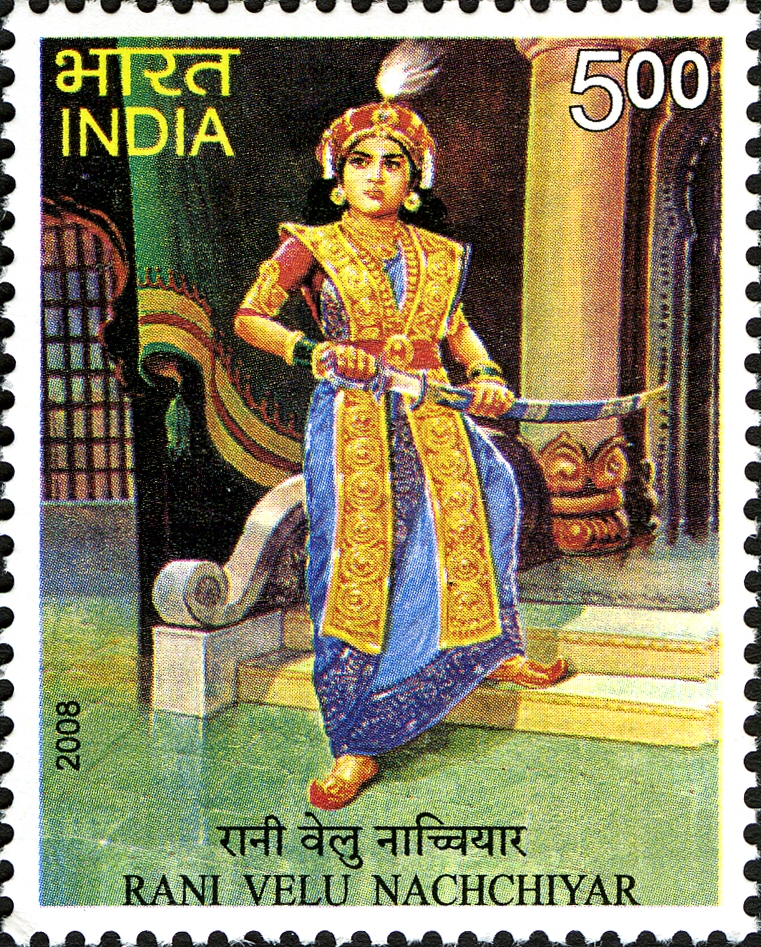
- Born: January 3, 1730, at Ramanathapuram
- Father: King Chellamuthu Vijayaragunatha Sethupathy of Ramnad
- Mother: Queen Sakandhimuthathal
- Husband: Muthuvaduganathaperiya Udaiyathevar, raja of Sivagangai
- Daughter: Vellacci
- Kingdom: Sivagangai Seemai, a small kingdom in present-day southern Tamil Nadu
- Reign: Approximately 1780 to 1790
- Key Ally: Hyder Ali of Mysore, who provided 5,000 soldiers
- Famous Commander: Kuyili, leader of the women’s regiment
- Honorific: Veeramangai, meaning “brave woman”
- Died: December 25, 1796, at Sivagangai
Who Was Rani Velu Nachiyar
Velu Nachiyar was the only child of Chellamuthu Sethupathy of Ramnad. Her parents raised her as they would have raised a son. She studied Tamil, Sanskrit, English, French and Urdu. She trained in Silambam, the Tamil stick-fighting tradition, and in Valari, the curved throwing club of the southern country. She rode horses and used the bow.
When she married into the neighbouring Sivagangai royal house, she carried that training with her. Her husband Muthuvaduganathaperiya ruled a small kingdom carved out of the older Marava country. The Marava chiefs paid loose tribute to the Nawab of Arcot, who in turn was bound to the East India Company. That triangular relationship was about to break.
The British system of paramountcy in the late eighteenth century did not allow for the kind of half-independent kingdom Sivagangai claimed to be. The Nawab of Arcot owed the Company money. The Company wanted that money from his subordinates. Sivagangai, with its grain wealth and stubborn raja, became a target.
Background and Historical Context
To understand Rani Velu Nachiyar, you need to understand the Carnatic of the 1770s. The Carnatic was a Mughal province on paper. In practice it was a patchwork of small Tamil and Telugu kingdoms, each negotiating with the Nawab of Arcot and through him with the East India Company. The Company had defeated the French and was now the real power broker in the south.
The 1772 Catastrophe at Kalayar Kovil
In June 1772 the Company sent a force under Colonel Joseph Smith and an Arcot detachment led by Muhammed Yusuf Khan’s successor to collect tribute from Sivagangai. The Sivagangai army met them at Kalayar Kovil. The raja Muthuvaduganathaperiya was killed in the engagement. Velu Nachiyar escaped with her young daughter Vellacci.
She did not surrender. She did not commit ritual suicide, which the Marava code would have allowed. Instead she rode west through the Western Ghats and took refuge at Virupachi near Dindigul. The Palayakaarar there, Kopaala Naayakkar, gave her shelter for eight long years. Those eight years were not idle. She used them to build a network.
Building the Alliance with Hyder Ali
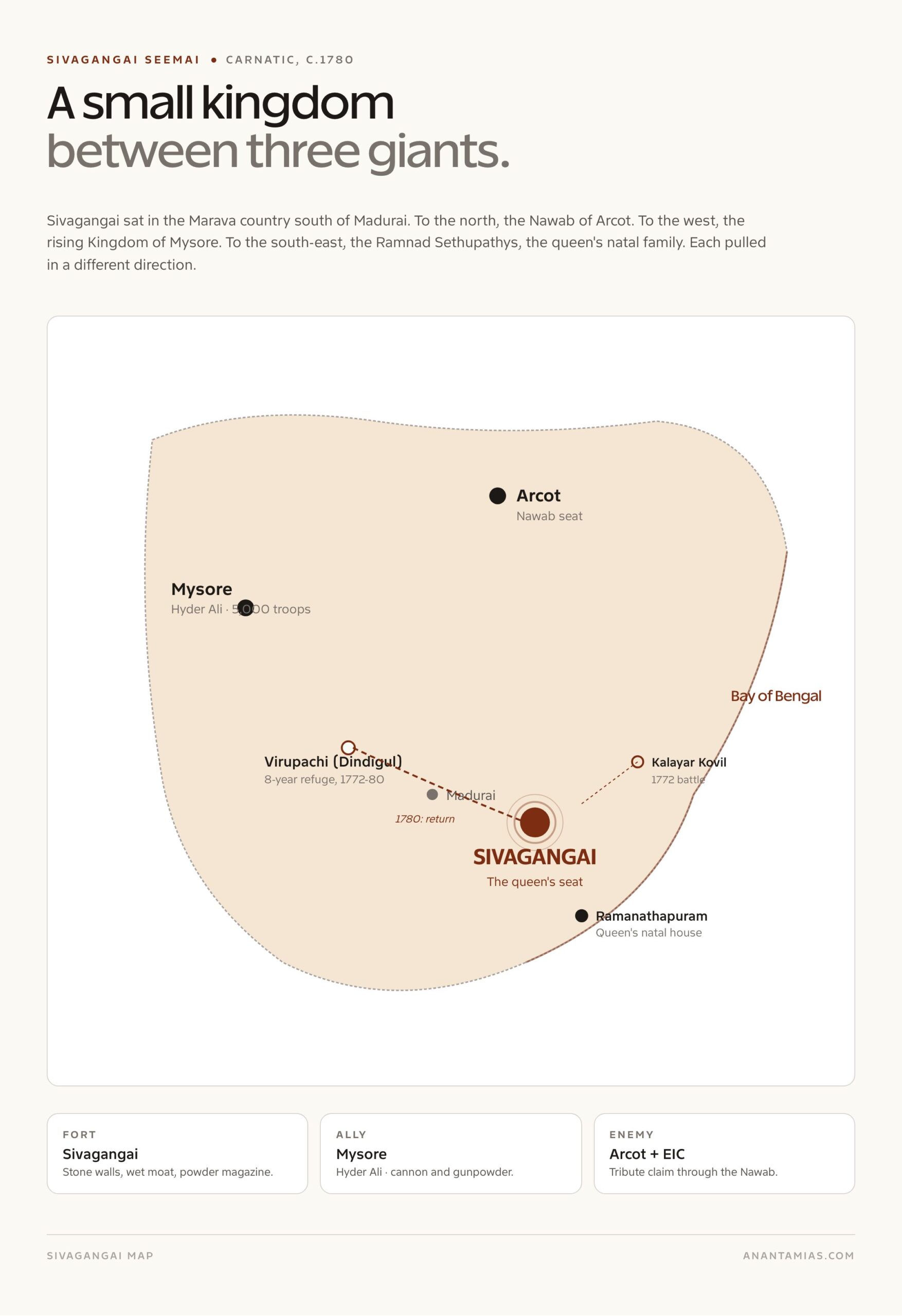
The most important diplomatic move of Velu Nachiyar’s life was reaching Hyder Ali. Mysore had its own quarrel with the Company. Hyder Ali had fought the First Anglo-Mysore War from 1767 to 1769 and was preparing for the second. A friendly southern kingdom in the Company’s rear was useful to him.
Velu Nachiyar travelled to Hyder Ali’s court. Sources differ on the meeting itself, but the result is clear in the records. Hyder Ali agreed to fund and equip a force. He supplied around 5,000 soldiers, gunpowder, cannon and a monthly stipend. He recognised her as the rightful ruler of Sivagangai. For a queen in exile this was extraordinary.
The Maruthu brothers, Periya Marudhu and Chinna Marudhu, joined her as commanders. They were officers from her late husband’s army who had also escaped Kalayar Kovil. The women’s regiment, called the Udaiyaal regiment after another fallen comrade, was placed under Kuyili.
Kuyili and the 1780 Assault on Sivagangai Fort
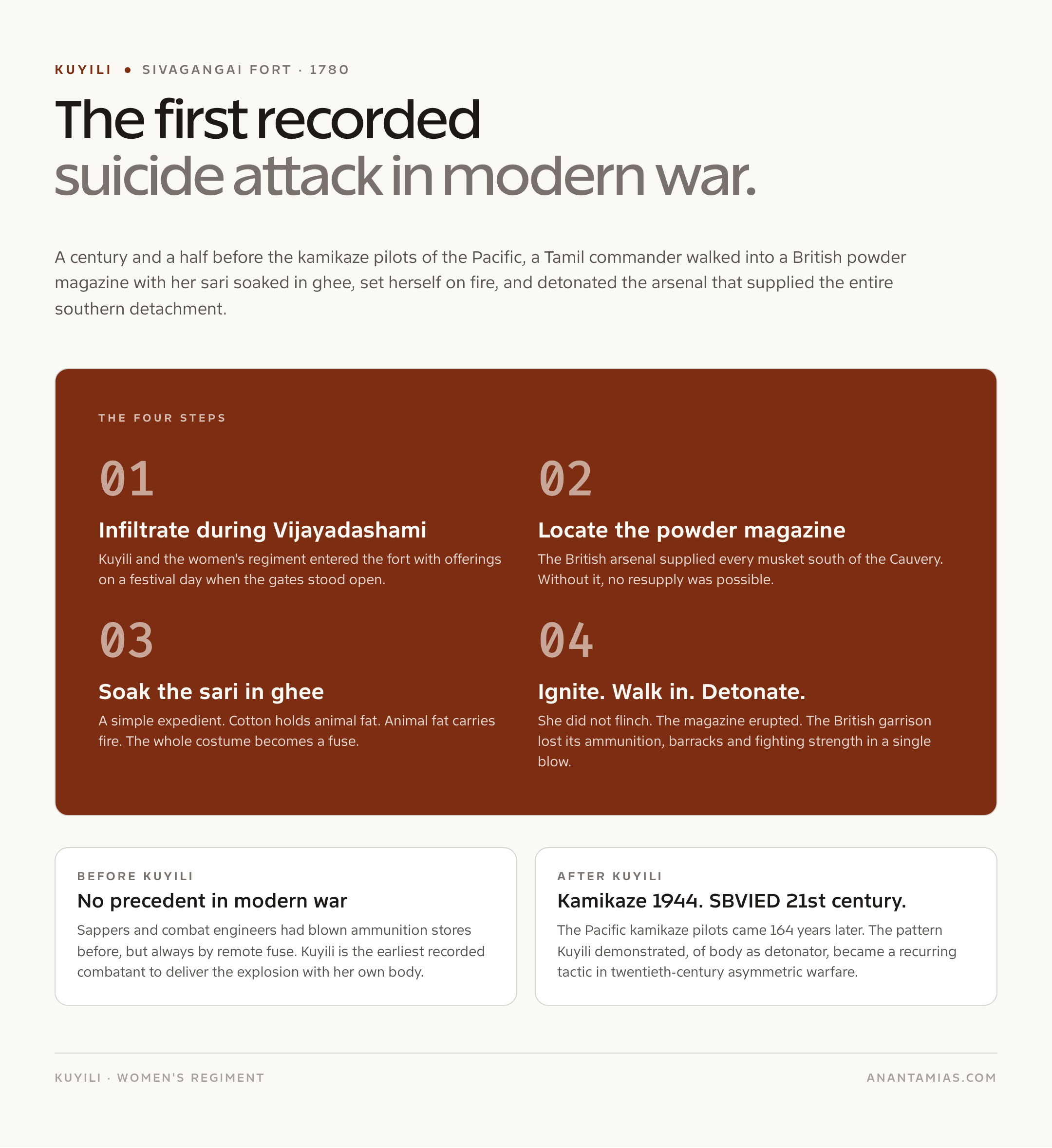
The campaign began in 1780. The Company garrison was lodged inside Sivagangai fort. The fort had stone walls, a wet moat and, crucially, a powder magazine that supplied the entire southern detachment. As long as the magazine stood, the British could resupply and outlast any siege.
Kuyili solved that problem. The standard reconstruction, drawn from Tamil oral tradition and corroborated by later British records of an unexplained explosion, is that Kuyili and her women’s regiment infiltrated the fort during the Vijayadashami festival when the gates were open for offerings. Kuyili soaked her sari in ghee, set herself on fire, and walked into the powder magazine. The magazine exploded. The British garrison lost its ammunition, its barracks and a large part of its fighting strength in a single blow.
This is why Kuyili is described, by historians like Cynthia Talbot and in Tamil Nadu government school textbooks, as the first recorded suicide bomber in modern military history. She predates the kamikaze pilots of the Second World War by more than a century and a half.
Detailed Analysis: How a Small Kingdom Beat the Company
Sivagangai’s victory in 1780 looks improbable on paper. The Company was the dominant military force in the Carnatic. It had artillery, drilled sepoy regiments, and a logistics chain stretching back to Madras. Velu Nachiyar had a smaller force and a borrowed army.
Four factors carried the day. First, she chose her moment. The Second Anglo-Mysore War began in July 1780. Hyder Ali invaded the Carnatic in September. The Company’s southern detachment was pulled north to defend Madras. The Sivagangai theatre became secondary. Second, the Marudhu brothers knew the terrain. Forest paths, river crossings and granary locations were not on Company maps. Third, Kuyili’s strike removed the powder reserve, which is what a Company garrison depends on for prolonged defence. Fourth, popular sympathy in the Sivagangai countryside lay with the queen, not with the Company’s tax farmers.
The combined effect was a quick reconquest. By late 1780 Velu Nachiyar held Sivagangai fort again. She formally ascended the throne and began ruling the kingdom in her own right.
Comparative: Velu Nachiyar, Chennamma, Lakshmibai
Indian school textbooks tend to telescope the queens of the resistance into one chapter. The differences are worth holding in mind. Rani Velu Nachiyar fought in 1780. Kittur Rani Chennamma fought in 1824. Rani Lakshmibai of Jhansi fought in 1857. Each faced the East India Company at a different stage of its power.
Velu Nachiyar fought before the Company had a doctrine for swallowing princely states. She won, ruled for a decade and died in office. Chennamma fought the first applications of what became the Doctrine of Lapse. She lost militarily and died in captivity. Lakshmibai fought during the great revolt itself and died in battle. The three together cover the arc of British conquest in the subcontinent. You can trace the entire eighteenth and nineteenth century through their biographies.
Challenges and Aftermath
Velu Nachiyar ruled Sivagangai for about ten years. She trained the Maruthu brothers as administrators and military commanders. She handed over effective control to her daughter Vellacci and to Chinna Marudhu in the late 1780s. She herself died at the end of 1796.
The kingdom did not survive long after her. The Maruthu brothers led the Polygar Wars against the Company in the late 1790s and into the early 1800s. They allied briefly with Tipu Sultan and then continued resisting after his death in 1799. The British finally captured and executed the brothers in 1801. Sivagangai was absorbed into the Madras Presidency.
The legacy survived in folk memory. Tamil street plays, Villupaattu ballads and temple songs kept Velu Nachiyar and Kuyili alive long after the kingdom itself was gone. The Government of India released a commemorative stamp in 2008. The Indian Army’s Madras Regiment carries her memory in regimental tradition.
Prelims Pointers
- Sivagangai is in present-day Tamil Nadu.
- Rani Velu Nachiyar is the first Indian queen to wage war against the East India Company.
- The Palayakaarar of Virupachi near Dindigul sheltered her for eight years.
- Hyder Ali of Mysore supplied 5,000 troops and supplies for her 1780 campaign.
- The Maruthu brothers, Periya Marudhu and Chinna Marudhu, were her chief commanders.
- Kuyili, leader of the women’s regiment, is described as the first recorded suicide attacker in Indian history.
- The 1780 reconquest of Sivagangai coincided with the Second Anglo-Mysore War.
- Velu Nachiyar reigned from about 1780 to 1790.
- She died on December 25, 1796.
- The Government of India issued a commemorative stamp on Velu Nachiyar in 2008.
Mains Questions
- “The first Indian war of independence was fought not in 1857 but a century earlier in the southern peninsula.” Examine this claim with reference to the resistance led by Rani Velu Nachiyar. (GS Paper I, 15 marks)
- Discuss the role of women in pre-1857 resistance against the East India Company, drawing on the careers of Rani Velu Nachiyar and Kittur Chennamma. (GS Paper I, 10 marks)
- The Palayakaarar system of southern India offered a different mode of resistance to colonial expansion than the larger princely states of the north. Analyse with examples. (GS Paper I, 15 marks)
- Comment on the value of folk memory and oral tradition as sources of modern Indian history, using the case of Rani Velu Nachiyar and Kuyili. (Essay / GS Paper I, 10 marks)
Legacy and Way Forward
The state of Tamil Nadu has built a memorial at Sivagangai and a statue of Velu Nachiyar in Chennai. The Sivagangai district administration runs an annual Veeramangai Velu Nachiyar Vizha around her birth anniversary on January 3. Several Tamil films have dramatised her life and Kuyili’s strike, most recently in the early 2020s.
The wider task is bigger than statues. Indian history syllabi at the school level still give the impression that 1857 was the first organised challenge to British rule. The careers of Velu Nachiyar, the Maruthu brothers, the Polygar chiefs and Kuyili push that date back by nearly eight decades. As the independence movement is restudied in light of regional archives, the south Indian resistance is finally getting the textbook space it always deserved.
Understanding her story is also a way of understanding how the Mughal Empire gave way to a new colonial order through a network of small kingdoms, and how the resistance to that order began long before the great revolt. Comparing her to figures like Bhagat Singh and Mahatma Gandhi is a useful exercise for the mains essay paper, because it forces students to think about how different generations resisted different forms of empire.
Frequently Asked Questions
Who was Rani Velu Nachiyar?
Rani Velu Nachiyar was the queen of Sivagangai Seemai in present-day Tamil Nadu. Born in 1730 at Ramanathapuram, she became the first Indian queen to wage and win a war against the British East India Company. Her 1780 reconquest of Sivagangai predates the Revolt of 1857 by seventy-seven years.
Why is Rani Velu Nachiyar called Veeramangai?
Veeramangai means u0022brave womanu0022 in Tamil. The Sivagangai people gave her that title after she refused to surrender following her husband’s death in 1772 and eventually returned with an army to retake her kingdom. The Government of Tamil Nadu uses the title in official commemorations.
Who was Kuyili and why is she historically important?
Kuyili was Velu Nachiyar’s trusted commander and the leader of the queen’s women’s regiment. During the 1780 assault on Sivagangai fort she soaked her sari in ghee, set herself on fire, and walked into the British powder magazine. The resulting explosion destroyed the British arsenal. Historians describe her as the earliest recorded suicide attacker in modern military history.
How did Hyder Ali help Velu Nachiyar?
Hyder Ali of Mysore was at war with the East India Company himself. He saw Velu Nachiyar’s claim as a useful southern front. He supplied her with around 5,000 soldiers, cannon, gunpowder and a monthly stipend, and he formally recognised her as the rightful ruler of Sivagangai.
What was Sivagangai Seemai?
Sivagangai Seemai was a small kingdom in southern Tamil Nadu carved out of the older Marava country. It paid loose tribute to the Nawab of Arcot and through him to the East India Company. The kingdom was based in the present-day Sivagangai district, between Madurai and Ramanathapuram.
When and how did Rani Velu Nachiyar die?
Rani Velu Nachiyar died on December 25, 1796, at Sivagangai. She had ruled the kingdom for around a decade and had transferred effective administrative authority to the Maruthu brothers and to her daughter Vellacci in the late 1780s. She died in office, not in battle, which sets her apart from most other queens of the resistance.
Who were the Maruthu brothers?
Periya Marudhu and Chinna Marudhu were officers of the Sivagangai army who escaped the 1772 disaster at Kalayar Kovil with Velu Nachiyar. They served as her chief military commanders during the 1780 campaign and later effectively ran the kingdom. They led the Polygar Wars against the Company in the late 1790s and were executed in 1801.
Why does Velu Nachiyar matter for the UPSC syllabus?
She is a high-value mains and essay figure for GS Paper I. Her career illustrates pre-1857 resistance, the role of women in the freedom struggle, the Palayakaarar system, alliance politics with Mysore, and the importance of folk and oral tradition as historical sources. Prelims questions on her have appeared in state PSC papers and may appear in the UPSC prelims.
Is there an authoritative biography of Rani Velu Nachiyar?
There is no single canonical biography. The best material is in district gazetteer records, Tamil Villupaattu ballad collections, and academic work on the Polygar Wars. Cynthia Talbot’s scholarship on south Indian queens and the Tamil Nadu State Archives at Egmore in Chennai are useful starting points for serious study.