S-400 Triumf in India: The ₹35,000 Crore Air-Defence Shield Explained for UPSC
S-400 Triumf in India is the Russian-made long-range surface-to-air missile system bought under a ₹35,000 crore deal in 2018. Here is the full UPSC explainer of the five-squadron contract, the layered 400/250/120/40 km engagement envelope, deliveries to Punjab, the Northeast and Rajasthan, the CAATSA waiver and the role in Operation Sindoor 2025.
The S-400 Triumf India deal is the single largest air-defence acquisition in Indian history and the cornerstone of the country’s modern integrated air-defence shield. Signed in October 2018 at a cost of about ₹35,000 crore ($5.4 billion) for five squadrons, the S-400 Triumf India contract gave the Indian Air Force a long-range surface-to-air missile system capable of detecting and engaging aircraft, cruise missiles, ballistic missiles and drones at ranges up to 400 km. Manufactured by Russia’s Almaz-Antey, the S-400 Triumf is widely regarded as one of the world’s most capable air-defence systems and is deployed by Russia, China, Belarus, Algeria, Turkey and now India. Three of the five squadrons have been delivered and inducted — covering the Punjab sector against Pakistan, the Northeast and Eastern Ladakh sector against China, and the Rajasthan sector. The remaining two squadrons are scheduled for delivery in 2026 and 2027.
For UPSC, the S-400 Triumf India deal spans GS-III internal security and defence acquisition, GS-II India–Russia–United States relations and the CAATSA sanctions regime, and current affairs through its reported role in Operation Sindoor in May 2025. It is a frequent Prelims fact-test and a recurring Mains case study on strategic autonomy, alongside the BrahMos missile, the Agni missile series and indigenous platforms such as INS Vikrant 2022.
What the S-400 Triumf Is
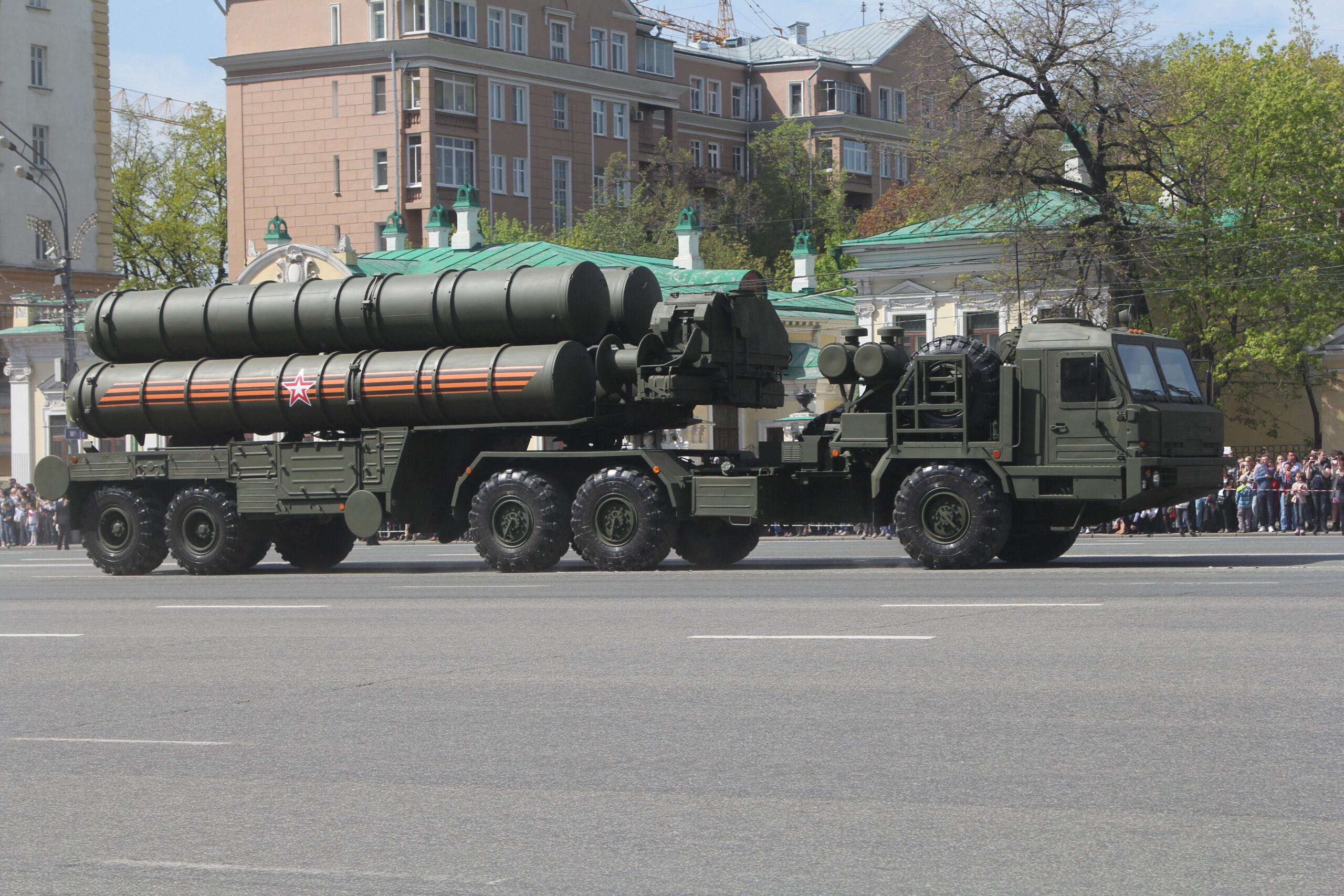
The S-400 Triumf is a mobile, long-range, multi-missile surface-to-air missile system developed by Russia’s Almaz-Antey design bureau. NATO designates it the SA-21 Growler. The S-400 Triumf entered Russian service in 2007 as the successor to the S-300 family. Each S-400 squadron — also called a regiment — comprises radars, a command-and-control vehicle and several transporter-erector-launchers, each carrying multiple missile tubes.
A Layered Air-Defence System
The defining feature of the S-400 Triumf is that it fires four different missile types with overlapping ranges, building a layered defence around any defended point —
- 40N6E — very long-range missile, up to 400 km against high-altitude targets
- 48N6 — long-range missile, up to 250 km
- 9M96E2 — medium-range missile, up to 120 km, designed for highly manoeuvring targets such as cruise missiles
- 9M96E — short-range missile, up to 40 km against low-altitude fast targets
This layered envelope means a single S-400 Triumf squadron defends not only against aircraft at long range but also against cruise missiles, ballistic missiles in the terminal phase, helicopters and even drones at short range. The system can engage up to 36 targets simultaneously.
Radars
Each S-400 Triumf regiment uses three principal radars — the 91N6E acquisition radar (range 600 km), the 96L6E all-altitude detection radar and the 92N6E engagement radar (range 400 km). The radars together provide 360-degree coverage and can detect stealth aircraft to a degree, including reported tracking of US-made F-35 fighters at limited ranges in tests.
The 2018 India–Russia Deal
India and Russia signed the S-400 Triumf India contract on 5 October 2018 during the annual India–Russia summit in New Delhi.
Contract Details
- Cost — about ₹35,000 crore ($5.4 billion)
- Squadrons — five (each comprising eight launchers, missiles, radars and support)
- Signed — 5 October 2018, Prime Minister Modi and President Putin
- Delivery — first squadron December 2021; deliveries phased through 2027
- Total missiles — over 1,000 across the contract
Why India Chose the S-400 Triumf
India faced a two-front air threat — Pakistan’s combat aircraft and increasingly Chinese-supplied missiles in the west, and China’s advanced air force and missile arsenal in the east. The existing Indian air-defence layer — Russian-supplied Pechora and Akash systems plus indigenous Akash-NG — covered medium ranges but not the 400 km long-range tier. The S-400 Triumf filled that gap with a single system and gave the IAF an integrated layered shield. The system’s mobility — components are on 8×8 truck chassis — was another decisive factor, since it allows redeployment in days rather than weeks.
The CAATSA Question
The S-400 Triumf India deal triggered a major US–India diplomatic exchange because of the Countering America’s Adversaries Through Sanctions Act (CAATSA).
What is CAATSA
CAATSA, passed by the US Congress in August 2017, authorises secondary sanctions on third countries that engage in significant transactions with Russia’s defence and intelligence sectors. The S-400 Triumf purchase falls squarely within the CAATSA threshold. Other US partners faced sanctions for similar Russian purchases — Turkey was expelled from the F-35 fighter programme after buying its own S-400 system.
The India Waiver
After 2018 the Trump administration and later the Biden administration weighed sanctions against India. The Indian government argued — successfully — that strategic autonomy, the legacy of Russian-Indian defence cooperation and India’s role as a Quad partner against China justified an exemption. In 2022 the US House of Representatives approved a CAATSA waiver for India through an amendment to the National Defense Authorization Act. The waiver was a major diplomatic win for India and demonstrated the depth of US–India strategic alignment in the Indo-Pacific.
Strategic Autonomy
The S-400 Triumf India deal is a textbook case of Indian strategic autonomy — buying the best capability for India’s threats regardless of source. India simultaneously procured the Rafale fighter from France, P-8I maritime aircraft from the US, MQ-9B drones from the US, INS Arihant submarines built indigenously and S-400 Triumf systems from Russia. The portfolio is deliberately diverse.
Delivery and Squadron Deployments
The S-400 Triumf India squadrons have been delivered in phases.
First Squadron — Punjab Sector (December 2021)
The first S-400 Triumf squadron arrived in December 2021 and was deployed in Punjab, covering the western air-defence sector against Pakistan. The location protects key Indian Air Force bases and the Delhi national capital region.
Second Squadron — Northeast (2022)
The second squadron was delivered in 2022 and deployed in the Northeast, with coverage extending into eastern Ladakh to counter the Chinese air threat after the Galwan Valley clash of 2020.
Third Squadron — Rajasthan (2023–24)
The third squadron entered service in the Rajasthan sector, covering the southern flank against Pakistan. Together with the Punjab squadron, this gives the Indian Air Force overlapping coverage of the entire western border.
Fourth and Fifth Squadrons (2026 and 2027)
Deliveries of the fourth and fifth squadrons were delayed by the Russia–Ukraine conflict, which strained Russian manufacturing capacity. The Indian Air Force expects the fourth squadron in 2026 and the fifth in 2027, completing the five-squadron contract.
S-400 Triumf in Operation Sindoor (May 2025)
The S-400 Triumf India system was reportedly active in air-defence operations during Operation Sindoor in May 2025. According to Indian government statements and defence-ministry briefings, the S-400 squadrons were tasked with engaging incoming Pakistani drones, cruise missiles and crewed aircraft attempting cross-border strikes during the operation. The Indian Air Force chief subsequently described the S-400 Triumf as having performed “exceptionally well” in its first combat employment. Defence analysts assessed Operation Sindoor as a vindication of the 2018 acquisition decision.
The operation also showcased the layered air-defence concept — the S-400 Triumf at long range, the Russian Pechora and the indigenous Akash at medium range, and short-range systems including the Israeli Spyder and Indian QRSAM. For wider data on India’s defence posture, see the SIPRI 2025 report on India’s defence and arms data.
S-400 Triumf and India’s Layered Air Defence
The S-400 Triumf India sits at the top of a multi-layered air-defence architecture.
Long Range — S-400 Triumf
The S-400 Triumf covers 400 km against aircraft and 60 km against ballistic missiles in the terminal phase.
Medium Range — Akash, Akash-NG, Barak-8
The DRDO-developed Akash (25 km) and Akash-NG (70 km) cover the medium range. The MR-SAM Barak-8 — a joint Indo-Israeli project — covers 70 km. These systems are deployed across IAF and Indian Army formations.
Short Range — Spyder, QRSAM, Indigenous
The Israeli-built Spyder, indigenous QRSAM (25 km), Pechora upgrades and shoulder-launched Igla cover the short-range tier.
Indigenous Top Layer — Project Kusha
For the long-range tier in the future, DRDO is developing Project Kusha, a fully indigenous 350 km surface-to-air missile system intended to complement (and potentially replace) the S-400 Triumf in the late 2020s. Like the Kaveri engine being adapted by DRDO, Project Kusha reflects India’s push to indigenise the highest-end defence capabilities.
Why the S-400 Triumf India Deal Matters for UPSC
The S-400 Triumf India is among the most frequently tested defence acquisitions in UPSC.
Prelims Facts
- Manufacturer — Almaz-Antey, Russia
- NATO designation — SA-21 Growler
- Contract — 5 October 2018, ₹35,000 crore ($5.4 billion), five squadrons
- Missile types — 40N6E (400 km), 48N6 (250 km), 9M96E2 (120 km), 9M96E (40 km)
- Targets — aircraft, cruise missiles, ballistic missiles, drones
- Deliveries — first squadron Dec 2021 (Punjab); 2nd Northeast (2022); 3rd Rajasthan (2023–24); 4th and 5th expected 2026 and 2027
- CAATSA waiver — granted by US in 2022
- First combat use — Operation Sindoor, May 2025
Mains Angles
- Strategic autonomy in defence procurement
- India–Russia versus India–United States defence relationship
- Two-front threat doctrine and layered air defence
- Atmanirbhar Bharat and Project Kusha
- CAATSA and the politics of sanctions
- Lessons from Operation Sindoor for air-defence doctrine
The S-400 Triumf India deal demonstrates how a major democracy can navigate competing partnerships to acquire the best capability for its strategic environment while building toward indigenous alternatives. It will remain a Prelims and Mains favourite for the next several examination cycles.
Frequently Asked Questions
What is the S-400 Triumf?
The S-400 Triumf is a Russian-made long-range surface-to-air missile system designed and manufactured by Almaz-Antey. NATO designates it the SA-21 Growler. The system can detect and engage aircraft, cruise missiles, ballistic missiles in the terminal phase, helicopters and drones at ranges up to 400 km. It entered Russian service in 2007 and is now operated by Russia, China, Belarus, Algeria, Turkey and India.
When did India sign the S-400 Triumf deal?
India signed the S-400 Triumf India contract on 5 October 2018 during the annual India–Russia summit in New Delhi between Prime Minister Narendra Modi and President Vladimir Putin. The contract value was about ₹35,000 crore (approximately $5.4 billion) for five S-400 squadrons. Deliveries began in December 2021 and will continue through 2027.
How many S-400 squadrons has India received?
India has received three of the five contracted S-400 Triumf squadrons as of 2026. The first squadron was deployed in Punjab in December 2021, the second in the Northeast in 2022, and the third in Rajasthan in 2023–24. The fourth and fifth squadrons are expected in 2026 and 2027 after delivery delays caused by the Russia–Ukraine conflict.
What is the range of the S-400 Triumf?
The S-400 Triumf has a layered range envelope using four different missile types — 40N6E up to 400 km against high-altitude aircraft, 48N6 up to 250 km, 9M96E2 up to 120 km against manoeuvring cruise missiles, and 9M96E up to 40 km against low-altitude fast targets. The system can engage up to 36 targets simultaneously and detect targets up to 600 km away with its acquisition radar.
What is CAATSA and how does it relate to the S-400 Triumf?
CAATSA — the Countering America’s Adversaries Through Sanctions Act, passed by the US Congress in 2017 — authorises secondary sanctions on third countries that engage in significant defence transactions with Russia. India’s S-400 Triumf purchase fell squarely within the CAATSA threshold. In 2022 the US Congress approved a CAATSA waiver for India in recognition of its strategic role in the Indo-Pacific and against China.
Where are the S-400 squadrons deployed in India?
The first S-400 Triumf squadron is deployed in Punjab covering the western border with Pakistan. The second is in the Northeast covering eastern Ladakh and the China border. The third is in Rajasthan covering the southern western border. The fourth and fifth squadrons, when delivered, will provide depth and coverage of other strategic sectors.
Did the S-400 Triumf play a role in Operation Sindoor?
Yes, the S-400 Triumf India squadrons were reportedly active in air-defence operations during Operation Sindoor in May 2025, engaging incoming drones, cruise missiles and aircraft attempting cross-border strikes from Pakistan. The Indian Air Force chief described the S-400 Triumf as having performed u0022exceptionally wellu0022 in its first combat employment. The operation validated the layered air-defence architecture.
What is Project Kusha?
Project Kusha is the indigenous long-range surface-to-air missile system under development by DRDO, intended to provide a 350 km engagement envelope similar to the S-400 Triumf. Once operational in the late 2020s, Project Kusha will complement and eventually substitute for the imported S-400 system as part of India’s Atmanirbhar Bharat defence indigenisation drive.