Introduction
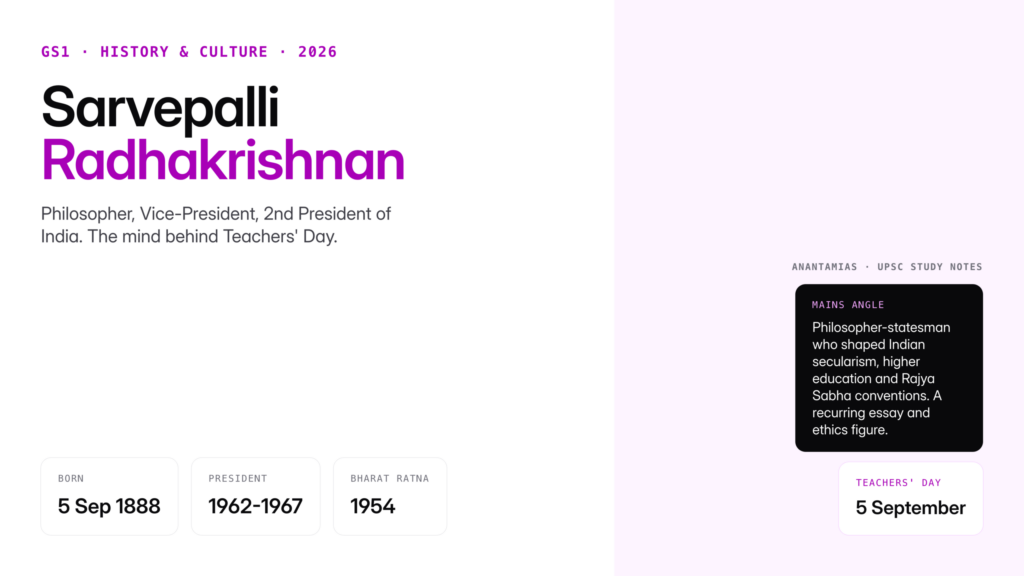
Dr Sarvepalli Radhakrishnan was a philosopher, scholar, diplomat and the second President of the Republic of India. He bridged Indian spiritual traditions with Western academic philosophy, becoming the first Indian to hold the Spalding Chair of Eastern Religions and Ethics at the University of Oxford and later a Vice-President and President of India.
For UPSC aspirants, Radhakrishnan is a multi-paper figure. GS1 cites him among the makers of modern India, GS2 examines his contribution to parliamentary traditions as Chairman of the Rajya Sabha, GS4 draws on his ethical philosophy, and the essay paper often returns to his views on education, secularism and civilisational dialogue. His birthday, 5 September, is celebrated as Teachers’ Day in India at his own suggestion.
Quick Facts at a Glance
| Parameter | Detail |
|---|---|
| Born | 5 September 1888, Tiruttani, Madras Presidency |
| Died | 17 April 1975, Madras |
| Spouse | Sivakamu (married 1903) |
| Education | Madras Christian College (MA Philosophy, 1909) |
| Key chair | Spalding Professor of Eastern Religions and Ethics, Oxford (1936-1952) |
| Ambassador to | USSR (1949-1952) |
| Vice-President of India | 1952-1962 |
| President of India | 1962-1967 (2nd President) |
| Bharat Ratna | 1954 |
| Other honours | Order of Merit (UK, 1963), Templeton Prize (1975), Peace Prize of German Book Trade (1961) |
| Major works | The Hindu View of Life, An Idealist View of Life, Indian Philosophy (2 vols), Eastern Religions and Western Thought |
| Teachers’ Day | 5 September, celebrated from 1962 |
Background and Historical Context
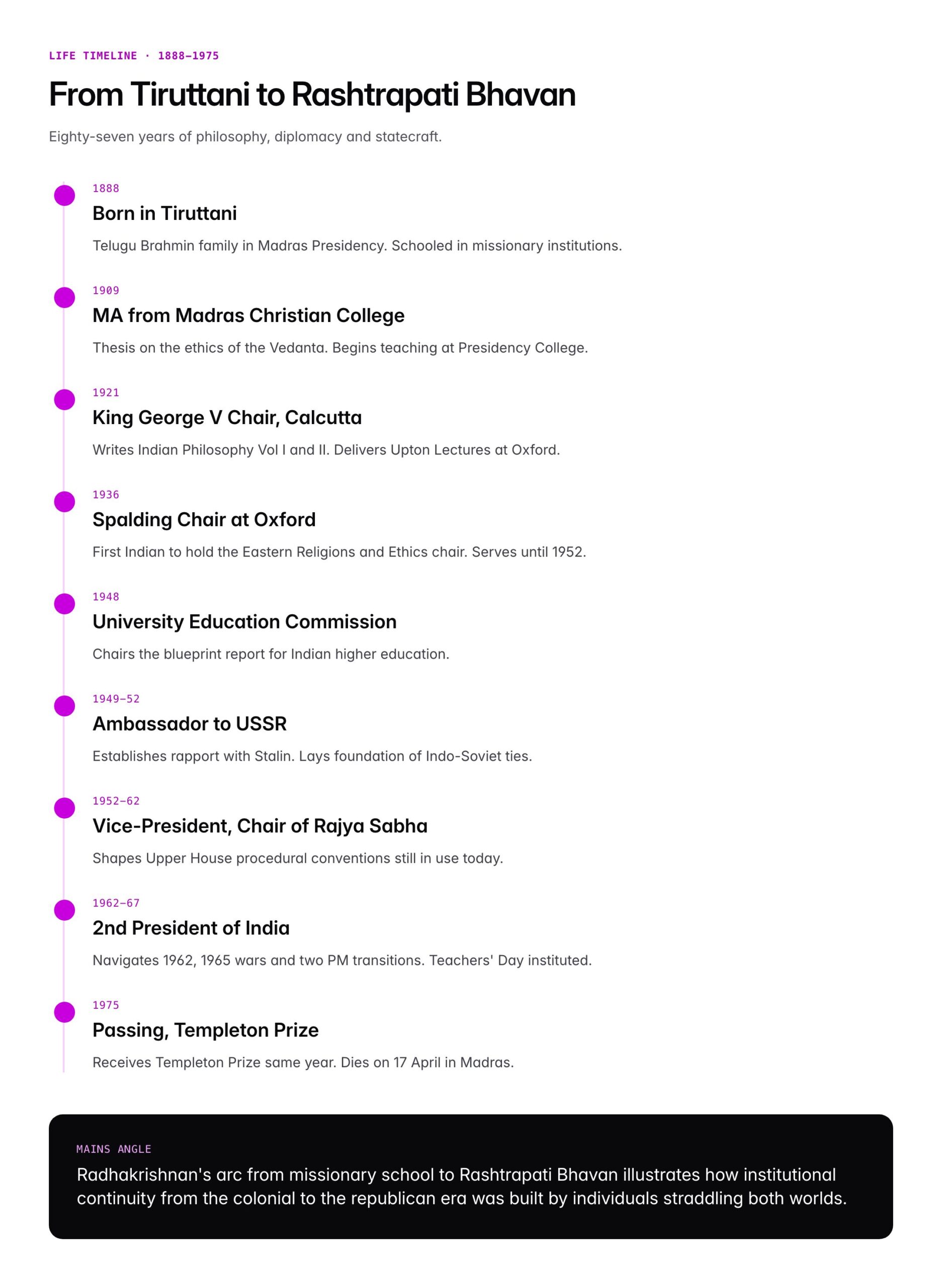
Sarvepalli Radhakrishnan was born into a Telugu Brahmin family in Tiruttani, a pilgrimage town north of Chennai. His father, a revenue official in a local zamindari, wanted him to learn Sanskrit and scripture. Instead, Radhakrishnan won scholarships to Christian missionary schools in Tirupati and Vellore, and eventually to Madras Christian College, where he specialised in philosophy. Confronted by missionary critiques of Hinduism, he chose the ethics of the Vedanta for his MA thesis, an early sign of the intellectual mission he would pursue for six decades.
By his late twenties Radhakrishnan was teaching at Presidency College, Madras, and by 1921 had secured the King George V Chair of Philosophy at the University of Calcutta. He made his international debut with the two-volume Indian Philosophy (1923 and 1927), which restated Indian thought in the vocabulary of Western academic philosophy. This work won him the invitation to deliver the Upton Lectures at Oxford and, in 1936, appointment as Spalding Professor of Eastern Religions and Ethics.
Alongside his scholarship, Radhakrishnan served as Vice-Chancellor of Andhra University (1931-1936) and later Banaras Hindu University (1939-1948), where he defied British attempts to shut down the campus during the Quit India movement. After Independence, he became chair of the University Education Commission (1948-1949), whose report became the blueprint for Indian higher education.
His transition from academia to diplomacy began with his appointment as Ambassador to the Soviet Union in 1949, where he established a personal rapport with Joseph Stalin. From there he moved into the Vice-Presidency in 1952 and the Presidency in 1962, succeeding Dr Rajendra Prasad.
Key Features
Philosophy of Advaita and Ethical Idealism
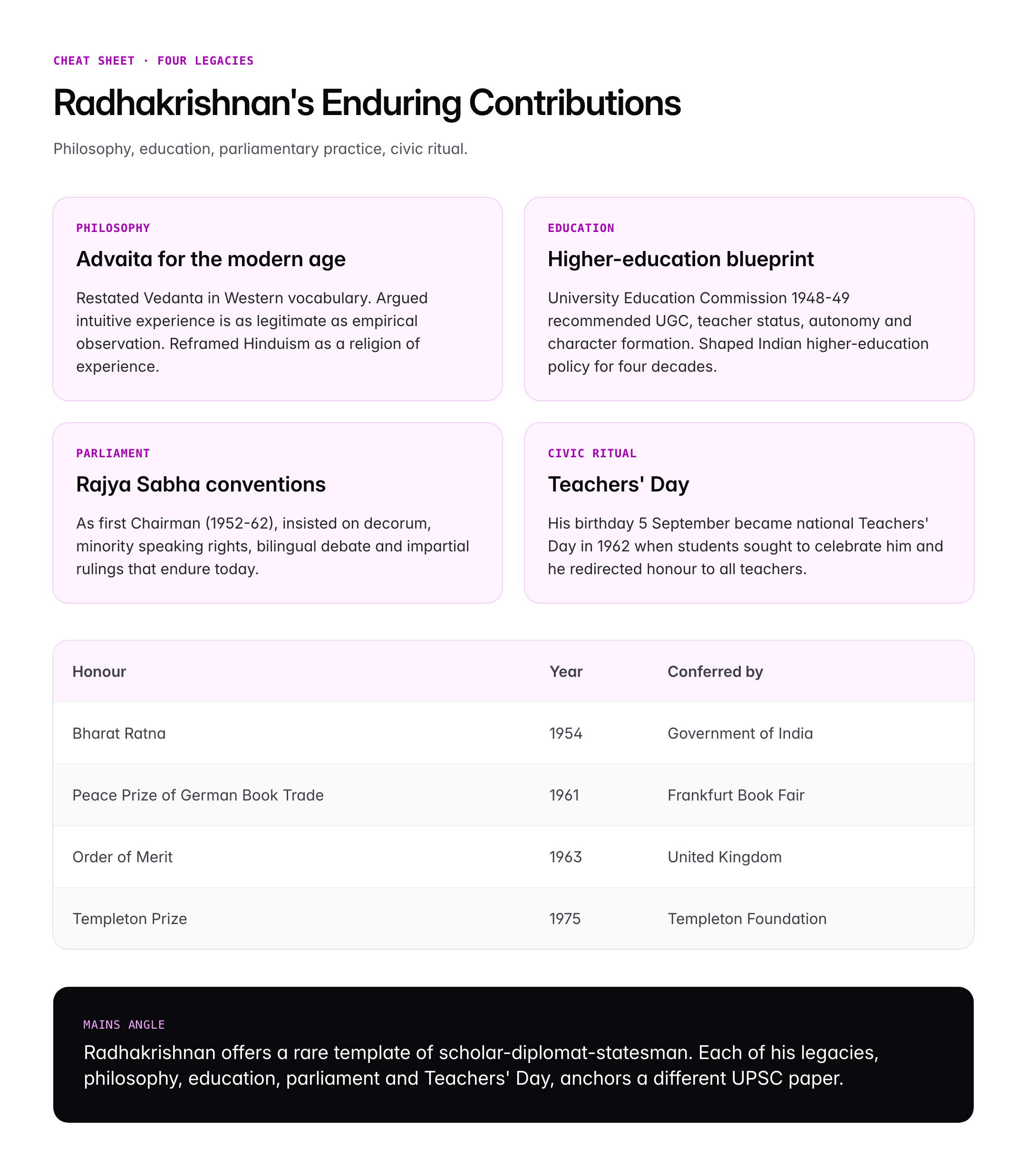
Radhakrishnan’s philosophical system was rooted in Advaita Vedanta, the non-dualism of Adi Shankara, but he refashioned it as a dynamic, ethical idealism suited to the modern age. In An Idealist View of Life (1932) he argued that intuitive experience is as legitimate a source of knowledge as empirical observation, and that the cultivation of inner life is the highest civilisational project.
Religion as Experience
His most widely read book, The Hindu View of Life (1927), positioned Hinduism as a religion of experience rather than dogma. He distinguished between the essentials of religion, which he called anubhava or direct experience, and the accretions of ritual and sect. This framework shaped later interpretations of Indian secularism as equal respect for all faiths rather than strict state-religion separation.
Educational Philosophy
As chair of the University Education Commission, Radhakrishnan authored a vision of higher education as the cultivation of character, not merely the transmission of skills. He insisted that universities be “homes of culture,” that teachers be accorded status and autonomy, and that learning be lifelong. Teachers’ Day itself grew out of this view: when students sought to celebrate his birthday after he became President, he asked them instead to mark 5 September as a day to honour all teachers.
Parliamentary Traditions
As the first Chairman of the Rajya Sabha for two consecutive terms, Radhakrishnan shaped many of its procedural conventions. He insisted on dignity of debate, the right of the minority to be heard, and the use of English and Hindi interchangeably. MPs from across the spectrum, including opposition leaders, recorded their admiration for his impartiality.
Presidency 1962-1967
His tenure as President coincided with the 1962 India-China war, the 1965 India-Pakistan war, and two Prime Ministerial transitions, from Nehru to Shastri to Indira Gandhi. Radhakrishnan used the Presidency as a moral voice, offering counsel to political leaders while scrupulously respecting parliamentary supremacy. His national address after the China war was candid about military failures and has since been cited in debates on civil-military relations.
Significance for UPSC and General Knowledge
- Shaped India’s modern understanding of Hinduism and of comparative philosophy, bridging Indian and Western traditions
- Built the institutional foundation for Indian higher education through the 1948-49 University Education Commission
- Set procedural conventions for the Rajya Sabha as its first Chairman, many still in force
- Demonstrated the President’s role as moral conscience rather than executive actor, an important constitutional convention
- Elevated the status of teachers through the designation of Teachers’ Day, making him a touchstone figure in education debates
- Received the Bharat Ratna in 1954, the Order of Merit in 1963, and the Templeton Prize in 1975, a rare sweep of civil, imperial and religious honours
Detailed Analysis: Philosophy Meets Statecraft
Unlike most philosopher-politicians of the twentieth century, Radhakrishnan practised what he theorised. His diplomacy in Moscow exemplified his belief in dialogue across civilisations: even in Stalin’s Kremlin he spoke of common ground between Indian spiritual traditions and Soviet humanist aspirations. Contemporary accounts record that Stalin, typically frosty with ambassadors, held long personal conversations with Radhakrishnan.
As Vice-President he built the Rajya Sabha’s ethos. His famous rulings insisted that members be given time to complete their points, that interruptions be discouraged, and that the Chairman’s role was to protect minority speaking rights. These conventions are cited by contemporary Vice-Presidents even today, a durable institutional legacy.
As President he broke new ground by publicly advising Prime Ministers. His 1962 broadcast after the Chinese incursions admitted that “credulity and negligence” had led to military reversals, language no contemporary Head of State had used. During the 1965 war he chaired the Emergency Committee of the Cabinet and played an active role in rallying civilian morale. On the succession after Shastri’s death in Tashkent, Radhakrishnan stayed strictly within constitutional bounds, appointing Gulzarilal Nanda as caretaker and letting the Congress Parliamentary Party choose Indira Gandhi.
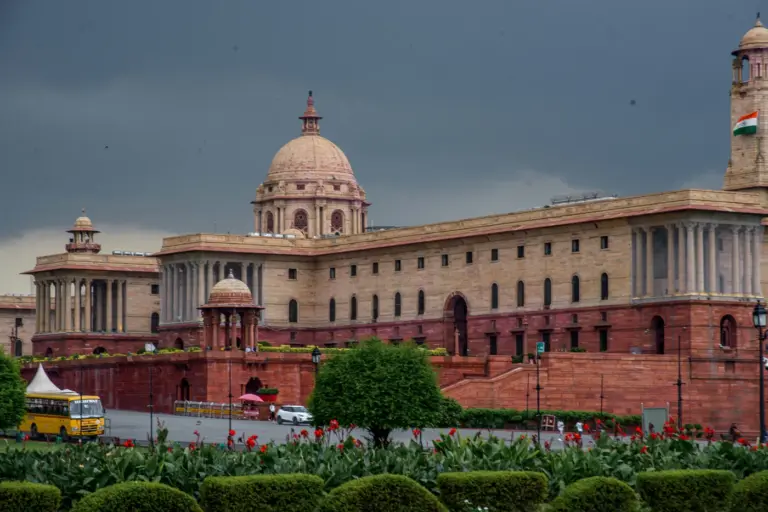
His ethical philosophy, grounded in dharma as duty, shaped his administrative decisions. He refused to accept the full presidential salary, donating a large portion to charity and the Prime Minister’s National Relief Fund. He lived in a modest two-room section of Rashtrapati Bhavan, setting an austere example for Indian public life.
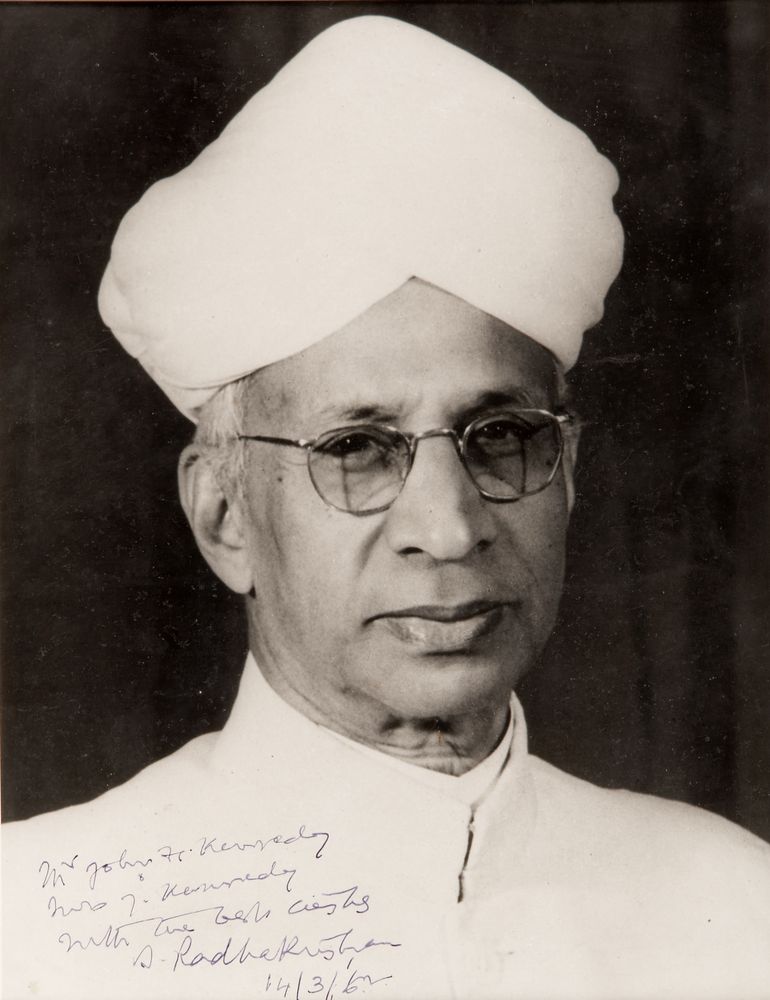
Comparative Perspective
| Figure | Role | Philosophical Orientation | Political Contribution |
|---|---|---|---|
| Sarvepalli Radhakrishnan | 2nd President of India | Advaita Vedanta, ethical idealism | Shaped Rajya Sabha conventions, higher education policy |
| Dr Rajendra Prasad | 1st President of India | Gandhian-moralist | Shepherded Constitution drafting in Constituent Assembly |
| Zakir Husain | 3rd President of India | Gandhian educationist | Chaired National Commission on Basic Education |
| V V Giri | 4th President of India | Socialist-trade union | Major role in 1969 presidential election split |
| Mahatma Gandhi | Freedom movement leader | Ethical Hindu, satyagraha | Mass mobilisation, non-violence |
Compared with his predecessor Rajendra Prasad, Radhakrishnan was more assertive in using the office as a moral platform. Compared with his successor Zakir Husain, he was more engaged with foreign policy, particularly with the Soviet Union and China. His unique niche is that of a working philosopher in the highest constitutional office.
Controversies and Debates
Radhakrishnan’s scholarship has been critiqued by later philosophers, including Paul Hacker, for “neo-Hindu universalism” that allegedly flattened doctrinal differences within and across religions. Scholars such as Wilhelm Halbfass have argued that his reading of Vedanta as inclusive of all religions was itself a modern construction, not faithful to classical Advaita. These debates continue in departments of comparative religion.
There are also contemporary charges of plagiarism levelled in the 1929 Madras High Court case of Jadunath Sinha, a student at Calcutta who alleged that Radhakrishnan had used his unpublished PhD material in Indian Philosophy Volume II. The case was settled out of court without admission of liability, but the episode is periodically revisited. Radhakrishnan’s defenders argue that thematic overlap was inevitable given shared syllabi and that the matter was professionally closed.
As President, some critics argue he was too deferential to the ruling Congress in appointments of Governors and in not questioning the economic crisis of 1966-67 more forcefully. Others counter that a constitutional Head of State has limited room to dissent in the Westminster model.
Prelims Pointers
- Sarvepalli Radhakrishnan was born on 5 September 1888 in Tiruttani
- He was the 2nd President of India, serving from 1962 to 1967
- He served as Vice-President from 1952 to 1962 and was the first Chairman of the Rajya Sabha
- He held the Spalding Chair of Eastern Religions and Ethics at Oxford from 1936 to 1952
- He served as India’s Ambassador to the USSR from 1949 to 1952
- He was awarded the Bharat Ratna in 1954, the same year as C Rajagopalachari and C V Raman
- He received the British Order of Merit in 1963 and the Templeton Prize in 1975
- Teachers’ Day in India is observed on 5 September in his honour
- His major works include The Hindu View of Life, An Idealist View of Life and Indian Philosophy
- He chaired the University Education Commission of 1948-1949
- He was Vice-Chancellor of Andhra University (1931-1936) and Banaras Hindu University (1939-1948)
- He was nominated for the Nobel Prize in Literature multiple times between 1933 and 1963
Mains Practice Questions
- “Sarvepalli Radhakrishnan’s contribution to Indian public life went beyond the ceremonial functions of Presidency.” Elucidate.
- Discuss his role in shaping Rajya Sabha procedural conventions as its first Chairman
- Examine the 1948-49 University Education Commission and its continuing influence on Indian higher education
- Analyse his use of the Presidency as a moral platform during the 1962 and 1965 wars
- Evaluate Dr Radhakrishnan’s philosophical vision of Indian secularism and its relevance to contemporary constitutional debates.
- Outline his definition of Hinduism as a religion of experience rather than dogma
- Contrast his pluralist model with strict state-religion separation
- Connect his framework with Articles 25-28 and current debates on minority rights
Conclusion
Radhakrishnan was the rare public figure whose scholarship, diplomacy and politics drew from a coherent ethical vision. His books remain foundational readings in Indian philosophy, his Rajya Sabha conventions still govern parliamentary practice, and his designation of Teachers’ Day is a recurring civic ritual for generations of Indian students.
For UPSC aspirants, his life rewards close reading. He exemplifies how disciplined thought, public service and institutional-building can be braided into a single career, offering a template of the philosopher-statesman that remains relevant in contemporary Indian public life.
Frequently Asked Questions
Who was Sarvepalli Radhakrishnan?
Sarvepalli Radhakrishnan was a philosopher-statesman, scholar of comparative religion and the 2nd President of India. Born on 5 September 1888 in Tiruttani, he held the Spalding Chair at Oxford, served as Vice-President from 1952 to 1962, President from 1962 to 1967, and received the Bharat Ratna in 1954.
Why is Sarvepalli Radhakrishnan important for UPSC?
He appears across GS1 as a modern maker of India, GS2 for constitutional conventions as Rajya Sabha Chairman, GS4 for ethical philosophy, and essay prompts on education and secularism. His 1948-49 University Education Commission shaped Indian higher education, and his use of the Presidency as a moral office is a standard case study.
How is Radhakrishnan related to Teachers’ Day in India?
Teachers’ Day is celebrated in India on 5 September because that is Radhakrishnan’s birthday. When students sought to celebrate his birthday after he became President in 1962, he asked them to mark it instead as a day to honour all teachers, recognising education as the foundation of national progress.
Which books did Sarvepalli Radhakrishnan write?
His major works include Indian Philosophy (two volumes, 1923 and 1927), The Hindu View of Life (1927), An Idealist View of Life (1932), Eastern Religions and Western Thought (1939), and translations with commentary of the Bhagavad Gita, the Principal Upanishads and the Brahma Sutras. He authored over 25 books across a six-decade career.
What were Radhakrishnan’s diplomatic contributions?
He served as India’s Ambassador to the Soviet Union from 1949 to 1952, where he built rare personal rapport with Joseph Stalin and laid the foundations of Indo-Soviet ties. He also led delegations to UNESCO, serving as Chairman of its Executive Board in 1948-49, and represented India in academic conferences across Europe and the United States.
What awards did Dr Radhakrishnan receive?
He received the Bharat Ratna in 1954 in the first round of the award alongside C Rajagopalachari and C V Raman, the British Order of Merit in 1963, the Peace Prize of the German Book Trade in 1961, the Templeton Prize in 1975, and was nominated for the Nobel Prize in Literature multiple times between 1933 and 1963.
What was Radhakrishnan’s philosophical contribution?
He restated Advaita Vedanta in modern philosophical vocabulary, arguing that intuitive spiritual experience is a legitimate source of knowledge alongside reason. His ethical idealism presented Hinduism as a religion of experience rather than dogma, shaping Indian secularism as equal respect for all faiths rather than strict state-religion separation.
How did Radhakrishnan shape the Rajya Sabha?
As the first Chairman of the Rajya Sabha for two terms between 1952 and 1962, he established conventions on decorum, the right of the minority to be heard, time management and bilingual debate. These procedural traditions are still cited by contemporary Vice-Presidents and form part of the institutional culture of the Upper House.
Tell Google you want more of this.
Add Anantam IAS as a preferred sourceOne tap, and this site shows up more often in your own Top Stories, AI Overviews and AI Mode. Remove it any time.