SDM Full Form: Meaning, Powers, Salary & How to Become One
SDM stands for Sub-Divisional Magistrate. Learn the SDM's BNSS powers, duties, salary, place in district administration, and routes into the role.
The SDM full form is Sub-Divisional Magistrate. An SDM heads a sub-division within a district and combines revenue administration, executive-magisterial work, certificates, elections, disaster response and coordination with police and local bodies.
The post is commonly held by a junior IAS officer or an officer of the State Civil Service. Under the Bharatiya Nagarik Suraksha Sanhita, 2023, Section 14 provides for an Executive Magistrate placed in charge of a sub-division to be called the Sub-Divisional Magistrate.
Use the official BNSS text for current section numbers. The law came into force on 1 July 2024, so older CrPC labels should now be treated as former equivalents rather than the operative provisions.
Quick facts: SDM full form and key parameters
| Parameter | Detail |
|---|---|
| SDM full form | Sub-Divisional Magistrate |
| Category | District Administration · Executive Magistracy |
| Legal basis | Section 14, BNSS 2023 (replaces Section 20 CrPC) |
| Typical incumbent | IAS officer (Junior Time Scale, Pay Level 10) or senior State Civil Service officer |
| Reports to | District Magistrate / Collector |
| Jurisdiction | Sub-division (2–4 tehsils) |
| Posting timing for IAS | Year 1–4 of service, after LBSNAA training |
| UPSC relevance | Prelims, GS-II Mains, GS-IV ethics, Personality Test |
What does SDM mean? Three precise words
The SDM full form is Sub-Divisional Magistrate. The three words carry distinct constitutional and administrative weight, and UPSC tests them separately.
- Sub-Divisional identifies the territorial unit. A sub-division sits between the district and the tehsil/taluka in India’s administrative ladder, usually containing 2–4 tehsils.
- Magistrate signals executive-magisterial authority. The SDM exercises preventive, regulatory, and inquest powers — not judicial trial powers — under the BNSS, 2023.
- The hyphenation matters. “Sub-Divisional” is one word with one meaning; “Sub Divisional” or “Subdivisional” are loose substitutes. The official BNSS term is “Sub-divisional Magistrate.”
The SDM is an Executive Magistrate, not a Judicial Magistrate. This separation, formalised by the CrPC Amendment of 1973 and now carried into the BNSS, 2023, is a foundational concept in Indian polity. Executive Magistrates handle prevention and administration; Judicial Magistrates handle trials and convictions. The two streams report to different chains of command.
Legal basis: Section 14 BNSS and the 2024 transition
From 1 July 2024, the BNSS replaced the Code of Criminal Procedure (CrPC). The SDM’s magisterial role now sits in Section 14 BNSS, which says: “The State Government may place an Executive Magistrate in charge of a sub-division… and the Magistrate so placed in charge of a sub-division shall be called the Sub-divisional Magistrate.”
Other Executive Magistrates in the sub-division are subordinate to the SDM, and the SDM is in turn subordinate to the District Magistrate. This three-step chain — DM → SDM → other Executive Magistrates — is the field-administration backbone of every Indian district.
Old CrPC sections, new BNSS sections
UPSC has started to test the new BNSS section numbers. Memorising the mapping is non-negotiable.
| Power | Old CrPC section | New BNSS section |
|---|---|---|
| SDM appointment | Section 20 CrPC | Section 14 BNSS |
| Prohibitory orders (“Section 144”) | Section 144 CrPC | Section 163 BNSS |
| Preventive bonds for breach of peace | Sections 107–110 CrPC | Sections 126–129 BNSS |
| Public-nuisance orders | Section 133 CrPC | Section 152 BNSS |
| Land/water dispute likely to cause breach of peace | Section 145 CrPC | Section 164 BNSS |
| Inquest into unnatural deaths | Section 174 CrPC | Section 194 BNSS |
If a Prelims question gives you the old “Section 144” framing, the BNSS equivalent is Section 163. The substantive content is mostly preserved; the numbering and a few procedural details have shifted.
Six functions of the SDM, explained with examples
The SDM job rolls six different mandates into one chair. A high-scoring Mains answer treats them as a working list, not a textbook taxonomy.
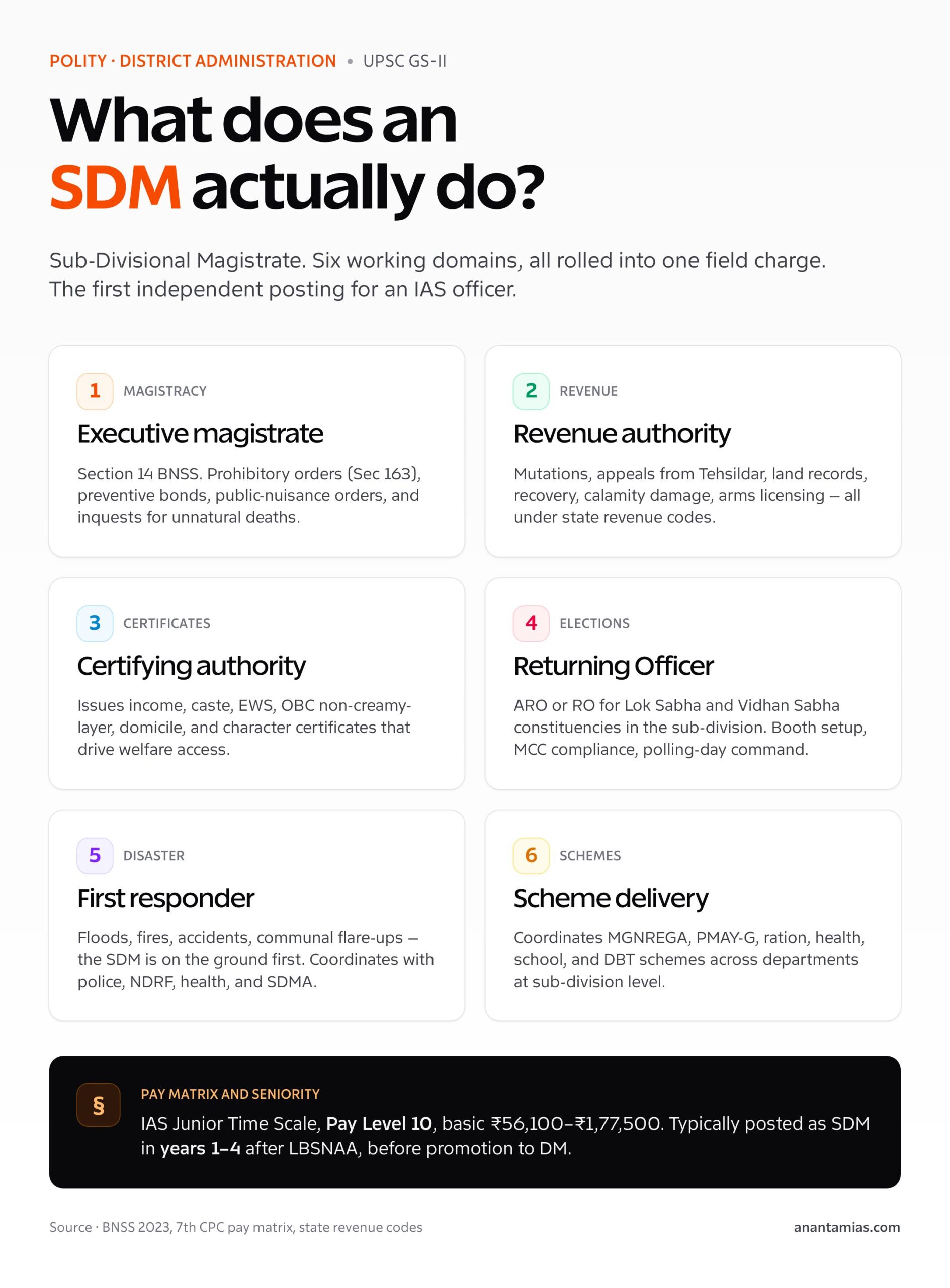
1. Executive magistrate
This is the magisterial half of the role. Operating under Section 14 BNSS, the SDM exercises preventive and regulatory powers within the sub-division.
- Section 163 BNSS: prohibitory orders to prevent unlawful assembly, riot, or risk to public peace. The colloquial “Section 144” of the past.
- Sections 126–129 BNSS: preventive bonds for keeping the peace and good behaviour, used for habitual offenders and persons likely to commit cognisable offences.
- Section 152 BNSS: conditional orders for removal of public nuisances — illegal structures, unsafe wells, hazardous trades, polluting emissions.
- Section 194 BNSS: inquest proceedings in cases of unnatural death (suicide, custodial death, accident, fire), with reports forwarded to the DM and to the relevant judicial authority.
2. Revenue authority
Revenue is the older half of the SDM job — older than the criminal code, in fact. The SDM is the revenue appellate authority above the Tehsildar within the sub-division.
- Land mutation appeals from Tehsildar decisions.
- Supervision of land records (Record of Rights, jamabandi, khatauni in different states).
- Revenue recovery proceedings under state Public Demands Recovery Acts.
- Damage assessment and relief disbursal during natural calamities like floods, hailstorms, and crop loss.
- Arms-licence issuance, renewal, and cancellation under the Arms Act, 1959.
- Land conversion permissions (agriculture to non-agriculture) in many states.
3. Certificate and attestation work
For most citizens, the SDM is the face of the State they actually meet. Certificate work is the everyday volume of the office.
- Income certificates — used for EWS reservation, scholarship eligibility, and welfare-scheme access.
- Caste certificates — SC, ST, OBC verification and issuance, including OBC non-creamy-layer determination.
- Domicile and residence certificates for state-quota admissions and recruitment.
- Character certificates for government employment and passport verification.
- Solvency certificates for tenders and contracts.
- Affidavit attestations, marriage registration in some states, and notary-equivalent functions where state law allows.
4. Returning Officer for elections
During Lok Sabha, Vidhan Sabha, and local-body elections, the Election Commission of India deploys SDMs as Returning Officers (RO) or Assistant Returning Officers (ARO) for constituencies within the sub-division.
- Booth setup, polling-personnel deployment, EVM and VVPAT logistics.
- Model Code of Conduct enforcement at sub-division level.
- Counting-day command, scrutiny of nominations, and result declaration for the constituency they cover.
- Coordination with the District Election Officer (the DM) on law and order, force deployment, and complaint redressal.
5. First responder for disasters and crises
Disaster management is one of the most testable angles of the SDM job. Under the Disaster Management Act, 2005, the District Disaster Management Authority (DDMA) is chaired by the DM, and the SDM is the field-level coordinator within the sub-division.
- First on-ground assessment for floods, cyclones, fires, road accidents, building collapses, and epidemic outbreaks.
- Coordination with police, fire, NDRF, SDRF, health, and revenue departments.
- Emergency relief distribution, ex gratia disbursement, and shelter management.
- Communal tension de-escalation through Section 163 BNSS prohibitory orders, curfew recommendations to the DM, and field intelligence.
For the wider framework, see disaster management in India, the NDMA structure, and the Disaster Management Amendment Bill 2024.
6. Scheme delivery and development coordination
The Second Administrative Reforms Commission specifically asked for the SDM’s role to evolve from regulation to development. In 2026, the SDM is the field-level convener for:
- MGNREGA, PMAY-G, PM-KISAN, and other welfare schemes through monthly review meetings with line departments.
- Public Distribution System and ration coverage at sub-division level.
- School and Anganwadi monitoring through random visits.
- Direct Benefit Transfer (DBT) verification and grievance redressal.
- Public hearings (Janata Darbar / samadhan diwas) on a fixed weekly cadence in most states.
Where the SDM fits: district administration hierarchy
| Level | Officer | Jurisdiction |
|---|---|---|
| Revenue Division | Divisional Commissioner | Multiple districts |
| District | District Magistrate / Collector / Deputy Commissioner | Entire district |
| Sub-Division | Sub-Divisional Magistrate (SDM) | Sub-division (2–4 tehsils) |
| Tehsil / Taluka | Tehsildar / Mamlatdar / BDO (in some states) | Tehsil |
| Block | Block Development Officer (BDO) | Development block |
| Circle | Naib Tehsildar / Kanungo / Revenue Inspector | Circle within tehsil |
| Village | Patwari / Lekhpal / Karnam / Talati | Village-level land records |
The SDM is the critical link between the district headquarters and the field. The DM relies on SDMs for ground-truth reporting, while citizens experience the State mostly through the SDM and below. For the broader civil-services map, see our explainer on the Indian Administrative Hierarchy: SDM to Cabinet Secretary.
SDM vs DM: clean comparison
| Parameter | SDM | DM |
|---|---|---|
| Full form | Sub-Divisional Magistrate | District Magistrate |
| Jurisdiction | Sub-division (part of a district) | Entire district |
| Service | Junior IAS (Year 1–4) or senior SCS | Mid-career IAS (typically Year 5–9 or later) |
| Pay matrix level | Level 10 (Junior Time Scale) | Level 11 (Senior Time Scale) and above |
| Magisterial powers | Delegated; full Section 14 BNSS authority within sub-division | Original Executive Magistrate of the district |
| Reports to | District Magistrate | Divisional Commissioner |
| Section 163 BNSS (old 144) | Exercises within sub-division when delegated | Original power holder for the district |
| DDMA | Field coordinator, member | Chairs the DDMA |
| Election role | Returning Officer / ARO for constituencies | District Election Officer for the district |
SDM vs SDO: the title difference, not the function difference
Several states use the title SDO (Sub-Divisional Officer) instead of SDM. The functions are largely identical; the nomenclature reflects state-specific administrative tradition.
| State / UT | Title used | Notes |
|---|---|---|
| Uttar Pradesh, Bihar, Rajasthan, Punjab, Haryana, Delhi, Madhya Pradesh, Uttarakhand | SDM | Standard usage |
| West Bengal | SDO | SDO is the headline title; SDM is the magisterial role within |
| Maharashtra, Gujarat (in parts) | Sub-Divisional Officer (Revenue) / Prant Adhikari | Revenue role styled differently |
| Bihar (in some districts) | SDM and SDO both | Two roles in some cases |
| Tamil Nadu | Revenue Divisional Officer (RDO) | RDO is the equivalent |
| Karnataka | Assistant Commissioner / Sub-Divisional Magistrate | Both titles are used |
The simple rule for UPSC: if the constitutional and BNSS function is “in charge of a sub-division as Executive Magistrate,” the officer is an SDM regardless of the local title.
Who becomes an SDM, and how?
IAS officers
Most SDM postings in larger or politically sensitive sub-divisions are held by IAS officers. The path is the standard one:
- Clear UPSC Civil Services Examination and join the IAS.
- Complete the Foundation Course at LBSNAA, Mussoorie, followed by the Phase-I and Phase-II training.
- Cadre allocation, district training, and Assistant Collector posting.
- SDM posting, typically in Year 1 to Year 4 of service.
- Promotion to DM (Senior Time Scale) usually follows by Year 5 to Year 9, depending on cadre.
State Civil Service officers
State Civil Service (SCS) officers — recruited through state public service commission examinations like UPPSC, BPSC, RPSC, MPPSC, and TNPSC — also serve as SDMs after seniority and promotion. In several states, the majority of sub-divisions are headed by SCS officers, with IAS officers placed in the larger or more sensitive sub-divisions.
SCS officers can be promoted into the IAS through the SCS-to-IAS quota under the IAS (Appointment by Promotion) Regulations, 1955. After IAS promotion, an SCS officer who served as SDM can later become DM.
SDM salary, allowances, and perks in 2026
For an IAS officer in Junior Time Scale, the SDM compensation in 2026 is structured as follows under the 7th Central Pay Commission framework.
| Component | Detail |
|---|---|
| Pay matrix level | Level 10 (Junior Time Scale) |
| Basic pay range | ₹56,100 to ₹1,77,500 |
| Starting basic pay | ₹56,100 per month |
| Approx. gross monthly | ₹83,000 to ₹88,000 (basic + DA + allowances) |
| Approx. annual CTC | ₹9 lakh to ₹15 lakh, rising with DA |
| HRA / housing | Government bungalow with staff in most states |
| Vehicle | Official vehicle with driver, often more than one for field duties |
| Security | House guards, personal security as per state norms |
| Study leave | Up to 2–4 years for higher education with pay |
| Pension | Lifetime pension and family pension on retirement |
SCS officers serving as SDMs are paid on the equivalent state pay matrix level, which is broadly comparable but varies state to state.
A day in the life of an SDM
Examiner-friendly, but also a useful lens for an aspirant who wants to picture the job rather than memorise it.
- 9:00 AM: Office opens. The morning starts with the Tehsildar’s report — overnight law-and-order incidents, accidents, deaths, and fresh disputes.
- 10:00 AM: Public hearing. Citizens line up for income certificates, mutation appeals, ration grievances, and complaints. The SDM hears and disposes the simpler cases on the spot, sends the rest for verification.
- 12:00 noon: Field visit. A flood-damaged village, an under-construction school, a polluting factory — the SDM verifies on the ground rather than relying on paper.
- 2:00 PM: Coordination meeting. Health, education, public works, police — the SDM convenes line departments on a scheme review or an upcoming festival deployment.
- 4:00 PM: Court duty. The SDM hears revenue appeals as a quasi-judicial authority, with arguments from advocates and parties.
- 7:00 PM: Reports. Daily situation report to the DM. Election-period night patrols when applicable. On disaster days, this clock breaks completely and runs on the situation, not the calendar.
Historical context: from Bengal Regulation 1793 to BNSS 2023
The sub-divisional tier did not appear by accident. It was a colonial response to a real administrative problem.
- 1772: Warren Hastings sets up the Collector system in Bengal districts.
- 1793: The Bengal Regulation formalises the District Collector’s revenue role.
- 1860s onwards: British districts are split into sub-divisions because a single Collector cannot supervise the entire district. The sub-divisional tier is born.
- 1947: Independence preserves the structure. The IAS replaces the ICS as the cadre that staffs the senior posts.
- 1966–70: The First Administrative Reforms Commission under Morarji Desai examines district administration.
- 1973: The CrPC Amendment formally separates Executive and Judicial Magistrates. The SDM, as a State-government Executive Magistrate, sits in the Executive stream.
- 2005–09: The Second ARC under Veerappa Moily recommends shifting the SDM toward development coordination and reducing the regulatory load.
- 2023–24: The BNSS, 2023 replaces the CrPC, with effect from 1 July 2024. Section 14 BNSS now governs the SDM appointment, and Section 163 BNSS replaces the old Section 144.
SDM in disaster management and the DDMA
Under the Disaster Management Act, 2005, the District Disaster Management Authority (DDMA) is chaired by the DM and includes the Superintendent of Police, the Chief Medical Officer, the Executive Engineer of Public Works, and the SDM as the lead field officer for the affected sub-division.
- Pre-disaster: identification of vulnerable villages, flood-marker installation, evacuation drills.
- During disaster: first situation reports, deployment of NDRF/SDRF, opening of relief camps, ration provisioning.
- Post-disaster: damage assessment, ex gratia disbursal, rehabilitation coordination, lessons-learned reports up the line.
The Disaster Management Amendment Act, 2024 has clarified institutional roles further, with stronger emphasis on the field officer’s accountability and on the integration of climate adaptation into DDMA plans.
SDM in Ethics and the Personality Test
SDM scenarios are the most common case-study pattern in GS Paper IV (Ethics) and in the Interview. The reason is simple. The SDM is the highest officer who routinely makes decisions in front of citizens with limited senior backup, often within hours.
- Communal tension at a religious procession: Section 163 BNSS, force deployment, dialogue with community leaders, balancing free movement with safety.
- Land-records dispute with political pressure: Quasi-judicial duty under state revenue code, transparency, refusal to favour any side, written orders.
- Disaster relief with limited resources: Triage of beneficiaries, compassion without favouritism, audit-trail thinking.
- Encroachment removal of a religious structure: Court orders, due notice, sensitivity to community feelings, neutral execution.
- Whistle-blower from a department: Confidentiality, protection of the complainant, separation of inquiry from administrative action.
For background on the ethical frameworks UPSC expects, see factors affecting ethics, value, definition and types, and features of public relationship.
Common SDM-related Prelims traps
- Executive vs Judicial Magistrate: the SDM is Executive. Judicial Magistrates of First Class and Second Class are under the High Court, not the State Government.
- Section 144 vs Section 163: after BNSS 2023, “Section 144” is no longer the correct citation. Use Section 163 BNSS for prohibitory orders.
- SDO vs SDM: in West Bengal, the SDO is the position; in Tamil Nadu, the equivalent is the RDO. The function is the same.
- Pay level: SDM is Level 10 (JTS), DM is Level 11 (STS) and above. Do not confuse JTS with STS.
- Election role: SDM is RO/ARO at constituency level, DM is District Election Officer. Do not blend the two.
- Disaster authority: the DDMA is chaired by the DM, not the SDM. The SDM is a member or an invitee, depending on state rules.
Quasi-judicial powers: the SDM as revenue court
One of the least-discussed but most testable angles is the SDM’s role as a quasi-judicial authority under state revenue codes. Each State has its own land revenue legislation — the UP Revenue Code 2006, the Bihar Tenancy Act, the Rajasthan Land Revenue Act 1956, the MP Land Revenue Code 1959, and so on. Most of these codes designate the SDM as a revenue court for a defined set of disputes.
- Mutation appeals against Tehsildar orders, with the SDM as the first appellate authority.
- Partition suits under state revenue rules, where the SDM passes preliminary and final orders.
- Boundary disputes between adjoining holders, decided after demarcation by the patwari and verification.
- Tenancy disputes, including allotments, surrender, and resumption of land in some states.
- Encroachment removal on government and Gram Sabha land, with notice, hearing, and reasoned orders.
The procedure mimics a civil court — written pleadings, evidence, witnesses, written orders, appeal rights — but the SDM is not a civil judge. Appeals from SDM orders typically lie with the District Collector and then with the Divisional Commissioner or the Board of Revenue, depending on the state. This is the part of the job that turns a young IAS officer from administrator into a careful, reasoned decision-maker very quickly.
Reform agenda: Second ARC and beyond
The Second Administrative Reforms Commission (Veerappa Moily, 2005–09) made a sustained set of recommendations that still drive the modern SDM agenda.
- Shift from regulator to facilitator: reduce the SDM’s burden of routine certificates by digitising eligibility, and free up bandwidth for development coordination.
- Citizen Charters and Time-Bound Service Delivery Acts: several states (Bihar, Madhya Pradesh, Karnataka, Delhi) have legislated time limits for SDM-issued certificates with appeal mechanisms.
- e-District and digital service delivery: certificate issuance increasingly happens through state portals, with the SDM as the digital signing authority rather than the manual issuer.
- Aadhaar-based authentication: for income, caste, domicile certificates, reducing duplication and fraud.
- Capacity building: mid-career training at LBSNAA and state academies on new BNSS sections, data-driven governance, and crisis communication.
The reform direction is consistent: less paper, less file-pushing, more on-the-ground stewardship. The next decade of SDM work will look less like an administrative bottleneck and more like a public-service delivery node, plugged into India Stack and the state-level digital service ecosystems.
SDM and the Right to Information Act
One often-overlooked dimension of the SDM role is its place in the Right to Information Act, 2005. Most state governments designate the SDM (or an officer in the SDM office) as a Public Information Officer (PIO) for the sub-division. The SDM also functions as the First Appellate Authority for RTI appeals against PIOs working under her in tehsil and block offices. That makes the SDM a regular interface with the transparency regime — replying to applications, conducting fee waivers for BPL applicants, and disposing first appeals within thirty days. RTI volumes at the SDM office have risen sharply since 2015, and timely disposal is now a routine performance metric.
UPSC relevance and answer scaffold
| Paper | How SDM appears |
|---|---|
| Prelims GS | SDM full form, BNSS Section 14, Section 163 (prohibitory orders), executive vs judicial magistrate, district hierarchy |
| Mains GS-II | District administration, federal field-level governance, civil services reform, role of generalist administrators |
| Mains GS-IV | SDM-as-officer ethical case studies — discretion, conflict of interest, whistle-blowing, crisis decision-making |
| Personality Test | “Walk me through district administration” and “What would you do as an SDM if…” scenarios |
A 250-word Mains scaffold on the SDM’s role
- Definition: SDM full form is Sub-Divisional Magistrate. The SDM is an Executive Magistrate placed in charge of a sub-division under Section 14 BNSS, 2023.
- Hierarchy: Sits between the District Magistrate and the Tehsildar in the field-administration ladder.
- Six functions: Executive magistracy, revenue administration, certifying authority, election officer, disaster first responder, scheme delivery.
- Powers under BNSS: Section 163 (prohibitory orders), Sections 126–129 (preventive bonds), Section 152 (public-nuisance orders), Section 194 (inquest).
- Strengths: Single-point coordination at the field level, generalist span, citizen-facing presence, decisive in crises.
- Limitations: Heavy regulatory load, low staff strength, political pressure, urgent-vs-important balance.
- Reform direction: Second ARC’s call for a development-led role, technology-enabled service delivery, separation of routine certificate work from policy and crisis response.
- Conclusion: The SDM is where the State meets the citizen most often. A modern, capable, ethical SDM cadre is therefore central to public-service delivery and to the credibility of the executive.
Key takeaways
- The SDM full form is Sub-Divisional Magistrate — Executive Magistrate in charge of a sub-division under Section 14 BNSS, 2023.
- Six core functions: executive magistracy, revenue, certificates, elections, disasters, schemes.
- BNSS section map: 144 CrPC → 163 BNSS; 107–110 CrPC → 126–129 BNSS; 133 CrPC → 152 BNSS; 174 CrPC → 194 BNSS.
- SDMs are typically IAS Junior Time Scale (Pay Level 10) officers in Year 1–4 of service, or senior State Civil Service officers.
- SDM is not a Judicial Magistrate; it is an Executive Magistrate in the State Government chain.
- For ethics and interview, the SDM is the most useful lens for thinking about field-level discretion, crisis management, and citizen-facing administration.
Frequently asked questions
What is the full form of SDM?
The SDM full form is Sub-Divisional Magistrate. The SDM is an Executive Magistrate placed in charge of a sub-division of a district under Section 14 of the Bharatiya Nagarik Suraksha Sanhita (BNSS), 2023.
What is the legal basis for an SDM under BNSS?
Under the new BNSS, 2023 (effective from 1 July 2024), Section 14 BNSS empowers the State Government to place an Executive Magistrate in charge of a sub-division as the SDM. Other Executive Magistrates in the sub-division are subordinate to the SDM, and the SDM is in turn subordinate to the District Magistrate.
What replaced Section 144 CrPC for SDMs?
After BNSS, 2023, the prohibitory orders previously issued under Section 144 CrPC are now issued under Section 163 BNSS. The substantive content is largely the same — preventing unlawful assembly, riot, or risk to public peace — but the section number and a few procedural details have changed.
Is an SDM an IAS or a State Civil Service officer?
Both. SDM postings in larger or politically sensitive sub-divisions are typically held by IAS officers in Junior Time Scale (Pay Level 10) in their first 1–4 years of service. In several states, the majority of sub-divisions are headed by senior State Civil Service (SCS) officers, who can later be promoted to IAS through the SCS-to-IAS quota.
What is the salary of an SDM in India?
An IAS SDM is paid on Pay Matrix Level 10 (Junior Time Scale), with a basic pay of ₹56,100 to ₹1,77,500. Gross monthly salary including DA and allowances ranges from ₹83,000 to ₹88,000, with annual CTC of ₹9–15 lakh. Perks include a government bungalow, official vehicle, security cover, study leave of up to 2–4 years with pay, and a lifetime pension.
What is the difference between SDM and DM?
The DM (District Magistrate) heads the entire district; the SDM heads a sub-division within the district. In pay terms, the DM is on Senior Time Scale (Level 11+) and the SDM is on Junior Time Scale (Level 10). The DM is the original Executive Magistrate of the district under BNSS; the SDM exercises Section 14 BNSS authority within the sub-division and reports to the DM.
What is the difference between SDM and SDO?
The functions are largely the same; the title differs by state. In states like West Bengal and parts of Maharashtra, the official title is SDO (Sub-Divisional Officer). In Tamil Nadu the equivalent is the Revenue Divisional Officer (RDO). In most North Indian states (UP, Bihar, Rajasthan, Haryana, Punjab, MP, Uttarakhand), the title is SDM.
Is the SDM a judicial magistrate?
No. The SDM is an Executive Magistrate, not a Judicial Magistrate. The two streams were formally separated by the CrPC Amendment of 1973 and continue under BNSS, 2023. Executive Magistrates handle prevention, regulation, and administration; Judicial Magistrates conduct trials and pass convictions and are under the High Court.
What role does the SDM play during elections?
During Lok Sabha, Vidhan Sabha, and local body elections, the Election Commission of India deploys the SDM as the Returning Officer (RO) or Assistant Returning Officer (ARO) for constituencies in the sub-division. The SDM handles booth setup, polling-personnel deployment, MCC enforcement, scrutiny of nominations, and counting-day command for the constituency.
How does an SDM contribute to disaster management?
Under the Disaster Management Act, 2005, the District Disaster Management Authority (DDMA) is chaired by the DM. The SDM is the field-level coordinator and first responder for the affected sub-division — coordinating police, NDRF/SDRF, health, and revenue departments; running relief camps; assessing damage; and disbursing ex gratia. The Disaster Management Amendment Act, 2024 has further strengthened these roles.