If ethics is the systematic study of right action, values are the enduring preferences that orient an agent toward right action long before any specific dilemma arises. The civil servant who walks into a sticky file with strong values resolves the file faster, more consistently, and more defensibly than one who walks in without them. The UPSC GS-IV syllabus places values beside attitude, aptitude and integrity among the foundational concepts because values are the compass on which everything else is calibrated.
This guide expands the compass extract on Value into a Mains-quality reference with definitions, types, formation processes, the values-vs-ethics distinction, and Indian case studies.
Defining Value
The compass extract gives three working definitions, all usable verbatim.
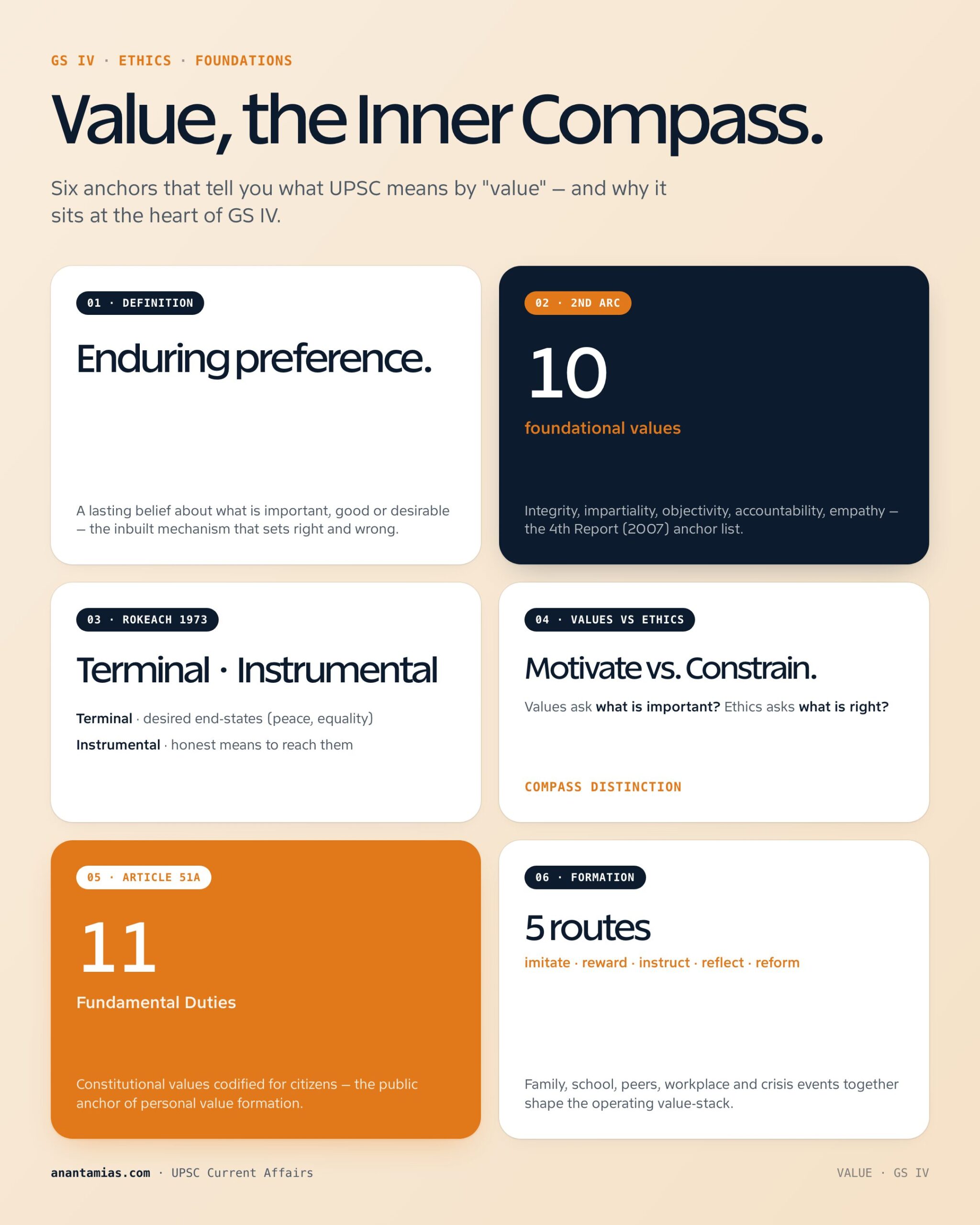
Values are our inbuilt mechanism to decide what is right or wrong.
Values are what is considered important by an individual, society, or organisation.
Values are important and lasting beliefs or ideas within an individual or society about what is good or bad and desirable or undesirable.
The first is functional — values do work inside us. The second is evaluative — values signal importance. The third is belief-based — values are a stable subset of beliefs, the ones about what matters.
Across all three, the core idea is the same: a value is an enduring preference for one state of affairs over another.
Where Values Come From
The compass extract notes that values are gathered through external environment, family, and experiences. The standard list of sources includes:
- Family — primary socialisation in the early years.
- School and teachers — formal value induction.
- Peer groups — horizontal validation.
- Religion and tradition — moral grammar.
- Society and culture — shared expectations.
- Media — modern, scaled socialisation.
- Constitution and law — public values codified.
- Personal experience — life-events that confirm or reform values.
- Inspirational figures — Gandhi, Ambedkar, Vivekananda, Mother Teresa.
- Workplace / organisation — induction into professional values.
Different sources dominate at different life-stages. A nine-year-old absorbs values from family; a twenty-year-old from peers and university; a thirty-year-old from workplace; a forty-year-old from leadership responsibility.
Types of Values
The literature classifies values along several axes.
By Domain
- Personal values — courage, honesty, perseverance.
- Family values — loyalty, mutual support, intergenerational respect.
- Social values — fraternity, civic responsibility, tolerance.
- Cultural values — vasudhaiva kutumbakam, atithi devo bhava.
- Constitutional values — justice, liberty, equality, fraternity (Preamble).
- Professional / civil-service values — integrity, impartiality, dedication, service.
- Organisational values — innovation (ISRO), accuracy (CAG), neutrality (UPSC).
- Universal / human values — dignity, freedom, peace.
By Function
- Terminal values — desired end-states (peace, salvation, equality). The Preamble of the Indian Constitution states terminal values.
- Instrumental values — preferred ways of behaving to reach the ends (honesty, courage, hard work).
This is Milton Rokeach's classic distinction (The Nature of Human Values, 1973). For a civil servant, the integrity is to keep instrumental values (means) aligned with terminal values (ends).
By Holder
- Individual values — held by a person.
- Collective values — held by a group, society, organisation.
- Universal values — held across cultures (don't kill the innocent, keep promises, be fair).
Values Are Importance Markers
The compass note is sharp: values denote the degree of importance of something. Values are the priority weights an agent applies to the world. Two civil servants may both believe in honesty and efficiency, but if one weights honesty above efficiency and the other weights efficiency above honesty, they will resolve a budget-vs-rules dilemma very differently.
For UPSC, this is the practical operating frame: the question is rarely whether a value is held, but how high it is ranked.
Values vs Ethics — The Compass Distinction
The compass extract supplies a four-row table that an aspirant should memorise.
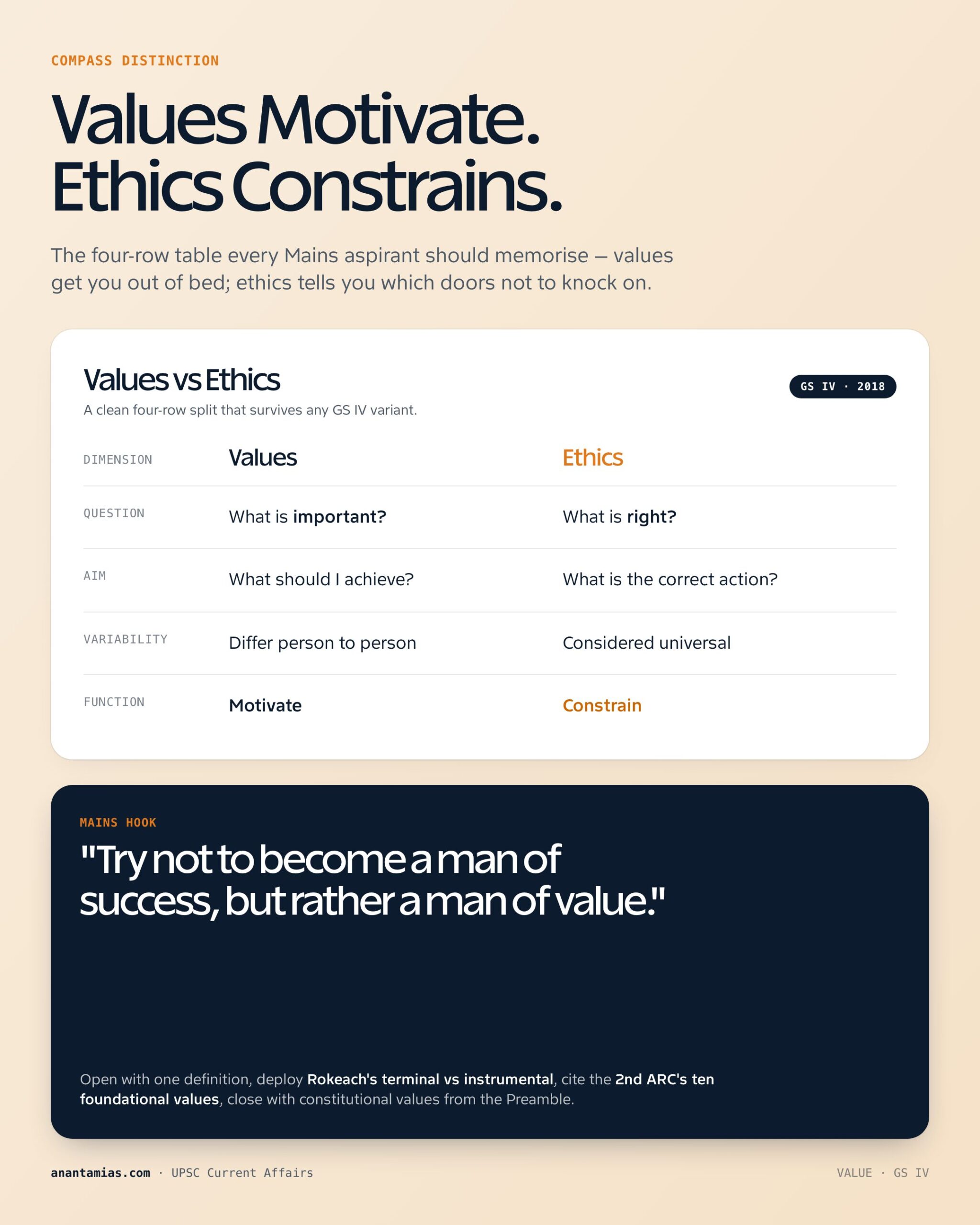
| Dimension | Values | Ethics |
|---|---|---|
| Question | What is important? | What is right? |
| Aim | What should I achieve? | What is the correct action? |
| Variability | Differ from person to person | Usually considered universal |
| Function | Motivate | Constrain |
This is the cleanest answer to a perennial Mains prompt — Distinguish between values and ethics. A few elaborations.
- Values motivate; ethics constrains. Values get you out of bed; ethics tells you which doors you may not knock on.
- Values are personal-to-cultural; ethics aspires to universality. The value of family loyalty is private; the ethical principle of do not lie under oath is universal.
- Values can conflict among themselves; ethics tries to resolve conflicts of values. Loyalty to a friend and duty to citizens are both values; the ethical question is which prevails when they conflict.
"Try not to become a man of success, but rather try to become a man of value." — Albert Einstein
Values and Beliefs — A Subtle Distinction
The compass note that values are 'beliefs' about 'what is important' deserves elaboration. Every value has a belief embedded in it. The value of honesty embeds the belief that honesty produces better long-term outcomes than dishonesty. The value of fraternity embeds the belief that humans flourish in solidarity rather than in atomised isolation.
Therefore, when a value is challenged, the underlying belief should be examined. Many "value debates" are actually belief disagreements in disguise.
Foundational Values for Civil Services
The 2nd Administrative Reforms Commission (ARC), 4th Report — Ethics in Governance (2007) identified the values civil servants should embody.
- Integrity — wholeness of character; conduct matches conviction.
- Impartiality — same treatment regardless of person.
- Objectivity — decisions on evidence, not preference.
- Anonymity — service that does not seek personal credit.
- Accountability — answerability for decisions made.
- Empathy — capacity to enter the citizen's situation.
- Compassion — active concern for those in distress.
- Dedication to public service — primacy of public over private interest.
- Commitment to constitutional values.
- Tolerance of dissent and diversity.
Every Mains answer on civil-service ethics can deploy three or four of these from memory.
How Values Are Formed — The Process
1. Imitation and Modelling
Children imitate parents; juniors imitate seniors. Values are first caught before they are taught. A young IAS officer's first Collector becomes her informal value template.
2. Reward and Punishment
Operant conditioning — values endorsed by reward become entrenched; values punished get suppressed. Schools, families, workplaces all use this.
3. Direct Instruction
Formal value education — moral science classes, civics, civil-service training modules — explicitly transmits values.
4. Cognitive Reflection
As cognitive ability matures, agents reflectively endorse or reject inherited values. Many adolescents go through this stage.
5. Crisis and Reformation
Major life events — bereavement, war, disillusionment, transformative encounter — can radically reorder values. Ashoka after Kalinga, Valmiki after Narada, Buddha after the four sights.
"Values are like fingerprints. Nobody's are the same, but you leave them all over everything you do." — Elvis Presley (yes, but also Aristotle in spirit)
Two Indian Case Studies
Case 1 — Values in the Punjab Floods of 2023
During the 2023 Punjab floods, district officers had to choose between staying on duty in flooded territory and protecting their own family residences in submerged neighbourhoods. The value of family competed with the value of public service. Most officers chose to stay; the ones who left for short periods to secure family safety and returned were not condemned. The value of dedication to public service was the dominant value, but the value of family was not erased — the ethical question was sequencing, not abandonment.
Case 2 — Babu Jagjivan Ram and the Value of Equality
As an early Dalit member of Nehru's cabinet, Babu Jagjivan Ram operated in a value-environment hostile to his very presence. He refused to abandon the value of equality as a personal anchor and built it into the labour and welfare policies he steered. The case shows how a personal value, deployed at scale through office, becomes public ethics.
Values in Organisational Life
Every public organisation has a value culture — the operating preferences of its staff over time. Successful organisations align their culture with constitutional values; failing organisations let cultural drift normalise misalignment.
| Organisation | Dominant Value Cluster |
|---|---|
| ISRO | Frugality, mission focus, collaboration |
| CAG | Independence, scepticism, written record |
| Election Commission | Neutrality, fairness, public trust |
| NITI Aayog | Innovation, evidence, federalism |
| NDMA | Preparedness, coordination, urgency |
UPSC Syllabus Relevance
GS-IV explicitly names values; their dimensions; role of family, society and educational institutions in inculcating values. This is among the most testable areas in the paper.
Past-Year Prompts
- "How could you as a civil servant come up against the menace of corruption? Discuss in the context of the foundational values of civil services." — 2014.
- "What do you understand by values and ethics?" — 2013, 2018 (multiple variants).
- "Differentiate between the following: (a) Law and Ethics (b) Ethical management and Management of ethics (c) Discrimination and Preferential treatment (d) Personal ethics and Professional ethics." — 2015.
- "Examine the relevance of the following in the context of civil service: (a) Empathy (b) Tolerance towards opposing views (c) Objectivity in one's task." — 2017.
- "State the three basic values, universal in nature, in the context of civil service and bring out their importance." — 2018.
Mains Answer-Writing Tips
- Open with one definition, then move to values vs ethics in two sentences.
- Use Rokeach's terminal vs instrumental distinction for analytical depth.
- Quote the 2nd ARC's foundational values list.
- Use one Indian case (Babu Jagjivan Ram, Punjab floods, Vinoba Bhave's bhoodan).
- Close with the constitutional values (Preamble) as the public anchor of personal values.
Prelims Pointers
- 2nd ARC, 4th Report (2007) — Ethics in Governance.
- Milton Rokeach, The Nature of Human Values, 1973 — terminal vs instrumental values.
- Shalom Schwartz, Theory of Basic Human Values, 1992 — ten universal values across cultures.
- Article 51A — Fundamental Duties enumerate constitutional values for citizens.
- Preamble — terminal values: justice, liberty, equality, fraternity.
FAQ
Are values universal or relative?
Both, in different layers. A small core of values (don't kill the innocent, keep promises, treat humans with dignity) recurs across cultures. Many specific values (dietary practice, dress, family arrangement) vary culturally. The civil servant respects the variable layer and enforces the universal layer.
Can values change?
Peripheral values change easily; core values change slowly, usually under pressure of major life events or sustained re-socialisation.
Are personal values relevant in office?
They are the seedbed. But office requires that constitutional values override personal values where they conflict. An officer whose personal value is religious orthodoxy must still apply secular law impartially.
How does one cultivate civil-service values?
Sustained exposure (training, mentorship), reflective practice (journaling, peer dialogue), and public commitment (oaths, codes, codes-of-conduct enforcement) are the three documented mechanisms.
Is there a hierarchy of values for civil servants?
The 2nd ARC suggests a working hierarchy: constitutional values at the top, professional civil-service values next, personal moral values below, and cultural / community values at the base. The hierarchy resolves most everyday conflicts.
Values are the silent ranking by which an officer triages every choice. Cultivating them is the patient, decade-long work of becoming the kind of public servant the Constitution had in mind when it designed the office.
Values are the silent ranking by which an officer triages every choice. Cultivating them is the patient, decade-long work of becoming the kind of public servant the Constitution had in mind when it designed the office.
Tell Google you want more of this.
Add Anantam IAS as a preferred sourceOne tap, and this site shows up more often in your own Top Stories, AI Overviews and AI Mode. Remove it any time.