Similipal National Park: Melanistic Tigers, Sal Forests, Mayurbhanj Odisha
Similipal National Park in Odisha's Mayurbhanj district, home to the world's only melanistic tiger population, UNESCO biosphere reserve since 2009, sal forests and tribal cultures.
In late 2017, a remote-camera image from a forest beat in northern Odisha began circulating among wildlife biologists. The animal in the frame was unmistakably a tiger, but the stripe pattern was so dense and the body so dark that the orange ground colour barely showed through. Subsequent images, reviewed by the National Tiger Conservation Authority and the Wildlife Institute of India, confirmed what local staff had long suspected: Similipal Tiger Reserve was home to a population of pseudo-melanistic tigers, the only such population recorded anywhere in the world. The discovery sealed Similipal’s place not just as a major tiger landscape but as a globally unique biological asset.
Similipal sits in the Mayurbhanj district of Odisha, draped across the Eastern Ghats foothills and the Chhotanagpur plateau edge. It is the second-largest biosphere reserve in India, a notified national park, a Project Tiger reserve from the very first cohort of 1973, and a UNESCO Man and the Biosphere site since 2009. Its forests carry the imprint of sal trees, simul cotton trees, and a network of perennial rivers that drain northward through Mayurbhanj into the larger Subarnarekha and Baitarani systems.
For UPSC, Similipal recurs in prelims through location, species, and tiger reserve questions, and in mains through landscape conservation, tribal community engagement, and biosphere reserve frameworks. This guide walks through what the park is, how it became one, what it protects, and what an aspirant must know.
Quick Facts
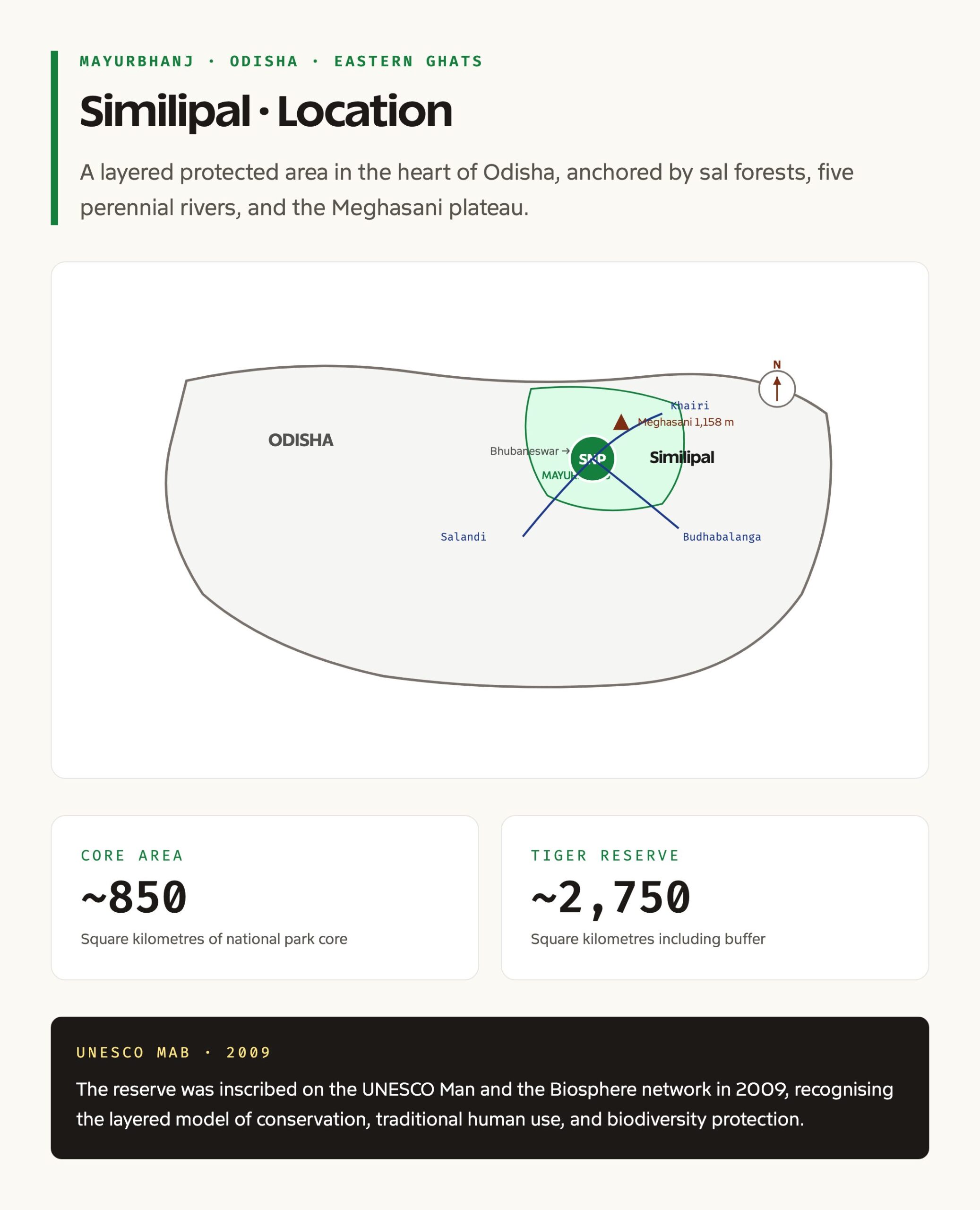
- Location: Mayurbhanj district, Odisha, eastern India
- Notified as Tiger Reserve: 1973 (Project Tiger inaugural cohort)
- Notified as National Park: 1980
- Notified as Biosphere Reserve: 1994 (national)
- UNESCO MAB inscription: 2009
- Origin of name: Simul tree (red silk cotton, Bombax ceiba)
- Core area: Approximately 850 sq km
- Total tiger reserve: Approximately 2,750 sq km
- Forest type: Predominantly moist deciduous (sal-dominant)
- Apex predator: Royal Bengal Tiger, including pseudo-melanistic morph
- Other key species: Asian elephant, chausingha, mugger crocodile, Hill Myna
- State bird of Odisha: Hill Myna (Gracula religiosa peninsularis)
- Major rivers: Budhabalanga, Khairi, Salandi, Palpala, Deo
- Iconic peaks/falls: Meghasani Peak, Barehipani Falls, Joranda Falls
- Key tribal communities: Erenga Kharia, Mankirdia (PVTGs), Santhal, Ho, Munda, Bhumij
- Cultural traditions: Akhand Shikar (banned), Mayurbhanj Chhau dance
What Is Similipal National Park
Similipal is a layered protected area. At its heart sits the national park, an inviolate core where human activity is tightly restricted. Wrapped around the core is the tiger reserve, with buffer zones that allow regulated tribal residence and forest produce collection. Wrapped around that, again, is the biosphere reserve, which extends to transition zones where regulated agriculture, animal husbandry, and forest-based livelihoods continue.
The terrain is undulating to hilly, rising from about 250 metres in the river valleys to over 1,150 metres at Meghasani Peak. The landscape is essentially a high plateau dissected by streams, with steep escarpments along the Mayurbhanj boundary. The forest cover is overwhelmingly moist deciduous, with sal (Shorea robusta) as the dominant species. The simul or red silk cotton tree (Bombax ceiba), which gives the reserve its name, occurs as scattered emergents and along forest edges.
The hydrology is significant. Five perennial rivers, the Budhabalanga, Khairi, Salandi, Palpala, and Deo, rise within or pass through Similipal. Their headwaters give the reserve a year-round water security that supports its tiger and elephant populations and the network of village settlements in the buffer.
Background and Historical Context
The Similipal forests have a deep human history. Tribal communities, including the Santhal, Ho, Munda, Bhumij, Erenga Kharia, and Mankirdia, have lived in and around the forests for centuries. The Mankirdia, in particular, traditionally specialised in monkey-catching for the temple and itinerant performance economy and remain a Particularly Vulnerable Tribal Group (PVTG). The Mayurbhanj princely state, which ruled until merger with Odisha in 1949, formally protected parts of the present Similipal area as private hunting reserves and timber blocks.
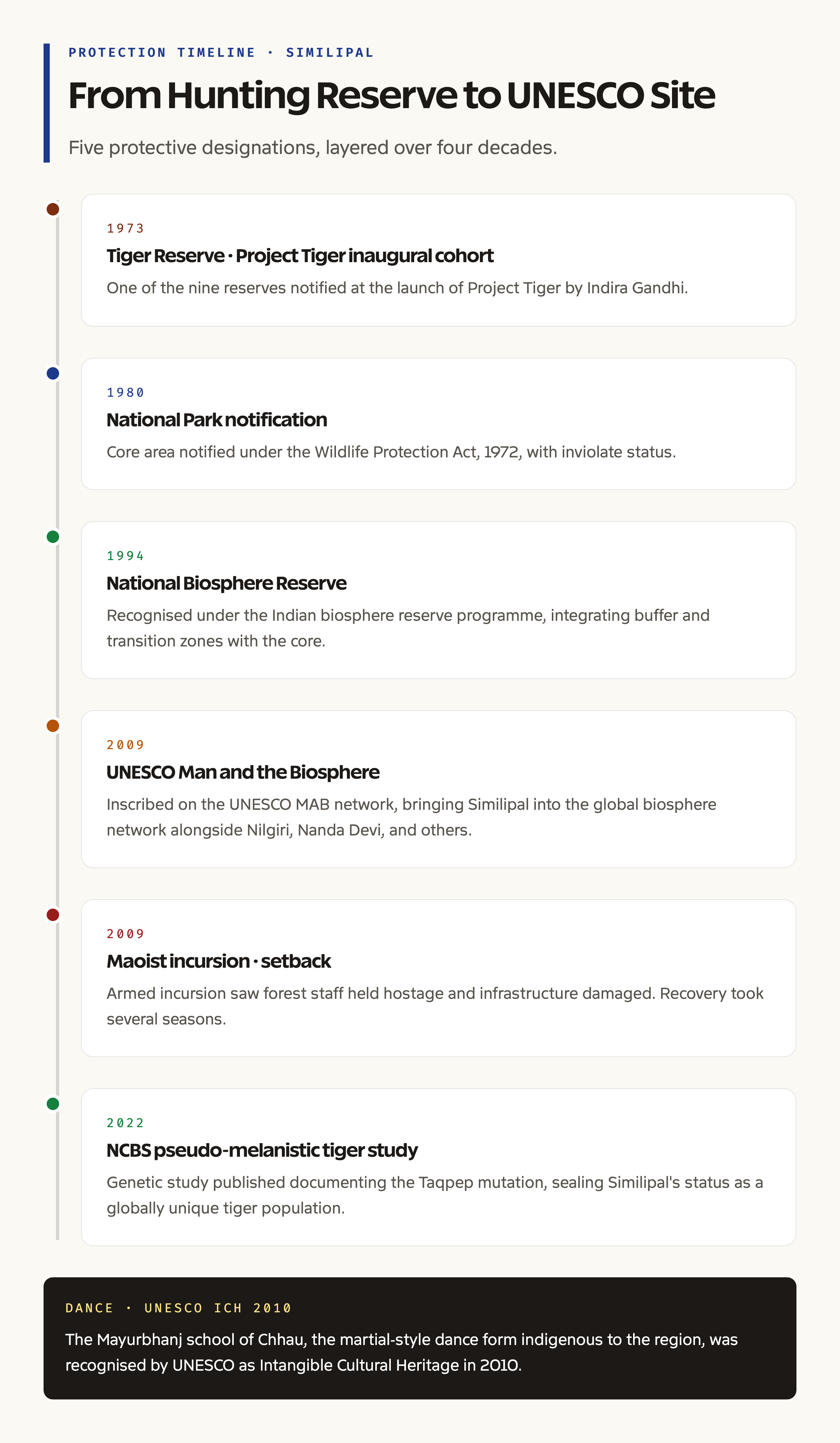
Post-independence, the forests came under state forest management. The conservation watershed came in 1973, when Similipal was included in the inaugural cohort of nine tiger reserves under the newly launched Project Tiger. The Project Tiger framework was a response to the dramatic decline of tiger populations across India through the 1960s, and it brought a coordinated central scheme to bear on a state-level forest department.
Following the tiger reserve notification, the core area was further notified as Similipal National Park in 1980, giving it inviolate status under the Wildlife Protection Act, 1972. National biosphere reserve status followed in 1994, recognising the wider landscape’s role in supporting traditional human use alongside core conservation. UNESCO Man and the Biosphere inscription in 2009 brought the reserve into the global biosphere network.
The reserve has had its troubled moments. In 2009, an armed Maoist incursion saw forest staff held hostage and infrastructure damaged. Recovery took several seasons. More recently, fire seasons have stretched longer, and human-elephant conflict on the periphery has remained a continuous management concern. Despite these pressures, Similipal’s tiger and elephant populations have held up, and the unique pseudo-melanistic tiger population has been consolidated by recent census exercises.
Key Geographic and Ecological Provisions
The reserve falls in the Eastern Ghats biogeographic zone, with strong influences from the Chhotanagpur plateau system to the north. The terrain ranges from the river valleys at around 250 metres to the high ridge of Meghasani at over 1,150 metres. The plateau is dissected by deep ravines and waterfall systems, including the celebrated Barehipani Falls at around 400 metres and Joranda Falls at around 150 metres.
The vegetation is structured by altitude, aspect, and soil. Below 600 metres, the cover is moist deciduous, dominated by sal with associates including asan (Terminalia tomentosa), kendu (Diospyros melanoxylon), bija (Pterocarpus marsupium), and simul. Higher elevations carry semi-evergreen patches and grassland clearings called chitals. The grasslands play a critical role in supporting prey-base species such as sambar, chital, and gaur.
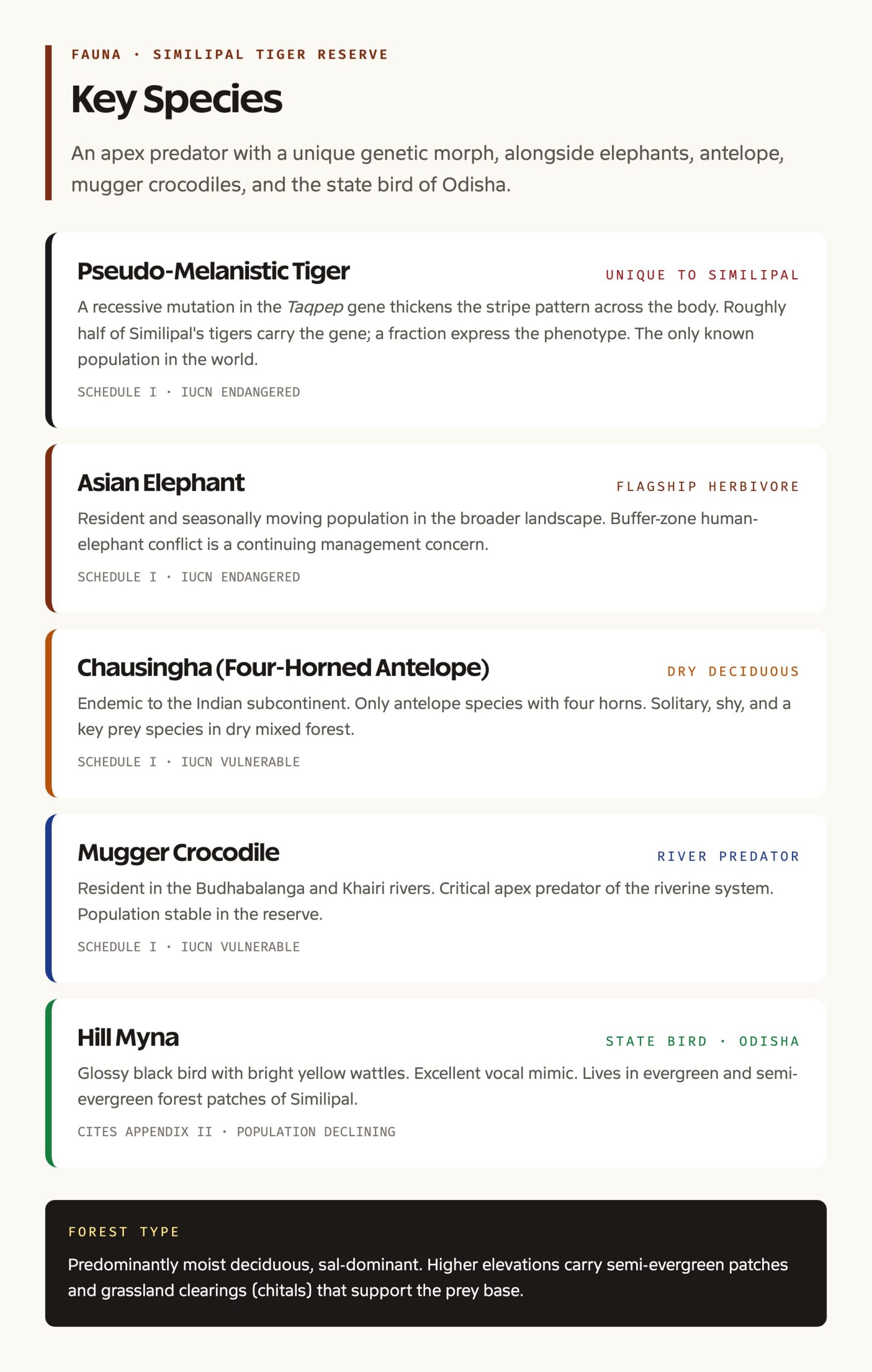
The fauna includes the tiger as apex predator, the leopard, the Asian elephant, gaur, sambar, chital, sloth bear, mugger crocodile in river systems, and the chausingha or four-horned antelope. Birdlife is rich, with the Hill Myna, the state bird of Odisha, the giant squirrel, and over 230 recorded bird species. The pseudo-melanistic tigers, with their characteristic dense black stripe pattern, have been the subject of recent genetic studies indicating a small founder population subject to local genetic drift.
Why Similipal Matters
The case for Similipal operates at three levels. Ecologically, it is the largest contiguous tiger habitat in eastern India and the only known stronghold of pseudo-melanistic tigers globally. Its sal forests, river systems, and grassland mosaics support a complete vertebrate guild from apex predator to small-bodied insectivores.
Culturally, the reserve is home to multiple tribal communities whose traditional ecological knowledge, ritual practice, and craft traditions are inseparable from the forest. The Mayurbhanj Chhau dance, recognised by UNESCO as Intangible Cultural Heritage in 2010, draws on the martial and ritual traditions of the region. The Akhand Shikar, a traditional mass-hunting ritual, has been formally banned but its ritual scaffolding survives in attenuated form.
Institutionally, Similipal links the tiger reserves in India network with the biosphere reserves in India framework, and offers a working example of a layered protected-area model. The lessons for landscape conservation are picked up by parks like Kaziranga National Park and the broader network of national parks of India.
Detailed Analysis: The Pseudo-Melanistic Tiger
The pseudo-melanistic tigers of Similipal are not true black tigers. They carry a recessive mutation in the Taqpep gene that thickens and coalesces the stripe pattern across the body, producing an animal that appears almost entirely black at distance. The mutation is the same family of mutation that produces the king cheetah’s coat pattern. In Similipal, the recessive allele has reached unusually high frequency, almost certainly because of the small effective population size and limited genetic exchange with surrounding tiger populations.
The 2022 study by the National Centre for Biological Sciences, in partnership with the Wildlife Institute of India and Odisha Forest Department, documented the genetic basis and the population structure of the trait. Roughly half of Similipal’s tigers carry at least one copy of the mutation, and a meaningful fraction express the pseudo-melanistic phenotype. The pattern is unique to Similipal among India’s tiger populations.
Conservation implications are double-edged. The unique trait is a genuine biological asset. The same isolation that produced it, however, also raises long-term inbreeding concerns. Recent management discussions have considered whether limited genetic exchange with neighbouring tiger landscapes such as Satkosia or even southern reserves is desirable, balancing the loss of distinctiveness against the risks of inbreeding depression.
Comparative Perspective
Similipal sits in the eastern tiger landscape alongside Satkosia in Odisha and Palamau in Jharkhand. Of the three, Similipal carries the largest and most viable tiger population. Compared to the western and central Indian tiger reserves like Bandhavgarh, Pench, or Tadoba, Similipal has lower visitor numbers, smaller infrastructure, and a distinct sal-forest character.
Among biosphere reserves, Similipal is the second-largest in India after the Nilgiri Biosphere Reserve. Its tribal community profile is closer to the Achanakmar-Amarkantak Biosphere Reserve in central India than to the Western Ghats biospheres. Internationally, Similipal’s combination of tiger habitat, indigenous community presence, and biosphere status invites comparison with parks like Cat Tien in Vietnam or Way Kambas in Sumatra, although neither matches Similipal’s tiger density.
Challenges and Issues
The reserve faces a clutch of challenges. Fire seasons have stretched over the past decade, with the 2021 season seeing exceptionally large burn areas that drew central concern. Climate, dry-deciduous fuel loads, and human ignition all contribute. Human-elephant conflict is a continuous strain on the buffer-zone communities, with crop damage and occasional human casualties.
Mining pressure in the surrounding Mayurbhanj district, particularly for iron ore, exerts indirect strain on the wider landscape and the corridors that connect Similipal to other forest blocks. Maoist activity, although significantly reduced from the 2009 incident, has historically constrained patrolling and infrastructure development in interior beats.
Tribal rights remain a continuing question. The Forest Rights Act, 2006, requires recognition of community forest rights in the buffer and transition zones. Implementation has been uneven, and the relationship between PVTG communities and the protected-area authority requires ongoing negotiation.
Genetic conservation of the pseudo-melanistic tiger population is a long-horizon concern. Population genetics studies have flagged the inbreeding risk, and the management response is still being formulated.
Prelims Pointers
- State: Odisha. District: Mayurbhanj.
- Tiger Reserve notification: 1973 (Project Tiger first cohort).
- National Park notification: 1980.
- Biosphere Reserve notification: 1994 (national); 2009 (UNESCO MAB).
- Origin of name: Simul tree, red silk cotton.
- Apex predator: Royal Bengal Tiger (pseudo-melanistic population).
- Other species: Asian elephant, chausingha, mugger, Hill Myna.
- State bird of Odisha: Hill Myna.
- Highest peak: Meghasani.
- Major rivers: Budhabalanga, Khairi, Salandi, Palpala, Deo.
- Famous waterfalls: Barehipani, Joranda.
- Forest type: Moist deciduous (sal).
- Tribal communities: Erenga Kharia, Mankirdia (PVTGs), Santhal, Ho, Munda, Bhumij.
- Dance form: Mayurbhanj Chhau (UNESCO Intangible Cultural Heritage, 2010).
Probable Mains Questions
- The pseudo-melanistic tiger population of Similipal Tiger Reserve is a genetic asset and a conservation challenge. Discuss. (250 words)
- Examine the layered protected-area model of Similipal as a framework for integrating biodiversity conservation with tribal community rights. (250 words)
- Discuss the role of Project Tiger in the conservation of eastern Indian tiger landscapes, with reference to Similipal. (150 words)
Way Forward
Similipal needs interventions on several fronts. Fire management must be modernised, drawing on satellite-based early-warning systems, community fire watchers, and controlled burning of fuel loads in the dry season. The Odisha Forest Department’s existing fire-line network needs scaling and integration with state disaster management.
Genetic management of the tiger population should follow a long-horizon plan informed by the National Centre for Biological Sciences and the Wildlife Institute of India. The plan should consider buffered genetic exchange with adjoining landscapes while preserving the pseudo-melanistic trait as long as possible.
Community engagement with the PVTG communities and the broader tribal population must move from administrative consultation to genuine co-management. Forest Rights Act implementation, livelihood diversification, and benefit-sharing from eco-tourism need a coordinated framework.
Eco-tourism has scope to grow without overwhelming the core. Distributed tourism along the buffer, with community guides and decentralised infrastructure, can generate revenue without trail erosion. Landscape connectivity with neighbouring forest blocks, including the corridors towards Satkosia and the wider Chhotanagpur plateau, needs explicit landscape planning supported by the Centre and the NTCA framework.
Frequently Asked Questions
Where is Similipal National Park located?
Similipal is in the Mayurbhanj district of Odisha, in the eastern part of the state. It is part of the Eastern Ghats biogeographic zone, with strong influences from the Chhotanagpur plateau to the north.
What does the name Similipal mean?
The name comes from the Simul tree, the red silk cotton tree (Bombax ceiba), which is abundant in the reserve and gives its name to the landscape. The word pal in Odia is associated with the tree’s local presence in the forest cover.
When was Similipal declared a tiger reserve?
Similipal was declared a tiger reserve in 1973, in the inaugural cohort of nine reserves notified at the launch of Project Tiger. It was subsequently declared a national park in 1980, a national biosphere reserve in 1994, and inscribed on the UNESCO Man and the Biosphere network in 2009.
Why is Similipal famous for black tigers?
Similipal is the only place in the world with a recorded population of pseudo-melanistic tigers. These tigers carry a recessive mutation that thickens the stripe pattern across the body, making the animal appear almost entirely black. Roughly half of Similipal’s tigers carry at least one copy of the gene, and a fraction express the trait.
What is the role of the Mayurbhanj princely state in Similipal’s history?
The Mayurbhanj princely state, which merged with Odisha in 1949, formally protected parts of the present Similipal area as private hunting reserves and timber blocks. The post-independence forest department inherited these protections, and they fed into the eventual tiger reserve and national park notifications.
What rivers flow through Similipal?
Five perennial rivers rise within or pass through the reserve: the Budhabalanga, Khairi, Salandi, Palpala, and Deo. These rivers feed the larger Subarnarekha and Baitarani systems and provide year-round water security for the reserve’s wildlife and human communities.
Which tribal communities live in and around Similipal?
Several communities live in and around the reserve, including the Erenga Kharia and Mankirdia (both Particularly Vulnerable Tribal Groups), the Santhal, Ho, Munda, and Bhumij. Their traditional livelihoods include forest produce collection, agriculture, and customary cultural practices.
What is the Mayurbhanj Chhau dance?
The Mayurbhanj Chhau is a martial-style dance form indigenous to the Mayurbhanj region. It is one of the three main schools of Chhau, alongside Seraikella and Purulia, and was recognised by UNESCO as Intangible Cultural Heritage in 2010.
What is the famous waterfall in Similipal?
The Barehipani Falls, dropping about 400 metres in two tiers, is among the highest waterfalls in India. The Joranda Falls, a single-drop fall of about 150 metres, is also a celebrated geographical feature of the reserve.
Is Similipal a UNESCO site?
Similipal is part of the UNESCO Man and the Biosphere Programme network, inscribed in 2009. It is not a UNESCO World Heritage Site. The biosphere designation recognises the integrated approach to biodiversity conservation, traditional human use, and sustainable development across the reserve and its transition zones.