Kaziranga National Park is the single most important habitat on Earth for the Greater One-Horned Rhinoceros, the UNESCO-inscribed crown of Indian wildlife conservation, and one of the few protected areas in South Asia where five large mammals — rhinoceros, Asiatic elephant, royal Bengal tiger, wild water buffalo, and eastern swamp deer — share a single floodplain. Sprawling across roughly 1,090 sq km of core and addition areas along the southern bank of the Brahmaputra in Assam, Kaziranga National Park holds about two-thirds of the world’s wild one-horned rhinos.
The park was first set up as a Reserve Forest in 1908, became a Wildlife Sanctuary in 1950, was declared a National Park in 1974, and was inscribed as a UNESCO World Heritage Site in 1985 under natural criteria (ix) and (x). It was declared a Tiger Reserve in 2007 under the National Tiger Conservation Authority framework. The 2022 rhino census placed the Kaziranga National Park population at 2,613 individuals, the highest ever recorded, and the most striking species recovery story in Indian conservation history.
Kaziranga National Park is also the most dramatic illustration of how India’s flagship parks now sit at the intersection of three forces: anti-poaching enforcement, climate-driven flood intensification, and the politics of land use along a major Himalayan river.
Location and Landscape of Kaziranga National Park
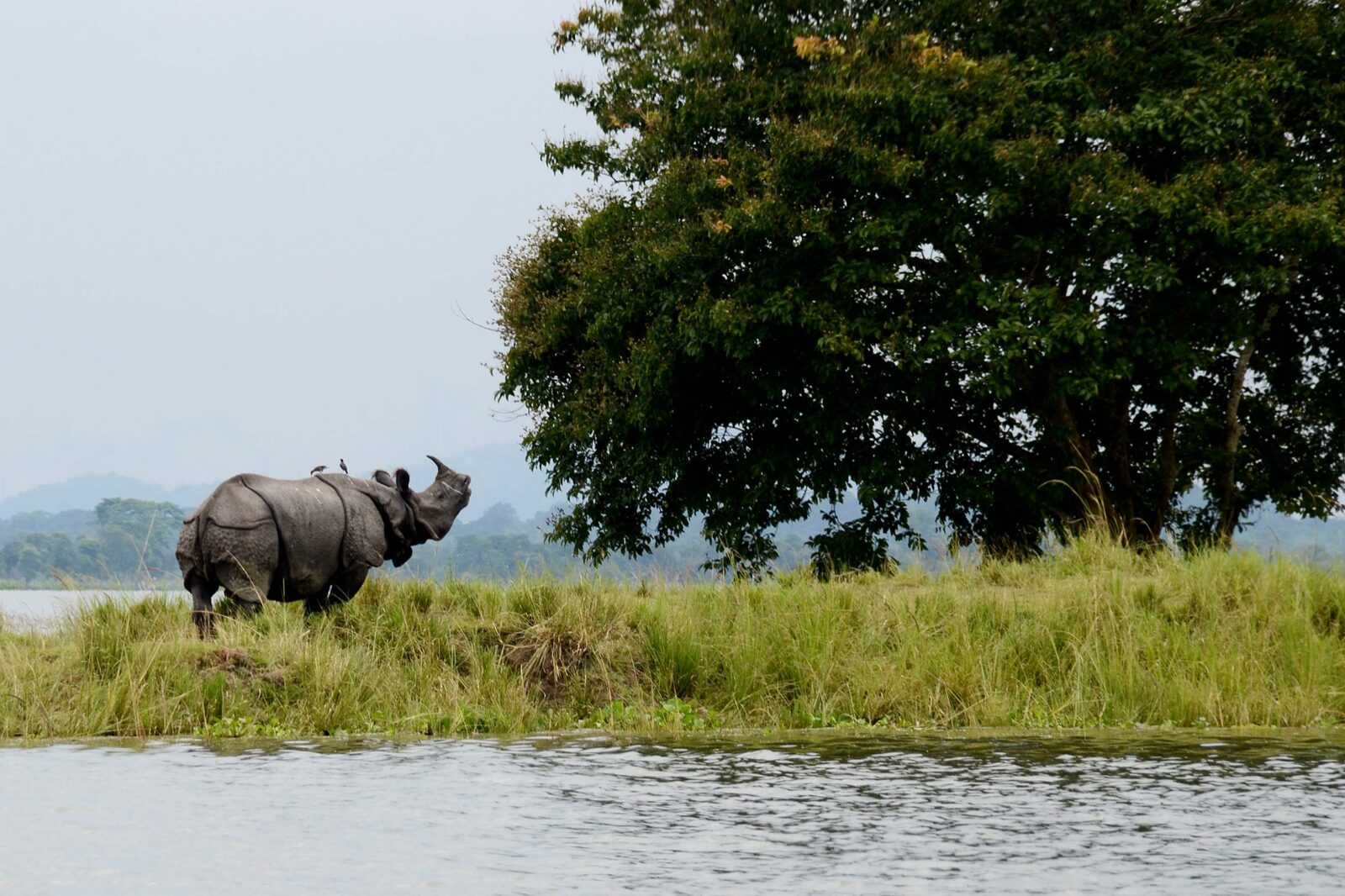
Kaziranga lies in the Golaghat, Nagaon, Sonitpur, Biswanath, and Karbi Anglong districts of Assam, on the southern bank of the Brahmaputra river. The park is essentially a vast alluvial floodplain — tall elephant grass, swamps, beels (oxbow lakes), and patches of semi-evergreen forest — flanked on the south by the Karbi Anglong hills.
Six Ranges, One Floodplain
The protected area is organised into six administrative ranges: Kohora (the central tourism range), Bagori (Western), Agoratoli (Eastern), Burapahar, Northern, and the recently added Biswanath addition. The Mikir-Karbi Anglong addition extends habitat into the hills, allowing wildlife to move out during the annual floods.
A Floodplain that Breathes
The defining ecological feature of Kaziranga National Park is its annual monsoon flood. Every year between June and September, the Brahmaputra rises and submerges most of the park, sometimes up to 90% of the core area. The flood is not a disaster in ecological terms — it deposits fresh silt, recharges beels, kills off invasive plants, and maintains the grassland mosaic that sustains the world’s densest grazer biomass. The flood becomes a problem only when its intensity and duration cross historical thresholds, as has happened repeatedly since 2017.
The Big Five of Kaziranga National Park
Kaziranga is the only protected area in India where the so-called “Big Five” of South Asian wildlife coexist in viable numbers in the same landscape.
Greater One-Horned Rhinoceros
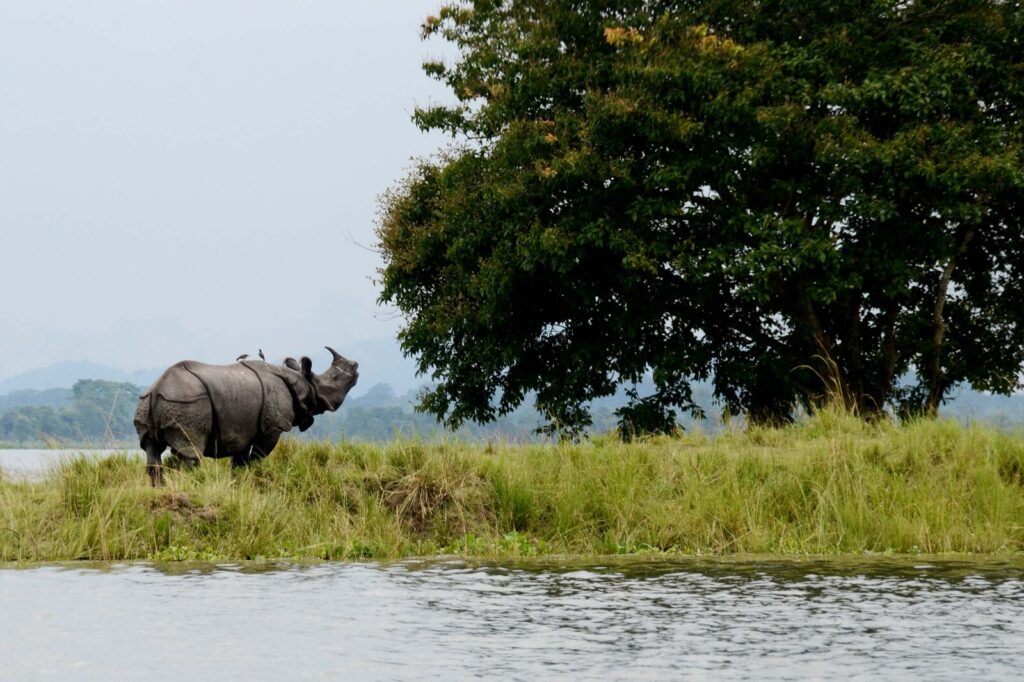
The flagship of Kaziranga National Park is the Greater One-Horned Rhinoceros (Rhinoceros unicornis). The 2022 census recorded 2,613 rhinos in the park, up from around 12 individuals at the start of the 20th century. This recovery is the single largest mega-herbivore success story in modern conservation. For more on the species itself, see Greater One-Horned Rhinoceros.
Asiatic Elephant
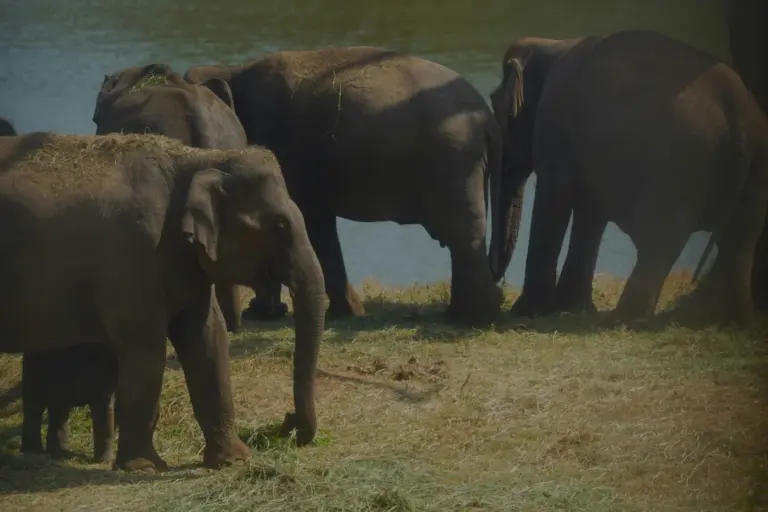
Kaziranga supports over 1,200 wild Asiatic elephants. The elephants move seasonally between the floodplain and the Karbi hills, and corridor severance by NH-715 (the old NH-37) remains a major conservation concern.
Royal Bengal Tiger
Kaziranga National Park was designated as a Tiger Reserve in 2007. It records one of the highest tiger densities in the world — over 100 tigers in a relatively compact core, with densities exceeding 30 individuals per 100 sq km in parts of the central range.
Wild Water Buffalo
The park holds the largest wild population of Wild Water Buffalo (Bubalus arnee) in the world, estimated at over 2,500 individuals. The species is listed as Endangered on the IUCN Red List, and Kaziranga is its most viable wild stronghold globally.
Eastern Swamp Deer
The Eastern Swamp Deer (Rucervus duvaucelii ranjitsinhi) is a subspecies endemic to the Assam floodplains, with roughly 1,000 individuals in Kaziranga National Park. It survives almost entirely within this single landscape.
Birdlife and Aquatic Fauna
Kaziranga is a designated Important Bird Area and lies along the East Asian-Australasian Flyway. The park records over 480 bird species, including nine of the 25 globally threatened species found in the Indian subcontinent: greater adjutant, lesser adjutant, Bengal florican, swamp francolin, black-necked stork, Pallas’s fish eagle, white-bellied heron, Asian openbill, and the spot-billed pelican.
The beels and the Brahmaputra channel within the park hold the Endangered Ganges River Dolphin, the gharial (occasionally), and several species of softshell turtles.
Vegetation: Grasslands That Make the Rhino
Kaziranga National Park is essentially a tall-grass system, and that grassland is the reason rhinos thrive here. Vegetation types include:
- Alluvial inundated grasslands (the famous “elephant grass” — Saccharum spontaneum, Phragmites karka, Imperata cylindrica)
- Alluvial savanna woodlands
- Tropical moist mixed deciduous forests (Burapahar)
- Tropical semi-evergreen forests on Karbi Anglong slopes
Active management — controlled burning of grasslands every winter, removal of invasive Mimosa diplotricha, and rotational grazing — keeps the grass mosaic productive.
Legal Status and UNESCO Inscription
Kaziranga National Park is protected as a national park under the Wildlife (Protection) Act 1972. Its UNESCO World Heritage status (1985) is based on natural criteria (ix) — outstanding ecological and biological processes — and (x) — natural habitats of in-situ conservation importance for biodiversity, including threatened species.
The 2007 Tiger Reserve notification brought it under the NTCA. For more on the underlying legal scaffolding, see Wildlife (Protection) Act 1972.
Anti-Poaching: The Hardened Frontier
Kaziranga National Park runs one of the most aggressive anti-poaching operations of any protected area in India. The Special Rhino Protection Force, the Forest Battalion, and armed forest guards operate under a “shoot at sight” interpretation that has been both credited with the population recovery and criticised by human rights observers.
Rhino poaching has declined sharply — from 27 rhinos in 2013–14 to zero confirmed rhino poaching incidents reported in calendar year 2022, the first such year in over four decades. The trend has held broadly stable since. The hardened enforcement model is the operational reason Kaziranga’s rhino numbers continue to rise.
Climate, Floods, and the Vulnerability Question
The biggest threat to Kaziranga National Park is no longer poaching — it is the changing character of the Brahmaputra flood.
High Flood Mortality
Heavy floods in 2017, 2019, and especially 2022 killed hundreds of animals each, including over 200 hog deer and several rhinos in single seasons. Animals crossing NH-715 to reach the Karbi hills during peak flood are particularly vulnerable to vehicle strikes.
Highland Construction Programme
Forest staff have built over 200 artificial highlands inside the park to give animals refuge during peak floods. Underpasses and overpasses are being progressively added along NH-715.
Climate Attribution
Studies by the Indian Institute of Tropical Meteorology and others link the intensification of pre-monsoon and monsoon flood pulses to glacier melt in the eastern Himalaya and shifting precipitation patterns. The implication for Kaziranga National Park is that the floodplain has to be managed for resilience, not stability.
Kaziranga National Park and UPSC
For Civil Services aspirants, Kaziranga is among the most heavily referenced protected areas in GS Paper III and Prelims environment questions. Common testable points:
- Year of national park notification (1974) and UNESCO inscription (1985)
- Big Five composition
- Latest rhino census (2,613 in 2022)
- Tiger Reserve declaration (2007)
- Annual flood and highland creation programme
- UNESCO natural criteria (ix) and (x)
- Karbi Anglong corridor and NH-715 mitigation
Cross-read Jim Corbett National Park, Kanha National Park, and Sundarbans National Park for a complete picture of flagship reserve geography. For wetland-led conservation policy, see Ramsar Sites of India. The eastern Himalaya region containing Kaziranga falls within India’s recognised biodiversity hotspots.
Outlook
Kaziranga National Park has demonstrated something rare in global conservation: that an Endangered megaherbivore can be brought back from near-extinction to a stable population of thousands, in a country with high human density, on a floodplain that is simultaneously a working agrarian landscape. The next decade will test whether that recovery can be insulated from intensifying floods, infrastructure pressure across NH-715, and the steady leakage of corridor land between the park and the Karbi hills.
If India is going to defend the credibility of its protected-area system, Kaziranga National Park is one of the two or three landscapes the defence will have to start with.
Frequently Asked Questions
Where is Kaziranga National Park located?
Kaziranga National Park is located on the southern bank of the Brahmaputra river in Assam, spread across Golaghat, Nagaon, Sonitpur, Biswanath, and Karbi Anglong districts. The core park area is around 430 sq km, with additions taking the total protected area to roughly 1,090 sq km.
When was Kaziranga declared a national park and a UNESCO site?
It was declared a national park in 1974 under the Wildlife (Protection) Act 1972. It was inscribed as a UNESCO World Heritage Site in 1985 under natural criteria (ix) and (x). It was additionally declared a Tiger Reserve in 2007.
What is the current rhino population in Kaziranga National Park?
The 2022 rhino census recorded 2,613 Greater One-Horned Rhinoceros in the park, the highest count ever. This represents roughly two-thirds of the global wild population of the species.
What are the Big Five of Kaziranga?
The Big Five are the Greater One-Horned Rhinoceros, Asiatic Elephant, Royal Bengal Tiger, Wild Water Buffalo, and Eastern Swamp Deer. Kaziranga National Park is the only Indian protected area where all five coexist in viable numbers in the same landscape.
How does Kaziranga handle the annual monsoon flood?
Each year the Brahmaputra inundates a large share of the park, sometimes up to 90% of the core area. Forest staff have built over 200 artificial highlands as animal refuges and have added underpasses on NH-715 to help wildlife move to the Karbi Anglong hills during peak flood.
Why is Kaziranga famous for anti-poaching?
The park runs one of the most assertive anti-poaching regimes in Asia, with armed guards, the Special Rhino Protection Force, and a hard enforcement posture. Rhino poaching collapsed from 27 in 2013–14 to zero confirmed cases in 2022, the first such year in over four decades.
How is climate change affecting Kaziranga National Park?
Floods in 2017, 2019, and 2022 were unusually intense, killing hundreds of animals each season. Studies link the intensification of monsoon and pre-monsoon flood pulses to glacier melt and shifting precipitation in the eastern Himalaya, forcing managers to plan for resilience rather than a stable hydrological baseline.
What is the difference between Kaziranga National Park and Kaziranga Tiger Reserve?
Kaziranga National Park is the inviolate core notified under the Wildlife (Protection) Act 1972. Kaziranga Tiger Reserve, declared in 2007, is the larger management unit covering the national park plus buffer areas, governed under the National Tiger Conservation Authority. The reserve contains one of the highest tiger densities in the world.
Tell Google you want more of this.
Add Anantam IAS as a preferred sourceOne tap, and this site shows up more often in your own Top Stories, AI Overviews and AI Mode. Remove it any time.