Introduction
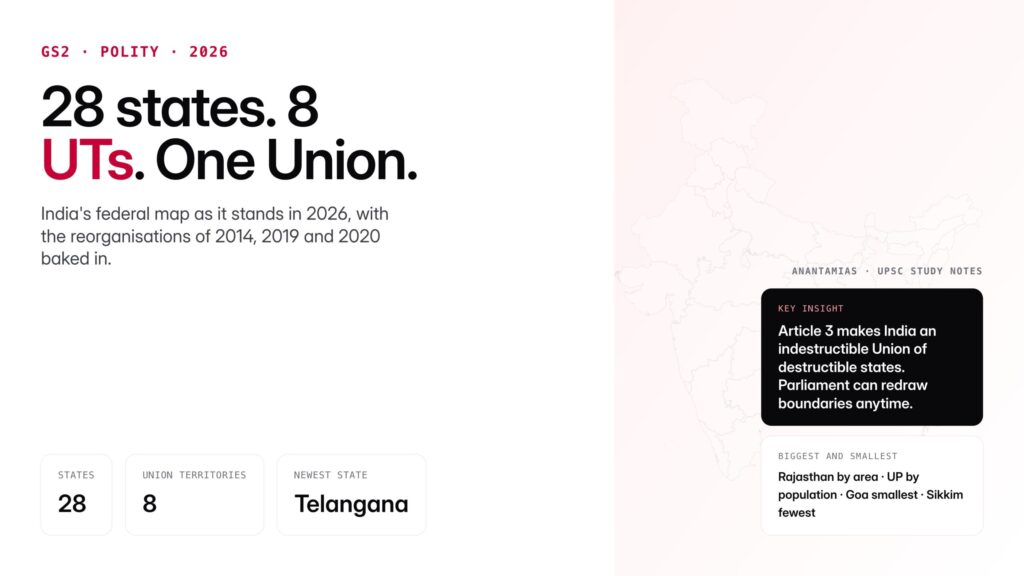
India in 2026 is a federal republic of twenty-eight states and eight union territories, spread across a land area of 3.28 million square kilometres and home to more than 1.42 billion people. For any UPSC aspirant, the list of states and capitals is one of the earliest and most tested pieces of knowledge, appearing in Prelims factual questions, in GS1 geography, GS2 polity and interview-level questions on federalism. Knowing the capitals is the first step; understanding why and when each state was created is the real preparation.
This guide consolidates the 2026 administrative map, including the latest changes from the reorganisation of Jammu and Kashmir in 2019, the merger of Daman and Diu with Dadra and Nagar Haveli in 2020, and the addition of Ladakh as a union territory. It also flags ongoing demands for new states such as Vidarbha, Bodoland and Gorkhaland, which make this chapter more than a memorisation drill.
Quick Facts at a Glance
| Attribute | Detail |
|---|---|
| Total states | 28 |
| Total union territories | 8 |
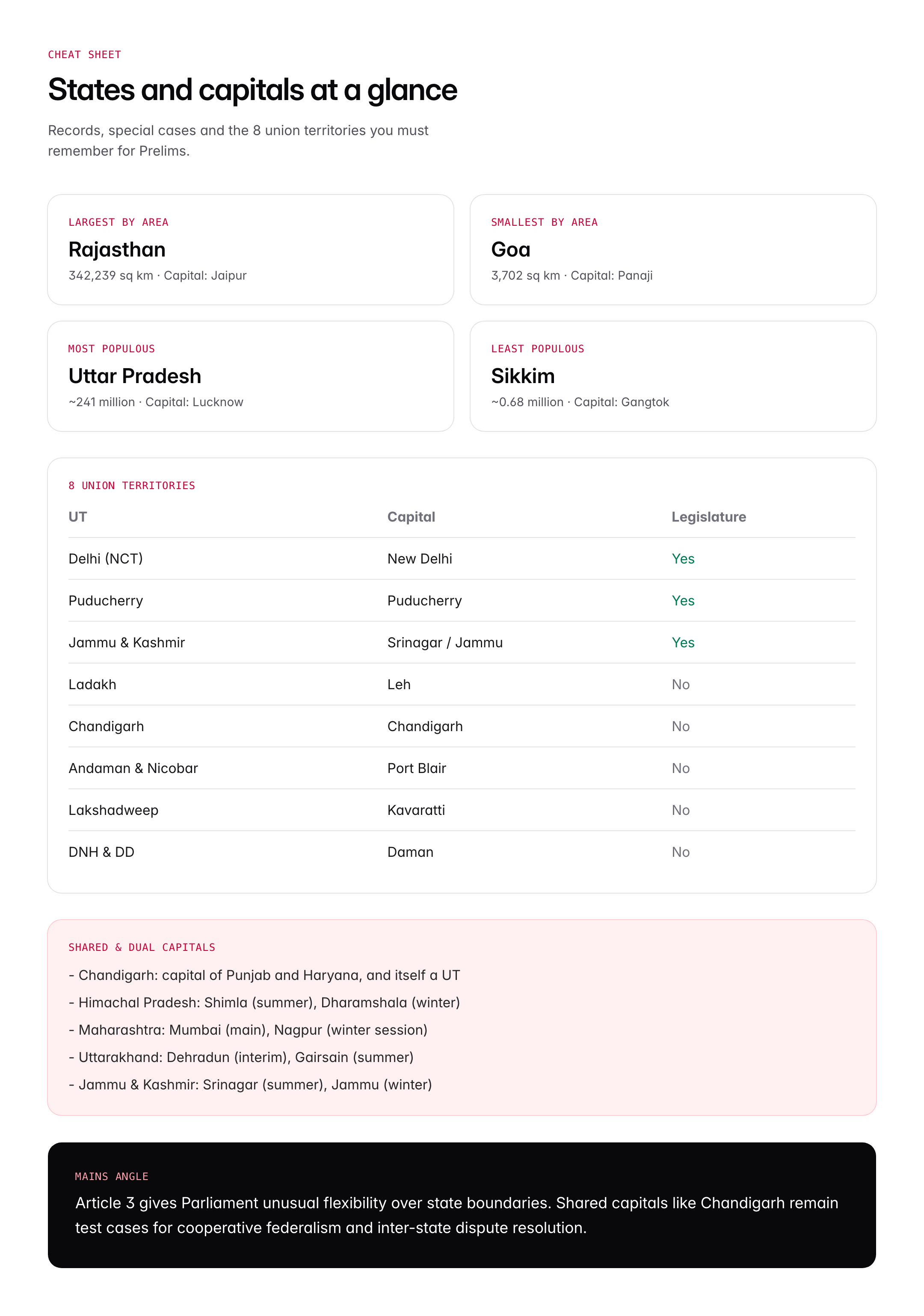
| Most populous state | Uttar Pradesh (approx. 241 million, 2023 est.) |
| Largest by area | Rajasthan (342,239 sq km) |
| Smallest by area | Goa (3,702 sq km) |
| Least populous state | Sikkim (approx. 0.68 million) |
| Newest state | Telangana (2 June 2014) |
| Newest union territory | Ladakh (31 October 2019) |
| States reorganisation basis | States Reorganisation Act, 1956 |
| Constitutional article for new states | Article 3 of the Constitution |
| States with special status | Article 371 variants for several states |
| Official languages recognised | 22 in Eighth Schedule |
Background and Historical Context
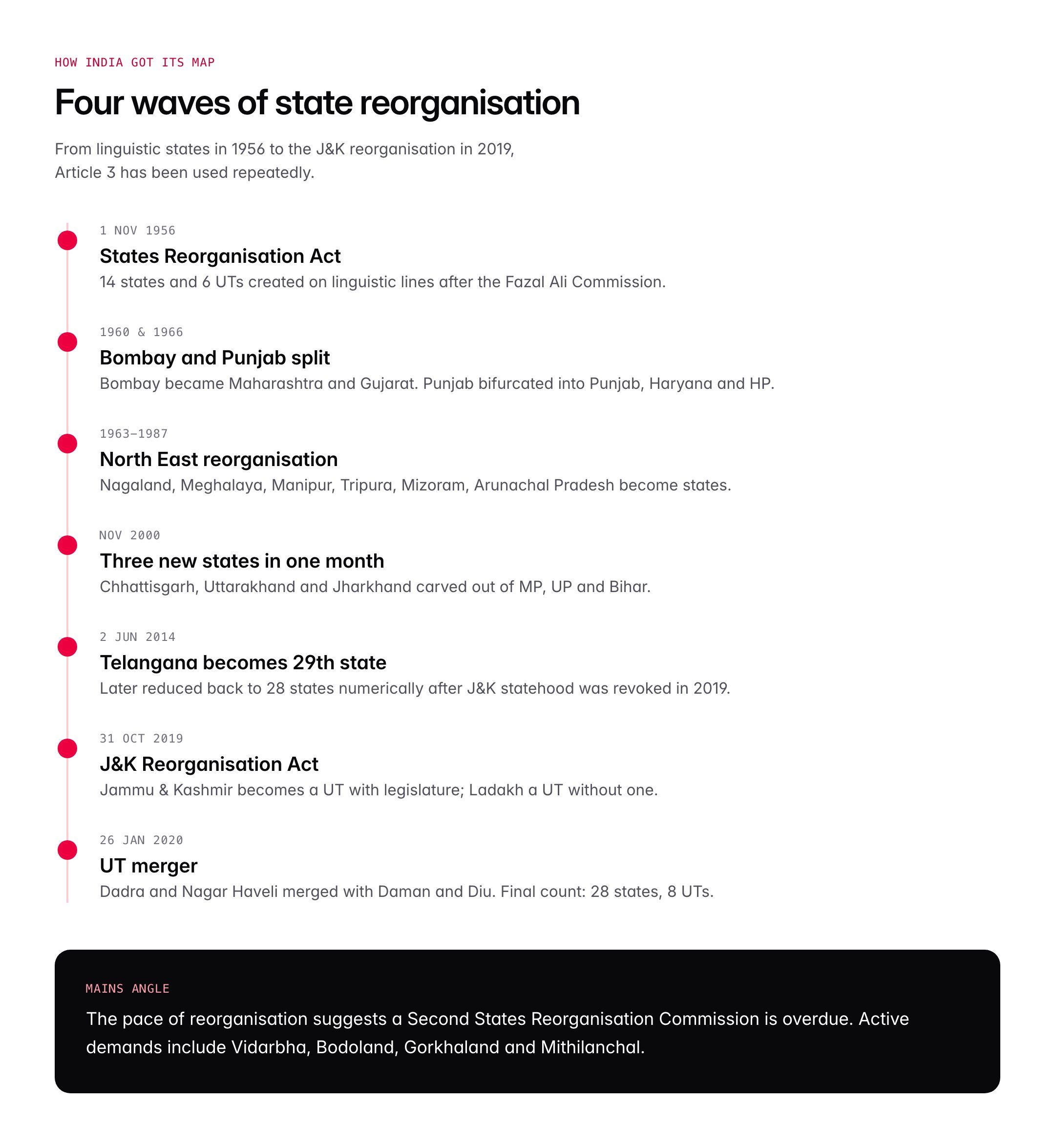
At Independence in 1947, India was a patchwork of British provinces and over 560 princely states. The integration drive led by Sardar Vallabhbhai Patel and V. P. Menon brought them under the Indian Union, but the internal map was still based on colonial convenience, not linguistic or cultural coherence. The first major reorganisation came through the States Reorganisation Act, 1956, which created fourteen states and six union territories based largely on the recommendations of the Fazal Ali Commission. Linguistic identity became the organising principle, following the creation of Andhra State in 1953 after the fast-unto-death of Potti Sreeramulu.
Over the following decades, new states were carved out in response to demands from regional, tribal and linguistic movements. Maharashtra and Gujarat were separated in 1960, Nagaland was created in 1963, Haryana in 1966 and Himachal Pradesh achieved full statehood in 1971. The North East saw Meghalaya (1972), Manipur and Tripura (1972) and Arunachal Pradesh and Mizoram (1987). The 88th Constitution Amendment and subsequent acts created Chhattisgarh, Uttarakhand (then Uttaranchal) and Jharkhand in November 2000, in response to long-standing tribal and regional demands. Telangana became the 29th state in 2014 after decades of agitation.
In 2019, the Jammu and Kashmir Reorganisation Act abolished the state of Jammu and Kashmir and created two union territories: Jammu and Kashmir (with a legislature) and Ladakh (without one). In 2020, Daman and Diu was merged with Dadra and Nagar Haveli into a single UT. As a result, India today has 28 states and 8 UTs, a configuration unchanged since early 2020 but kept alive by active demands from Vidarbha, Bodoland, Gorkhaland, Mithilanchal, Bundelkhand and Harit Pradesh.
Key Features: State and UT Lists
Full List of 28 States and Capitals
| # | State | Capital | Formation date | Official language(s) |
|---|---|---|---|---|
| 1 | Andhra Pradesh | Amaravati (de facto) | 1 Oct 1953 / 1 Nov 1956 | Telugu |
| 2 | Arunachal Pradesh | Itanagar | 20 Feb 1987 | English |
| 3 | Assam | Dispur | 26 Jan 1950 | Assamese |
| 4 | Bihar | Patna | 26 Jan 1950 | Hindi |
| 5 | Chhattisgarh | Raipur | 1 Nov 2000 | Hindi |
| 6 | Goa | Panaji | 30 May 1987 | Konkani |
| 7 | Gujarat | Gandhinagar | 1 May 1960 | Gujarati |
| 8 | Haryana | Chandigarh | 1 Nov 1966 | Hindi |
| 9 | Himachal Pradesh | Shimla | 25 Jan 1971 | Hindi |
| 10 | Jharkhand | Ranchi | 15 Nov 2000 | Hindi |
| 11 | Karnataka | Bengaluru | 1 Nov 1956 | Kannada |
| 12 | Kerala | Thiruvananthapuram | 1 Nov 1956 | Malayalam |
| 13 | Madhya Pradesh | Bhopal | 1 Nov 1956 | Hindi |
| 14 | Maharashtra | Mumbai | 1 May 1960 | Marathi |
| 15 | Manipur | Imphal | 21 Jan 1972 | Manipuri (Meitei) |
| 16 | Meghalaya | Shillong | 21 Jan 1972 | English |
| 17 | Mizoram | Aizawl | 20 Feb 1987 | Mizo, English |
| 18 | Nagaland | Kohima | 1 Dec 1963 | English |
| 19 | Odisha | Bhubaneswar | 26 Jan 1950 | Odia |
| 20 | Punjab | Chandigarh | 1 Nov 1966 | Punjabi |
| 21 | Rajasthan | Jaipur | 1 Nov 1956 | Hindi |
| 22 | Sikkim | Gangtok | 16 May 1975 | English, Nepali |
| 23 | Tamil Nadu | Chennai | 26 Jan 1950 | Tamil |
| 24 | Telangana | Hyderabad | 2 Jun 2014 | Telugu, Urdu |
| 25 | Tripura | Agartala | 21 Jan 1972 | Bengali, Kokborok |
| 26 | Uttar Pradesh | Lucknow | 26 Jan 1950 | Hindi |
| 27 | Uttarakhand | Dehradun (winter) / Gairsain (summer) | 9 Nov 2000 | Hindi, Sanskrit |
| 28 | West Bengal | Kolkata | 26 Jan 1950 | Bengali |
Full List of 8 Union Territories and Capitals
| # | Union Territory | Capital | Formation / notable date |
|---|---|---|---|
| 1 | Andaman and Nicobar Islands | Port Blair | 1 Nov 1956 |
| 2 | Chandigarh | Chandigarh | 1 Nov 1966 |
| 3 | Dadra and Nagar Haveli and Daman and Diu | Daman | 26 Jan 2020 (merged) |
| 4 | Delhi (NCT) | New Delhi | 1 Nov 1956 |
| 5 | Jammu and Kashmir | Srinagar (summer) / Jammu (winter) | 31 Oct 2019 |
| 6 | Ladakh | Leh | 31 Oct 2019 |
| 7 | Lakshadweep | Kavaratti | 1 Nov 1956 |
| 8 | Puducherry | Puducherry | 1 Nov 1954 / 16 Aug 1962 |
Capitals with Dual or Rotating Arrangements
- Uttarakhand: Dehradun is the interim capital; Gairsain has been declared the summer capital.
- Himachal Pradesh: Shimla is the capital, with Dharamshala as the winter capital.
- Maharashtra: Mumbai is the capital, Nagpur is the winter (session) capital.
- Jammu and Kashmir (UT): Srinagar in summer, Jammu in winter under the Darbar Move tradition (formally ended in 2021 but the cities retain importance).
- Andhra Pradesh: Amaravati is the de facto capital; the three-capital proposal (Amaravati, Visakhapatnam, Kurnool) remains contested.
Significance for UPSC and General Knowledge
- Foundational factual knowledge for Prelims, often tested directly as match-the-following.
- Linked to federal structure under Articles 1 to 4 of the Constitution, essential for GS2 polity.
- Connects to the Inner Line Permit regime in Arunachal Pradesh, Mizoram, Nagaland and Manipur, relevant for security and North East questions.
- Forms the basis for analysing Article 371 special provisions for several states and Article 370 history for Jammu and Kashmir.
- Provides grounding for fiscal federalism, Finance Commission devolution and inter-state disputes.
- Supports understanding of Sixth Schedule areas and autonomous councils in the North East.
Detailed Analysis: State Formation and Federal Evolution
India’s state map has evolved in four broad phases. The first phase (1947-1956) dealt with integration and linguistic reorganisation, culminating in the 1956 Act that created Andhra Pradesh, Kerala, Karnataka (then Mysore), Madhya Pradesh and Rajasthan on linguistic lines. Jawaharlal Nehru, initially sceptical of linguistic states, accepted the principle after Potti Sreeramulu’s death in 1952, which made Andhra the first linguistically defined state.
The second phase (1960s-1980s) saw bilingual Bombay split into Gujarat and Maharashtra in 1960, Nagaland created as a response to insurgency in 1963, and Punjab reorganised in 1966 along linguistic lines into Punjab, Haryana and Himachal Pradesh, with Chandigarh as a shared capital and UT. The North East was reorganised through the North Eastern Areas (Reorganisation) Act, 1971 and a series of state-creation acts, reflecting tribal distinctiveness protected under the Sixth Schedule.
The third phase (2000) responded to tribal and regional movements in the Hindi belt, creating Chhattisgarh from Madhya Pradesh, Jharkhand from Bihar and Uttaranchal (later Uttarakhand) from Uttar Pradesh. All three states were created within a single month in November 2000.
The fourth phase (2014-2020) saw the creation of Telangana in 2014, ending a fifty-year demand rooted in the Telangana movement of the 1950s and 1960s. The 2019 reorganisation of Jammu and Kashmir and the 2020 UT merger completed the current count. Article 3 of the Constitution gives Parliament the power to form new states, alter boundaries or change names, requiring only a Presidential reference to the concerned state legislature, whose views are not binding. This makes India an “indestructible Union of destructible states”, as Dr. B. R. Ambedkar famously summarised.
Population distribution remains deeply uneven. Uttar Pradesh alone has more people than Brazil; Sikkim has fewer than a medium Indian city. The Fifteenth Finance Commission used 2011 Census data adjusted for demographic performance, a partial concession to southern states concerned about delimitation. With the delimitation exercise expected after 2026 based on the next Census, state representation in the Lok Sabha is poised for major change.
Comparative Perspective
India’s state structure is unusual among large federations. The table compares key federations.
| Country | Constituent units | Federal model | Residuary powers |
|---|---|---|---|
| India | 28 states, 8 UTs | Quasi-federal, strong Centre | Union (Article 248) |
| USA | 50 states, 1 federal district, 5 territories | Dual federalism | States (10th Amendment) |
| Australia | 6 states, 10 territories | Cooperative federalism | States |
| Canada | 10 provinces, 3 territories | Asymmetric federalism | Federal government |
| Germany | 16 Länder | Cooperative federalism | Länder |
| Brazil | 26 states, 1 federal district | Federal | Residual to states |
India’s Centre-tilt arises from Article 3 (Parliament can alter state boundaries), Article 356 (President’s Rule), All India Services, financial dependence on the Union, and the Governor’s appointment by the Centre. The North Eastern states enjoy Sixth Schedule autonomy and Article 371 protections that introduce asymmetry comparable to Canadian federalism.
Challenges and Debates
The biggest unresolved debate is demands for new states. Vidarbha (Maharashtra), Gorkhaland (West Bengal), Bodoland (Assam), Harit Pradesh, Poorvanchal and Bundelkhand (Uttar Pradesh), Mithilanchal (Bihar) and Saurashtra (Gujarat) all have active movements with varying intensity. The criteria for creating new states, such as administrative efficiency, cultural identity and economic viability, have never been codified. The Second States Reorganisation Commission, often demanded, has never been formally constituted.
Capital disputes are a second challenge. Andhra Pradesh’s three-capital proposal has been bogged down in litigation since 2020. Chandigarh remains a contested capital between Punjab and Haryana, with the UT administration largely drawn from Punjab cadre officers. The Article 370 abrogation has moved Jammu and Kashmir into a UT status, with political parties demanding full statehood restoration. The Supreme Court in December 2023 upheld the abrogation while directing that statehood be restored “at the earliest” and elections held.
Federalism stress is visible in Centre-state disputes over GST compensation, Governor’s role, National Education Policy and financial devolution. Southern states have voiced concerns about losing parliamentary seats in delimitation, given their lower population growth. These tensions make the seemingly simple question of “how many states” a live constitutional issue.
Prelims Pointers
- India currently has 28 states and 8 union territories as of 2026.
- Telangana, created on 2 June 2014, is the youngest state.
- Ladakh and the new UT of Jammu and Kashmir were created on 31 October 2019.
- Dadra and Nagar Haveli and Daman and Diu merged on 26 January 2020.
- Chandigarh serves as the joint capital of Punjab and Haryana.
- Hyderabad served as the joint capital of Andhra Pradesh and Telangana until 2024.
- Article 3 of the Constitution empowers Parliament to form new states and alter boundaries.
- The States Reorganisation Act, 1956 followed the Fazal Ali Commission’s recommendations.
- The Eighth Schedule currently lists 22 scheduled languages.
- Sixth Schedule areas exist in Assam, Meghalaya, Tripura and Mizoram.
- The largest state by area is Rajasthan; the smallest by area is Goa.
- The most populous state is Uttar Pradesh; the least populous is Sikkim.
Mains Practice Questions
- “India is an indestructible Union of destructible states.” Analyse this statement in the light of Article 3 of the Constitution and recent reorganisations. (250 words)
- Explain Article 3 and the non-binding nature of state consent.
- Examine the 2019 J&K reorganisation and 2014 Telangana creation as case studies.
- Evaluate implications for federalism and quasi-federal character.
- Do the existing criteria for creating new states in India strike a balance between administrative efficiency and identity politics? Suggest a framework for a Second States Reorganisation Commission. (250 words)
- Review historic bases: language, tribal identity, backwardness, administrative convenience.
- Assess demands from Vidarbha, Bodoland, Gorkhaland and others.
- Propose criteria: viability, revenue base, minority protection and stakeholder consultation.
Conclusion
The map of India’s 28 states and 8 union territories is neither random nor final. Every line on it tells a story of negotiation between language, culture, geography and politics. From the integration of princely states under Sardar Patel, through the linguistic reorganisation of 1956 and the tribal and regional moments of 2000 and 2014, to the reorganisation of Jammu and Kashmir in 2019, the Indian state has shown both flexibility and central strength. Knowing the capitals is a starting point; understanding the forces that moved them is what makes an aspirant a polity student rather than a quiz participant.
Looking ahead, pressures on this map will continue. Demands for new states will test Parliament’s appetite for reorganisation; delimitation will test inter-state solidarity; technology and digital governance will redefine what a capital even means when much government work happens online. For UPSC preparation and civic life alike, the takeaway is the same. India’s federal design is a living document, and its states and capitals list is a snapshot, not a monument.
Frequently Asked Questions
How many states and union territories does India have in 2026?
India has 28 states and 8 union territories as of 2026. The current configuration was finalised after the creation of Ladakh and the reorganised UT of Jammu and Kashmir on 31 October 2019, and the merger of Daman and Diu with Dadra and Nagar Haveli on 26 January 2020. No new state or UT has been added since.
What is the difference between a state and a union territory?
A state has its own elected government, legislature and chief minister, with powers drawn directly from the Constitution. A union territory is administered by the President through a Lieutenant Governor or Administrator. Some UTs, Delhi, Puducherry and Jammu and Kashmir, have legislatures with limited powers, while Ladakh, Chandigarh, Lakshadweep, Andaman and Nicobar, and the merged DNH and DD UT do not.
Why is knowing states and capitals important for UPSC aspirants?
It is foundational for Prelims factual questions, GS1 geography, GS2 polity and federalism, and GS3 economy topics linked to state-level schemes. It also underpins understanding of Article 3, the States Reorganisation Act 1956, Article 371 special provisions, Sixth Schedule areas, Finance Commission devolution and delimitation debates that routinely feature in Mains essays.
How is the list of states and capitals related to Article 3 of the Constitution?
Article 3 empowers Parliament to form a new state, alter boundaries of existing states, change their names or merge states. The bill requires a Presidential reference to the concerned state legislature, but its views are not binding on Parliament. This provision has been used for every reorganisation since 1956, including the creation of Telangana in 2014 and the 2019 Jammu and Kashmir reorganisation.
Which is the newest state of India?
Telangana, carved out of Andhra Pradesh on 2 June 2014, is the newest state. It was created through the Andhra Pradesh Reorganisation Act, 2014 after a long agitation rooted in the Telangana movement of the 1950s. Hyderabad served as the joint capital of Andhra Pradesh and Telangana for ten years, a period that ended in June 2024.
Which states share Chandigarh as their capital?
Chandigarh is the capital of both Punjab and Haryana and is itself a union territory directly administered by the Union government. The arrangement was set up in 1966 when Haryana was carved out of Punjab. The long-standing demand by Punjab for exclusive control over Chandigarh has not been resolved, making it one of India’s most prominent inter-state boundary and capital disputes.
What happened to Jammu and Kashmir and Ladakh in 2019?
Through the Jammu and Kashmir Reorganisation Act, 2019, which came into force on 31 October 2019, the state of Jammu and Kashmir was bifurcated into two Union Territories: Jammu and Kashmir with a legislature, and Ladakh without one. Simultaneously, Article 370 and Article 35A were effectively abrogated. In December 2023, the Supreme Court upheld the abrogation and directed that statehood be restored at the earliest.
Which Indian states have multiple or seasonal capitals?
Several states operate with multiple capitals for governance. Himachal Pradesh uses Shimla as capital with Dharamshala as winter capital. Maharashtra holds winter sessions in Nagpur alongside capital Mumbai. Uttarakhand has Dehradun as interim capital and Gairsain declared as summer capital. Jammu and Kashmir historically followed the Darbar Move between Srinagar and Jammu. Andhra Pradesh’s proposed three-capital model (Amaravati, Visakhapatnam, Kurnool) is still under litigation.
Tell Google you want more of this.
Add Anantam IAS as a preferred sourceOne tap, and this site shows up more often in your own Top Stories, AI Overviews and AI Mode. Remove it any time.