Introduction
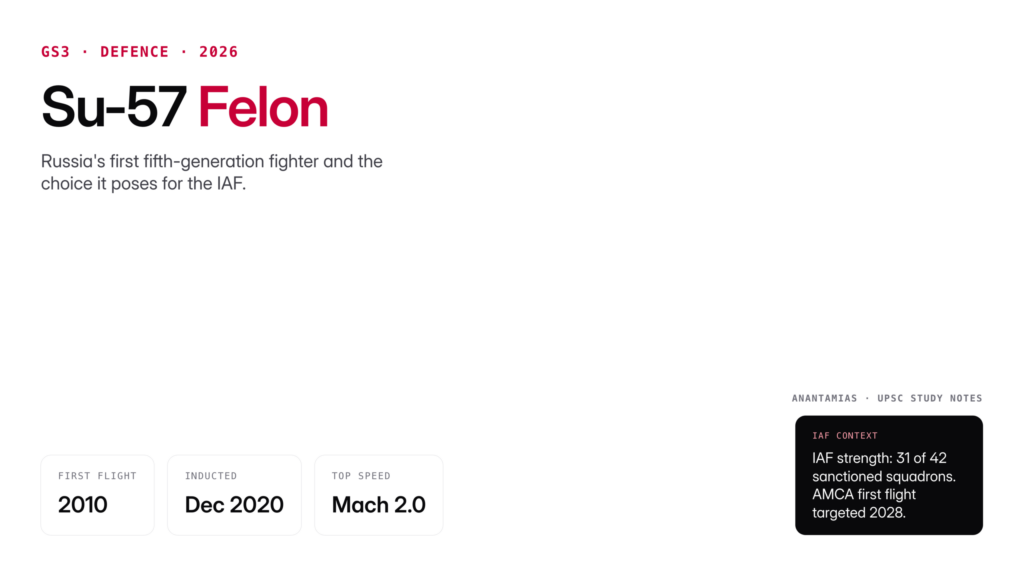
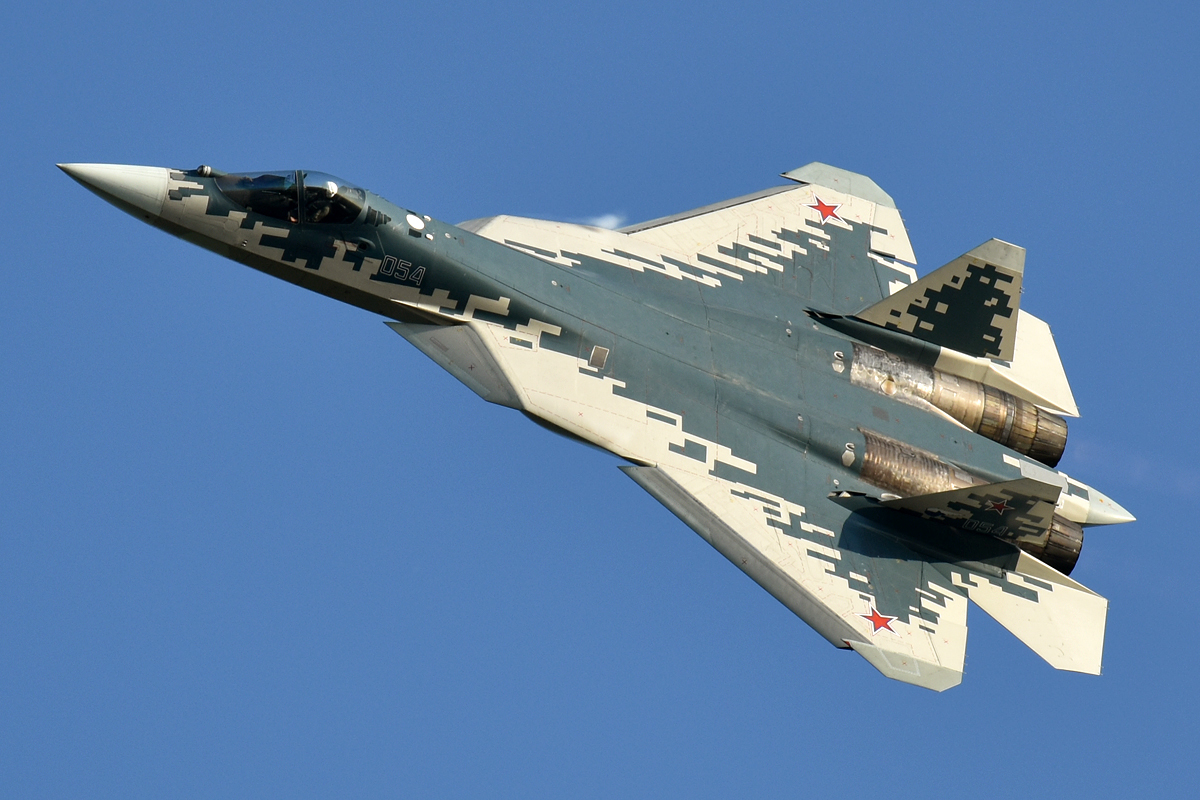
The Sukhoi Su-57, NATO reporting name Felon (often misspelt as Felucon in Indian coverage), is Russia’s first operational fifth-generation fighter aircraft. It is a single-seat, twin-engine multirole platform developed by the Sukhoi Design Bureau under the PAK FA programme and inducted into the Russian Aerospace Forces in December 2020. For India, the Su-57 is both a technology reference and a potential procurement option in a decade when the Indian Air Force (IAF) is short of squadrons and the Advanced Medium Combat Aircraft (AMCA) is still years from induction.
For UPSC aspirants, the Su-57 is relevant under GS Paper 3 internal and external security, the science and technology portion of current affairs, and defence procurement policy questions. The aircraft also helps aspirants understand the broader debate about stealth, the limits of fifth-generation technology, and India’s choices between indigenous development and foreign purchase.
Quick Facts at a Glance
| Attribute | Detail |
|---|---|
| Designation | Sukhoi Su-57 |
| NATO reporting name | Felon |
| Programme name | PAK FA / T-50 |
| Role | Multirole stealth fighter |
| Manufacturer | Sukhoi (UAC) |
| First flight | 29 January 2010 |
| Operational induction | December 2020, Russian Aerospace Forces |
| Engines (initial) | 2 x Saturn AL-41F1 (Izdeliye 117) |
| Target engine | Izdeliye 30 (Saturn AL-51F1) |
| Top speed | Mach 2.0 (approx) |
| Combat radius | 1,500 km (approx) |
| Armament | 30 mm GSh-30-1 cannon; R-37M, R-77M, Kh-59MK2 missiles |
Background and Historical Context
The Su-57 traces its origins to the Russian PAK FA (Perspektivny Aviatsionny Kompleks Frontovoy Aviatsii) programme launched in 2002. The aim was to develop a successor to the Su-27 family that could match the American F-22 Raptor and the forthcoming F-35 Lightning II. Sukhoi’s prototype, designated T-50, first flew on 29 January 2010 at Komsomolsk-on-Amur.
From 2007 to 2018, India participated in the PAK FA programme through the Fifth-Generation Fighter Aircraft (FGFA) partnership with Russia. Hindustan Aeronautics Limited was to co-develop an Indian two-seat derivative. After several delays and disagreements over technology transfer, engine performance, stealth signature and workshare, India withdrew from the FGFA programme in 2018. Russia continued alone and the aircraft was renamed Su-57.
The Su-57 programme has faced multiple hurdles. The target second-stage engine, Izdeliye 30, has seen its induction pushed back several times, and the first loss of a production aircraft occurred in December 2019 near Komsomolsk-on-Amur. Despite these setbacks, serial production resumed and, as of 2024 Indian and international defence assessments (IISS Military Balance, Janes), around 20 to 22 airframes had been delivered.
The Su-57 was reportedly used in limited combat roles in Syria (2018) and in the Russian operations over Ukraine from 2022, mostly in stand-off strike profiles using Kh-59MK2 cruise missiles. At the Aero India 2025 show in Bengaluru, Russia publicly offered the Su-57E export variant to India, reopening a decade-old debate.
Key Features and Capabilities
Stealth and airframe
The Su-57 uses a blended wing-body design with internal weapons bays, canted vertical stabilisers and radar-absorbent coatings. Analysts generally assess its frontal radar cross-section as higher than that of the F-22 or F-35 but lower than that of the Su-30MKI. The airframe is optimised for supermanoeuvrability rather than pure stealth, a different design philosophy from American fifth-generation aircraft.
Engines
The initial batch uses the Saturn AL-41F1 (Izdeliye 117), a derivative of the engine used in the Su-35. The definitive powerplant, Izdeliye 30 (Saturn AL-51F1), is still under testing and is designed for supercruise, higher thrust-to-weight ratio and 3D thrust vectoring. Supercruise, the ability to sustain supersonic flight without afterburner, is a hallmark of fifth-generation capability.
Avionics and sensors
The aircraft carries the N036 Byelka AESA radar suite, which combines a nose-mounted main array with cheek-mounted arrays and wing-root L-band arrays for counter-stealth detection. The 101KS Atoll electro-optical system provides infrared search and track and distributed aperture imaging similar in concept to the F-35’s EOTS and DAS.
Weapons
The Su-57 carries a 30 mm GSh-30-1 cannon. Internal bays can carry long-range air-to-air missiles such as the R-37M (range over 300 km), medium-range R-77M, short-range R-74M2, and air-to-surface weapons including the Kh-59MK2 stealth cruise missile and KAB-250 guided bombs. External hardpoints can carry heavier or non-stealthy munitions when required.
Networking and loyal wingman
The Su-57 is designed to operate with the S-70 Okhotnik-B unmanned combat air vehicle as a loyal wingman. This manned-unmanned teaming is one of the aircraft’s most modern features and aligns with the direction of sixth-generation thinking globally.
Significance for UPSC and General Knowledge
- Case study in fifth-generation fighter technology (supercruise, stealth, AESA, sensor fusion).
- India’s withdrawal from the FGFA programme in 2018 is a frequent example of defence procurement decision-making.
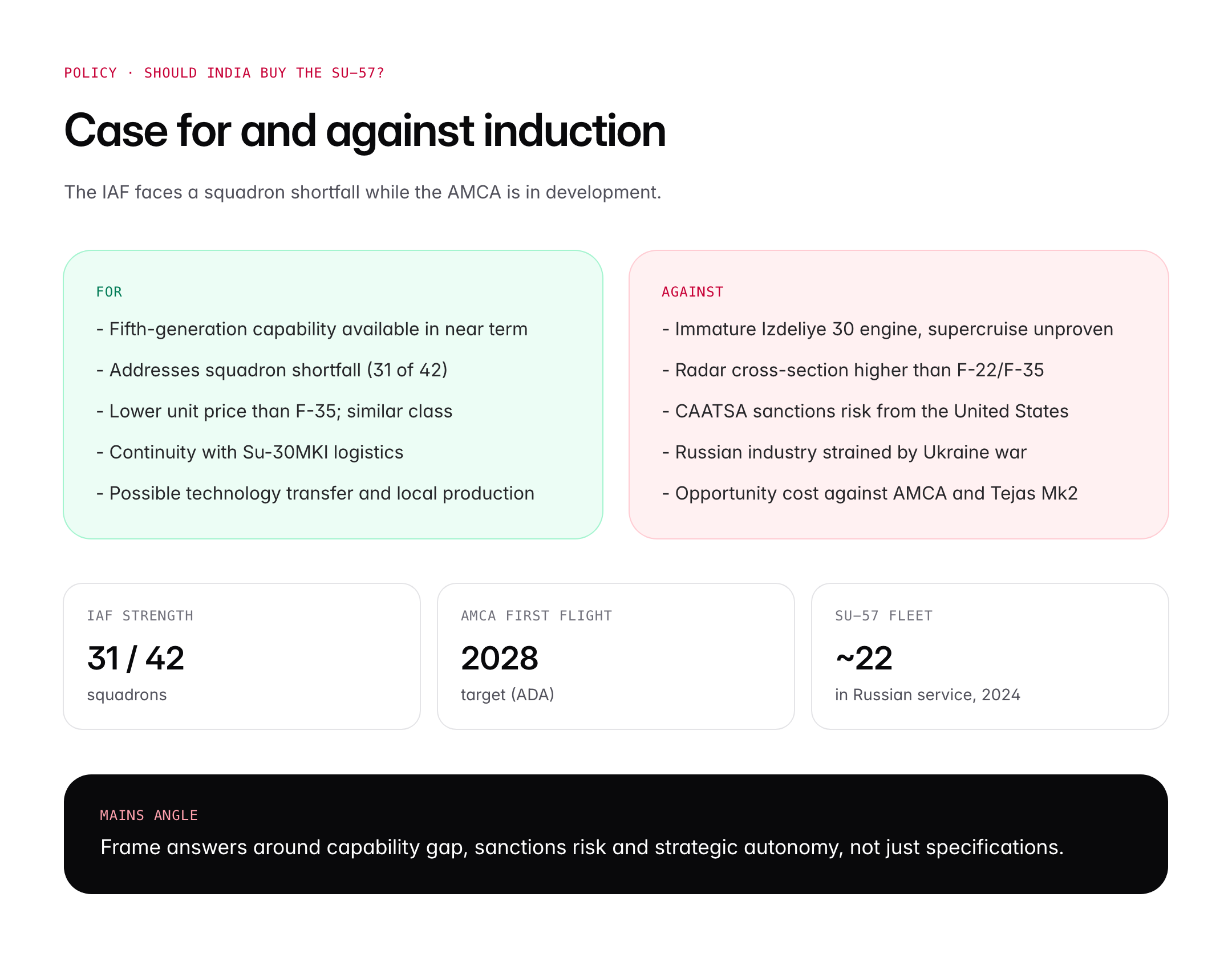
- Su-57E export offer directly affects the IAF’s squadron depletion debate, currently at around 31 squadrons against a sanctioned 42.
- Relevant to the AMCA programme managed by the Aeronautical Development Agency, with first flight targeted for 2028.
- Illustrates the technology-sanctions nexus after the Countering America’s Adversaries Through Sanctions Act, 2017 (CAATSA).
- Relevant to manned-unmanned teaming, a growing area in defence science and technology.
Reign and Operational Profile
The Su-57 is still early in its service life. Russia’s 2020 induction was modest in numbers, with the first operational unit forming at Akhtubinsk. Reports by the International Institute for Strategic Studies place the active fleet at around 20 to 22 aircraft by late 2024, with an announced order of 76 airframes by 2028. Export interest has come from Algeria, which reportedly signed a contract in 2024-25, and inquiries have been reported from Vietnam, Myanmar and others.
Operationally, the aircraft has been used in Syria for short evaluation deployments in 2018, with two airframes reportedly flying live sorties. Over Ukraine from 2022, Russian Aerospace Forces have used the Su-57 primarily in stand-off roles, launching Kh-59MK2 and Kh-69 cruise missiles from Russian airspace rather than crossing into contested airspace. Some sorties have included suppression of enemy air defences using anti-radiation weapons. Losses are hard to verify in open sources, but a ground-attack strike on Akhtubinsk air base in June 2024 reportedly damaged at least one airframe.
For the IAF, the key operational question is whether the Su-57 can bridge the gap between the existing Su-30MKI, Rafale and Tejas fleet and the future AMCA. Proponents argue that a limited buy of 36 to 54 aircraft could provide fifth-generation capability by the late 2020s. Critics point to CAATSA-related sanctions risk, the unresolved engine situation, maintenance dependency on Russia during the Ukraine war, and the opportunity cost against a larger AMCA allocation. The Indian Ministry of Defence has not, as of early 2026, issued an RFI or RFP for the Su-57.
Comparative Perspective
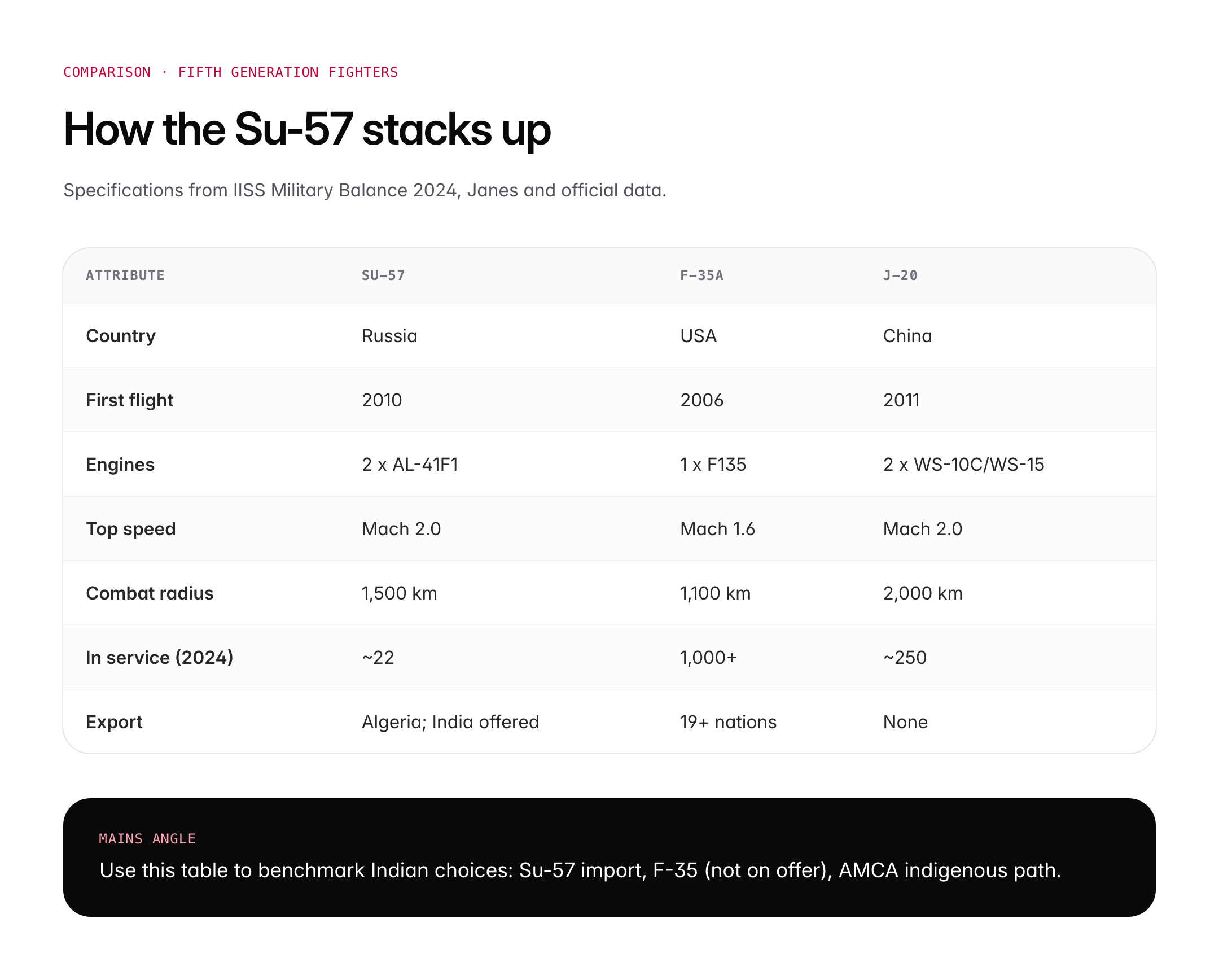
| Feature | Su-57 Felon | F-35 Lightning II | J-20 Mighty Dragon | Rafale F4 |
|---|---|---|---|---|
| Country | Russia | United States | China | France |
| Generation | Fifth | Fifth | Fifth | 4.5 |
| First flight | 2010 | 2006 | 2011 | 1986 (F4 upgrade 2023) |
| Stealth focus | Moderate, supermanoeuvrability | High, sensor fusion | High frontal | Low observable features |
| Top speed | Mach 2.0 | Mach 1.6 | Mach 2.0 | Mach 1.8 |
| Export status | Offered to India, Algeria | Operated by 19+ nations | Not exported | Operated by India, UAE, others |
The Su-57’s closest philosophical analogue is not the F-35 but the F-22: a large, twin-engine air-superiority platform with secondary strike capability. Compared with the J-20, the Su-57 is smaller and optimised for kinematic performance; the J-20 emphasises long range and frontal stealth. Compared with the Rafale F4 already operated by India, the Su-57 adds stealth and supercruise at the cost of significantly higher per-unit and life-cycle costs.
Challenges and Criticisms
Three clusters of criticism surround the Su-57. The first concerns stealth performance. Independent analyses by western think-tanks suggest that surface features, exposed rivets and engine nozzle geometry produce a higher radar cross-section than that of the F-22 or the F-35. Russia argues that detection range matters less than electronic warfare and sensor reach, and that its L-band arrays are effective against American stealth.
The second cluster concerns the engine. The current AL-41F1 is a Su-35 derivative; the definitive Izdeliye 30 has slipped repeatedly. Without the Izdeliye 30, the aircraft does not reliably supercruise and its combat radius is below headline numbers. Sustained war in Ukraine since 2022 has strained Russian engine production capacity.
The third cluster concerns strategic risk for India. Large Su-57 induction would deepen dependence on Russian logistics at a time when Russia’s defence industrial base is consumed by its war effort. CAATSA sanctions from the United States, though partially waived for the S-400 system, remain a live concern for any major Russian procurement. Indian strategic commentators such as Vice Admiral Vinod Pasricha (retd) and analysts at the Observer Research Foundation have argued that funds are better directed to AMCA, Tejas Mk2 and additional Rafales.
Prelims Pointers
- Su-57 NATO reporting name is Felon; Russian programme name was PAK FA / T-50.
- First flight: 29 January 2010 at Komsomolsk-on-Amur.
- Operational induction into Russian Aerospace Forces: December 2020.
- Twin-engine: Saturn AL-41F1 (current), Izdeliye 30 (planned).
- Radar: N036 Byelka AESA; infrared suite: 101KS Atoll.
- Carries R-37M long-range air-to-air missile (range over 300 km).
- Loyal wingman: S-70 Okhotnik-B unmanned combat air vehicle.
- India exited the Indo-Russian FGFA programme in 2018.
- Russia offered the Su-57E export variant to India at Aero India 2025.
- IAF sanctioned strength is 42 squadrons; current strength around 31.
- India’s indigenous fifth-generation programme is AMCA by the ADA.
- CAATSA (2017) governs secondary sanctions on major Russian defence purchases.
Mains Practice Questions
Q1. Examine the strategic and technological trade-offs in procuring the Su-57 for the Indian Air Force, with reference to squadron depletion and the AMCA programme. (250 words)
- IAF squadron shortfall and near-term induction timelines.
- Technology gap between Su-30MKI/Rafale and a fifth-generation platform.
- Sanctions, sustainment and opportunity cost against AMCA.
Q2. Fifth-generation fighter aircraft are defined by a set of capabilities rather than a single feature. Discuss with reference to the Su-57 and the AMCA. (250 words)
- Stealth, supercruise, sensor fusion, networked operations.
- How the Su-57 meets each criterion.
- AMCA targets and current stage of development at ADA.
Conclusion
The Su-57 Felon is a technically ambitious platform that has arrived in small numbers and with key subsystems still maturing. It offers Russia and its export partners an avenue into fifth-generation combat aviation at a price point below the F-35 but with significant strategic and industrial baggage. For India, it is less a clear acquisition choice than a useful reference aircraft: a concrete example of what a fifth-generation fighter looks like, what it costs to field, and what it takes to sustain.
For UPSC preparation, the Su-57 sits neatly at the intersection of security studies, science and technology, and defence procurement. An aspirant should be comfortable with its key specifications, the history of the FGFA partnership and its dissolution, the comparative landscape that includes the F-35 and J-20, and the choice architecture facing the IAF between imported stealth and the AMCA. Holding those elements together is more useful for the examination than memorising speed numbers alone.
Frequently Asked Questions
What is the Su-57?
The Sukhoi Su-57, NATO reporting name Felon, is Russia’s first operational fifth-generation multirole stealth fighter. Developed under the PAK FA / T-50 programme, it first flew in 2010 and was inducted into the Russian Aerospace Forces in December 2020. It is a twin-engine, single-seat platform with internal weapons bays, AESA radar and plans for a supercruise-capable Izdeliye 30 engine.
Why is the Su-57 important for UPSC?
It is a live case study in GS Paper 3 defence and science-technology. Aspirants should know its features, India’s 2018 exit from the FGFA programme, Russia’s 2025 Su-57E export offer, and the trade-offs against the AMCA. It also illustrates broader themes of stealth, manned-unmanned teaming, CAATSA sanctions risk and IAF squadron depletion.
How is the Su-57 related to India’s AMCA programme?
The AMCA is India’s indigenous fifth-generation fighter, developed by the Aeronautical Development Agency and targeted for first flight around 2028. The Su-57 represents an imported alternative: a near-term capability at the cost of foreign dependence. AMCA and Su-57 options compete for a limited defence budget and for the IAF’s future force structure.
When did the Su-57 first fly?
The Su-57 prototype, then known as T-50, made its first flight on 29 January 2010 at the Komsomolsk-on-Amur Aviation Plant in Russia’s Far East. It spent a decade in flight testing and small-batch production before entering regular service with the Russian Aerospace Forces in December 2020 with the formation of the first operational unit at Akhtubinsk.
Why did India withdraw from the FGFA programme in 2018?
India’s concerns included inadequate technology transfer, an unsatisfactory radar cross-section, performance shortfalls in the Izdeliye 117 engine, cost escalation, and a workshare that did not deliver meaningful Hindustan Aeronautics involvement. The Ministry of Defence judged that the Indian two-seat derivative did not justify further investment and redirected effort to the indigenous AMCA programme.
What weapons can the Su-57 carry?
The Su-57 carries a 30 mm GSh-30-1 cannon, the long-range R-37M air-to-air missile, the medium-range R-77M, short-range R-74M2, and air-to-ground systems including the Kh-59MK2 stealth cruise missile and KAB-250 guided bombs. Internal bays preserve stealth, while external hardpoints add capacity at the cost of radar signature.
How does the Su-57 compare with the F-35?
The F-35 emphasises sensor fusion, networked operations and very low observability; the Su-57 emphasises supermanoeuvrability, long-range missiles and electronic warfare. The F-35 operates from 19 nations with mature logistics. The Su-57 has under 25 airframes in service, a less mature engine, but a lower unit price and greater kinematic performance.
Has the Su-57 been used in combat?
Yes, in limited roles. Two airframes were briefly deployed to Syria in 2018 for operational evaluation. Since 2022, Russian Aerospace Forces have used the Su-57 over Ukraine mostly in stand-off profiles, launching Kh-59MK2 and Kh-69 cruise missiles from within Russian airspace. A ground attack on Akhtubinsk air base in June 2024 reportedly damaged at least one aircraft.
Tell Google you want more of this.
Add Anantam IAS as a preferred sourceOne tap, and this site shows up more often in your own Top Stories, AI Overviews and AI Mode. Remove it any time.