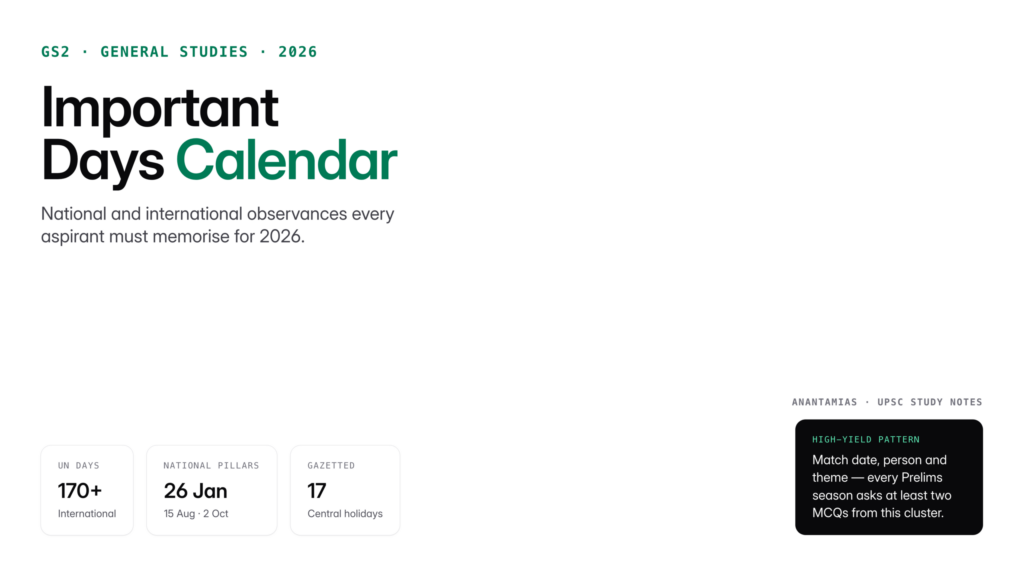
Which special day is today in India? It depends on the date you are checking — India observes some national, international or awareness day on almost every date of the year. To find today's, match the current date against the month-wise 2026 calendar below. The fixed national anchors are 26 January (Republic Day), 15 August (Independence Day), 2 October (Gandhi Jayanti), 28 February (National Science Day), 21 June (International Day of Yoga) and 26 November (Constitution Day), alongside more than 170 United Nations international days observed through the year.
Introduction
Every day of the Indian calendar carries weight. A glance at the date may reveal a national commemoration, a United Nations observance, a reformer’s birth anniversary, or a scientific milestone that governs public messaging, school assemblies and UPSC question papers. Asking which special day is today is therefore more than trivia. It is a compact way to read the civic, cultural and policy priorities of the Indian state and the global community to which India contributes.
This guide is a working 2026 reference for aspirants, teachers and curious readers. It organises the year into national days, international days under United Nations custody, commemorative anniversaries, and awareness-driven observances promoted by Indian ministries. It also explains the mechanics of how a special day is declared, why certain dates were chosen, and how UPSC typically frames questions around them.
Quick Facts at a Glance
| Attribute | Detail |
|---|---|
| Total UN-designated international days | Over 170 |
| Indian national days (Republic, Independence, Gandhi Jayanti) | 3 |
| Gazetted holidays in India (Central Government, typical year) | 17 |
| First observance on Indian calendar | 1 January — DRDO Foundation context |
| Key month for national integration | August (Independence Day, Sadbhavana Diwas, Quit India) |
| Designating agency (India) | Ministry of Home Affairs, MoCA, MoHFW and sectoral ministries |
| Designating agency (global) | United Nations General Assembly |
| Common exam angle | Prelims MCQ and Mains values-based questions |
| Most observed scientific day | 28 February — National Science Day |
| Closest to Constitution | 26 November — Constitution Day (Samvidhan Divas) |
Background and Historical Context
The tradition of setting aside specific days for remembrance pre-dates independent India. The British Raj marked Empire Day on 24 May, and reformist movements such as the Brahmo Samaj and Arya Samaj observed founder birthdays as public events. After 1947, the Government of India formalised three pillar national days — Republic Day on 26 January, Independence Day on 15 August, and Gandhi Jayanti on 2 October. Each was chosen with deliberate historical anchoring: the Purna Swaraj declaration of 1930, the transfer of power in 1947, and the birth of Mahatma Gandhi in 1869.
Through the 1950s and 1960s, independent India expanded the civic calendar. Teachers’ Day on 5 September was instituted in 1962 on Dr. Sarvepalli Radhakrishnan’s own suggestion. Children’s Day on 14 November marks Jawaharlal Nehru’s birthday. National Science Day on 28 February commemorates the discovery of the Raman Effect in 1928.
At the global level, the United Nations became the primary driver of international days. Beginning with World Health Day in 1948, the UN General Assembly has since proclaimed more than 170 themed days covering health, environment, rights, culture and education. India co-sponsored and anchors several, most notably International Day of Yoga on 21 June, adopted in 2014 through UNGA Resolution 69/131 after a proposal by Prime Minister Narendra Modi.
Ministries within India issue their own observances. The Ministry of Ayush, Ministry of Health and Family Welfare, Ministry of Education and Ministry of Women and Child Development each anchor annual awareness campaigns, many of which have become fixtures of the school and public calendar.
Key Features: 2026 Month-wise Calendar
January — New Year, Republic and Reform
- 1 January — Global New Year, Army Medical Corps Raising Day
- 9 January — Pravasi Bharatiya Divas, commemorating Gandhi’s return from South Africa in 1915
- 12 January — National Youth Day, Swami Vivekananda’s birth anniversary
- 15 January — Indian Army Day, marking Field Marshal Cariappa’s 1949 takeover
- 24 January — National Girl Child Day
- 25 January — National Voters’ Day, founded 2011 to mark ECI Foundation Day
- 26 January — Republic Day, adoption of the Constitution in 1950
- 30 January — Martyrs’ Day (Shaheed Diwas), Gandhi’s assassination anniversary
February — Science and Cooperation
- 2 February — World Wetlands Day, Ramsar Convention anniversary
- 4 February — World Cancer Day
- 13 February — National Women’s Day (Sarojini Naidu Jayanti)
- 24 February — Central Excise Day
- 28 February — National Science Day, Raman Effect commemoration
March — Rights and Water
- 8 March — International Women’s Day
- 15 March — World Consumer Rights Day
- 21 March — International Day of Forests
- 22 March — World Water Day and Bihar Diwas
- 23 March — Shaheed Diwas, martyrdom of Bhagat Singh, Rajguru, Sukhdev
- 24 March — World TB Day
April — Health and Heritage
- 5 April — National Maritime Day
- 7 April — World Health Day
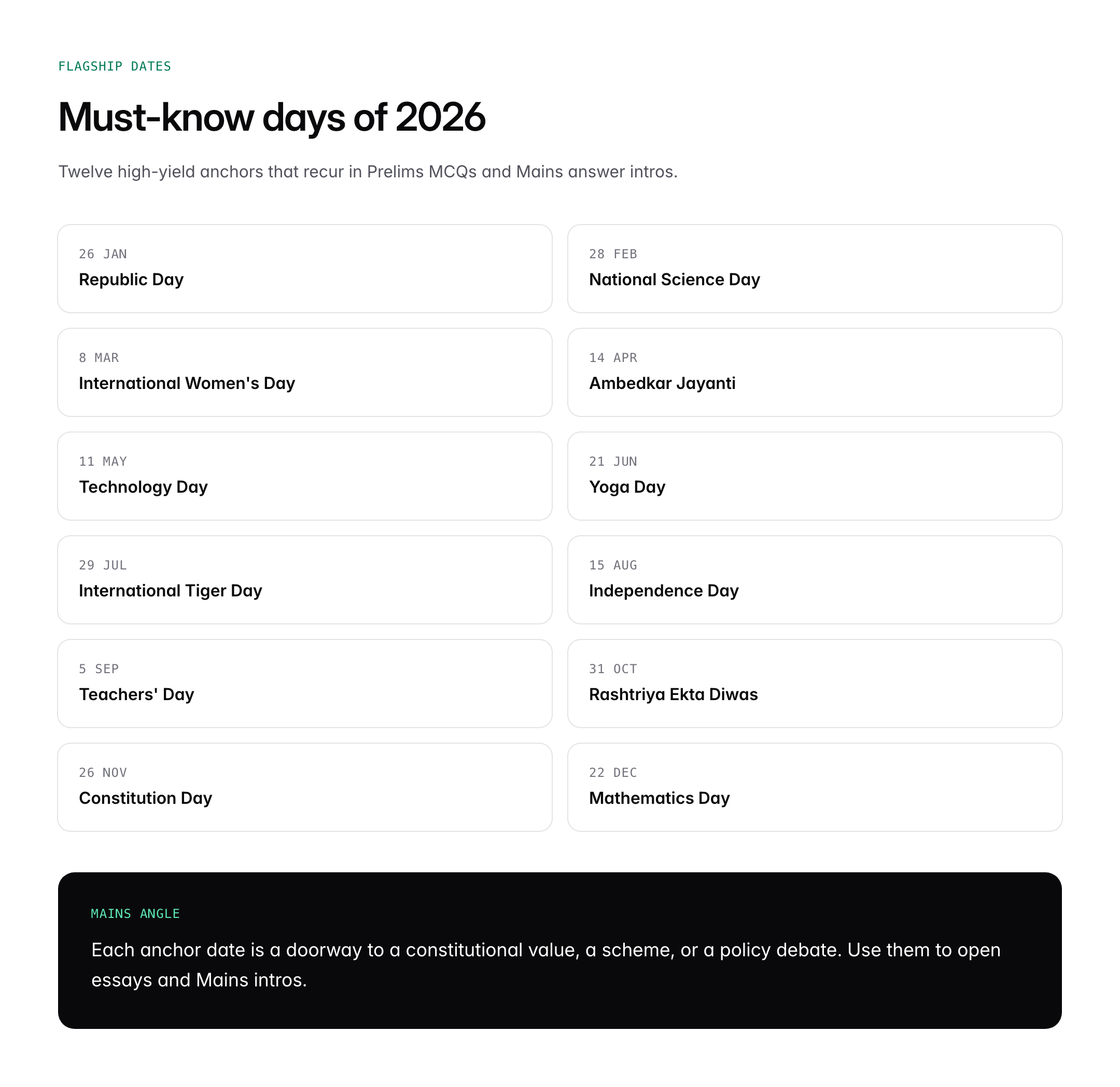
- 14 April — Ambedkar Jayanti
- 18 April — World Heritage Day
- 22 April — Earth Day
- 24 April — National Panchayati Raj Day
May — Labour and Family
- 1 May — International Labour Day, Maharashtra Day, Gujarat Day
- 3 May — World Press Freedom Day
- 8 May — World Red Cross Day
- 11 May — National Technology Day, Pokhran-II anniversary
- 12 May — International Nurses Day
- 15 May — International Day of Families
- 22 May — International Day for Biological Diversity
- 31 May — World No Tobacco Day
June — Environment and Yoga
- 5 June — World Environment Day
- 8 June — World Oceans Day
- 12 June — World Day Against Child Labour
- 14 June — World Blood Donor Day
- 20 June — World Refugee Day
- 21 June — International Day of Yoga
July — Population and Tigers
- 1 July — National Doctors’ Day, Dr. B. C. Roy’s birth and death anniversary
- 11 July — World Population Day
- 26 July — Kargil Vijay Diwas
- 28 July — World Nature Conservation Day
- 29 July — International Tiger Day
August — Freedom and Friendship
- 6 August — Hiroshima Day
- 8 August — Quit India Movement anniversary
- 12 August — International Youth Day
- 15 August — Independence Day
- 19 August — World Humanitarian Day
- 20 August — Sadbhavana Diwas, Rajiv Gandhi’s birth anniversary
- 29 August — National Sports Day, Dhyan Chand’s birth anniversary
September — Literacy and Hindi
- 5 September — Teachers’ Day
- 8 September — International Literacy Day
- 14 September — Hindi Diwas
- 15 September — Engineers’ Day, M. Visvesvaraya’s birth anniversary
- 21 September — International Day of Peace
- 27 September — World Tourism Day
- 29 September — World Heart Day
October — Gandhi and Reform
- 1 October — International Day of Older Persons
- 2 October — Gandhi Jayanti, also International Day of Non-Violence
- 8 October — Indian Air Force Day
- 10 October — World Mental Health Day
- 11 October — International Day of the Girl Child, also JP Jayanti
- 16 October — World Food Day
- 24 October — United Nations Day
- 31 October — Rashtriya Ekta Diwas (National Unity Day), Sardar Patel Jayanti
November — Rights and Children
- 9 November — Legal Services Day and Uttarakhand Foundation Day
- 14 November — Children’s Day
- 19 November — World Toilet Day and Rani Lakshmibai Jayanti
- 26 November — Constitution Day (Samvidhan Divas)
December — Human Rights and Farmers
- 1 December — World AIDS Day
- 2 December — National Pollution Control Day
- 3 December — International Day of Persons with Disabilities
- 4 December — Indian Navy Day
- 10 December — Human Rights Day
- 14 December — National Energy Conservation Day
- 22 December — National Mathematics Day, Ramanujan’s birth anniversary
- 23 December — Kisan Diwas, Chaudhary Charan Singh’s birth anniversary
- 25 December — Good Governance Day (Sushasan Diwas), Atal Bihari Vajpayee Jayanti
Significance for UPSC and General Knowledge
- Frequent Prelims MCQs match date, person and theme
- Helps remember flagship scheme launches (e.g., Beti Bachao launched 22 January)
- Anchors essay introductions on values, rights, environment
- Clarifies constitutional milestones — 26 January, 26 November
- Bridges international commitments (Paris, CBD, WHO) with domestic days
- Useful for Interview Board cross-questioning on recent themes
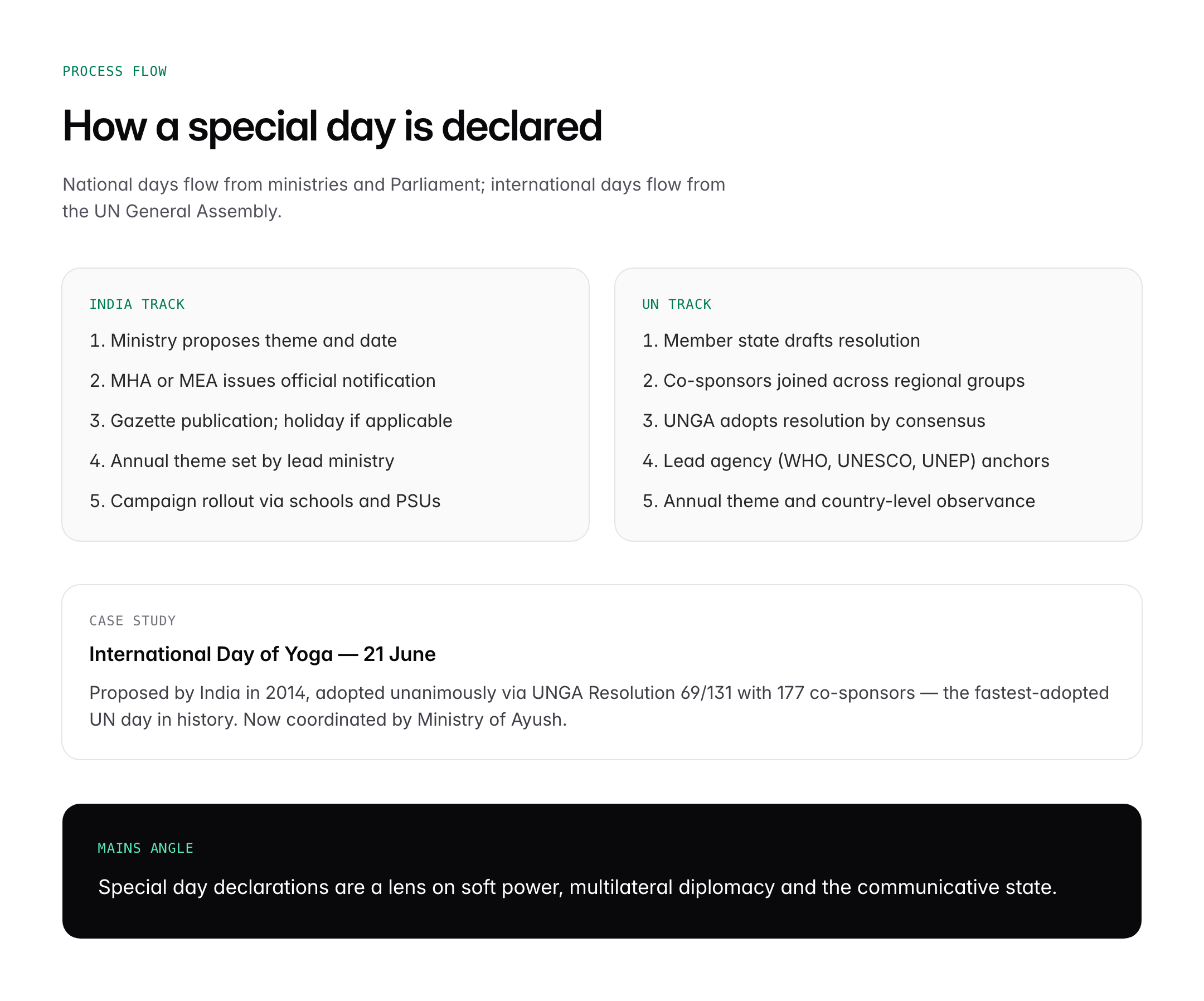
Detailed Analysis: How Special Days Are Declared and Used
A special day is rarely spontaneous. In India, declarations flow from the Ministry of Home Affairs for civic and security events, the Ministry of Health and Family Welfare for health days, the Ministry of Education for teachers and literacy, the Ministry of Environment, Forest and Climate Change for conservation observances, and the Ministry of External Affairs for diaspora days such as Pravasi Bharatiya Divas.
At the global level, the United Nations General Assembly adopts international days through a resolution introduced by one or more member states. For example, UNGA Resolution 69/131 proclaimed the International Day of Yoga in 2014 after 177 member states co-sponsored the Indian proposal. Similarly, UNGA Resolution 47/237 created Children’s Day, and UNESCO anchors World Press Freedom Day since 1993.
The cycle does not end at the declaration. Each day is activated by a theme set annually by the lead agency. The WHO releases World Health Day themes (such as Our Planet, Our Health), the UNEP announces World Environment Day themes each 5 June, and the Ministry of Ayush publishes an annual yoga protocol before 21 June. These themes feed directly into current affairs, giving UPSC aspirants predictable question fodder.
Implementation varies widely. Some days trigger gazetted holidays (Republic Day, Independence Day, Gandhi Jayanti). Others drive ministry campaigns — Swachhata Pakhwada in October, Vigilance Awareness Week around 31 October, Ayushman Bharat Diwas on 30 April. A third category supports civil society advocacy, such as International Women’s Day campaigns led by NGOs and corporate foundations.
For exam purposes, the most testable angles are pairing date and person, matching date and theme, and linking day to scheme or legislation. Constitution Day on 26 November invariably prompts questions on the Constituent Assembly, while National Voters’ Day on 25 January links to the Election Commission of India.
Comparative Perspective
| Category | Origin | Example | Legal character |
|---|---|---|---|
| National day | Indian government | Republic Day | Gazetted holiday |
| International UN day | UN General Assembly | Yoga Day | Advisory, member observance |
| Ministerial awareness day | Specific ministry | National Science Day | Non-holiday, campaign |
| Religious observance | Community and state | Diwali, Eid, Christmas | Gazetted holiday |
| State foundation day | State legislation | Gujarat Day, Maharashtra Day | Gazetted in that state |
Where India designates Republic Day through constitutional and statutory practice, UN days operate through soft law. The difference matters because only some days trigger mandatory government action, while others create an expectation of voluntary observance by ministries, schools and civil society.
Challenges and Criticisms
The proliferation of special days brings its own problems. Critics argue that with over 170 UN observances and hundreds of ministry days, the signal is diluted. Schools face pressure to hold event after event with limited teaching time. Social media campaigns can reduce complex issues — women’s rights, disability inclusion, mental health — to a single colour, hashtag or video, a phenomenon sometimes called awareness-washing.
There are also debates about exclusion. For decades, International Day of the Boy Child, declared by individual organisations on 16 May, lacked formal UN recognition while the girl child day (11 October) gained prominence. Similar arguments surface around single-issue days that overlap thematically, such as water (22 March), oceans (8 June) and wetlands (2 February).
Finally, political contestation is visible around the choice of commemorations. The decision to observe Samvidhan Divas from 2015 was welcomed broadly but also debated for overlapping with the earlier practice of Law Day on 26 November. Kisan Diwas on 23 December and Sushasan Diwas on 25 December illustrate how governments of different parties privilege different figures in the national calendar.
Prelims Pointers
- 26 January 1950 — Constitution of India came into force
- 26 November 1949 — Constitution adopted by the Constituent Assembly
- 28 February 1928 — C. V. Raman announced the Raman Effect
- 15 August 1947 — India attained independence
- 2 October — Gandhi Jayanti and International Day of Non-Violence (UN)
- 21 June — International Day of Yoga, UNGA Resolution 69/131
- 25 January — National Voters’ Day, ECI Foundation
- 29 August — National Sports Day, Major Dhyan Chand’s birth anniversary
- 31 October — Rashtriya Ekta Diwas, Sardar Patel’s birth anniversary
- 22 December — National Mathematics Day, Srinivasa Ramanujan’s birth
- 5 September — Teachers’ Day, Sarvepalli Radhakrishnan’s birthday
- 15 September — Engineers’ Day, M. Visvesvaraya’s birthday
Mains Practice Questions
Q1. “Commemorative days have evolved from moments of remembrance into instruments of policy communication.” Examine with Indian examples. (250 words)
- Illustrate with National Science Day, Voters’ Day, Sushasan Diwas
- Discuss how ministries use themes to drive awareness and scheme uptake
- Balance with critique of awareness-washing and event fatigue
Q2. Discuss the role of the United Nations in promoting international days and India’s engagement with selected observances such as the International Day of Yoga. (250 words)
- Explain UNGA resolution mechanism and role of specialised agencies
- Case study of Yoga Day, Ayurveda Day, Non-Violence Day
- Evaluate soft power implications and critiques
Conclusion
The calendar of important days is a living document. It archives national memory, communicates government priorities, and participates in a global conversation on shared values. For aspirants, learning the date, person and theme for each observance pays direct dividends in Prelims, cements Mains arguments with concrete references, and demonstrates civic awareness in the Interview Board.
More importantly, the calendar is an invitation to act. Whether it is planting a sapling on 5 June, visiting a polling booth rehearsal on 25 January, or rereading the Preamble on 26 November, every special day offers a small opportunity to practice the values that India and the wider world have chosen to honour.
Frequently Asked Questions
What is a special day in India?
A special day in India is a calendar date formally observed for a civic, cultural, scientific, or international purpose. Such days are declared by the Government of India, individual ministries, or the United Nations. They range from gazetted national holidays such as Republic Day to awareness observances like National Science Day and International Day of Yoga.
Why are important days in India relevant for UPSC?
Important days feature directly in Prelims MCQs matching date with person, theme, or event. They anchor Mains answers on governance, rights and environment, and help Interview Board candidates show civic awareness. Pairing anniversaries with schemes and constitutional milestones is a consistent high-yield preparation strategy.
How are international days related to Indian national days?
International days declared by the UN General Assembly coexist with Indian national days. Some overlap — 2 October is both Gandhi Jayanti and the International Day of Non-Violence. Others were proposed by India, most famously the International Day of Yoga on 21 June, adopted by UNGA Resolution 69/131 in 2014.
Which special day is today in India?
The answer depends on the date you check, but India observes hundreds of special days across the year. Major anchors include 26 January (Republic Day), 15 August (Independence Day), 2 October (Gandhi Jayanti), 28 February (Science Day), 21 June (Yoga Day) and 26 November (Constitution Day). Always cross-reference the MHA and UN calendars.
How are international days officially declared?
The United Nations General Assembly adopts international days by resolution, often co-sponsored by multiple member states. Specialised agencies such as WHO, UNESCO and UNEP may also anchor days. Once declared, member states and civil society observe them voluntarily, usually around annually rotating themes set by the lead agency.
Why is 28 February celebrated as National Science Day?
National Science Day commemorates the discovery of the Raman Effect by Indian physicist C. V. Raman on 28 February 1928. The discovery won him the Nobel Prize in Physics in 1930. The Government of India instituted the day in 1986 to popularise science, and the National Council for Science and Technology Communication sets an annual theme.
What is the difference between a gazetted holiday and an awareness day?
A gazetted holiday is notified by the Government of India under the Negotiable Instruments Act and the Central Government holiday list, implying closure of offices and banks. An awareness day is not a public holiday but drives government, school and civil society campaigns. Most special days fall in the second category.
How many international days does the United Nations observe?
The United Nations currently observes more than 170 international days, weeks and years, covering health, rights, environment, education, peace and culture. Each is adopted through a General Assembly resolution and many are anchored by specialised agencies such as WHO, UNESCO, UNEP and UNICEF with an annual theme.
Tell Google you want more of this.
Add Anantam IAS as a preferred sourceOne tap, and this site shows up more often in your own Top Stories, AI Overviews and AI Mode. Remove it any time.