Introduction
UDAN, the acronym for Ude Desh ka Aam Nagrik (Let the common citizen fly), is the operational arm of India’s Regional Connectivity Scheme (RCS). Launched on 21 October 2016 and flagged off with its first commercial flight between Shimla and Delhi on 27 April 2017, UDAN aims to bring affordable air travel to tier-2 and tier-3 cities, connect unserved and under-served airports, and catalyse regional economic growth. By April 2026, the scheme has operationalised over 580 routes across more than 85 airports, helipads and water aerodromes.
For UPSC aspirants, UDAN cuts across GS2 (welfare schemes, governance) and GS3 (infrastructure, economy). It is also a recurrent Prelims subject, with questions on Viability Gap Funding (VGF), fare caps, the three-year exclusivity period, and the Regional Connectivity Fund (RCF). Understanding UDAN requires engagement with its financial engineering, federal design and the broader story of Indian civil aviation reform.
Quick Facts at a Glance
| Attribute | Detail |
|---|---|
| Full form | Ude Desh ka Aam Nagrik (Regional Connectivity Scheme) |
| Launched | 21 October 2016 |
| First flight | Shimla to Delhi, 27 April 2017 |
| Ministry | Civil Aviation (MoCA) |
| Implementing agency | Airports Authority of India (AAI) |
| Legal basis | National Civil Aviation Policy 2016 |
| Policy goal | 1 crore RCS passengers by 2027 |
| Fare cap (1 hour flight) | Rs 2,500 (indexed) |
| Exclusivity period | 3 years per route |
| VGF funding | 80% centre, 20% state (NE and UTs: 90:10) |
| Rounds completed | UDAN 1.0 to UDAN 5.5 |
| Operational routes | 580-plus as of April 2026 |
| Airports operationalised | 85-plus under RCS |
| RCS passengers carried | 1.4 crore-plus cumulative |
Background and Historical Context
Before UDAN, Indian aviation was heavily concentrated on metro-to-metro trunk routes. Six metros accounted for more than 60 percent of domestic traffic through the 2000s. Regional airports built during the British era or in the 1950s, like Shimla, Kullu, Jamshedpur and Agatti, lay dormant or operated intermittent seasonal services. The Route Dispersal Guidelines (1994) had attempted to cross-subsidise regional routes by mandating airlines to operate a minimum share on Category II and III routes, but implementation was weak and focused mostly on the Northeast.
The reform momentum built up in the 2010s. The Naresh Chandra Committee (2003) and subsequent working groups flagged the absence of a viable regional airline ecosystem. The Aviation Turbine Fuel (ATF) burden, airport charges and the 5/20 rule for international flying compounded the problem. The National Civil Aviation Policy (NCAP) 2016, released on 15 June 2016, became the first holistic policy since 2000. Its most operational instrument was the Regional Connectivity Scheme, which became UDAN.
UDAN’s innovation lay in reversing the financing model. Instead of mandating airlines to run unprofitable routes, it introduced a demand-side subsidy through Viability Gap Funding disbursed from a dedicated Regional Connectivity Fund. Airlines bid for routes on a reverse auction basis, agreeing to cap fares on a portion of seats. The mechanism combined market competition with a targeted public subsidy, an approach then rare in Indian infrastructure policy.
Key Features of UDAN
Viability Gap Funding (VGF)
The cornerstone of UDAN is Viability Gap Funding. The Government of India, through the Regional Connectivity Fund, partially reimburses selected airline operators for the difference between their operational costs and revenue on subsidised seats. VGF is financed by a RCS levy of Rs 5,000 per departure on all scheduled domestic flights except RCS itself and Cat II/IIA routes. The centre-state share for VGF is 80:20 for general states and 90:10 for the Northeast, UTs and islands.
Fare Cap and Seat Quota
On every RCS flight, airlines must sell at least 50 percent of seats at capped airfares. Caps are structured by stage length and flight duration. For a one-hour fixed-wing flight, the cap was Rs 2,500 at launch; caps for helicopter services and longer legs scale up. Airlines retain freedom to price the remaining seats at market rates, creating a blended revenue model.
Route Allocation and Exclusivity
Routes are awarded through reverse e-auctions, with the bidder requesting the lowest VGF winning. Selected operators enjoy a three-year exclusivity period on a given route, during which no other scheduled operator can fly the same pair. This protects initial investments and allows the route to build traffic.
Airport Infrastructure: Revival and Development
UDAN finances upgrade of unserved and underserved airports through the Airports Authority of India. Through 2026, over 85 airports have been operationalised, including historic re-openings at Hubballi, Jharsuguda, Kishangarh, Belagavi, Tezu, Pakyong (Sikkim, India’s first greenfield airport in a hilly area), and water aerodromes at Sabarmati, Statue of Unity and Shillong.
International UDAN and UDAN Yatri Café
The International UDAN scheme, launched in 2019, extends VGF to selected international routes from state-nominated airports, particularly from the Northeast and Uttar Pradesh. In 2022-23 the Ministry introduced the UDAN Yatri Café concept at airports, offering affordable food and beverages to boost passenger experience.
Krishi UDAN and Lifeline UDAN
Krishi UDAN 2.0, launched on 27 October 2021, subsidises airfreight of agricultural produce from 58 airports, especially from the Northeast, tribal and hilly regions. Lifeline UDAN, activated during the COVID-19 pandemic, carried over 1,000 tonnes of medical cargo across 600 flights.
Significance for UPSC and General Knowledge
- GS3 infrastructure and economy: aviation, regional development, public-private partnerships
- GS2 governance: cooperative federalism through centre-state VGF sharing
- Essay: “Aviation for the aam nagrik” and inclusive growth themes
- Prelims factual: VGF mechanism, Regional Connectivity Fund, fare caps, exclusivity
- Connects to Bharatmala, Sagarmala, PM Gati Shakti as multi-modal logistics narrative
- Linked to Vision 2040 target of 1,200 operational aircraft and 200-plus airports
Detailed Analysis: Rounds, Routes and Latest Update
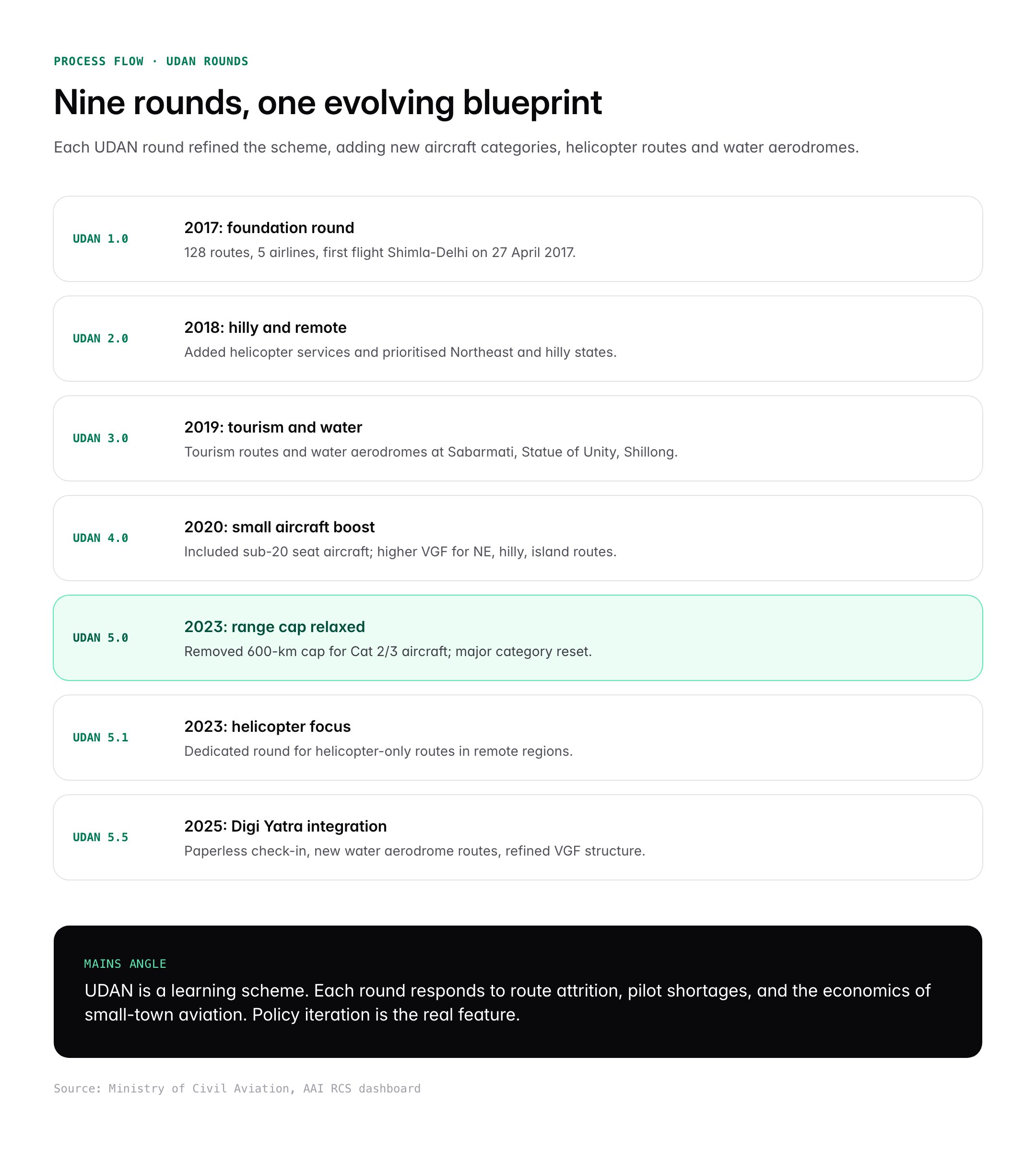
UDAN has been rolled out in waves. UDAN 1.0 (2017) awarded 128 routes across 5 airlines and 27 proposals. UDAN 2.0 (2018) added hilly and remote region routes, introducing helicopter services. UDAN 3.0 (2019) extended coverage to tourism-linked destinations and opened water aerodromes. UDAN 4.0 (2020) prioritised the Northeast, hilly states and islands, offering higher VGF and including small aircraft up to 20 seats.
UDAN 4.2 (2021) focused on smaller helicopter-based routes. UDAN 5.0 (2023) relaxed the 600-km range cap and allowed Category 2 and 3 aircraft (20-80 seats) to bid on any priority route length. UDAN 5.1 (2023) targeted helicopter-only routes. UDAN 5.2 and 5.3 expanded to remote areas and refined the VGF structure. UDAN 5.5, launched in late 2025, introduced new water aerodrome routes and integrated UDAN with the Digi Yatra paperless check-in system.
Per the Ministry of Civil Aviation dashboard as of April 2026, over 1.4 crore RCS passengers have been carried. States with highest UDAN intensity include Karnataka, Maharashtra, Gujarat, Madhya Pradesh, Himachal Pradesh, Arunachal Pradesh and Uttarakhand. Airlines active on UDAN include Alliance Air, IndiaOne Air, FlyBig, Star Air, Air India Express and private helicopter operators.
The Union Budget 2024-25 enhanced the UDAN allocation, emphasising Tier-2 and Tier-3 city connectivity. The Vision 2040 document targets 220 operational airports and 1 crore RCS passengers annually. The National Infrastructure Pipeline (NIP) allocates significant capital expenditure to airport modernisation, complemented by Greenfield Airport Policy approvals and AAI asset monetisation under the National Monetisation Pipeline.
Comparative Perspective
India’s UDAN sits within a global family of regional connectivity programmes. A comparison clarifies what is distinctive and what is not.
| Country | Programme | Subsidy Model | Key Feature |
|---|---|---|---|
| India | UDAN / RCS | Viability Gap Funding, reverse auction | Fare caps, 3-year exclusivity |
| USA | Essential Air Service (EAS) | Direct federal subsidy | Small community connectivity since 1978 |
| EU | Public Service Obligation (PSO) | Tender-based route subsidy | Used in France, Spain, Norway for remote regions |
| Australia | Remote Air Services Subsidy (RASS) | Per-passenger subsidy | Focus on Aboriginal communities and Outback |
| Brazil | PDAR (Airport Development Plan) | Investment grants | Regional airport infrastructure |
India’s design is closest to the European PSO model but adds the reverse-auction innovation borrowed from power-sector solar bids. Its scale of ambition, hundreds of routes and a 1-crore passenger target, exceeds EAS and PSO. The financing through a per-departure levy on trunk routes is a unique cross-subsidy that does not rely on general budget allocations.
Challenges and Criticisms
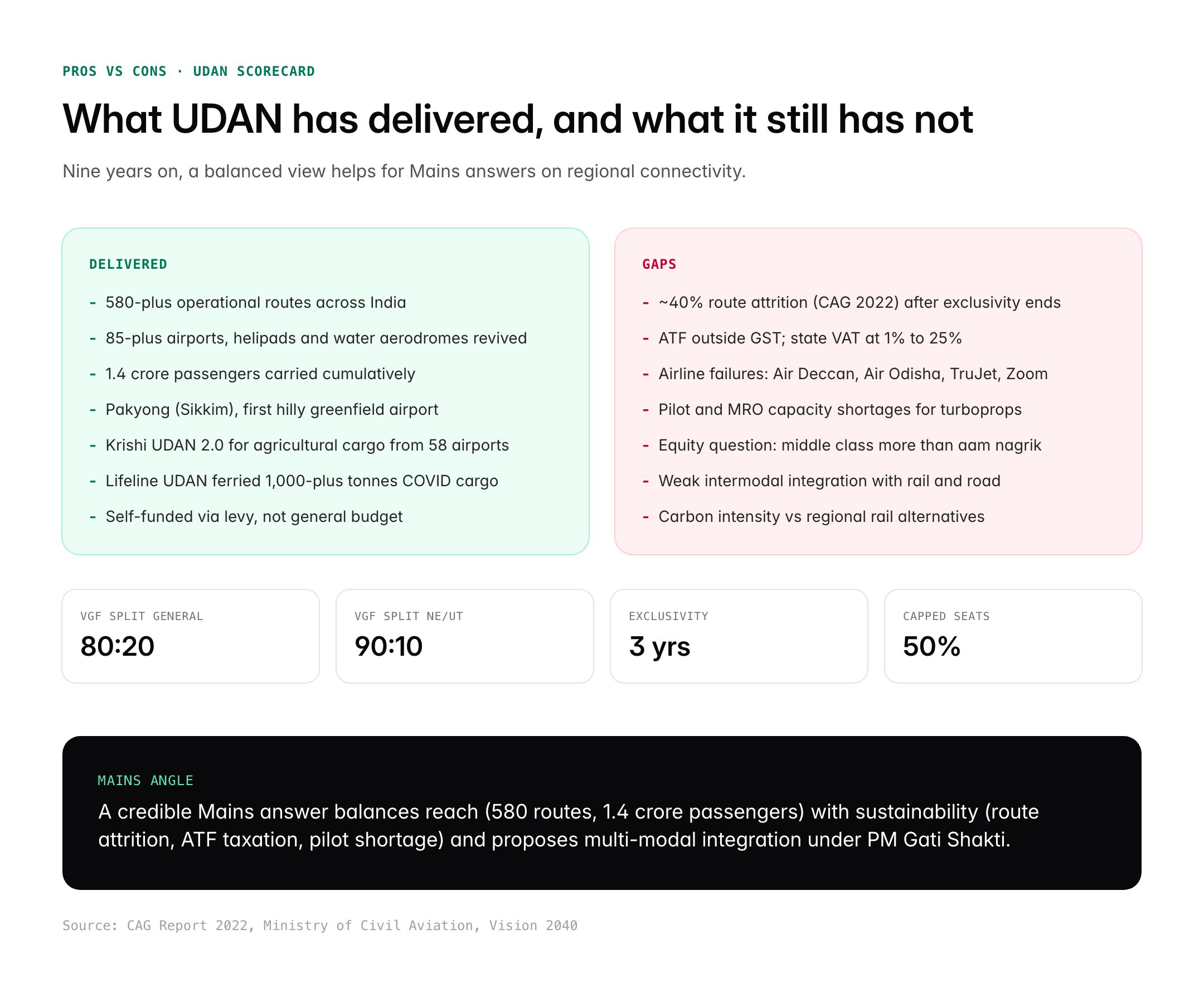
Independent evaluations by the CAG and industry bodies flag several issues. Route sustainability is the first. A 2022 CAG review found that roughly 40 percent of UDAN routes awarded in earlier rounds had been discontinued or operated sub-optimally by the end of their three-year exclusivity period. Airlines cite low load factors, high ATF costs, inadequate ground infrastructure and airspace congestion.
ATF taxation remains a sore point. ATF is not under GST, and states levy VAT ranging from 1 percent to 25 percent, severely affecting airline economics on thin regional routes. The NCAP 2016 recommendation to bring ATF under GST remains unimplemented as of 2026. Airline financial distress, including the failures of Air Deccan, Air Odisha, Zoom Air and TruJet, has hampered continuity. Pilot shortages and MRO capacity constrain aircraft induction, particularly for small turboprops and seaplanes.
A further critique is the equity question: has UDAN reached the aam nagrik? Ticket prices on capped seats are affordable, but airport access costs, limited frequency and metro-connection needs mean the beneficiary profile is often the middle class, not the working poor. The environmental angle, particularly carbon intensity of short-haul flights versus expanded rail, has also been raised in Parliamentary Standing Committee reports. Integration with railways and PM Gati Shakti is the policy response, but execution is uneven.
Prelims Pointers
- UDAN full form: Ude Desh ka Aam Nagrik
- Launched: 21 October 2016; first flight 27 April 2017 (Shimla-Delhi)
- Policy parent: National Civil Aviation Policy 2016
- VGF split: 80:20 (general); 90:10 (NE, UTs, islands)
- Fare cap reference: Rs 2,500 for 1-hour flight
- Exclusivity period: 3 years per route
- Implementing agency: Airports Authority of India (AAI)
- Financing source: RCS levy (Rs 5,000 per departure on non-RCS scheduled flights)
- Rounds so far: UDAN 1.0 through UDAN 5.5
- First greenfield airport in hilly region under UDAN: Pakyong (Sikkim)
- Water aerodromes: Sabarmati, Statue of Unity, Shillong
- Krishi UDAN 2.0 launched: 27 October 2021
- Target: 220 operational airports and 1 crore RCS passengers (Vision 2040)
Mains Practice Questions
Q1. Evaluate the role of the UDAN scheme in achieving regional connectivity and inclusive growth in India. Discuss the challenges faced in its implementation. (15 marks, 250 words)
- Define UDAN; outline VGF, fare cap, reverse auction; cite 580+ routes and 1.4 crore passengers
- Link to regional growth: tier-2/3 airport revival, tourism, Krishi UDAN
- Challenges: route attrition, ATF taxation, airline distress, pilot shortage, equity gap
Q2. “Aviation connectivity is incomplete without multi-modal integration.” Comment with reference to UDAN, PM Gati Shakti and the National Logistics Policy. (10 marks, 150 words)
- UDAN’s standalone design; need for rail, road and port integration
- PM Gati Shakti’s layered infrastructure map and logistics optimisation
- NLP 2022 cost-reduction target from 13-14 percent of GDP to under 8 percent
Conclusion
UDAN represents a rare example of Indian infrastructure policy that combined competitive auction design, a cross-subsidy financing model and a clear social objective. Nine years after launch, the scheme has opened over 580 routes, operationalised 85-plus airports and carried more than 1.4 crore RCS passengers. It has put towns like Kishangarh, Jharsuguda, Belagavi and Pakyong on India’s aviation map.
Yet the next decade will test UDAN’s durability. Route attrition, ATF economics and the challenge of integrating air travel into a multi-modal logistics system demand continuous policy refinement. If the scheme can maintain route viability while meeting its 2040 targets of 220 airports and 1 crore annual RCS passengers, it will have delivered one of the most ambitious regional development programmes in post-independence India.
Frequently Asked Questions
What is the UDAN scheme?
UDAN, standing for Ude Desh ka Aam Nagrik, is India’s Regional Connectivity Scheme launched on 21 October 2016 under the National Civil Aviation Policy 2016. It aims to make air travel affordable from tier-2 and tier-3 cities by providing Viability Gap Funding to airlines that agree to cap fares on a share of seats, operate unserved or underserved routes, and revive regional airports.
Why is the UDAN scheme important for UPSC?
UDAN is a high-yield topic spanning GS2 governance and GS3 infrastructure. Prelims questions probe VGF, fare caps, the three-year exclusivity rule and the Regional Connectivity Fund. Mains questions link UDAN to regional development, cooperative federalism, multi-modal logistics under PM Gati Shakti, and the economics of civil aviation reform.
How is UDAN related to PM Gati Shakti?
UDAN provides the air leg of India’s multi-modal connectivity ambition. PM Gati Shakti, launched in October 2021, is a National Master Plan that layers aviation, rail, road, port and logistics infrastructure onto a shared GIS platform. UDAN airports and routes feed into Gati Shakti’s integration with the National Logistics Policy 2022 to reduce logistics cost from about 13 percent of GDP to below 8 percent.
What is Viability Gap Funding under UDAN?
Viability Gap Funding is a subsidy that covers the gap between airline operating cost and revenue on UDAN routes. It is funded by the Regional Connectivity Fund, built from a Rs 5,000 levy per departure on non-RCS scheduled flights. The centre and states share VGF in an 80:20 ratio for general states and 90:10 for the Northeast, UTs and island territories.
What is the fare cap on UDAN flights?
Under UDAN, airlines must sell at least 50 percent of seats at capped fares. The reference cap was Rs 2,500 for a one-hour fixed-wing flight at launch, with scaled caps for longer legs and helicopter services. Airlines can price the remaining seats at market rates, creating a blended revenue model that keeps select seats affordable for ordinary travellers.
How many airports have been operationalised under UDAN?
As of April 2026, UDAN has operationalised more than 85 airports, helipads and water aerodromes, including revived historic airports like Shimla, Hubballi, Kishangarh and Belagavi, and new ones like Pakyong in Sikkim. Water aerodromes operate at Sabarmati, the Statue of Unity and Shillong. Cumulative passengers carried exceed 1.4 crore across more than 580 routes.
What are the different rounds of UDAN?
UDAN has been rolled out in multiple rounds: UDAN 1.0 (2017), 2.0 (2018), 3.0 (2019), 4.0 (2020), 4.2, 5.0 (2023), 5.1, 5.2, 5.3 and 5.5 (2025). Each round refined route selection, added helicopter and water aerodrome services, and extended coverage to the Northeast, hilly regions and tourism destinations. UDAN 5.0 relaxed the 600-km range cap for larger aircraft.
What are the main challenges faced by UDAN?
Key challenges include route attrition after the three-year exclusivity period, high Aviation Turbine Fuel taxation because ATF is outside GST, airline financial distress seen in failures of Air Deccan, Air Odisha and TruJet, pilot and MRO shortages, and equity concerns over whether the aam nagrik is actually the beneficiary. A CAG review in 2022 flagged that nearly 40 percent of early UDAN routes were discontinued.