Introduction
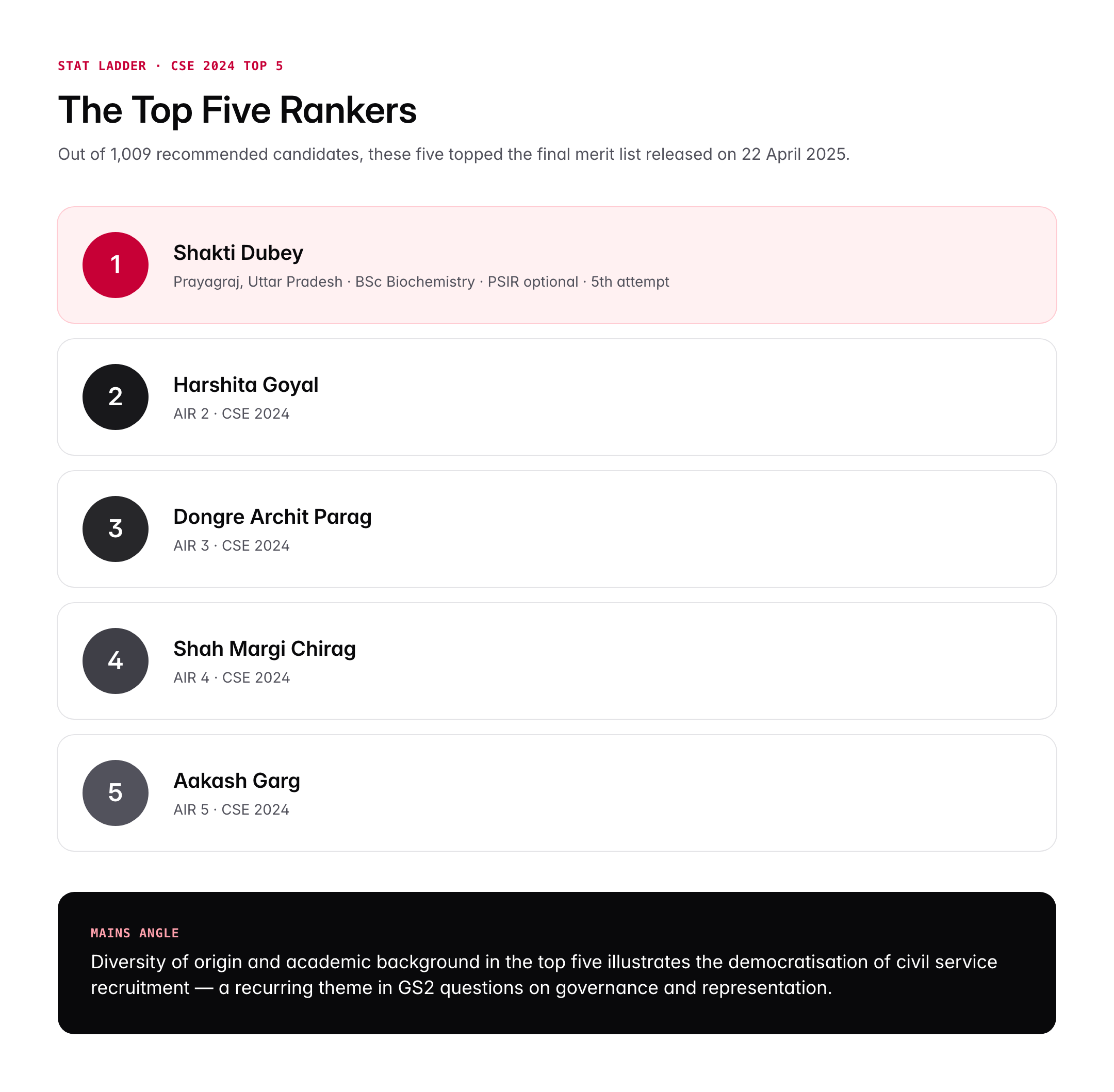
The Civil Services Examination final result for 2024, declared by the Union Public Service Commission on 22 April 2025, crowned Shakti Dubey of Prayagraj, Uttar Pradesh, as All India Rank 1. She topped an examination in which 1,009 candidates were recommended for appointment from a pool of more than 10 lakh applicants, underscoring both the scale of the contest and the patience required to come through it. Her journey — five attempts, two optional switches, and a home state still shaping its share of the civil services — has become the case study most 2026 aspirants will study this year.
For the UPSC aspirant, studying the topper is never about imitation. It is about extracting the handful of transferable principles that the topper herself names: a strong Mains-first strategy, relentless answer-writing practice, and an optional subject chosen on interest rather than on strike-rate rumours. This article profiles Shakti Dubey, lists the top five of the 2024 batch, breaks down her strategy, compares the 2024 cycle to prior years, and distils the lessons that a 2026 aspirant can apply to the months between now and the Prelims.
Quick Facts at a Glance
| Field | Detail |
|---|---|
| Examination cycle | UPSC Civil Services Examination 2024 |
| Result declared | 22 April 2025 |
| All India Rank 1 | Shakti Dubey |
| Home city / state | Prayagraj, Uttar Pradesh |
| Optional subject (AIR 1) | Political Science and International Relations (PSIR) |
| Education | BSc in Biochemistry, University of Allahabad; MA preparation Banaras Hindu University |
| Number of attempts (AIR 1) | Fifth attempt |
| Total candidates recommended | 1,009 |
| Top 5 (AIR 2, 3, 4, 5) | Harshita Goyal, Dongre Archit Parag, Shah Margi Chirag, Aakash Garg |
| Probable service allocation | Indian Administrative Service |
Background and Historical Context
The Civil Services Examination is the most competitive recruitment process in India, run by the Union Public Service Commission under Article 320 of the Constitution. It selects officers for the Indian Administrative Service, Indian Police Service, Indian Foreign Service and sixteen other Central Services. The three-stage format of Preliminary, Mains and Personality Test has been broadly stable since the Kothari Committee reforms of 1979, with the most recent structural change being the inclusion of an aptitude paper (CSAT) in 2011 and the introduction of the four ethics papers in 2013.
Across the last decade, the UPSC topper list has been notable for diversity. The 2020 topper Shubham Kumar came from rural Bihar, the 2021 topper Shruti Sharma returned Uttar Pradesh to the summit, the 2022 topper Ishita Kishore came from Delhi, and the 2023 topper Aditya Srivastava was an engineer from IIT Kanpur. Women have topped in three of the last five years, a pattern Shakti Dubey’s 2024 rank continues. Her background — a biochemistry undergraduate who worked through five attempts, including interview appearances in two earlier cycles, before finishing first — mirrors the “persistence wins” narrative that shapes aspirant motivation.
The 2024 cycle also had a record number of women in the top twenty-five and a strong showing from non-metro cities. Prayagraj, long regarded as an incubator of civil service talent through institutions such as the University of Allahabad and Bundelkhand University, reclaimed prominence with Shakti Dubey’s rank. UPSC data released alongside the result show that 725 of the 1,009 recommended candidates were male and 284 were female, with the differentially-abled, SC, ST and OBC quotas represented in line with the 2019 reservation matrix including the 10 per cent EWS category.
Key Features of the 2024 Topper’s Profile
Educational Background
Shakti Dubey graduated with a Bachelor of Science in Biochemistry from the University of Allahabad. She subsequently pursued postgraduate studies at Banaras Hindu University while preparing for the Civil Services Examination. Her academic record was steady rather than spectacular, a useful counter to the belief that a topper must come from IIT or AIIMS. Her preparation years were spent primarily in Prayagraj and Delhi, using a mix of self-study and selective test-series enrolment.
Optional Subject
Shakti’s optional was Political Science and International Relations, commonly abbreviated as PSIR. This was a change from her earlier attempts. PSIR has returned to popularity in recent years because its syllabus overlaps with GS Paper II international relations and the GS Paper I society modules, offering integration benefits. Other top rankers in 2024 also chose overlap-heavy optionals such as Sociology and Anthropology, though Commerce, Geography and Public Administration remain common choices.
Preparation Philosophy
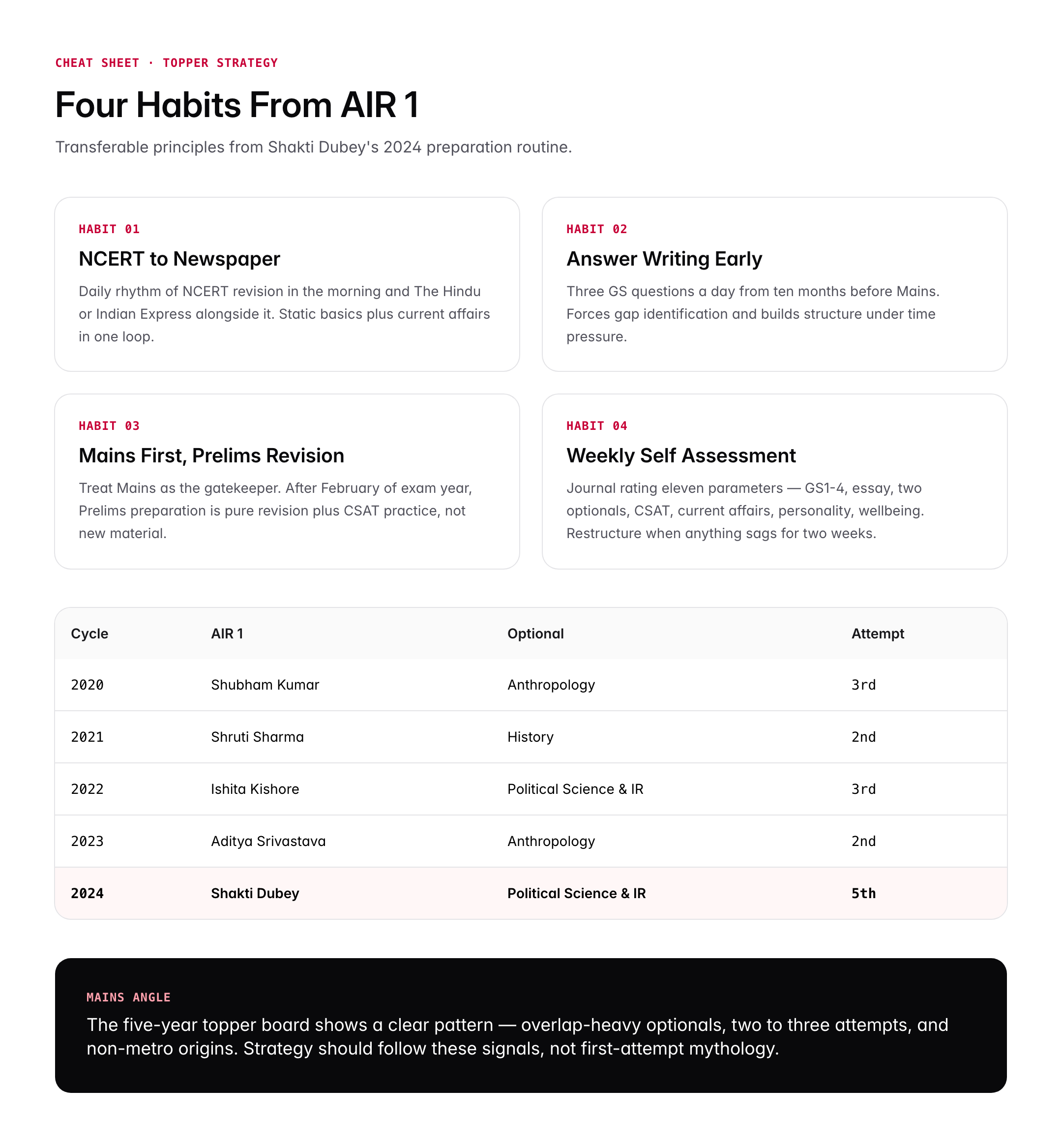
In post-result interviews, Shakti emphasised three pillars of her approach. First, NCERT to newspaper as a daily rhythm, reading The Hindu or Indian Express alongside NCERT revision for basics. Second, answer-writing as a non-negotiable habit, at least three GS questions per day through the final six months. Third, Mains is the gatekeeper, so Prelims preparation after February of the exam year was pure revision and CSAT practice rather than new material.
Interview and Personality Test
Shakti secured a strong Personality Test score at UPSC’s Dholpur House board, helped by fluent English, steady composure and a well-thought-through Detailed Application Form that flagged her biochemistry background and Prayagraj roots as conversation anchors. The Personality Test carries 275 marks and often separates the top 100 from the top 10. Her board asked questions on PSIR, on dual degree pathways, on women’s participation in science and on the implications of the G20 New Delhi Declaration.
Significance for UPSC and General Knowledge
- Provides a contemporary case for civil services strategy discussions in 2026
- Illustrates the persistence pattern — a fifth-attempt topper reinforces that early failures are common
- Shows the continuing weight of PSIR as an optional among top rankers
- Demonstrates non-metro, non-engineering paths to AIR 1
- Useful in interview when asked to name recent UPSC toppers or reflect on role models
- Connects with GS2 discussions on recruitment, gender balance and representation in civil services
Detailed Analysis: Strategy and Takeaways
Shakti Dubey’s timetable, as reconstructed from interviews, ran roughly as follows. Early morning from 6 to 9 was devoted to newspaper reading and current affairs note-making, often from monthly compilations produced by coaching institutes but filtered against the syllabus. A late morning block from 10 to 13 covered static subjects in rotation, moving through polity, economy, history, geography, science and technology, and environment. The afternoon, 14 to 16, was reserved for optional, rotating between PSIR Paper I political theory and Paper II international relations. The evening, 17 to 20, was answer writing and test-series review, with the final hour on revision.
Her study materials were deliberately limited. For polity she used M. Laxmikanth along with D. D. Basu for constitutional depth. For modern history she used Bipan Chandra and Spectrum. For environment she used Shankar IAS and the India Year Book. For economy she combined Sanjeev Verma with the Economic Survey and selected Ramesh Singh chapters. For PSIR she relied on Andrew Heywood and Rumki Basu for theory, and IGNOU notes plus Rajiv Sikri and C. Raja Mohan for international relations.
A consistent refrain across her interviews is the importance of answer writing early. Many aspirants defer it until the Mains is imminent, which she argues is a critical error. Writing forces you to confront gaps, trains you to structure under time pressure and builds the muscle memory needed to produce three hours of legible, analytical prose. She recommends aspirants begin daily writing at least ten months before Mains, starting with previous years’ questions and graduating to full-length tests.
Equally important is realistic self-assessment. Shakti used a simple weekly journal to rate her preparation across eleven parameters — GS1 through GS4, essay, the two optional papers, CSAT, current affairs, personality preparation and wellbeing. Where any parameter sank below a threshold for two weeks, she restructured the following week’s plan. This kind of active tracking, she argues, separates aspirants who improve month on month from those who merely put in hours.
Comparative Perspective
The 2024 topper data fits a five-year pattern the Department of Personnel and Training has noted repeatedly. Women have taken AIR 1 in 2020 (Shruti Sharma in 2021 cycle), 2022 (Ishita Kishore), and now 2024 (Shakti Dubey). Non-metro origin is increasingly common — Prayagraj, Haridwar, Kanpur and smaller towns have produced several top rankers. And optional subjects cluster around PSIR, Sociology, Anthropology and Geography.
| Cycle | AIR 1 | Home state | Optional | Attempt |
|---|---|---|---|---|
| 2020 | Shubham Kumar | Bihar | Anthropology | 3rd |
| 2021 | Shruti Sharma | Uttar Pradesh | History | 2nd |
| 2022 | Ishita Kishore | Delhi | Political Science and IR | 3rd |
| 2023 | Aditya Srivastava | Uttar Pradesh | Anthropology | 2nd |
| 2024 | Shakti Dubey | Uttar Pradesh | Political Science and IR | 5th |
The table suggests two quiet trends worth noting. First, three of the last four toppers come from Uttar Pradesh, an outcome more about aspirant volume than any state-level edge. Second, three of the last five toppers chose optionals with heavy GS overlap — Political Science and IR twice, Anthropology twice — reinforcing the case for overlap-driven optional choice. Finally, the average number of attempts for AIR 1 over this window is just over three, indicating that the typical topper is not a first-attempt prodigy but a disciplined repeat candidate.
Controversies and Debates
The UPSC 2024 cycle was also the one in which the Puja Khedkar controversy unfolded. Ms Khedkar, a 2022-batch recommended candidate, was deallocated and her candidature terminated following investigations into alleged misuse of disability and OBC reservations. The episode prompted the UPSC to implement Aadhaar-linked biometric verification across all examination stages from the 2024 cycle and triggered calls in Parliament for a review of the reservation verification process. While this did not involve Shakti Dubey or the 2024 topper list, it shadowed the release of results and dominated media commentary around civil service selection integrity.
Commentators have also reopened older debates on the number of attempts and the upper age limit. The Baswan Committee report had recommended rationalising attempts between general and reserved categories. Critics argue that allowing up to six attempts for general candidates creates a secondary coaching economy and crowds out the opportunity for freshers. Defenders counter that the Indian examination requires maturity and that fifth-attempt toppers like Shakti Dubey demonstrate why persistence should be rewarded. The 2026 aspirant is best served by understanding both sides for interview and Mains essay purposes.
Prelims Pointers
- UPSC CSE 2024 result declared on 22 April 2025
- AIR 1: Shakti Dubey from Prayagraj, Uttar Pradesh
- AIR 1 optional: Political Science and International Relations
- AIR 1 attempt: fifth
- Total recommended: 1,009 candidates
- AIR 2: Harshita Goyal; AIR 3: Dongre Archit Parag
- AIR 4: Shah Margi Chirag; AIR 5: Aakash Garg
- UPSC constituted under Article 315 of the Constitution
- Civil Services examination structure: Prelims, Mains, Personality Test
- Personality Test carries 275 marks
- Mains total: 1,750 marks, seven counted papers plus two qualifying language papers
- Aadhaar-linked biometric verification introduced post Puja Khedkar episode
Mains Practice Questions
Q1. The profile of UPSC toppers in recent years points to democratisation of the civil services examination. Examine the trend with reference to the 2024 result. (15 marks, 250 words)
- Map geographic and social diversity among 2020-2024 toppers — non-metro origins, women’s share, educational backgrounds
- Discuss enabling factors: digital learning, affordable coaching, quality of NCERT materials, test series ecosystem
- Balance with concerns: coaching-driven preparation, urban bias in ranks, under-representation of certain states
Q2. “Integrity of the recruitment process is foundational to public trust in civil services.” Discuss in light of the Puja Khedkar episode and subsequent UPSC reforms. (10 marks, 150 words)
- Summarise the facts and the integrity failure involved
- Analyse UPSC responses including biometric verification and tighter certificate scrutiny
- Recommend further reform: third-party audits, digital disability certification, deterrent penalties
Conclusion
Shakti Dubey’s journey to AIR 1 in UPSC CSE 2024 is a study in disciplined persistence. Five attempts, two optional choices settled into PSIR, and a strategy built around early answer writing and realistic self-assessment produced the top rank in a pool of more than a million. The 2024 result also confirmed the quieter trends of the last half-decade — women at the top, non-metro origins rising, and overlap-heavy optionals retaining their edge.
For 2026 aspirants the lessons are practical rather than mystical. Start answer writing ten months before Mains. Keep a weekly self-assessment journal. Choose an optional on interest and GS overlap, not on the previous year’s strike rate. And above all, treat the examination as a marathon that rewards revision discipline over occasional brilliance. The topper profile changes every year, but the principles that produce one do not.
Frequently Asked Questions
Who is the UPSC topper 2024?
Shakti Dubey from Prayagraj, Uttar Pradesh, was declared All India Rank 1 in the UPSC Civil Services Examination 2024 cycle, with the result announced on 22 April 2025. She is a BSc Biochemistry graduate from the University of Allahabad, cleared the examination on her fifth attempt, and chose Political Science and International Relations as her optional subject.
Why is the UPSC topper 2024 important for UPSC aspirants?
The topper profile offers a recent, verifiable case study for interview and essay preparation, illustrating realistic preparation timelines, optional subject choices and attempts. For 2026 aspirants it reinforces that persistence, disciplined answer writing and a Mains-first strategy matter more than a specific undergraduate background, and it points to the continued relevance of PSIR as an overlap-rich optional.
How is the UPSC topper 2024 related to the Civil Services Examination structure?
The Civil Services Examination selects officers for the IAS, IPS, IFS and seventeen other services through three stages — Preliminary, Mains and Personality Test — under Article 320 of the Constitution. Shakti Dubey’s AIR 1 reflects strong performance across all three stages, with Mains written answers and a 275-mark Personality Test interview driving final rank outcomes.
What was the optional subject of UPSC topper 2024?
Shakti Dubey chose Political Science and International Relations (PSIR) as her optional subject. PSIR is popular because its syllabus overlaps with GS Paper II international relations and with Paper I sections on political theory. She combined standard textbooks like Andrew Heywood and Rumki Basu with IGNOU notes and commentators such as Rajiv Sikri and C. Raja Mohan for the IR half.
How many attempts did the UPSC topper 2024 take?
Shakti Dubey secured AIR 1 in her fifth attempt at the UPSC Civil Services Examination. She had appeared in earlier cycles, including interview stages, before finally topping in 2024. Her journey underscores a broader pattern: the average AIR 1 over 2020-2024 took around three attempts, and fifth-attempt toppers are not unprecedented in UPSC history.
Who were the top five UPSC rankers in 2024?
The top five candidates in UPSC CSE 2024 were Shakti Dubey (AIR 1), Harshita Goyal (AIR 2), Dongre Archit Parag (AIR 3), Shah Margi Chirag (AIR 4) and Aakash Garg (AIR 5). A total of 1,009 candidates were recommended for appointment across the IAS, IPS, IFS and other allied services, with women accounting for 284 of the recommended list.
What is Shakti Dubey’s preparation strategy?
Her strategy rests on three pillars: daily newspaper reading paired with NCERT revision, early and sustained answer-writing practice with at least three GS questions a day, and treating Mains as the gatekeeper so Prelims preparation after February becomes pure revision. She also kept a weekly self-assessment journal rating preparation across eleven parameters to course-correct rapidly.
How did the Puja Khedkar case affect UPSC 2024?
The Puja Khedkar controversy, involving alleged misuse of disability and OBC reservations by a 2022-batch recommended candidate, unfolded during the 2024 cycle. While it did not affect the 2024 topper list, it prompted UPSC to introduce Aadhaar-linked biometric verification across examination stages, tighten certificate scrutiny, and shadowed media commentary around the release of the 2024 results.