Urban Heat Island (UHI) — UPSC Environment Notes
UPSC guide to Urban Heat Island: causes, impacts, cool roofs, green cover, urban planning, IPCC findings, Heat Action Plans, climate adaptation in cities.
Urban Heat Islands (UHIs) are cities that run 3-7°C hotter than surrounding rural areas due to human-made surfaces, reduced greenery, and concentrated heat sources. The IPCC AR6 (2021) explicitly flagged UHIs as an anthropogenic amplifier of warming in Indian cities. With India’s urban population set to cross 600 million by 2030, UHI mitigation is now a core climate-adaptation priority. For UPSC, the concept intersects climate change, urban governance, and disaster management.
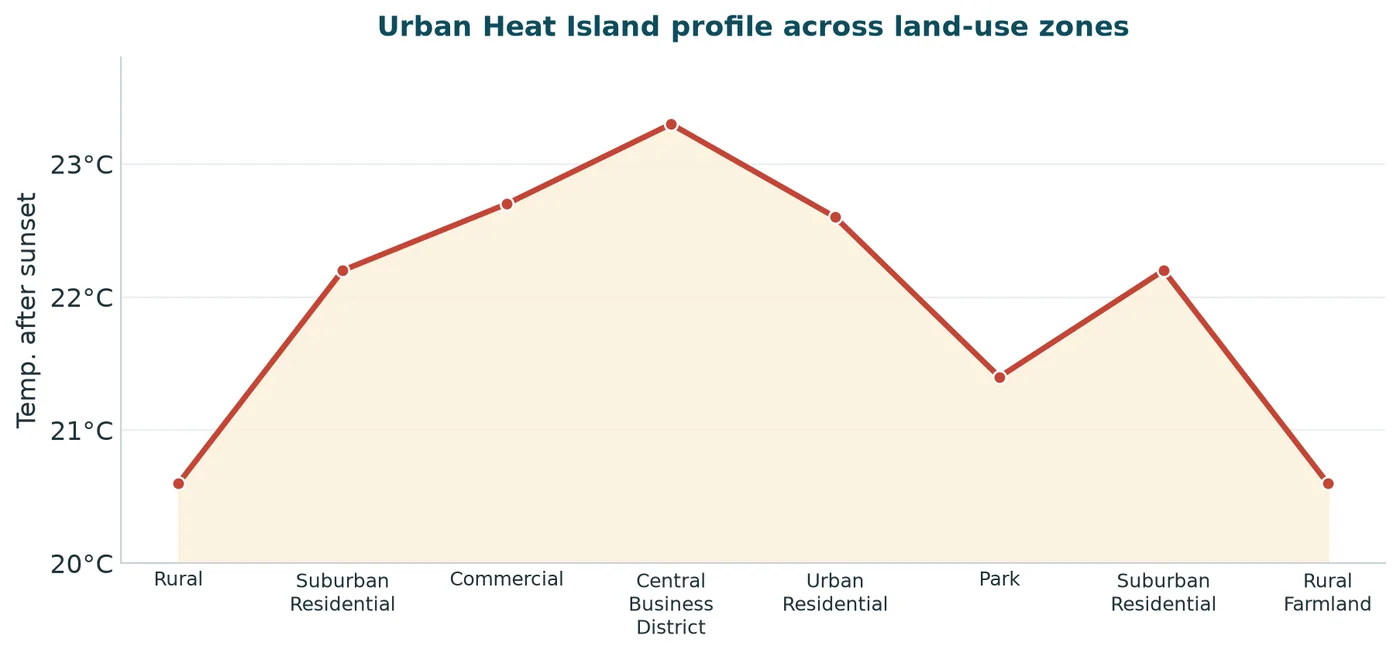
What is an urban heat island?
A UHI is a localised warming phenomenon where urban areas record significantly higher temperatures than surrounding rural zones. The effect is strongest:
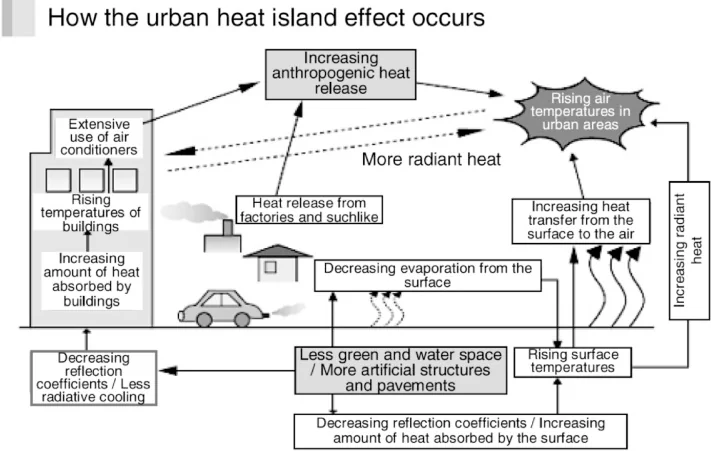
- At night — when concrete and asphalt re-emit stored heat.
- In summer — compounding heat wave lethality.
- In dry/still weather — limited wind dispersal.
UHI intensity is typically measured as Δ T (urban minus rural), which can reach 3-7°C in Indian metros and up to 10°C in extreme cases.
Two types of UHI
| Type | Description |
|---|---|
| Surface UHI | Surface temperatures (measured by satellites) |
| Canopy-layer UHI | Air temperatures at pedestrian level (more relevant to human heat exposure) |
Causes of UHI
1. Land surface modification
- Concrete, asphalt, roof tiles absorb and retain solar radiation.
- Urban canyon effect — tall buildings trap heat and restrict wind flow.
- Low albedo of dark roofs and roads.
2. Reduced vegetation
- Loss of tree cover — trees cool through shade and evapotranspiration.
- Paved-over wetlands, ponds, and parks lose evaporative cooling.
3. Anthropogenic heat
- Vehicular exhaust.
- Air conditioning exhausts heat outside while cooling inside — a self-reinforcing loop.
- Industrial processes.
- Electricity consumption — motors, lights, appliances.
4. Waste heat from buildings
- Poorly insulated buildings lose heat outward.
- Waste heat generation by energy use.
5. Urban density and growth
- Expanding cities progressively raise average temperatures.
- Sprawl adds paved area without proportionate cooling.
IPCC AR6 findings on UHI in India
- Anthropogenic forcing has exacerbated UHIs across India.
- Mean daytime surface temperature of urban areas ~2°C higher than surrounding regions.
- Hindu Kush-Himalaya region could see temperature rises of 5.2°C.
- Heat wave frequency could increase 3-4 times; duration also lengthening.
- Monsoon rainfall could change by average 14% (up to 22.5%) by 2100 — with increased interannual variability.
Rainfall implications for Indian cities
- Overall monsoon rainfall decreased 6% between 1950 and 2015.
- Dry spells increased 27% during 1981-2011 vs 1951-1980.
- Extreme rainfall events increased 75% in central India (1950-2015).
- Compounding cycle — drought and flood in same season (e.g., monsoons of 2018, 2019).
Impacts of UHI
Local climate
- Higher temperatures day and night.
- Increased downwind precipitation.
- Extended growing seasons in peri-urban areas — one study found a 15-day extension at city limits.
- Altered wind patterns.
Biodiversity
- Cold-blooded species migrate into warmer cities.
- Thermal pollution of urban water bodies affects aquatic life.
- Phenology shifts — flowering/breeding timing.
Human health
- Heat waves compounded by UHI lethality.
- Night-time temperatures don't drop — preventing physiological recovery.
- Heat cramps, exhaustion, stroke.
- Cardiovascular and respiratory stress.
- Increased mortality among elderly, outdoor workers, slum residents.
- Mental health — heat-irritability, sleep disruption.
Energy
- AC demand spikes — driving more emissions, more UHI → feedback loop.
- Peak electricity demand strains grids.
Economy
- Labour productivity loss — outdoor workers in construction, agriculture.
- Infrastructure stress — concrete, asphalt, rail expansion damage.
Air quality
- Higher temperatures accelerate photochemical smog formation — ozone production.
Mitigation strategies
1. Cool roofs and cool pavements
- High-albedo white/reflective coatings on roofs.
- Cool pavement materials on roads.
- C40's Cool Roofs Initiative piloted in Ahmedabad.
2. Urban greening
- Tree planting — 1 healthy tree can cool a 10-15 m radius by 2-3°C.
- Green roofs and walls — soil and plants insulate and evapotranspire.
- Urban forests and parks — major cooling oases.
- Miyawaki forests — dense native-species urban forests.
3. Water bodies and wetlands
- Preserve lakes, tanks, ponds.
- Urban lakes restoration — BBMP Bengaluru, Chennai's tanks, Ahmedabad's Kankaria.
- Fountains and water features in squares.
4. Building design
- Passive cooling — cross-ventilation, thermal mass, shading.
- ECBC 2017 for commercial buildings — mandates energy performance.
- Verandahs, courtyards — traditional Indian architecture.
5. Urban planning
- Compact vs sprawling development — compact cities with green cover are cooler.
- Wind corridors — preserve natural wind paths.
- Zoning — industrial separation from residential.
6. Reducing anthropogenic heat
- EV transition — reduces vehicular waste heat.
- Energy efficiency — buildings, appliances.
- District cooling systems replacing individual ACs.
7. Heat Action Plans (HAPs)
- Ahmedabad HAP (2013) — first in India; saved 1,100+ lives/year.
- Now in 23+ states, 130+ cities.
- Include early warning, hospital preparedness, cooling centres, public awareness.
Policy ecosystem
| Initiative | Role |
|---|---|
| India Cooling Action Plan (ICAP), 2019 | Reduce cooling demand 20-25% by 2038 |
| AMRUT 2.0 | Water body rejuvenation |
| Smart Cities Mission | Sensor-based monitoring |
| NDMA Heat Wave Guidelines 2019 | Disaster response |
| NAPCC Sustainable Habitat Mission | Energy efficiency |
Case studies
Ahmedabad
- First HAP in Asia (2013).
- Cool Roofs Initiative — reflective coatings on 3,000+ roofs.
- Early warning system with IMD.
Surat
- Urban tree planting programme.
- Green corridors along rivers.
Delhi
- Mission Green Delhi — urban greening.
- Smog towers at Connaught Place, Anand Vihar.
- Ridge forest protection.
Chennai
- Pallikaranai Marsh restoration.
- Tree transplantation in Metro Rail projects.
Latest developments (2024-26)
Updated context: check NDMA, NIUA, MoHUA annual releases.
- 2024 summer — Delhi reported up to 52.9°C at Mungeshpur; severe UHI signature.
- COP29 Cool Communities — India joined initiative.
- ICAP update — MoEFCC reviewing 2019 plan.
- Miyawaki forests expanding in major cities.
- Urban Forests Scheme (Nagar Van) — target 400+ urban forests; funding expanded.
- 16th Finance Commission — expected to recommend city-level climate grants.
- Supreme Court 2024 — right to life includes protection from extreme heat.
UPSC relevance
GS-III mapping
- Climate change, conservation.
- Urban environment.
- Disaster management.
Prelims bullets
- UHI Δ T in Indian metros: 3-7°C.
- First Indian HAP: Ahmedabad (2013).
- India Cooling Action Plan (ICAP): 2019.
- ECBC 2017 — building energy code.
- Miyawaki method — dense native-species urban forests.
- Nagar Van Yojana — urban forests scheme.
Mains angles
- "Discuss the causes and consequences of Urban Heat Island in Indian cities."
- "Evaluate mitigation strategies for UHI with reference to passive cooling, urban greening, and energy efficiency."
- "Linked with Heat Action Plans and India's climate adaptation, how can cities become climate-resilient?"
Essay hooks
- Hot cities, warm planet — the urban amplification.
- Equity in cooling — who can afford to escape the heat?
- Green urbanism as climate adaptation.
Quick revision
| Cause | Mitigation |
|---|---|
| Dark surfaces | Cool roofs, cool pavements |
| Lost green cover | Tree planting, urban forests |
| Waste heat | EVs, efficient buildings |
| Lost water bodies | Wetland restoration |
| Poor design | Passive cooling, wind corridors |
| Lethality | Heat Action Plans |
Bottom line for UPSC: UHI is the daily-life face of climate change in Indian cities — amplifying heat waves, straining health systems, and disproportionately harming the poor. Mitigation is not optional; it is the most immediate climate adaptation in India's urban playbook.