
Thermal pollution is the degradation of water quality caused by any process that raises or lowers the natural temperature of a water body. Most commonly, it refers to the discharge of heated water — typically from thermal power plants, nuclear plants, and industrial facilities — into rivers, lakes, or coastal waters. This seemingly invisible form of pollution has profound consequences for aquatic ecosystems, particularly by reducing dissolved oxygen levels and causing thermal shock to aquatic organisms.
For UPSC, thermal pollution is relevant to Environment (GS Paper III) and connects to water pollution, environmental legislation, and ecological concepts.
Definition and Mechanism
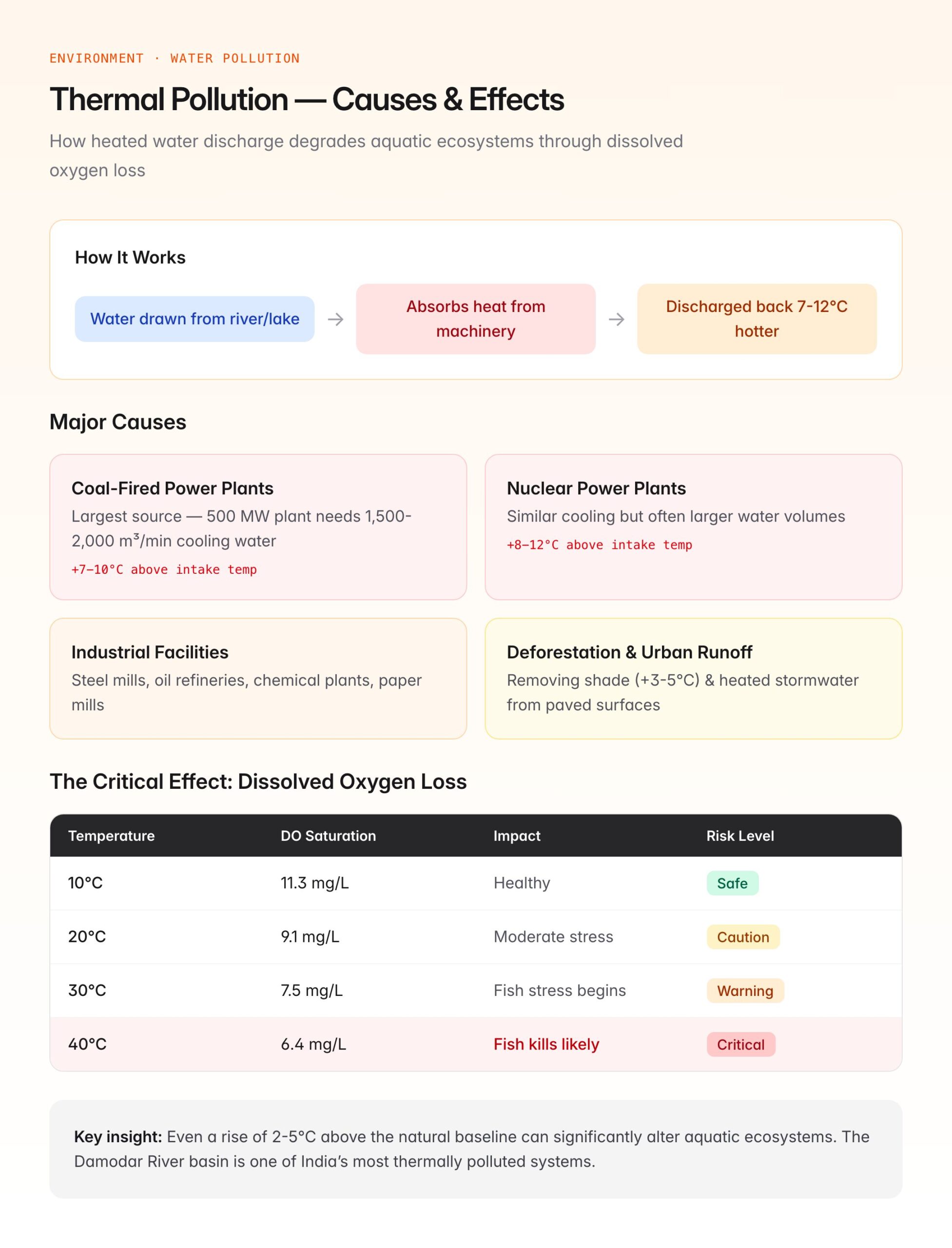
Thermal pollution occurs when human activity changes the temperature of a natural water body, making it warmer (or occasionally cooler) than its normal range. The most common mechanism involves using water as a coolant in industrial processes:
- Water is drawn from a river, lake, or sea (intake)
- It absorbs heat from machinery, condensers, or reactors
- The heated water is discharged back into the source water body (outfall)
- The receiving water body's temperature rises above its natural range
Even a rise of 2-5 degrees Celsius above the natural baseline can significantly alter the aquatic environment.
Causes of Thermal Pollution
Major Sources
| Source | Mechanism | Temperature Rise |
|---|---|---|
| Thermal power plants (coal-fired) | Use river/lake water to cool steam condensers; discharge heated water back | 7-10 degrees C above intake temperature |
| Nuclear power plants | Similar cooling process but often with larger water volumes | 8-12 degrees C above intake |
| Industrial facilities | Steel mills, oil refineries, chemical plants, paper mills use water for cooling | Varies by industry |
| Domestic hot water discharge | Hot water from urban areas entering storm drains and rivers | Minor but cumulative |
| Deforestation along water bodies | Removal of riparian shade increases solar heating of streams | 3-5 degrees C in exposed stretches |
| Soil erosion | Increased turbidity makes water absorb more solar radiation | Indirect warming |
| Urban runoff | Heated stormwater from paved surfaces (roads, parking lots) enters water bodies | Significant in summer |
Thermal Power Plants — The Largest Source
India's thermal power sector is the largest contributor to thermal pollution. A typical 500 MW coal-fired power plant requires approximately 1,500-2,000 cubic metres of cooling water per minute. This water is drawn from nearby rivers or reservoirs and returned at elevated temperatures.
Key Indian examples:
- Power plants along the Damodar River (Jharkhand/West Bengal) — one of the most thermally polluted river systems in India
- Coastal thermal plants discharging into the Bay of Bengal and Arabian Sea
- Plants along the Yamuna, Ganga, and their tributaries
Effects on Aquatic Ecosystems
1. Reduced Dissolved Oxygen
The most critical effect of thermal pollution is the reduction of dissolved oxygen (DO) in water:
| Temperature | Dissolved Oxygen Saturation (at sea level) |
|---|---|
| 10 degrees C | 11.3 mg/L |
| 20 degrees C | 9.1 mg/L |
| 30 degrees C | 7.5 mg/L |
| 40 degrees C | 6.4 mg/L |
Warmer water holds less dissolved oxygen. Since aquatic organisms — fish, invertebrates, and aerobic bacteria — depend on dissolved oxygen for respiration, a reduction in DO can be lethal. Fish kills near thermal discharge points are well documented.
2. Thermal Shock
When organisms adapted to a specific temperature range are suddenly exposed to significantly warmer (or cooler) water, they experience thermal shock:
- Cold-water species (such as trout and salmon) are particularly vulnerable — they cannot survive in water above 20-22 degrees C
- Sudden temperature changes prevent organisms from acclimating
- Mass mortality events can occur when discharge patterns are intermittent (plant starts and stops)
3. Impact on Reproduction and Growth
| Effect | Detail |
|---|---|
| Altered spawning | Many fish species spawn only within narrow temperature ranges; thermal pollution disrupts breeding cycles |
| Egg and larval mortality | Fish eggs and larvae are highly sensitive to temperature changes |
| Accelerated metabolism | Higher temperatures increase metabolic rates, requiring more food and oxygen — stressing organisms |
| Growth abnormalities | Some species grow faster but with reduced body condition and lifespan |
4. Eutrophication Acceleration
Warmer water accelerates the growth of algae and cyanobacteria (blue-green algae), contributing to:
- Algal blooms that block sunlight and deplete oxygen when they decompose
- Production of toxins by harmful algal species
- Disruption of the aquatic food web
5. Changes in Species Composition
Thermal pollution creates a selection pressure that favours warm-water species over cold-water species:
- Native cold-water fish species decline or disappear
- Warm-water and invasive species colonise the heated zone
- Overall biodiversity decreases near discharge points
- The thermal plume (area of elevated temperature) creates a distinct microhabitat that differs from the natural river ecology
Case Studies
Damodar River Basin
The Damodar River in eastern India is one of the most industrialised river basins in the country, with multiple thermal power plants (DVC power stations at Bokaro, Chandrapura, etc.) discharging heated water. Studies have documented:
- Temperature rises of 5-8 degrees C near discharge points
- Reduced fish diversity in thermally affected stretches
- Altered macroinvertebrate communities
Coastal Thermal Plants
Coastal power plants in India (such as those at Tuticorin, Mundra, and Ratnagiri) discharge heated seawater, affecting:
- Coral reef ecosystems — corals are extremely sensitive to temperature rises (coral bleaching occurs at even 1-2 degrees C above maximum monthly mean)
- Mangrove-associated fisheries
- Marine biodiversity in the nearshore zone
Remedies and Mitigation
Engineering Solutions
| Method | How It Works |
|---|---|
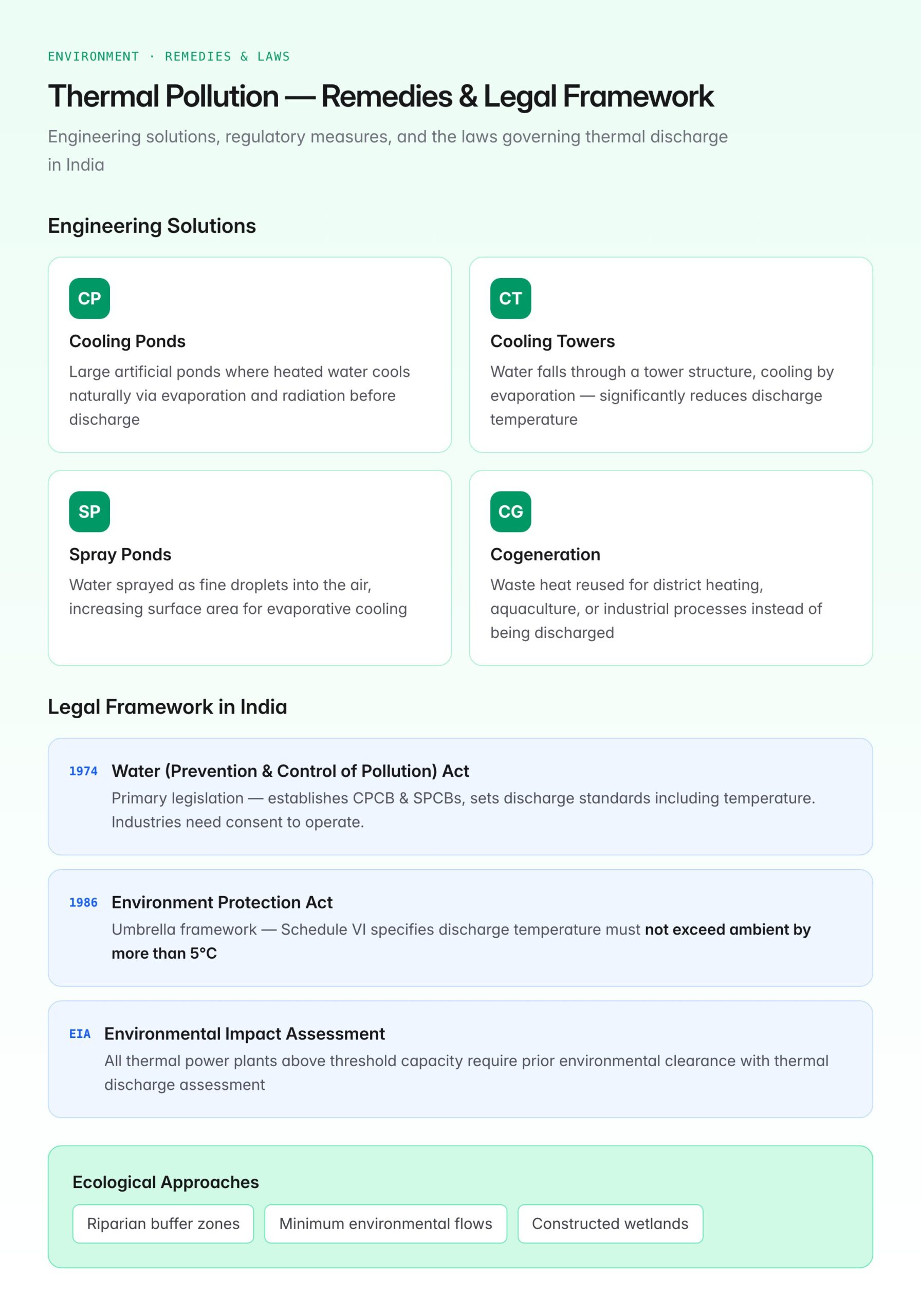
| Cooling ponds | Heated water is held in large artificial ponds where it cools naturally through evaporation and radiation before being discharged or reused |
| Cooling towers | Water is cooled by evaporation as it falls through a tower structure; significantly reduces discharge temperature |
| Spray ponds | Water is sprayed into the air as fine droplets, increasing surface area for evaporative cooling |
| Artificial lakes/reservoirs | Large impoundments allow natural cooling before water enters the river |
| Cogeneration | Using waste heat for district heating, aquaculture, or industrial processes rather than discharging it |
Regulatory Approaches
| Measure | Detail |
|---|---|
| Discharge temperature limits | Regulations limiting the maximum temperature of discharged water (e.g., not more than 5 degrees C above ambient) |
| Mixing zones | Defining areas where thermal discharge is permitted to mix with ambient water |
| Seasonal restrictions | Limiting thermal discharge during critical periods (fish spawning, low-flow conditions) |
| Environmental Impact Assessment (EIA) | Mandatory assessment of thermal discharge impacts before project approval |
Ecological Approaches
- Riparian buffer zones — maintaining tree cover along water bodies to provide shade and regulate temperature
- Minimum environmental flows — ensuring sufficient river flow to dilute thermal discharge
- Constructed wetlands — using natural processes to cool water before it enters the main river
Legal Framework in India
Water (Prevention and Control of Pollution) Act, 1974
The Water Act, 1974 is the primary legislation governing water pollution in India:
- Establishes the Central Pollution Control Board (CPCB) and State Pollution Control Boards (SPCBs)
- Empowers boards to set standards for discharge of effluents, including temperature parameters
- Industries and power plants require consent to operate from the SPCB, which can include thermal discharge conditions
- Violation can result in prosecution, closure, or fines
Environment Protection Act, 1986
The EPA, 1986 provides the umbrella framework:
- The General Standards for Discharge of Environmental Pollutants (Schedule VI) include temperature limits for industrial effluents
- The standard specifies that the temperature of discharged water should not exceed the receiving water temperature by more than 5 degrees C
Environmental Impact Assessment Notification
All thermal power plants above a certain capacity require prior environmental clearance under the EIA Notification, which includes assessment of thermal discharge impacts.
UPSC Relevance
GS Paper Mapping
| Paper | Topic | Connection |
|---|---|---|
| GS Paper III | Environment — Water Pollution | Thermal pollution as a type of water pollution |
| GS Paper III | Environment — Biodiversity | Impact on aquatic ecosystems, dissolved oxygen |
| GS Paper III | Environment — Legislation | Water Act 1974, EPA 1986, EIA notification |
| GS Paper III | Infrastructure — Energy | Thermal power plants and environmental trade-offs |
Key Points for Prelims
- Thermal pollution is the degradation of water quality by raising (or lowering) the temperature of natural water bodies
- The largest source is thermal power plants using water as coolant
- Warmer water holds less dissolved oxygen — this is the primary ecological impact
- Thermal shock causes mass mortality of aquatic organisms adapted to specific temperature ranges
- Remedies include cooling ponds, cooling towers, spray ponds, and cogeneration
- The Water (Prevention and Control of Pollution) Act, 1974 governs water pollution including thermal discharge
- Discharge temperature should not exceed ambient temperature by more than 5 degrees C (as per EPA standards)
- Thermal pollution accelerates eutrophication by promoting algal growth
- The Damodar River basin is one of India's most thermally polluted river systems
- Cold-water species (trout, salmon) are most vulnerable to thermal pollution
Tell Google you want more of this.
Add Anantam IAS as a preferred sourceOne tap, and this site shows up more often in your own Top Stories, AI Overviews and AI Mode. Remove it any time.