Introduction
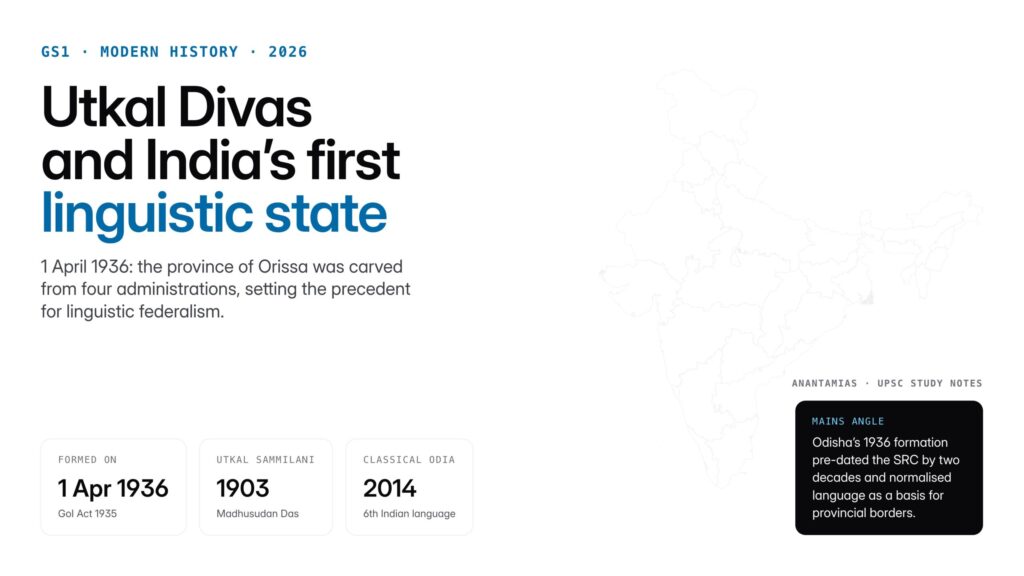
Every year on 1 April, the state of Odisha celebrates Utkal Divas, also called Utkala Dibasa or Odisha Foundation Day, marking its creation as a separate province in 1936. For a state that had been carved and re-carved by Mughal subahs, Maratha revenue lords, the Bengal Presidency, the Madras Presidency and the Central Provinces, the carving out of a linguistically defined Odisha in 1936 was nothing less than the recovery of a political identity.
For UPSC aspirants, Utkal Divas is an unusually rich date. It links the freedom movement to the first successful linguistic reorganisation of a British Indian province, the late 19th-century Oriya language movement to the 1956 States Reorganisation Commission, and the life of Utkal Gourav Madhusudan Das to the federal logic of modern India. This article treats Utkal Divas not as a ceremonial day, but as a hinge on which modern Indian federalism began to turn.
Quick Facts at a Glance
| Attribute | Detail |
|---|---|
| Observance date | 1 April every year |
| Commemorates | Creation of Odisha as a separate province on 1 April 1936 |
| Legal instrument | Government of India Act 1935; Odisha formed under powers of the Act and subsequent orders |
| Pre-1936 administrative scatter | Bengal, Bihar and Orissa Province, Madras Presidency, Central Provinces |
| Language basis | Oriya (Odia) linguistic majority |
| Capital at formation | Cuttack (later shifted to Bhubaneswar in 1948) |
| Key leaders | Utkal Gourav Madhusudan Das, Fakir Mohan Senapati, Gopabandhu Das, Pandit Nilakantha Das |
| Key organisation | Utkal Sammilani, founded 1903 |
| Odia classical language status | Granted in 2014 |
| Current capital and districts | Bhubaneswar; 30 districts (2026) |
Background and Historical Context
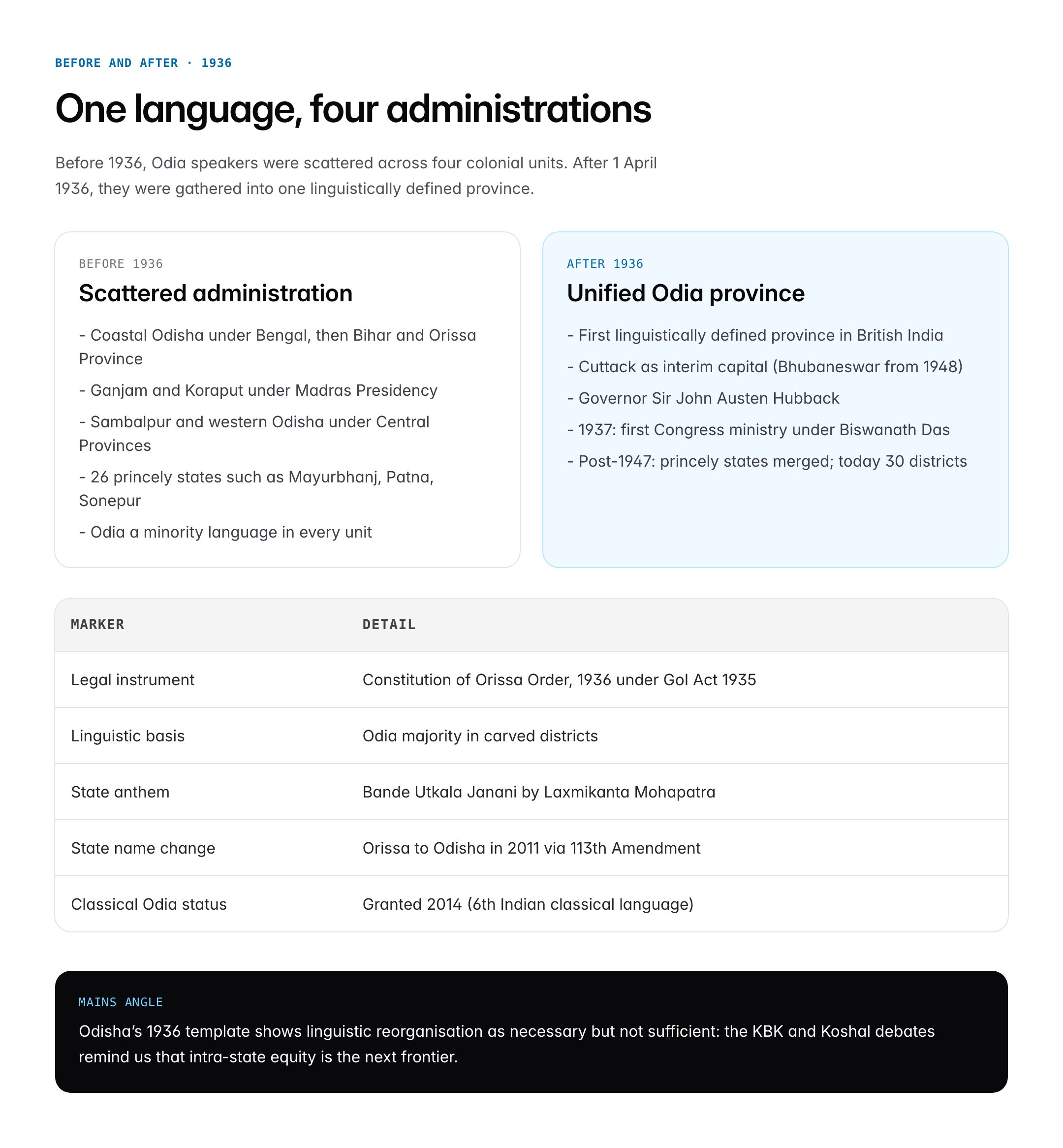
Before 1936, the Odia-speaking population lived scattered across at least four administrative units. The coastal Odia districts were governed from Calcutta as part of the Bengal Presidency, later the Bihar and Orissa Province. Ganjam and Koraput lay with the Madras Presidency. Sambalpur and parts of western Odisha fell under the Central Provinces. Princely states such as Mayurbhanj, Sonepur and Patna remained formally outside British India. Odia speakers were a permanent minority in every one of these units, and their language was threatened by the dominance of Bengali in schools and courts.
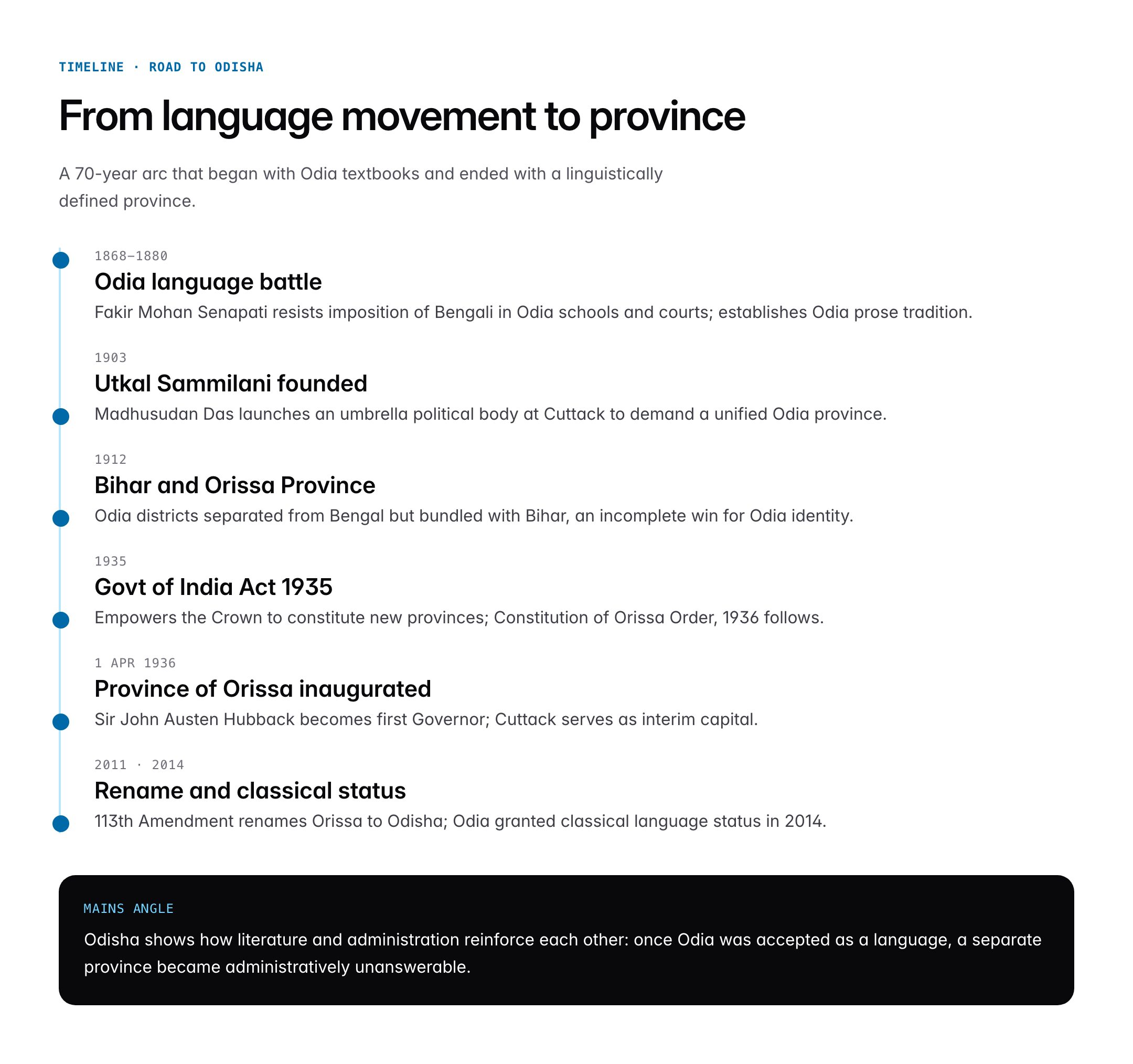
Starting in the late 19th century, a group of Odia intellectuals launched a sustained cultural and political campaign for a united Odia province. Fakir Mohan Senapati, the father of modern Odia prose, fought a bitter language battle against the imposition of Bengali in Odia medium schools. His novels, especially Chha Mana Atha Guntha (1902), helped consolidate Odia literary identity. Political organisation followed. The Utkal Sammilani, founded in 1903 and led by Madhusudan Das, became the umbrella movement for provincial unification.
The campaign intersected with colonial administrative reforms. The 1903 Risley Circular, the 1905 Partition of Bengal, the 1912 separation of Bihar and Orissa, the Montagu-Chelmsford Reforms of 1919 and the Simon Commission of 1928 each opened partial doors. The decisive move came with the Government of India Act 1935. Acting under its provisions, the British government issued the Government of India (Constitution of Orissa) Order, 1936, and a new province of Orissa was inaugurated on 1 April 1936. This made Odisha the first British Indian province to be created on linguistic lines, a precedent that shaped the later demand for linguistic states after Independence.
Key Features
Madhusudan Das and the Utkal Sammilani
Madhusudan Das (1848-1934), affectionately called Utkal Gourav or Pride of Utkal, was the central architect of the Odia movement. A lawyer, legislator, industrialist and social reformer, he founded the Utkal Sammilani in 1903 at Cuttack. The Sammilani brought together zamindars, princely rulers and middle-class professionals behind a single demand: a unified Odia-speaking province.
Fakir Mohan Senapati and the language movement
Fakir Mohan Senapati (1843-1918), the father of modern Odia literature, translated the Ramayana, Mahabharata and Upanishads into Odia, and wrote novels that established Odia as a language of realist fiction. His defence of Odia in schools and courts countered the argument that Odia was a mere dialect of Bengali, a claim that had underpinned administrative neglect.
Formation of the province, 1 April 1936
The Government of India Act 1935 empowered the Crown to constitute new provinces. The Government of India (Constitution of Orissa) Order, 1936, dated 3 March 1936, carved Orissa out of the Bihar and Orissa Province, together with Odia-majority areas of the Madras Presidency and the Central Provinces. The new province of Orissa, with Cuttack as its interim capital and Sir John Austen Hubback as its first Governor, came into being on 1 April 1936.
Post-Independence consolidation
After 1947, the 26 princely states within Odisha’s geographical frame, including Mayurbhanj, Sonepur and Patna, were integrated into the province through the States Department led by Sardar Patel and V. P. Menon. The States Reorganisation Act 1956 retained Odisha as a linguistic state, later renamed Odisha under the Orissa (Alteration of Name) Act, 2011 and the 113th Constitutional Amendment. The classical language status for Odia was granted in 2014, making it the sixth Indian language to earn this recognition.
Celebration and public memory
Utkal Divas is marked across Odisha with cultural performances of Odissi dance, recitals of Bande Utkala Janani (the state anthem composed by Laxmikanta Mohapatra), tributes at the samadhi of Madhusudan Das, exhibitions on Odia literature, and special editions of state-run services. In 2026, the day will mark the 90th foundation day of the state.
Significance for UPSC and General Knowledge
- First example in modern Indian history of a province carved along linguistic lines, predating the 1956 States Reorganisation Commission by two decades.
- Demonstrates the strong link between language politics, literature and provincial identity in late colonial India.
- Links the freedom struggle (Utkal Sammilani, Congress’s 1920 Nagpur session with linguistic provincial committees) to post-Independence federalism.
- Anchors questions on the Government of India Act 1935, a recurring GS2 and modern history topic.
- Connects to Odia’s classical language status, part of the larger debate on the Eighth Schedule and the National Commission for Linguistic Minorities.
- Provides a concrete case for GS1 questions on Indian culture, including Odissi, Jagannath tradition and Odia literature.
Detailed Analysis: Language and Statehood
Utkal Divas marks more than a date. It marks the moment when the linguistic principle became operationally legitimate in Indian provincial administration. Three strands are worth unpacking.
The first strand is the Congress party’s formal acceptance of linguistic provinces. At the 1920 Nagpur session, the Congress reorganised its own provincial committees on a linguistic basis, which indirectly normalised the principle for future Indian governance. Odisha’s 1936 formation validated this line: language, not revenue convenience, could be a legitimate basis for drawing provincial borders.
The second strand is the interaction between language, literature and administration. Fakir Mohan’s campaign against the 19th-century claim that Odia was a dialect of Bengali shows how academic and administrative arguments fed each other. Once Odia was accepted as a distinct language, the administrative argument for separate revenue, judicial and educational systems became far harder to refuse. This dynamic recurred after 1947 with the Dhar Commission and the JVP Committee, and culminated in the States Reorganisation Commission under Fazl Ali in 1953-1955.
The third strand is federalism under the Government of India Act 1935. The Act introduced provincial autonomy, an expanded franchise and bicameral legislatures in several provinces. Odisha’s 1936 inauguration used these new institutions almost immediately: the Biswanath Das ministry took charge in 1937 after provincial elections under the Act, becoming the first Congress ministry in Odisha and part of the national wave of 1937 Congress ministries.
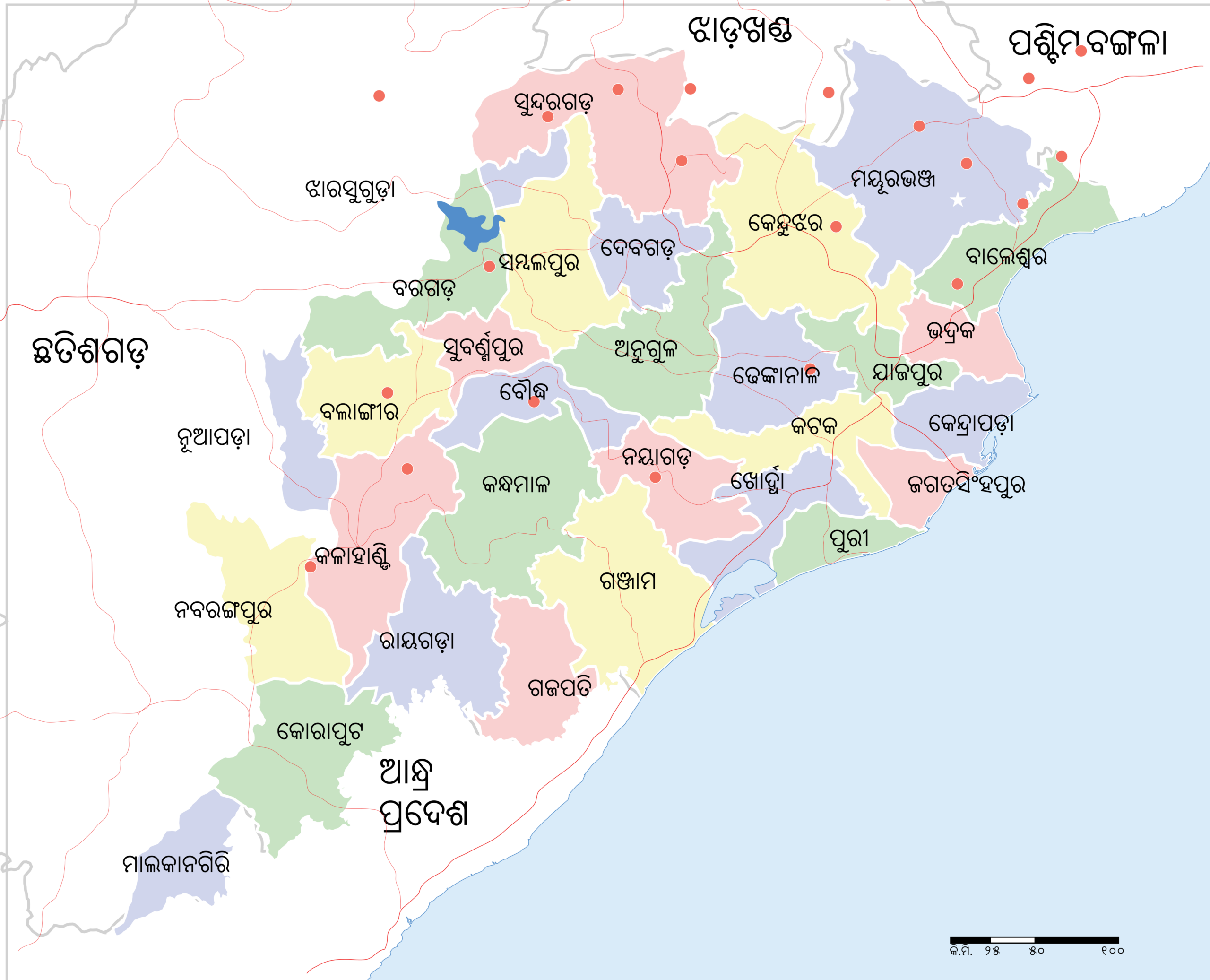
Odisha’s formation also offered an early template for integrating princely states. Between 1947 and 1949, the 26 princely states within its geographical zone were merged through instruments of accession and mergers supervised by V. P. Menon. Many of the current districts of Odisha, such as Mayurbhanj, Kalahandi and Bolangir, correspond to former princely territories. This merger exercise rehearsed, on a state scale, the all-India integration Patel completed elsewhere.
Comparative Perspective
Odisha’s 1936 formation sits inside a broader sequence of Indian linguistic state formation. The table below places Utkal Divas in that arc.
| Event | Year | Mechanism | Key driver |
|---|---|---|---|
| Separation of Bihar and Orissa from Bengal | 1912 | Administrative re-carving | Bengal unrest post-1905 |
| Formation of Orissa Province | 1936 | Govt of India Act 1935; Constitution of Orissa Order | Language (Odia) |
| Formation of Andhra State | 1953 | Parliamentary Act after Potti Sriramulu fast | Language (Telugu) |
| States Reorganisation Act | 1956 | SRC Report 1955, constitutional amendment | Language, administrative efficiency |
| Bombay State bifurcation (Gujarat, Maharashtra) | 1960 | Bombay Reorganisation Act | Language (Gujarati, Marathi) |
| Odisha renamed from Orissa | 2011 | 113th Constitutional Amendment | Linguistic accuracy |
The key insight is that Odisha’s 1936 precedent preceded and arguably enabled the post-1956 linguistic reorganisation. Without a successful prior example of a linguistically carved province, the Dhar Commission’s reservations about linguistic states in the 1940s might have carried more weight.
Challenges and Criticisms
Odisha’s formation and subsequent development carry their own challenges. The linguistic principle, while historically progressive, did not by itself solve socio-economic disparities. Western Odisha, including the Kalahandi-Bolangir-Koraput (KBK) region, has struggled with chronic poverty, drought and migration, and the long-standing demand for a separate Koshal state reflects intra-linguistic regional grievances that linguistic reorganisation alone cannot address.
Tribal rights, mining policy and displacement, especially around bauxite and iron-ore belts, raise questions about whether the state’s development model has benefited all its sub-regions equally. Critics argue that the Odia-centric framing of Utkal Divas sometimes underplays the contributions of Adivasi communities, who account for roughly 23 percent of the state’s population according to the 2011 Census. The Odisha government’s response includes programmes such as the Odisha Adivasi Empowerment and Livelihoods Programme, the KBK Long Term Action Plan and the more recent Mission Shakti and Ama Odisha Nabin Odisha initiatives, but debate persists on whether they are adequate. Utkal Divas, to retain its relevance, must absorb these debates rather than sidestep them.
Prelims Pointers
- Utkal Divas is observed on 1 April every year.
- Odisha was formed as a separate province on 1 April 1936.
- The formation was authorised under the Government of India Act 1935 and the Government of India (Constitution of Orissa) Order, 1936.
- Odisha was the first British Indian province created on linguistic lines.
- The first Governor was Sir John Austen Hubback.
- The first Congress ministry was led by Biswanath Das in 1937.
- Madhusudan Das founded the Utkal Sammilani in 1903 at Cuttack.
- Fakir Mohan Senapati is the father of modern Odia literature.
- Bande Utkala Janani, the state anthem, was composed by Laxmikanta Mohapatra.
- The state was renamed from Orissa to Odisha by the 113th Constitutional Amendment in 2011.
- Odia received classical language status in 2014, the sixth Indian language to do so.
- Current capital: Bhubaneswar; number of districts: 30 (as of 2026).
Mains Practice Questions
- The formation of Orissa on 1 April 1936 is often described as the first successful application of the linguistic principle in Indian provincial administration. Discuss its historical background and significance for subsequent Indian federalism. (GS1, 15 marks)
- Trace the Odia language movement from Fakir Mohan and Madhusudan Das to the Utkal Sammilani.
- Explain the role of the Government of India Act 1935 and the Constitution of Orissa Order, 1936.
- Link to the 1956 States Reorganisation and the ongoing debates on sub-regional identities.
- “Linguistic reorganisation is necessary, but not sufficient, for equitable development.” Examine in the context of Odisha since 1936. (GS2, 15 marks)
- Outline the benefits of linguistic reorganisation: administrative coherence, cultural assertion, political representation.
- Highlight persistent disparities: KBK, tribal regions, Koshal demand, displacement.
- Suggest a framework combining regional equity, decentralisation under the Fifth Schedule and PESA, and participatory development.
Conclusion
Utkal Divas is not just Odisha’s birthday. It is the anniversary of an idea that language can legitimately define political community in a federal India. The carving of Odisha in 1936, against the grain of colonial administrative inertia, set a precedent that the makers of the Constitution and the States Reorganisation Commission would later use to redraw the map of independent India.
For aspirants, the lesson is to connect dates to ideas. Remember 1 April 1936 not as isolated trivia, but as the first tangible win for linguistic federalism, a win that ran from Fakir Mohan’s printing press to Madhusudan Das’s Sammilani to the Government of India Act and onwards to the SRC. Read that way, Utkal Divas becomes one of the most teachable dates in the modern Indian history syllabus.
Frequently Asked Questions
What is Utkal Divas?
Utkal Divas, also called Utkala Dibasa or Odisha Foundation Day, is observed on 1 April every year to mark the creation of Odisha as a separate province on 1 April 1936. It was the first British Indian province carved out on a linguistic basis, bringing together Odia-speaking districts earlier scattered across the Bihar and Orissa Province, the Madras Presidency and the Central Provinces.
Why is Utkal Divas important for UPSC?
Utkal Divas links the Odia language movement, the Government of India Act 1935 and the post-1956 linguistic reorganisation of Indian states. It appears in GS1 modern history, GS2 polity and GS1 culture via Odissi, Jagannath tradition and Odia literature, and provides a concrete case study for essays and mains questions on Indian federalism.
Who was Madhusudan Das and why is he associated with Utkal Divas?
Madhusudan Das (1848-1934), known as Utkal Gourav, was a lawyer, legislator and social reformer who founded the Utkal Sammilani in 1903. The Sammilani was the umbrella organisation that pressed the colonial government for a unified Odia-speaking province, a demand that bore fruit on 1 April 1936. He is the central political figure commemorated on Utkal Divas.
How was Odisha formed in 1936?
Odisha was formed under the provisions of the Government of India Act 1935 through the Government of India (Constitution of Orissa) Order, 1936, dated 3 March 1936. Effective 1 April 1936, it united Odia-majority areas from the Bihar and Orissa Province, the Madras Presidency and the Central Provinces. Sir John Austen Hubback became its first Governor with Cuttack as the interim capital.
How is Utkal Divas related to linguistic reorganisation of states?
Odisha’s 1936 formation was the first precedent of a linguistically defined Indian province. It validated the argument that language could legitimately draw provincial borders, a principle later adopted after the Potti Sriramulu agitation in 1953, the creation of Andhra State, and the landmark States Reorganisation Act of 1956. Utkal Divas therefore marks the birth of linguistic federalism in India.
What is the significance of Fakir Mohan Senapati to Odisha’s statehood?
Fakir Mohan Senapati (1843-1918), the father of modern Odia literature, defended Odia as an independent language at a time when some colonial officials dismissed it as a dialect of Bengali. His prose, translations and novels such as Chha Mana Atha Guntha legitimised Odia in schools, courts and public life, and created the cultural foundation on which the political demand for a separate Odia province rested.
When did Orissa become Odisha?
The state’s name was officially changed from Orissa to Odisha, and the language from Oriya to Odia, through the Orissa (Alteration of Name) Act, 2011, together with the Constitution (113th Amendment) Act, 2011. The change came into effect on 1 November 2011, aligning the state’s English name with the original Odia pronunciation.
What is the status of Odia as a classical language?
Odia was granted classical language status by the Government of India in 2014, becoming the sixth Indian language to be recognised as classical after Tamil, Sanskrit, Telugu, Kannada and Malayalam. The status acknowledges Odia’s long literary tradition, its independent linguistic evolution and a corpus of ancient texts, and unlocks funding for research, chairs and manuscript preservation.
Tell Google you want more of this.
Add Anantam IAS as a preferred sourceOne tap, and this site shows up more often in your own Top Stories, AI Overviews and AI Mode. Remove it any time.